 Vista
Updated: 24 November 2026
If you have received a legal notice at home from an advocate, bank or company in India, preserve the document, verify the sender and identify the demand and deadline. Check the allegations against your records and prepare an accurate response, with legal assistance where appropriate. Receiving an advocate’s notice does not automatically mean that a case has been filed or that you will be arrested. However, a genuine court summons, statutory demand or police appearance notice should never be ignored.
There is no universal seven-day, fifteen-day or thirty-day deadline for replying to every legal notice in India. The applicable statute, contract and nature of the document determine what you must do. This guide explains the differences and how to respond without making avoidable mistakes.
What is a legal notice, and what should you do first?
A legal notice is ordinarily a written communication setting out someone’s claim, objection or demand. It may be sent by the claimant directly or by an advocate acting on their behalf. It can relate to unpaid debts, tenancy, property, employment, family matters or breach of contract. A notice may offer an opportunity to settle a dispute, or it may fulfil a requirement imposed by a particular law before further proceedings.
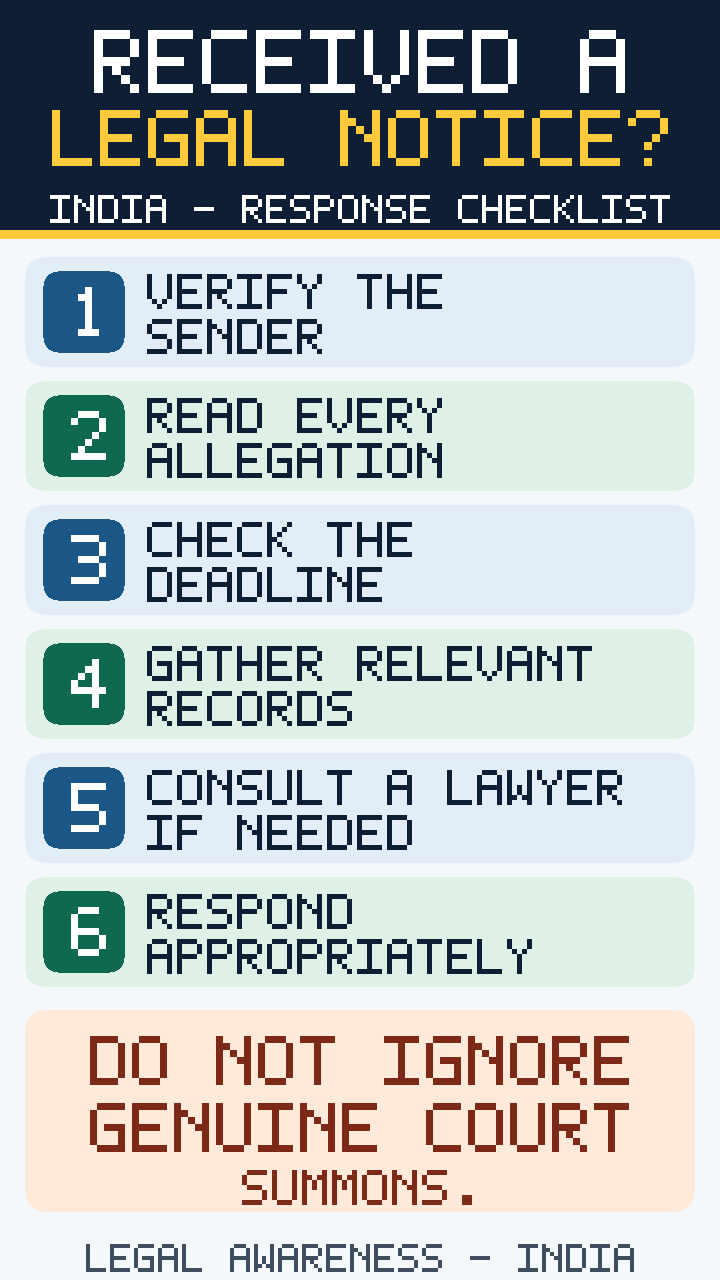
- Keep the original letter, envelope, postal tracking record or electronic message.
- Record both the date printed on the notice and the date you actually received it.
- Identify the sender, the person or organisation represented and the subject of the dispute.
- Mark the requested payment, action or documents, and any stated deadline.
- Compare each allegation against your agreements, payment records and correspondence.
- Seek timely legal advice if the notice involves a statutory deadline, substantial liability or formal proceedings.
Read every page, including annexures. The introductory paragraphs may not contain the most important demand. If pages or supporting documents are missing, request a complete copy without assuming that the request automatically suspends the deadline. Keep your communications factual and avoid responding with threats or emotional accusations.
Legal notice versus police notice versus court summons
| Document | Meaning and appropriate response |
|---|---|
| Advocate’s legal notice | A party’s claim or demand. Review the facts and respond appropriately. |
| Statutory demand notice | A demand governed by a particular law. Check its legal consequences and deadline. |
| Police appearance notice | An official investigation-related direction. Verify and comply with applicable requirements. |
| Court summons | Formal judicial process. Follow the court’s directions and appearance date. |
An advocate’s letter does not require a court seal merely to communicate a private demand. Conversely, a document with a red stamp or a legal section printed on it is not necessarily a genuine court summons. Order V of the Code of Civil Procedure, 1908 (CPC) governs summons in civil suits. If a defendant fails to appear after valid service, the court may proceed without them in appropriate circumstances. Criminal summons are subject to different procedural requirements and consequences.
Section 35(3) of the Bharatiya Nagarik Suraksha Sanhita, 2023 (BNSS) provides for a police appearance notice in relevant cases where arrest is not required under the preceding provision. Subsections (4) to (6) address compliance and its consequences. A person who complies and continues to comply is generally not to be arrested for the offence specified in the notice unless the officer records reasons why arrest is necessary. Failure to comply can have legal consequences. Other police notices may have different legal bases, so identify the section and the capacity in which you are being called.
How to verify whether a legal notice is genuine
Check the advocate’s name, office address, client details, notice date and identifying particulars of the dispute. Where available, verify enrolment information through the relevant State Bar Council. Obtain independent contact details rather than relying exclusively on the telephone number printed in an unexpected notice. For a bank letter, compare the loan account and branch information with your official bank records.
For a court document, search the case number or CNR through eCourts Services. Use the appropriate High Court or tribunal website for proceedings not covered by that search. An absent online result does not necessarily prove forgery; contact the court registry independently if verification remains uncertain.
Beware of impersonators who threaten immediate arrest and demand payment into personal bank accounts. Do not install remote-access applications, share OTPs or disclose passwords to an unsolicited caller. If you have suffered online financial fraud, promptly notify your bank, call 1930 and report through cybercrime.gov.in.
How many days do you have to reply to a legal notice?
Private demand letters commonly specify a requested response period. This is not necessarily a statutory deadline. The following examples show why the type of notice matters:
| Notice type | Relevant timing |
|---|---|
| Ordinary advocate’s letter | Check the demand, contract and applicable law. |
| Cheque dishonour, NI Act section 138 | A qualifying demand notice gives the drawer 15 days from receipt to pay the cheque amount. |
| SARFAESI Act section 13(2) | A qualifying secured debt demand requires discharge of liabilities within 60 days from the notice date. |
| CPC section 80 | Generally requires two months’ notice before specified suits against government or public officers; statutory exceptions exist. |
| Police notice or court summons | Follow the specified date and applicable procedural law. |
The fifteen-day period under section 138 of the Negotiable Instruments Act, 1881 is a payment opportunity, not simply a deadline to send a reply. Sending a denial does not substitute for payment where the statutory requirements otherwise apply. Under SARFAESI section 13(3A), a borrower may make a representation or objection; if rejected, the secured creditor must generally communicate its reasons within fifteen days. Subsequent enforcement measures under section 13(4) and remedies under section 17 have separate requirements and deadlines. Not every bank collection letter is a SARFAESI notice.
Request additional time in writing if necessary, but do not assume that a requested extension changes a statutory deadline or court direction. A valid extension depends on the applicable procedure and authority.
How to write a legal notice reply: acknowledgement format
A substantive response should identify the notice, address relevant allegations, explain your version of the facts and refer to supporting documents. Check figures and dates before sending it. Avoid admitting a disputed debt, promising repayment or accepting a settlement without understanding the consequences. If a calculation is unclear, request the underlying statement and supporting records.
To: ______ (verified sender’s name and address). Subject: Acknowledgement of notice dated ______.
Dear Sir/Madam, I acknowledge receipt on ______ of your notice dated ______. I am reviewing the allegations and relevant records. Please provide the documents or details concerning ______. This acknowledgement is not an admission of any disputed allegation or liability. I intend to provide an appropriate response after reviewing the matter. All applicable legal rights are reserved. Name, date, signature and safe correspondence address: ______.
This is a general acknowledgement, not a complete legal defence. It does not satisfy a statutory payment obligation, replace a written statement in court or excuse attendance required by a police notice. The final response should be adapted to the facts. Retain a signed copy and proof of delivery through the applicable channel. A reservation of rights does not automatically protect an otherwise harmful admission.
What if you refuse delivery, receive a WhatsApp notice or owe a bank?
Refusing postal delivery does not necessarily invalidate notice. Depending on the applicable law and proof of proper addressing and dispatch, a presumption of service may arise. Judicial service rules can also attach consequences to refusal. An emailed or WhatsApp private notice is neither automatically invalid nor universally sufficient: the contract, applicable law, authenticity and proof of service matter. Police appearance notices and court summons have specific procedural rules, so verify them through official channels.
If a bank has sent a demand, request the complete account statement, principal balance, interest calculation and payment history. If you are experiencing financial hardship, ask about an agreed repayment or restructuring arrangement. Ordinary inability to repay does not by itself establish criminal cheating, although a genuine criminal allegation requires separate advice. Do not ignore a secured asset enforcement notice or tribunal proceeding while negotiating informally.
Frequently asked questions
Does a legal notice mean that a case has already been filed?
Not necessarily. A private demand can precede a case or seek settlement without litigation.
Can I reply without hiring a lawyer?
You may respond personally to an ordinary letter, but obtain legal help for serious allegations or statutory proceedings.
Does silence automatically admit the allegations?
No. However, failure to respond can have evidentiary or procedural consequences depending on the circumstances.
Can the police arrest me merely because I received a notice from an advocate?
No. Arrest requires a separate legal basis. Comply with any verified statutory police direction.
Where can I get free legal assistance?
Call NALSA’s helpline 15100 or contact your District Legal Services Authority to ask about eligibility.
Conclusion: Identify the document, verify its source, preserve the evidence and act before the applicable deadline. Seek legal assistance where necessary rather than ignoring the notice.
Official references: India Code — BNSS section 35, CPC section 80 and Order V, Negotiable Instruments Act section 138, and SARFAESI Act sections 13 and 17; eCourts; NALSA FAQs. General legal information for India, not individual legal advice.

















Share Your Opinion
Comments are closed on this post.