 Vista
Updated: 24 November 2026
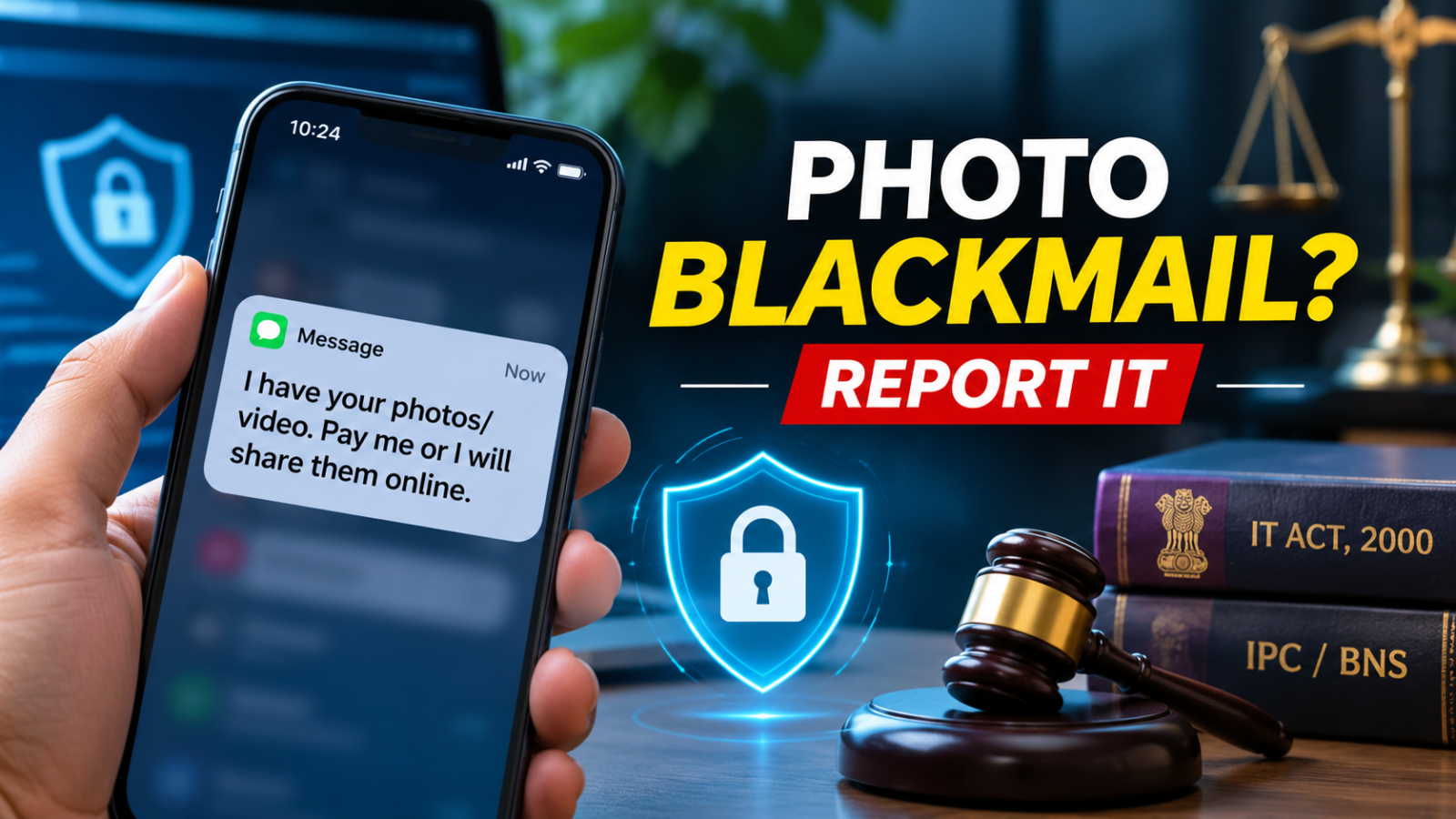
If someone threatens to publish your private photographs, a video call recording or an AI-generated intimate image unless you pay or meet another demand, do not comply. Preserve safe evidence of the threats, report the account, seek support and file a complaint through India’s National Cyber Crime Reporting Portal. If the content has already been posted, immediately request removal through the platform’s reporting and grievance channels. India’s amended IT Rules, effective from 20 February 2026, prescribe a two-hour response for removal or disabling access to specified categories of intimate or impersonation content following an eligible complaint.
Consent to take or privately share an image does not amount to consent to distribute it publicly. Whether an image is genuine or fabricated, the person threatening you is responsible for their conduct. If you are in immediate physical danger, call 112. If money has been lost through online financial fraud, notify your bank and call 1930 promptly.
What to do immediately when someone threatens to leak private photos
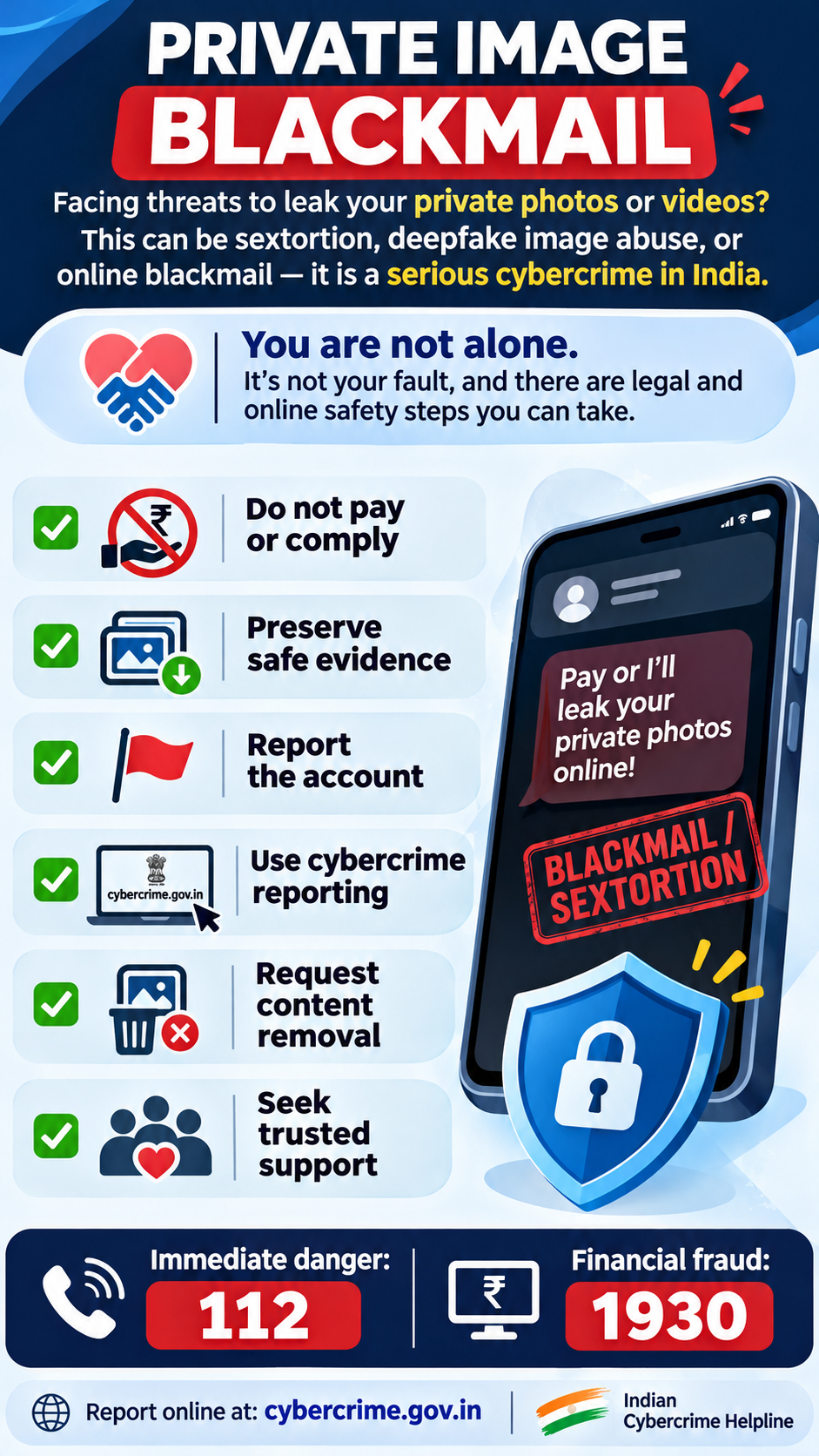
- Do not send money, additional images, passwords or other requested material. Payment cannot guarantee that the threats will stop.
- Preserve safe evidence of the threats, account identifiers, timestamps and relevant links.
- Report the threatening messages and account to the platform. Stop further contact when it is safe to do so.
- Review your social media privacy settings. If you suspect account compromise, change passwords from a trusted device and enable two-factor authentication.
- Report the incident to cybercrime authorities and request content removal separately if images have appeared online.
- Tell someone you trust. If the person threatening you knows your address or can approach you physically, prioritise personal safety.
Do not confront the blackmailer in person, retaliate or try to hack their account. If you have already paid, you can still report the incident. Stop additional payments and seek assistance. You may prefer to approach a trusted friend, lawyer or support organisation before discussing the situation with a wider group of people. You do not have to handle this alone.
How to preserve evidence of sextortion and deepfake abuse safely
Evidence preservation does not require circulating intimate images. Record the threatening text messages, username, profile URL, telephone number, dates, payment demands and transaction references. Preserve the original conversation and device where possible. Avoid including unnecessary intimate material in screenshots, and do not forward sensitive files to friends, strangers or private recovery agents.
If a fake Instagram profile uses your name or photograph, record the profile link, account handle and identifying claims. For AI-generated image abuse, information showing the difference between an ordinary original photograph and the manipulated content may help investigators. Do not upload private images to unknown deepfake detection services. Describe the facts and your suspicions accurately; you are not required to prove the entire offence yourself before reporting it.
Important for anyone under 18: Do not download, screenshot, copy or forward sexual images involving minors, even for evidence. Record the account identifiers, URLs and non-explicit threatening messages instead. Obtain guidance from the police or an appropriate child protection service about handling existing material safely.
How to file a private photo blackmail complaint in India
Go directly to cybercrime.gov.in. Select the relevant reporting category for crimes against women or children, or other cybercrimes, depending on the incident. Provide an accurate description, relevant account details, dates and any payment references. Complete the verification requested by the portal and retain the acknowledgement number. Follow the instructions for submitting evidence securely.
Anonymous reporting is available for certain specified categories of content involving women or children, but it is not a universal option for all sextortion complaints. Other reporting and tracking procedures can require your identity and contact details. Explain any confidentiality or safety concerns to the investigating officer. A portal acknowledgement is not automatically an FIR. You can also approach the local police station or cybercrime cell.
Sample complaint: Since ______, the person/account ______ has threatened to publish my private images or videos. The demand is ______. The relevant account links, messages and transaction references, if any, are ______. I request an investigation, appropriate legal action, assistance with content removal where applicable, and protection of my privacy and safety. My safe contact details are ______.
Use the actual facts. If an image has not been published, say that you received a threat. If the image is fabricated or AI-generated, explain that clearly. Do not state that an unknown individual committed a specific act unless the evidence supports that assertion.
How to remove private images from Instagram, Facebook and websites
Report the specific post or message as well as the offending account through the platform’s available categories, such as non-consensual intimate imagery, impersonation, harassment or manipulated sexual content. Find the platform’s designated Indian Grievance Officer through its official help centre. Submit the precise content URL and your objection, and keep the ticket number and submission time.
Under amended Rule 3(2)(b) of the Information Technology (Intermediary Guidelines and Digital Media Ethics Code) Rules, 2021, intermediaries must take reasonable and practicable measures within two hours of receiving a qualifying complaint from the affected individual or their representative to remove or disable access to specified content involving private areas, nudity, sexual depiction or electronic impersonation, including artificially morphed images. The previous 24-hour period was reduced by the 2026 amendments. This is not a guarantee that every copy will disappear from the entire internet.
If the grievance officer’s decision is unsatisfactory, an eligible appeal may be submitted through the Grievance Appellate Committee, generally within 30 days of receiving the decision. Police investigation and platform removal requests can proceed separately. If the material appears in Google Search, use Google’s personal content removal request. Removing a search result does not necessarily remove the material from the original hosting website.
StopNCII and Take It Down: what these tools can and cannot do
StopNCII.org is a free service designed to help eligible adults prevent the distribution of intimate images without consent. Its eligibility requirements include being an adult when the image was taken, meeting the current age requirement and having access to the relevant material. Its FAQ also covers qualifying synthetic or deepfake images depicting the applicant. The service generates a digital fingerprint on your device and shares that fingerprint with participating platforms rather than uploading the original image. Keep the case number and PIN secure.
StopNCII cannot scan every website, private message or encrypted service. Use it alongside platform reporting and appropriate legal assistance. For material created when you were under 18, consider Take It Down, operated by the National Center for Missing & Exploited Children. Never download or ask someone to send an intimate image in order to use this service. Follow its instructions for eligible material already on your device. Seek help from a trusted adult, the police or India’s child helpline 1098.
Which Indian laws may apply to private image blackmail?
Section 308 of the Bharatiya Nyaya Sanhita, 2023 concerns extortion and related conduct, while section 351 deals with criminal intimidation. Section 77 may be relevant to voyeurism involving a woman where its statutory requirements are met. Under the Information Technology Act, 2000, section 66E addresses specified violations of privacy, section 67A concerns electronic publication or transmission of sexually explicit material, and section 67B addresses sexual material involving children. The Protection of Children from Sexual Offences Act may also apply to cases involving minors. The appropriate provisions depend on the circumstances and evidence.
If you lost money, notify your bank and call 1930 to report financial cyber fraud. Avoid anyone promising guaranteed removal or recovery in exchange for advance fees. Verify any purported police communication independently. Eligible individuals can contact the District Legal Services Authority or NALSA’s helpline 15100 for information about free legal aid.
Frequently asked questions
Will paying a blackmailer guarantee deletion of my photographs?
No. Paying does not guarantee deletion or an end to further demands. Seek help and report the threats.
Can I complain about a fake or AI-generated image?
Yes. Describe the manipulation, threats and account details accurately, and use the relevant platform removal process.
Can I report blackmail without everyone finding out?
Request confidentiality and use official channels. Complete anonymity cannot be guaranteed for every type of complaint.
Must I wait until the image is posted?
No. Report the threats promptly, even when publication has not occurred.
Is 1930 the helpline for all blackmail cases?
1930 is the immediate financial cyber fraud reporting channel. Use the cybercrime portal or police for general image-based blackmail, and 112 for immediate danger.
Conclusion: Prioritise your safety, preserve evidence without spreading sensitive material, and use official complaint and content removal channels. You deserve respectful assistance regardless of how the threat began.
References: National Cyber Crime Reporting Portal FAQ; Government explanation of the amended IT Rules; Bharatiya Nyaya Sanhita; IT Act; StopNCII FAQ; Take It Down FAQ. General legal and safety information, not individual legal advice.
















Share Your Opinion
Comments are closed on this post.