 Vista

India remain fourth in the ICC World Test Championship 2025–27 standings after the first Test against New Zealand ended in a draw at Wellington on 23 November 2026. India’s points percentage has fallen from 51.52 to 50.00 despite adding four points. South Africa lead with 75.00 PCT, Australia are second at 69.23 and New Zealand have slipped to third at 66.67. India can still reach the June 2027 final, but need stronger results from the six Tests remaining in the cycle as well as favourable movement elsewhere.
Updated: 23 November 2026 | ICC WTC 2025–27
WTC Points Table: all nine teams on 23 November 2026
| Rank | Team | Played | Won | Lost | Draw | Points | PCT |
|---|---|---|---|---|---|---|---|
| 1 | South Africa | 8 | 6 | 2 | 0 | 72 | 75.00 |
| 2 | Australia | 13 | 9 | 4 | 0 | 108 | 69.23 |
| 3 | New Zealand | 7 | 4 | 1 | 2 | 56 | 66.67 |
| 4 | India | 12 | 5 | 4 | 3 | 72 | 50.00 |
| 5 | Bangladesh | 9 | 3 | 4 | 2 | 44 | 40.74 |
| 6 | England | 16 | 7 | 8 | 1 | 74 | 38.54 |
| 7 | West Indies | 14 | 3 | 8 | 3 | 46 | 27.38 |
| 8 | Sri Lanka | 8 | 1 | 3 | 4 | 13 | 13.54 |
| 9 | Pakistan | 11 | 3 | 7 | 1 | 16 | 12.12 |
Source: ICC match update and contemporaneous standings. Historical snapshot, not a forecast.
The updated WTC points table after the Wellington draw
The latest ICC article dated 23 November confirms India’s position as fourth rather than third. India have played 12 Tests in this championship cycle, winning five, losing four and drawing three. Their 72 points equate to a 50.00 points percentage. South Africa lead the nine-team standings, and Australia have moved ahead of New Zealand following the latter’s draw with India. Comparing only raw points leads to misleading conclusions: India have more points than New Zealand because they have played five more matches, but New Zealand have a much better share of the points that were available to them. For anyone checking a screenshot, the date and PCT column are therefore essential. This table is a snapshot, not a prediction for December or the 2027 final.
What happened in the India vs New Zealand Wellington Test?
The opening Test was scheduled for 19–23 November at Basin Reserve in Wellington. India established a strong position but could not take the final five wickets needed to force victory on the last day. New Zealand’s resistance took the second innings to 239 for five in 120 overs before the contest was drawn. A draw is not a defeat in the match record, but it provides fewer WTC points than a win. The difference matters particularly when a team is trying to close a large gap to the leading two. Fans searching ‘IND NZ draw highlights’ should distinguish this match from older tour footage. The next scheduled meeting is at Christchurch from 27 November, not an immediate rematch in Wellington.
How WTC points and PCT work: 12, 6, 4 and 0
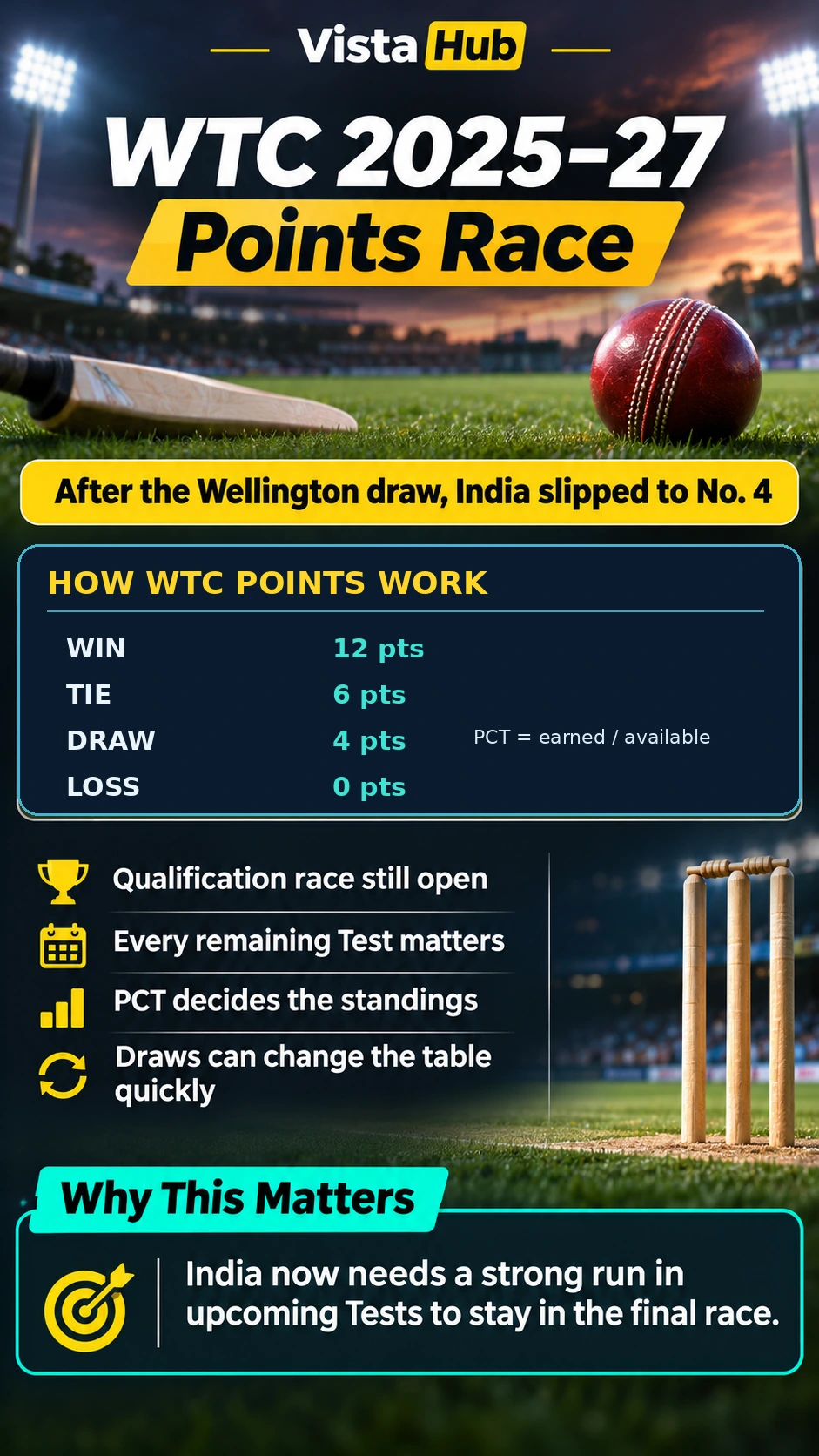
Under the WTC points system, a win generally earns 12 points, a tie six, a draw four and a loss none. The basic percentage formula is points earned divided by the maximum available points from matches played, multiplied by 100. For India, 12 completed matches create a denominator of 12 × 12 = 144 available points. India have earned 72, giving a percentage of precisely 50.00. The calculation can also be affected by deductions for slow over rates or other officially imposed penalties, so the ICC table rather than a fan-made spreadsheet is the final authority. This is why the WTC rankings do not sort by the number of total points alone. Teams play different numbers of Tests and must be compared on the same proportional basis.
Why India’s percentage dropped despite earning four points
Before Wellington, India had 68 points from 11 Tests. Its basic PCT was 68 divided by 132, or approximately 51.52. The draw added four points, raising its total to 72; however, completing another match increased the maximum available points to 144. Dividing 72 by 144 gives 50.00, below the previous percentage. This is not a calculation error or hidden penalty. A draw earns only one-third of the maximum available points in a Test, and that proportion is lower than India’s existing average. If a match ends without a win, the mathematics can therefore lower a team’s percentage even as its total points go up. The explanation is a useful response to the frequent question ‘How can India gain points and still lose ground?’.
Australia climb to second as New Zealand slip to third
The ICC reports that Australia occupy second place on 69.23 PCT after the Wellington result. New Zealand, who entered the match in a stronger position, fell to 66.67 and third. This movement can occur without Australia playing a match that day because standings are relative to the performances of all sides. South Africa are currently first on 75.00, and India remain fourth at 50.00. If a headline says Australia ‘jumped up’ without explaining why, the key is that New Zealand’s denominator grew when it drew. The Black Caps still have a promising percentage, but their cushion over other challengers has narrowed. The remaining fixtures for each contender should be assessed rather than assuming today’s top two will stay there until June 2027.
Can India still qualify for the WTC Final in 2027?
Yes, India remain mathematically in contention as of 23 November, though their position is difficult. The top two teams in the final standings progress to the match at The Oval in June 2027. After Wellington, India have one Test remaining in New Zealand and five home Tests against Australia in the coming months. Winning all six could add 72 points to the existing 72, resulting in 144 from 18 completed Tests and a basic PCT of 66.67, assuming no deductions. That figure is illustrative, not a promise of qualification, because South Africa, Australia and New Zealand also have fixtures that can change the threshold needed for second place. A five-win, one-draw scenario produces 136/216, or about 62.96 PCT. Neither result alone settles the qualification race.
Why the Christchurch Test on 27 November matters
The ICC schedule lists the second New Zealand–India Test at Christchurch from 27 November to 1 December 2026. India will need as many points as possible from that contest. A victory would carry the maximum 12 WTC points, while another draw would bring only four. Weather interruptions, batting conditions and New Zealand’s home advantage make predictions uncertain; an article should not treat the unplayed game as a win or loss. Readers should check the current schedule for local start times and team news, then revisit the standings only after confirmed results. The search intent behind ‘India next Test date’ differs from ‘India WTC final scenario’, but both connect naturally in one practical points-table explainer without producing duplicate articles.
The Australia series and the remaining six-Test equation
India’s remaining schedule includes five home Tests against Australia in January and February 2027, a series with a direct bearing on the relative percentages of two competing teams. Australia currently sit second, so results between them can produce a large swing in the top-two race. But the WTC final does not depend on these games alone. South Africa have further fixtures, New Zealand face more Tests, and other teams can affect points and rankings. Also consider that an over-rate penalty can alter official totals. Avoid forecasts that guarantee the final from one particular win count without incorporating other results. The most responsible way to present the race is with clearly labeled scenarios and the date of the underlying standings.
Reading the visual points-system chart and official standings
The informational poster on this page explains the scoring system rather than showing a constantly updating table. A screenshot of an old WTC standings graphic quickly becomes misleading when a new Test finishes or a penalty is recorded. Check the ICC standings page for the official current PCT, matches played and recorded deductions. The table below is dated 23 November and will naturally become historical once another fixture is completed. If sharing a visual on WhatsApp, include the date and the actual article link so readers can see the context, not a detached image with no explanation. Accurate image captions and good date labels are particularly important for sports search, where stale snippets often rank beside fresh coverage.
Frequently asked questions
Where does India rank in WTC 2025–27 on 23 November?
Fourth, on 50.00 PCT after 12 matches.
Did India win the first Wellington Test against New Zealand?
No, the first Test ended in a draw on 23 November 2026.
How many WTC points are awarded for a draw?
Four points; a win earns 12, a tie six and a loss zero.
Can India still play the June 2027 WTC Final?
Yes, the route remains mathematically possible but depends on future results.
When is the next India vs NZ Test?
It starts in Christchurch on 27 November 2026.
What happens if India win all six remaining Tests?
A simplified no-penalty calculation yields about 66.67 PCT, not an automatic final berth.
Conclusion
India are fourth at 50.00 PCT as of the Wellington draw. Qualification remains possible but cannot be guaranteed from a single simplified scenario.
Sources
Future results or penalties will change the table.
























Share Your Opinion
Comments are closed on this post.