 Vista
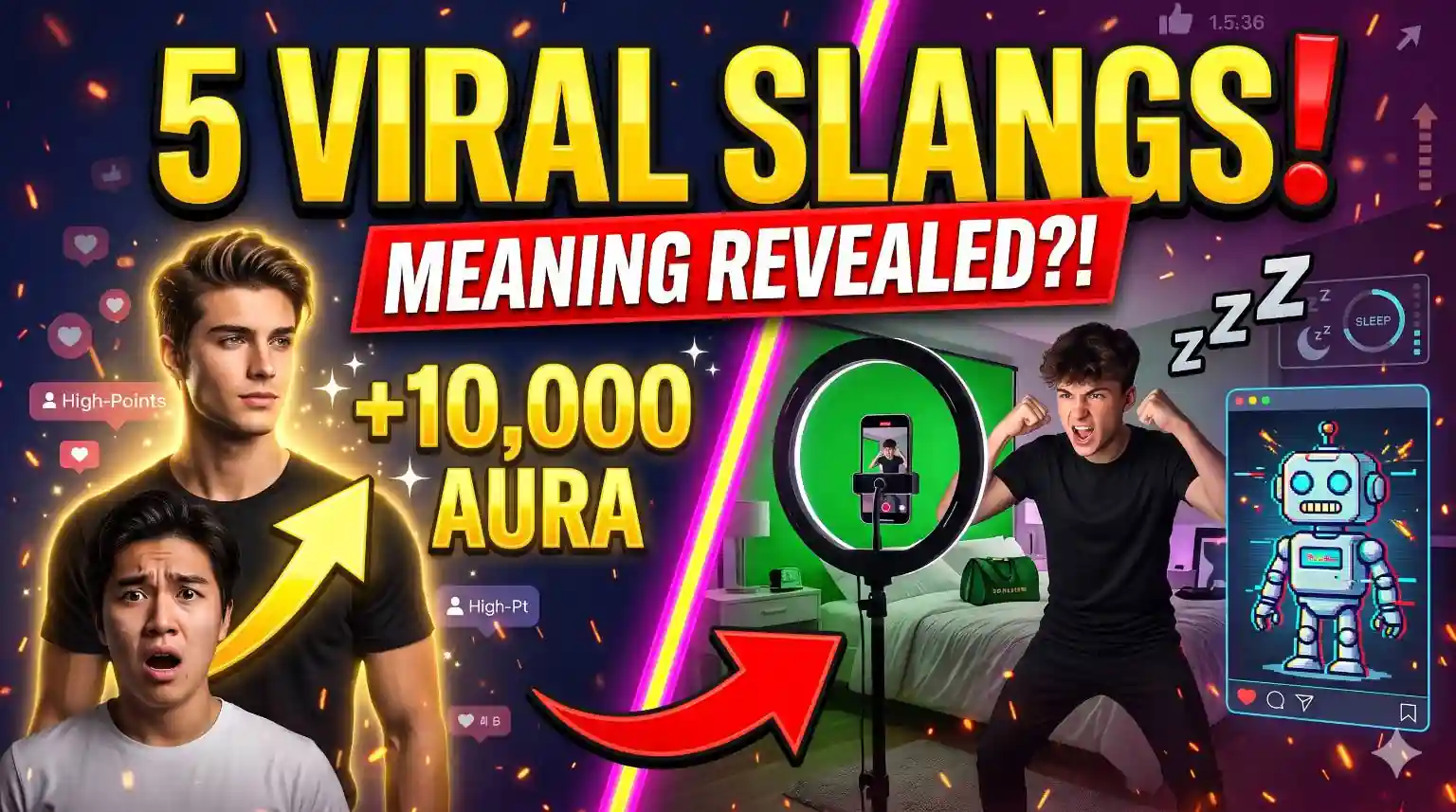
Maxxing, mogging, aura farming, clanker and larping are five online expressions appearing in 2026 social posts, TikTok captions, meme comments and everyday Gen Z conversations. The short definitions are: maxxing means intensely optimizing something; mogging means noticeably outshining someone; aura farming means deliberately cultivating a cool or impressive image; clanker is a mocking word for robots or AI systems; and larping, in one newer online sense, means acting out an identity or lifestyle that does not match reality. They are not necessarily words invented in 2026: some have older gaming, fan or internet origins.
Updated 22 November 2026. Two have special dictionary recognition: Dictionary.com selected “maxxing” as its 2026 Word of the Year, while Collins chose “mogging”. No official authority assigns “aura points”, and the phrases often move between genuine description, playful exaggeration and sarcastic insult. Here is how to read them in context, including the differences that quick meme dictionaries miss.
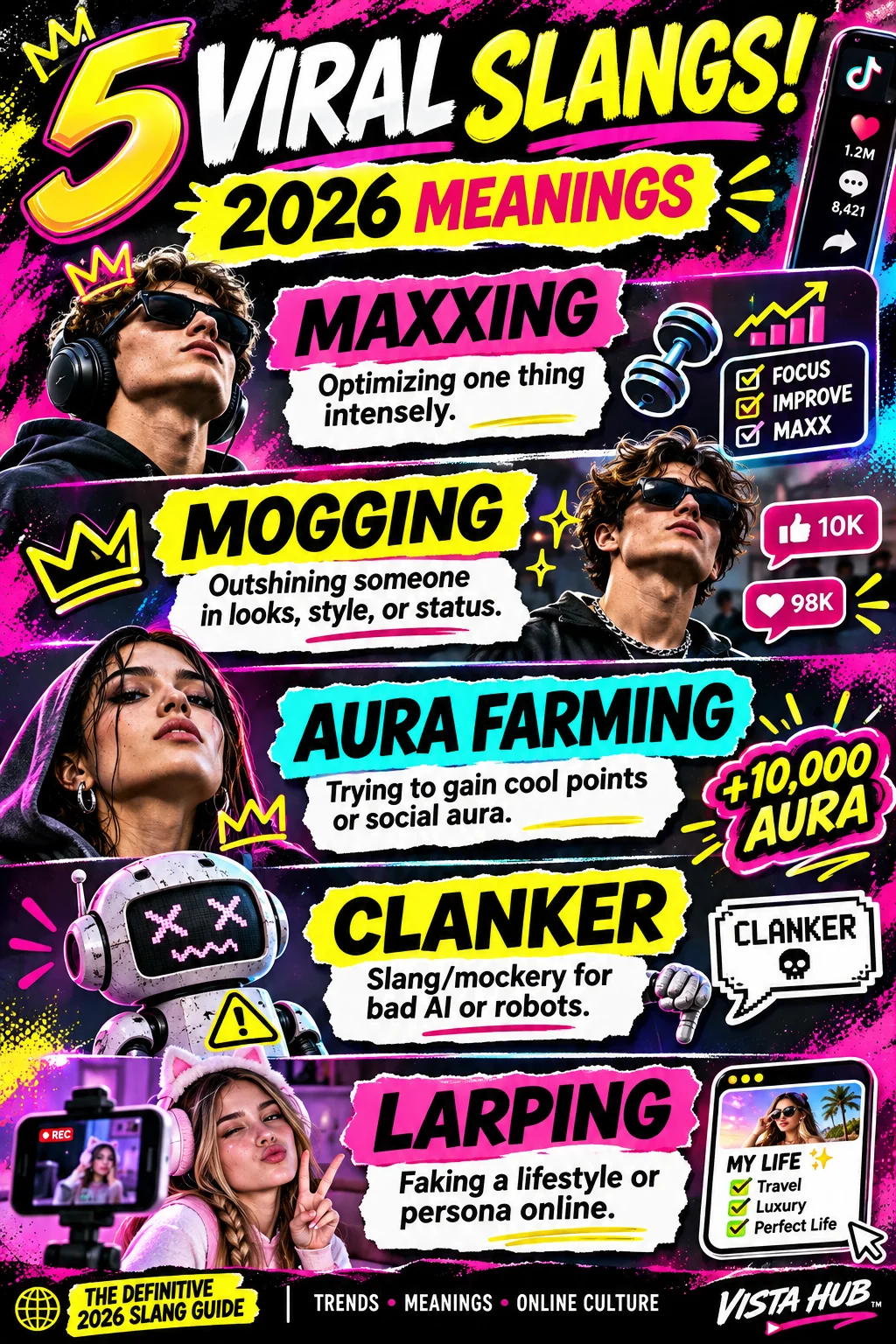
Five viral internet slang words of 2026: quick meaning chart
A comment containing only one unfamiliar word can change the tone of an entire post. “She mogged the whole group” might be admiration or a cruel comparison. “He’s aura farming” might praise somebody’s sense of style or tease someone for trying too hard. Rather than treat these terms as timeless dictionary definitions, read the speaker’s intention and the social setting.
| Slang | Core meaning | Typical example | Tone |
|---|---|---|---|
| Maxxing | Taking optimization or improvement to an extreme | “He’s studymaxxing before exams.” | Neutral, admiring or ironic |
| Mogging | Outshining someone by comparison | “Her outfit is mogging everyone.” | Playful or insulting |
| Aura farming | Trying to build an effortlessly cool image | “That dramatic entrance is aura farming.” | Admiring or teasing |
| Clanker | Mocking label for robot or AI system | “Another clanker support bot.” | Disparaging, joking |
| Larping | Role-playing; online: performing a possibly fake persona | “He is larping as a tech founder.” | Context-dependent, often skeptical |
These terms cross communities—gaming, lifestyle creators, productivity forums, sports, fashion and AI discourse—so each can shift slightly. The useful search question is not merely “what is mogging?” but “what does this word mean in this caption?” The examples below are invented to demonstrate usage, not quotes attributed to identifiable creators.
Maxxing meaning: why Dictionary.com chose its 2026 Word of the Year
Maxxing comes from “maximize” and is used when somebody tries to improve, optimize or intensify an area of life. It can stand alone—“everyone is maxxing something”—but appears particularly often as a suffix. Looksmaxxing centers on improving perceived appearance; sleepmaxxing on sleep habits; studymaxxing on study strategies; and cozymaxxing on maximizing comfort. Dictionary.com says its broader story runs through gaming’s “min-maxing”, early online forums and later social-media culture. It chose the term on 25 October 2026, noting how many different “-maxxing” variations had developed.
The word does not automatically mean the person has improved anything. “I’m productivity-maxxing” could refer to a reasonable method of organizing work, an exaggerated twenty-app routine, or a joke about rearranging a desk instead of starting an assignment. Context matters. A creator’s results cannot be inferred from the suffix itself.
Sleepmaxxing and cozymaxxing: harmless habits or over-optimization?
Sleepmaxxing often describes attempts to optimize bedtime, room lighting, sleep schedules and tracking. Establishing a consistent bedtime or reducing bright light before sleep may be useful, but an online challenge promising perfect sleep from a device, supplement or extreme schedule is not a medical recommendation. Health outcomes vary, and persistent sleep problems deserve qualified care. Cozymaxxing is usually gentler: arranging blankets, reading, cooking, reducing noise or finding pleasant routines. Both are labels for behavior, not established scientific treatment categories.
Example: “Sunday is for cozymaxxing” means somebody plans a particularly comfortable day. “I bought four trackers to sleepmaxx” may be earnest, satirical or critical. A useful article explains what the speaker is attempting rather than selling products on the assumption that every “maxxing” trend is beneficial.
Mogging meaning: Collins’ 2026 Word of the Year, and why it can offend
Mogging is the act of outperforming or outshining somebody so dramatically that the comparison makes the other person seem less impressive. Collins named it its 2026 Word of the Year. In looks-based internet culture it may mean that one person’s height, style, physique, attractiveness or confidence dominates a photo or group. Its meaning has widened: an athlete might “mog” opponents in a highlights clip, or an artist’s performance might “mog” everyone else’s.
For an English learner, “She mogged the red carpet” can be roughly paraphrased as “She stood out far above the others.” But it is not always praise. Comments like “He got mogged” can be used to humiliate someone about appearance or body size. The same meme can be playful among consenting friends or needlessly harsh to a stranger. Young audiences should not mistake an appearance-comparison meme for objective evidence of personal worth.
The word is often pronounced like mog-ing, with a hard “g”, rather than the letters M-O-G individually. “Mog” can function as a verb, while “mogging” describes the action. It is not the same as maxxing: maxxing focuses on what somebody does to optimize themselves; mogging emphasizes how somebody compares with another person.
Aura farming meaning: what are aura points and why do people say “+10,000 aura”?
Online, aura means an impression of effortless charisma, coolness, mysterious confidence or status. Aura farming is acting deliberately to create or maintain that impression: making a dramatic walk, carefully timing a pose, dressing to look unfazed, posting a cinematic clip or behaving as if an audience is always watching. The irony is that the result is supposed to seem effortless even when a lot of effort went into it.
“+10,000 aura” and “-500 aura” are humorous imaginary scores. There is no official TikTok, Instagram or psychology scale awarding these points, and they have no fixed conversion to money, followers or social rank. A teenager may write “That backflip is +1,000 aura” simply to say it looked impressive. When somebody visibly overperforms, “he’s aura farming” can also mean “he is trying too hard to look cool.”
Aura farming vs mogging: aura farming describes image-building behavior; mogging describes relative dominance or outshining. A performer can aura-farm without any specific rival, while a person may “mog” someone unintentionally. Using these words as a guide to what people mean is fine; treating aura scores as a measure of someone’s social value is not.
Clanker slang: why people call AI chatbots and robots “clankers”
Clanker is generally a derisive term for a robot, automated system or AI assistant, especially one perceived as mechanical, incompetent, intrusive or unreliable. A user annoyed by an unhelpful support bot might say “That clanker sent me in circles.” Sometimes the tone is clearly humorous; at other times the word expresses anxiety about automation or robots replacing human service interactions.
This word was not coined in November 2026. Its robot-related history includes science fiction and the Star Wars franchise, whose droid soldiers were disparaged with the name, and it became a conspicuous anti-AI online meme in 2025. Dictionary.com’s slang entry also traces the older origin and later AI-era spread. Calling it a newly invented 2026 term would be inaccurate; it is included because people still encounter it in contemporary posts.
It is better to describe its use precisely than claim it is an established legal category of discrimination. Calling a machine a “clanker” can be a joke about software performance, not an attack on a human identity. But when directed at real employees handling automation or made part of harassment campaigns, the communication can still be harmful. Read the whole sentence, not just the word.
Larping meaning online: from live-action role-playing to a fake lifestyle
LARP originally stands for live-action role-playing—a genuine hobby in which participants physically act out fictional characters, often with costumes, stories and agreed game rules. There is nothing inherently fake or fraudulent about this activity: everyone understands it is role-play. This older meaning should not disappear from a glossary simply because a slang reinterpretation is currently popular.
In recent online usage, someone may accuse a person of larping when they appear to perform a role they do not actually inhabit: pretending to be a billionaire while borrowing luxury props, posing as a verified insider without evidence, or claiming expertise they may not have. The newer slang use was discussed in 2026 by Psychology Today and other media. In a comment, “He is larping as a founder” usually means the commenter doubts the authenticity of a public identity.
The accusation is not proof. A photo staged for art, a skit clearly labeled fictional or a carefully curated personal profile does not necessarily constitute deception. Likewise, calling a creator a “larper” does not establish that their wealth or credentials are false. Avoid repeating serious allegations without evidence. Ask whether the person has actually made a specific claim and whether it can be corroborated.
Maxxing vs mogging vs aura farming vs larping: when should you use each?
Imagine a college student changes their sleep habits, makes a dramatic entrance and posts a picture beside a luxury car. Depending on the context, someone might describe their bedtime plan as sleepmaxxing, their entrance as aura farming, their outfit as mogging classmates or their expensive lifestyle captions as larping. The words describe different things: optimization, comparison, social image and claimed authenticity. None automatically establishes a fact about the student’s health, status or finances.
Some creators use all of them ironically. A person might caption a photo “mogging the office while cozymaxxing and farming infinite aura,” which makes deliberate use of exaggerated meme logic. A literal translation will miss the joke. For users searching “mogging meaning in Hindi”, “aura farming meaning”, or “larping slang in 2026”, a clear example and the difference between compliment and insult is usually more useful than a long list of synonyms.
Parents and teachers can ask what a phrase means to the young person using it rather than immediately assuming it is threatening. Some slang is harmless play; other variants can conceal body-shaming, pressure to optimize, influencer scams or bullying. Focus on the behavior, not merely unfamiliar vocabulary. Do not buy a miracle sleep product, appearance procedure or financial course because a creator attached “maxxing” to its name.
2026 viral slang FAQs
Is “maxxing” really the 2026 Word of the Year?
Yes—Dictionary.com chose maxxing for 2026. That does not mean every dictionary made the same selection; Collins chose a different term, mogging.
What does “mogging someone” mean in simple English?
It means outshining or outperforming another person, sometimes especially in looks or confidence. It can be a compliment to one person or a put-down of another.
What does “aura farming” mean on TikTok?
Deliberately behaving in ways that appear cool, charismatic or cinematic. “Aura points” are playful made-up scores, not an official social-media metric.
Does “clanker” mean a bad ChatGPT response?
It can. Clanker is broader mocking slang for robots or AI, not a precise brand name or model-quality rating. It became prominent as an AI meme before 2026.
Does “larping” always mean lying about wealth?
No. Its traditional meaning is live-action role-playing; the newer internet sense may refer to performing a false identity, expertise or lifestyle. An accusation alone is not evidence.
Is sleepmaxxing a medically proven treatment?
No. Sleepmaxxing is slang for optimizing sleep routines. Some underlying habits may be sensible, but dramatic health claims require medical evidence and individual context.
Sources, update note and conclusion
For primary word selections, read Dictionary.com’s 2026 Word of the Year announcement and Collins’ 2026 mogging explanation. The Dictionary.com clanker glossary documents earlier roots, while Psychology Today’s 2026 larping analysis explains the newer online sense. For context on social slang’s shifting definitions, see Euronews’ 2026 slang guide.
Bottom line: Maxxing is about optimization; mogging is about outshining; aura farming is about cultivating coolness; clanker mocks robots or AI; and larping can mean performing a questionable persona online, although its original gaming meaning still exists. These expressions are social shorthand, not verified judgments about anybody. The article is a language and culture explainer, not endorsement of bullying, risky body-image practices or fabricated influencer claims.

























Share Your Opinion
Comments are closed on this post.