 Vista

Quick answer: Blood type compatibility depends on which blood component is being transfused. For red blood cells, O-negative is commonly described as the universal ABO/RhD red-cell donor and AB-positive as the broadest red-cell recipient. For plasma, the ABO direction reverses: AB plasma can be given across ABO groups under the usual compatibility rule, while group O recipients can generally receive plasma from all ABO groups. These are educational summaries; real transfusions require a clinical blood bank’s type, screen, crossmatch and product-specific procedures.
Updated: 21 November 2026. For education only; not a clinical transfusion guide.
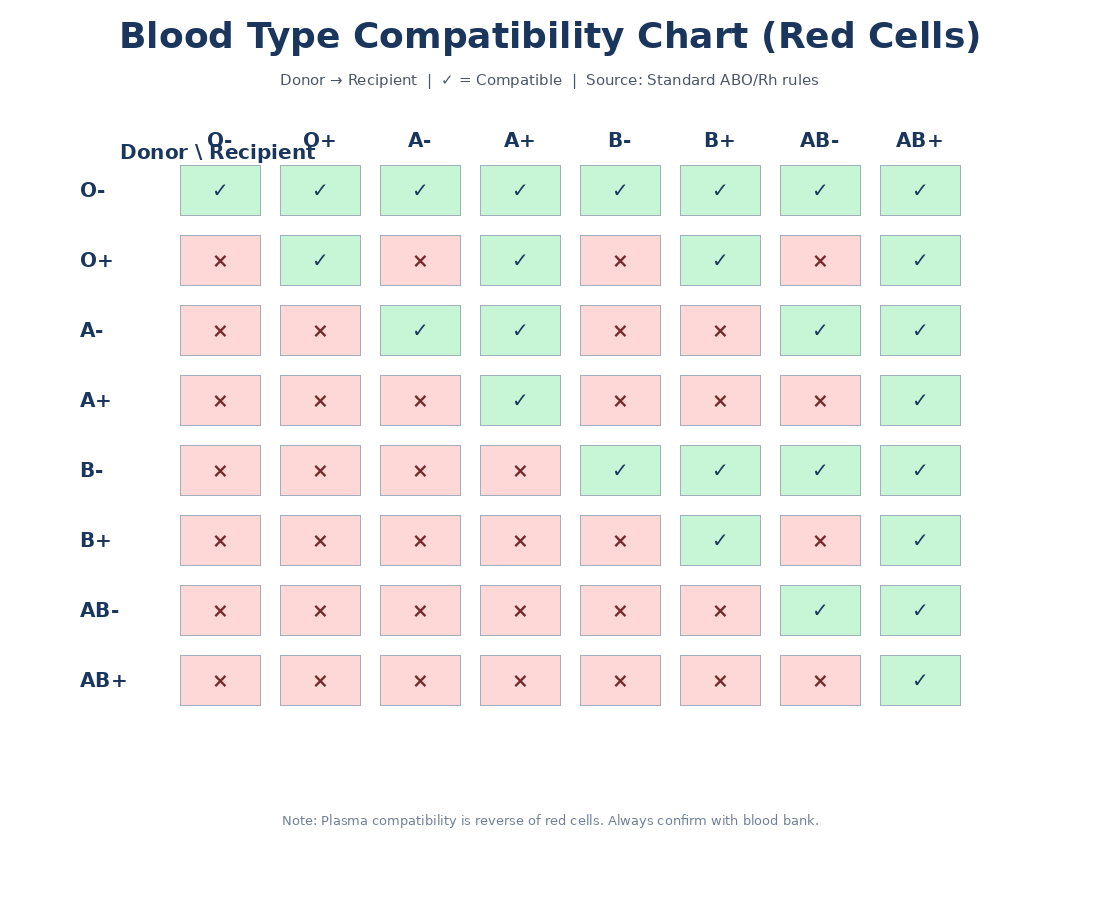
RBC recipient compatibility: red-cell donor types
Important: The recipient is the first column; this is general ABO/RhD packed-red-cell compatibility, not an instruction to issue a unit.
| Recipient blood type | Generally ABO/RhD-compatible red blood cell donor types |
|---|---|
| O− | O− |
| O+ | O−, O+ |
| A− | O−, A− |
| A+ | O−, O+, A−, A+ |
| B− | O−, B− |
| B+ | O−, O+, B−, B+ |
| AB− | O−, A−, B−, AB− |
| AB+ | O−, O+, A−, A+, B−, B+, AB−, AB+ |
Plasma ABO compatibility is different
This recipient-first plasma ABO table is a simplified overview; clinical blood banks apply the full component protocol.
| Plasma recipient ABO type | Usually compatible donor plasma ABO type |
|---|---|
| O | O, A, B, AB |
| A | A, AB |
| B | B, AB |
| AB | AB |
Eight familiar ABO/RhD blood types: the underlying antigens
The four major ABO groups are O, A, B and AB. Blood group A has A antigen on red cells, B has B, AB has both, and O has neither A nor B antigen. A person’s circulating plasma usually contains relevant ABO antibodies against antigens they lack, with clinical details affected by age and individual circumstances. Adding the RhD positive or negative designation produces the eight familiar types: O−, O+, A−, A+, B−, B+, AB− and AB+.
Rh is not just one simple switch in all of transfusion medicine; the Rh blood-group system includes several antigens, of which D is the one most often reflected in the everyday plus/minus label. Other blood group systems, including Kell and many additional antigens, can matter. Someone who knows their ABO/RhD type still needs appropriate testing before a transfusion. A simple colourful chart cannot detect clinically significant antibodies and should never be used to select a unit independently of a licensed blood bank.
Red blood cell compatibility: recipient-first chart
The correct way to read the red-cell table here is to start with the patient or recipient. A recipient with group A red cells usually needs donor red cells lacking incompatible B antigens; therefore the common ABO choices are A and O, subject to RhD and other matching. An O-negative recipient is typically shown with O-negative red cells only in a simplified ABO/RhD diagram. AB-positive is the broadest receiving category under this limited framework.
This chart describes general ABO/RhD choices for packed red blood cells, not whole blood, plasma or platelets. It also does not mean every listed unit is suitable for every patient. Blood banks perform compatibility testing and consider current clinical state, previous transfusions, pregnancy history and the presence of antibodies. Emergency-release protocols may sometimes make different choices under professional control when risk is immediately life-threatening. Readers should not infer that the table authorises a family member to supply blood directly to a patient.
Why O negative is called the universal red-cell donor
O-negative red cells lack A, B and RhD antigens, making them broadly useful when a patient’s group is unknown and emergency transfusion is needed. That is why many blood-service education pages refer to O negative as the universal red-cell donor. It is a statement about common red-cell ABO/RhD matching, not about plasma, all rare red-cell antigens or complete clinical compatibility in every case.
A whole unit from an O-negative donor contains more than red cells if it is not specifically processed into a red-cell component. The antibody content and product type matter. Furthermore, not all patients have the same risk factors or special transfusion needs. During a shortage or a major emergency, hospitals operate under tightly controlled protocols. This simplified teaching phrase should never replace appropriate patient identification, laboratory tests, expert judgement or local policies for component selection.
AB positive: universal red-cell recipient has important limits
AB-positive patients generally possess A, B and RhD antigens, so they can receive red-cell units of any of the eight common ABO/RhD types under the basic matching framework. This is why AB positive is commonly called the universal red-cell recipient. However, this does not mean universal compatibility with every donated blood component or every blood bank unit without testing.
Red cells have many additional antigens beyond ABO and RhD. A person can develop antibodies after previous transfusions or pregnancies and may need specially matched red cells. Certain patient groups need irradiated, CMV-safe or otherwise specially prepared components for reasons unrelated to simple blood group labels. Therefore the phrase “AB+ can receive anything” is unsafe without the qualifying words “ABO/RhD red cells, as clinically tested and selected.”
Rh-positive and Rh-negative red-cell considerations
For routine RBC matching, RhD-negative recipients are generally shown receiving RhD-negative red cells, while RhD-positive recipients can commonly receive RhD-positive or RhD-negative red cells as otherwise compatible. Exposure of an RhD-negative person to RhD-positive red cells can prompt anti-D antibody formation, with implications for future transfusions or pregnancy. This is one reason RhD compatibility is particularly important in many clinical settings.
There are exceptions or emergency protocols where clinical risk assessment leads specialists to use RhD-positive red cells for selected RhD-negative recipients. Such decisions depend on the situation and applicable blood-bank policy; they must not be made from an internet chart. The Rh label also does not settle all antigen matching. If you see contradictory online diagrams, check whether they are depicting routine RBC choices, emergency release or a different blood product.
Plasma compatibility runs in the other ABO direction
Plasma contains antibodies, so the matching question differs from donor red cells. AB plasma is generally the most broadly ABO-compatible donor plasma because AB plasma normally lacks anti-A and anti-B antibodies. For a recipient with group O red cells, donor plasma of O, A, B or AB may be compatible under the usual ABO framework. An AB recipient, by contrast, generally receives AB plasma in a simplified compatibility table.
This reversal explains why a single ‘universal donor’ infographic can mislead readers. O-negative for red cells and AB for plasma refer to different components. RhD is generally less central in pure plasma component matching than ABO because plasma components contain negligible red cells, while platelets have additional compatibility concerns. Blood banks may choose components according to local inventory, antibody levels and policies. Always separate RBC and plasma tables by clear headings and label the recipient and donor columns unambiguously.
Platelets and whole blood: why the RBC chart is not enough
Platelet transfusions follow component-specific selection strategies. ABO-identical components are often preferred, but ABO-nonidentical platelets may sometimes be issued under controlled criteria. Platelets do not normally express RhD antigens, but residual donor red cells can affect the RhD considerations of some recipients. Whole blood likewise is not automatically governed by the exact same rules as packed red cells, because it contains plasma and antibodies as well.
A modern patient may receive leukoreduced red cells, platelets, plasma, cryoprecipitate or specialized components, each with its own indications and matching rules. If a hospital says a patient needs blood, ask the care team which product is actually being requested rather than sharing a social-media donor chart with relatives as a transfusion plan. Blood donation eligibility and specific product needs are determined by the authorised blood service. Product choice should always remain with licensed healthcare professionals.
Crossmatching, antibody screening and emergency decisions
ABO/RhD typing is an important first step, but a type and screen can also look for clinically significant antibodies. Crossmatching is used to check donor-patient compatibility before issue as required by the clinical scenario. The process includes robust patient and sample identification, laboratory verification and component traceability. A compatible letter combination in a chart is not a pass on those safety checks.
Severe acute haemolytic reactions are among the dangers of an incompatible transfusion. Signs during or after a transfusion may include fever, chills, back pain, breathing difficulty or other symptoms requiring immediate professional attention. This article cannot diagnose reactions or instruct staff on emergency transfusion practice. If a transfusion is happening and the patient becomes unwell, alert the treating clinical team immediately. Decisions about timing, testing and product release belong to the hospital blood bank and clinicians.
Donation myths, family groups and using charts responsibly
Blood type is inherited through genetic variants, but a basic Punnett-square cartoon does not establish a child’s identity, paternity or complete genotype. Rare ABO variants, testing circumstances and other factors can complicate simplified inheritance predictions. Blood type is not evidence of a person’s character, diet needs or athletic abilities. Nor does having O-negative blood mean a donor’s unit will suit every plasma recipient.
For education, label the image “ABO/RhD red-cell compatibility” and provide a separate plasma explanation. Verify that arrows point from donor red-cell type to compatible recipient groups, or state clearly when the table is organised by recipient. A reversed arrow is a meaningful medical error, not a minor design issue. Students should learn why professional crossmatching and component selection remain essential. Anyone arranging an actual transfusion should rely entirely on licensed healthcare and blood-bank services.
Frequently asked questions
Can O-negative blood be given to everyone?
O-negative red cells are broadly ABO/RhD compatible, but full transfusion compatibility and product-specific requirements still need clinical testing.
Is AB-positive a universal recipient for plasma?
No. AB positive is a broad RBC recipient; plasma ABO matching works differently.
Which plasma donor is universal under ABO matching?
AB plasma is generally the broadest ABO-compatible donor plasma.
Can group A patients receive group O red cells?
Generally yes under ABO/RhD red-cell compatibility, subject to RhD matching and blood-bank crossmatch.
Does matching the same blood group make crossmatching unnecessary?
No. Other clinically significant red-cell antibodies may still be present.
Can this chart guide an emergency transfusion?
No. Only trained clinical teams and blood-bank protocols should select and issue blood products.
Conclusion
Blood group compatibility is component-specific. Safe transfusion always requires patient identification, applicable testing, compatible product selection and professional blood-bank oversight.
Medical sources
- American Red Cross — Blood types and safe matching
- Australian Red Cross Lifeblood — matching blood groups
- Australian Red Cross — Component compatibility
- American Society of Hematology — Blood safety and crossmatching
- Ministry of Health India — National Standards for Blood Centres
Medical disclaimer: Do not choose, give or receive blood based on this article or graphic. Only qualified clinical teams and authorized blood banks may select and crossmatch blood components.




















Share Your Opinion
Comments are closed on this post.