Understanding the Hindi Alphabet (Varnamala) and Its Importance
The Hindi alphabet, known as Varnamala, is the bedrock of the Hindi language, derived from the Devanagari script. It’s considered one of the most scientific writing systems globally, as it’s written phonetically – exactly as it’s spoken. Mastering the Varnamala, including its vowels (Swar) and consonants (Vyanjan), is crucial for accurate pronunciation and comprehension in Hindi. Without a solid grasp of the alphabet from the start, children may face significant challenges in reading and writing Hindi later on. A good understanding of the alphabet not only aids in correct spelling and pronunciation but also enhances a child’s ability to recognize words, understand sentences, and develop overall language skills and cognitive abilities.
The Two Main Components: Swar (Vowels) and Vyanjan (Consonants)

The Hindi alphabet is broadly divided into two main categories:
1. Swar (Vowels)
Vowels are independent sounds that can be pronounced without the help of any other letter. They flow freely from the mouth. Hindi has 11 primary vowels and 2 additional symbols called Ayogvah (Anuswar and Visarg):
- अ (a) – Anar (Pomegranate)
- आ (aa) – Aam (Mango)
- इ (i) – Imli (Tamarind)
- ई (ee) – Eekh (Sugarcane)
- उ (u) – Ullu (Owl)
- ऊ (oo) – Oon (Wool)
- ऋ (ri) – Rishi (Sage)
- ए (e) – Ek (One)
- ऐ (ai) – Ainak (Spectacles)
- ओ (o) – Okhli (Mortar)
- औ (au) – Aurat (Woman)
- अं (an) – Angoor (Grapes) – Anuswar
- अः (ah) – Pratah (Morning) – Visarg
Understanding vowels is fundamental to grasping Hindi matras (vowel diacritics).
2. Vyanjan (Consonants)
Consonants are sounds that require the support of vowels for their pronunciation. The airflow is obstructed by parts of the mouth like the tongue, palate, or teeth. Hindi has 33 basic consonants and 4 compound consonants, totaling 37:
- K Varg: क (ka), ख (kha), ग (ga), घ (gha), ङ (nga)
- Ch Varg: च (cha), छ (chha), ज (ja), झ (jha), ञ (nya)
- T Varg: ट (ta), ठ (tha), ड (da), ढ (dha), ण (na) (ड़, ढ़ are additional)
- T Varg: त (ta), थ (tha), द (da), ध (dha), न (na)
- P Varg: प (pa), फ (pha), ब (ba), भ (bha), म (ma)
- Antahstha (Semivowels): य (ya), र (ra), ल (la), व (va)
- Ushma (Sibilants/Fricatives): श (sha), ष (ṣha), स (sa), ह (ha)
- Sanyukt Vyanjan (Compound Consonants): क्ष (ksha), त्र (tra), ज्ञ (gya), श्र (shra)
Compound consonants are formed by combining two or more consonants (e.g., क्ष = क् + ष). They are an integral part of the Hindi alphabet.
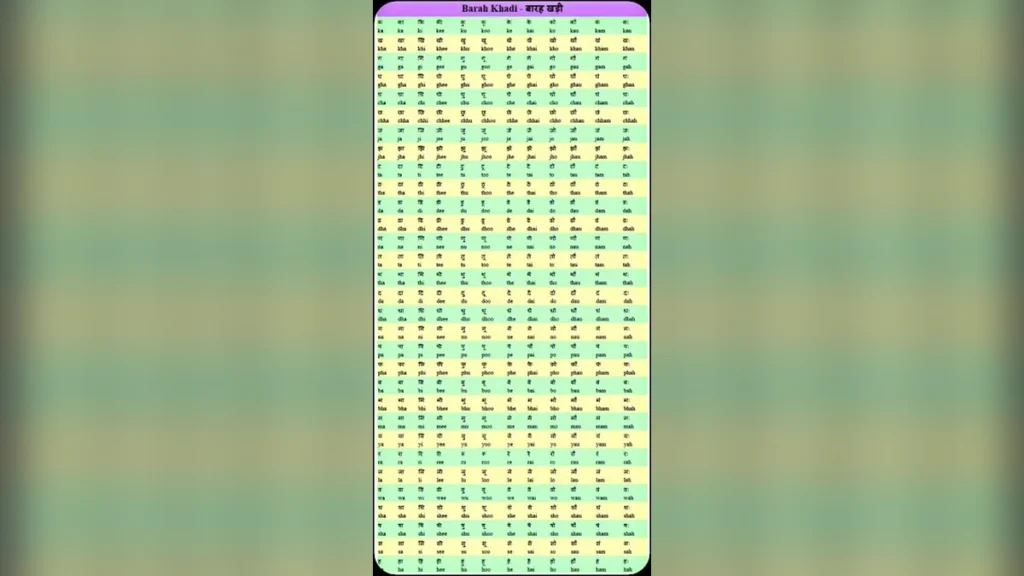
The Role of the Barakhadi
The Barakhadi is a vital step in learning Hindi, representing the combination of consonants with vowel matras. For instance, the consonant ‘क’ (ka) combined with the vowel ‘आ’ (aa) matra becomes ‘का’ (kaa). Practicing the Barakhadi helps children recognize and correctly pronounce words with different matras.
Benefits of Using Hindi Alphabet Charts for Children

An effective Hindi alphabet chart significantly aids a child’s learning journey:
- Visual Learning: Children easily recognize and remember letters when associated with vibrant images and colors. Engaging charts capture their attention for longer periods.
- Regular Reinforcement: Charts displayed at home or in classrooms encourage frequent viewing and repetition of letters.
- Pronunciation Improvement: Associating letters with relevant pictures helps children connect the visual representation with the correct sound.
- Boosted Confidence: As children begin to identify and read letters, their confidence grows, motivating them to learn more.
Engaging Ways to Teach Hindi Alphabet Using Charts
Here are some simple methods to make learning Hindi with charts enjoyable:
- Daily Recitation: Spend 10-15 minutes daily reviewing the letters on the chart with your child.
- Playful Learning: Show pictures related to letters, tell stories, or sing short songs.
- Letter Recognition Games: Ask your child to identify a specific letter or point to it on the chart.
- Writing Practice: Encourage them to copy the letters from the chart into a notebook.
- Word Association: Introduce common words starting with each letter and have the child repeat them.
Download Free HD Hindi Alphabet Charts

Our goal is to make Hindi learning accessible to every child. At vhoriginal.com, we offer free downloads of high-quality (HD) Hindi alphabet charts, covering both Swar and Vyanjan. These charts are perfect for decorating your child’s room, using in school projects, or as a handy reference during study sessions.
- Full Varnamala Chart: Includes Swar, Vyanjan, and Sanyukt Vyanjan together.
- Hindi Swar Chart: For a detailed understanding of vowels (अ to अः).
- Hindi Vyanjan Chart: To identify consonants and their respective groups (क to ज्ञ).
Simply click to download these excellent charts and make your child’s Hindi learning adventure both easier and more fun!
Conclusion
Learning the Hindi alphabet is an exciting first step for any child. With the right tools and a little effort, this journey can be not only rewarding but also foster a lifelong love for the Hindi language. Our Hindi alphabet charts are designed to help you achieve this goal. Download them today and lay the foundation for your child’s bright future!
Frequently Asked Questions (FAQs)
-
What are the basic components of the Hindi alphabet?
The Hindi alphabet, or Varnamala, is primarily divided into Swar (vowels) and Vyanjan (consonants). There are 11 main vowels and 33 basic consonants, along with some additional letters and compound consonants.
-
How can I make learning the Hindi alphabet fun for my child?
Use colorful Hindi alphabet charts with pictures, play letter recognition games, sing alphabet songs, tell stories related to letters, and practice writing regularly. Making the learning process interactive and playful is key.
-
Where can I find free Hindi alphabet charts for kids?
Websites like vhoriginal.com offer free downloadable HD images of Hindi alphabet charts, including Swar and Vyanjan charts, suitable for children.
-
Why is learning the Hindi alphabet important for children?
Learning the Hindi alphabet is fundamental for developing strong reading, writing, and comprehension skills in Hindi. It also enhances cognitive development and builds a connection to the language and culture.
-
What is the difference between Swar and Vyanjan in Hindi?
Swar (vowels) are independent sounds like ‘अ’, ‘आ’, ‘इ’, etc., while Vyanjan (consonants) like ‘क’, ‘ख’, ‘ग’ require the support of vowels to be pronounced fully.