Understanding the Human Body: A Bilingual Approach for Children
Children possess an innate curiosity about their own bodies. Introducing them to the names of body parts in both Hindi and English through visual aids like charts can significantly boost their memory and vocabulary. This approach is particularly beneficial in today’s educational landscape where bilingualism is increasingly valued.
Why Learn Body Parts in Both Hindi and English?
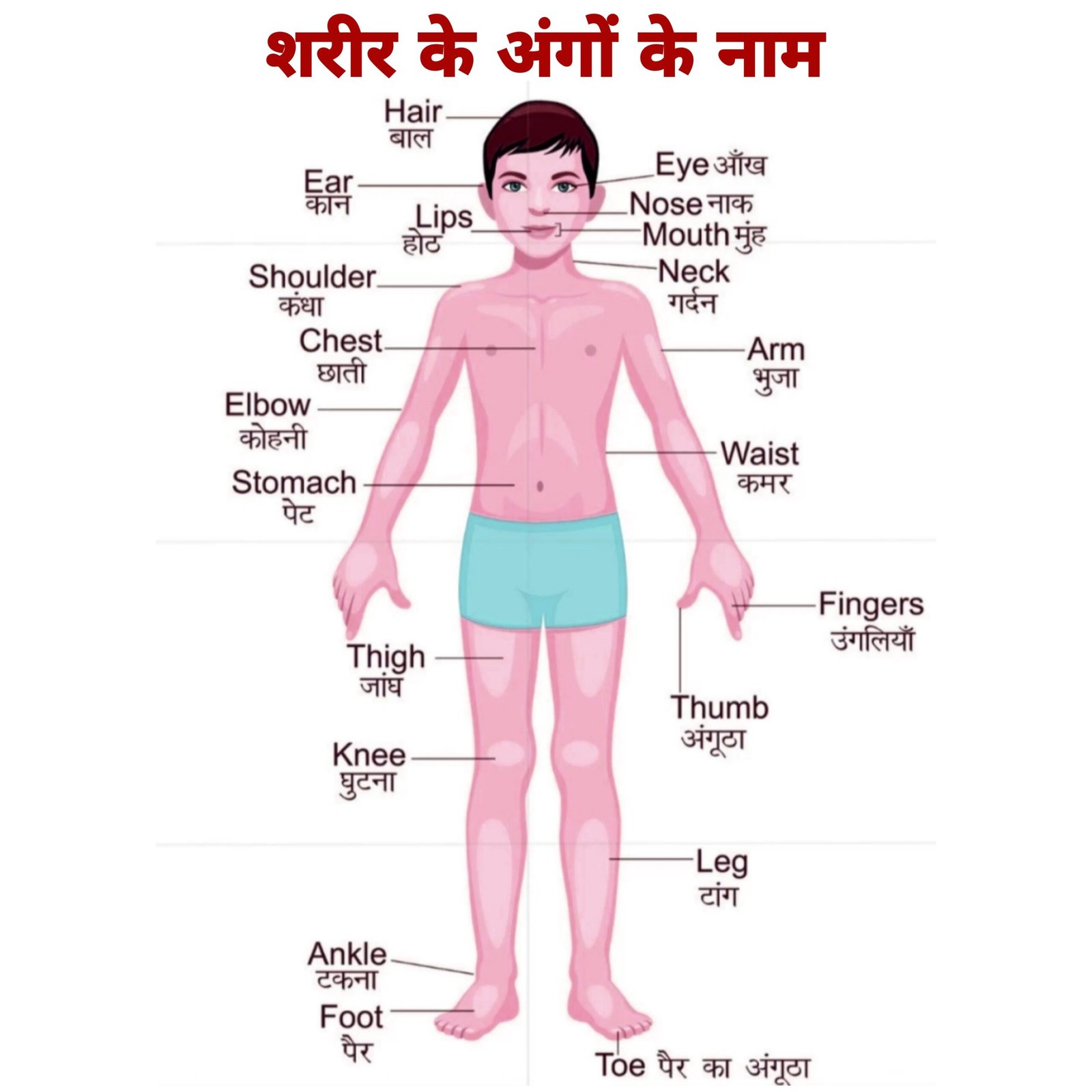
In many schools, English is the primary medium of instruction. While children might quickly pick up English terms like ‘Nose’, ‘Eyes’, and ‘Ears’, they might sometimes forget their Hindi counterparts – ‘नाक’, ‘आँख’, and ‘कान’. A well-rounded education equips a child with proficiency in both their mother tongue and a global language. Our charts are designed to facilitate this by presenting the Hindi and English names side-by-side with clear images, aiding in oral tests and general knowledge acquisition.
High-Quality HD Charts for Download and Printing
Finding clear, printable images online can be challenging, as many appear blurry when printed. The charts provided here are in high-quality HD resolution, ensuring clarity even when enlarged. Here’s how you can download them:
- For Mobile/Smartphone Users: Long-press on the desired image for 2-3 seconds, then select ‘Download Image’ or ‘Save to Gallery’.
- For Computer/Laptop Users: Right-click on the image and select ‘Save Image As…’ to save it to your preferred folder.
Once downloaded, these images can be printed in color from a local print shop, making them perfect for school science projects.
Engaging Activities to Teach Body Parts Names
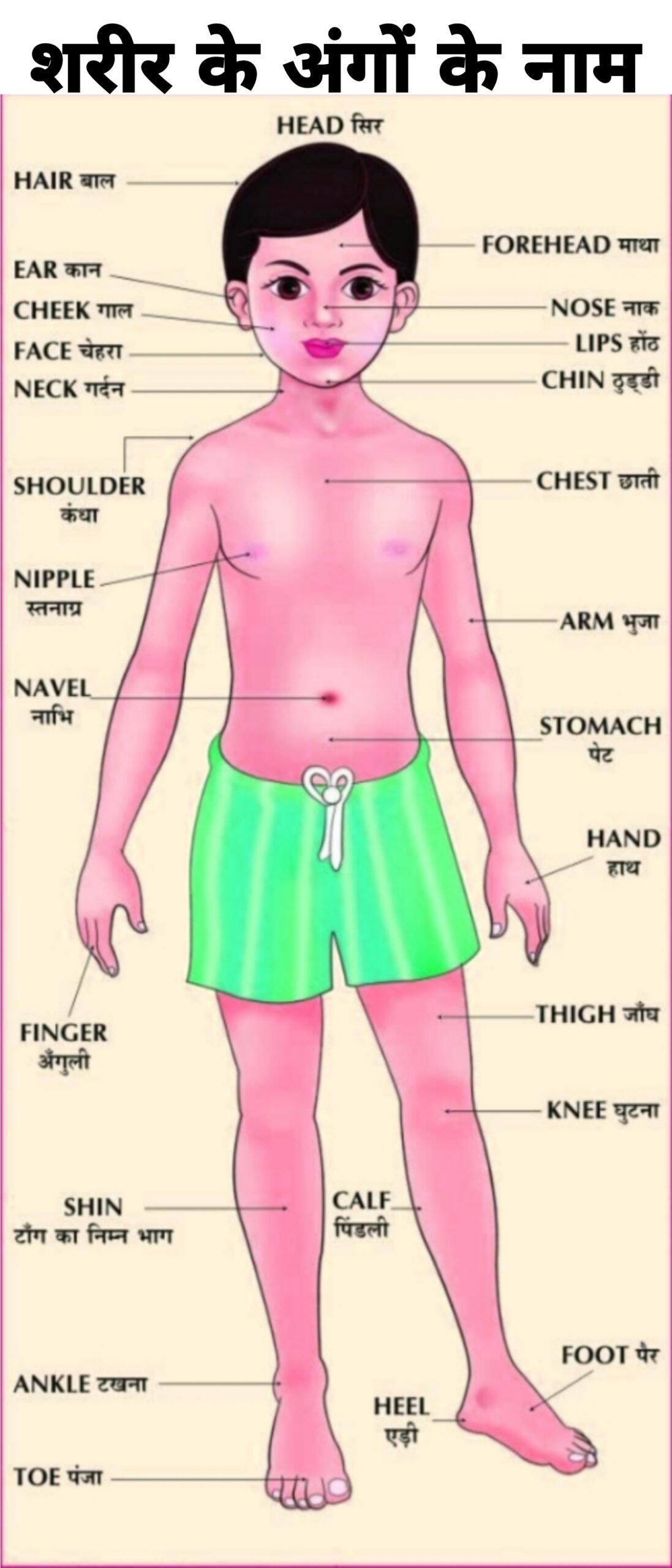
Rote learning can be ineffective for young children. To ensure they remember body parts names in Hindi and English, incorporate fun activities:
- Mirror Game: Stand your child in front of a mirror. Using the chart, ask them to point to their ‘Nose’ (नाक). Touching the body part while seeing it in the mirror reinforces the connection.
- Action Songs: Adapt popular songs like ‘Head, Shoulders, Knees and Toes’ into a Hindi version, such as “सिर, कंधे, घुटने और पैर…” While singing, encourage touching the corresponding body parts.
- Labeling Game: Draw a human figure on a plain paper. Ask your child to refer to the body parts chart and write the correct Hindi and English names. This also helps improve spelling.
Creative Use in School Projects
Science and EVS classes often assign projects on the parts of the body. Our high-quality HD images can make these projects stand out. For chart paper projects, place a large image in the center and draw arrows pointing to different parts, labeling them clearly in both Hindi and English. You can also print the image, mount it on cardboard, and create a 3D model for a truly impressive presentation.
Practical Tip for Consistent Learning
A practical tip is to get a glossy color print of the body parts chart, laminate it, and display it in a high-traffic area like the bathroom mirror or near the washbasin. Daily exposure during routines like brushing teeth or washing hands can help children learn the names and spellings within a couple of weeks without requiring extra study time.
Frequently Asked Questions (FAQs)
Q1. Which body parts should I teach young children first?
Start with easily visible and frequently used parts like eyes (आँख), nose (नाक), mouth (मुँह), hands (हाथ), and legs (पैर). Once these basic names are mastered, introduce terms like elbow (कोहनी) and ankle (टखना).
Q2. Can I print this Body Parts HD Image as a large poster (A3 size)?
Yes, absolutely. The images are high-definition and can be printed on large chart papers (A3 size) or banners without losing clarity or becoming blurry.
Q3. At what age should children be taught about internal body organs?
Around the age of 6-7, once they have a good grasp of external body parts, you can begin explaining basic internal organs like the heart (दिल), brain (दिमाग), and stomach (पेट).
Q4. Is this chart completely free to download?
Yes, this chart is 100% free. You can use it for personal study, school projects, or tuition classes without any restrictions.
We hope this Body Parts Name in Hindi and English Chart significantly enhances your child’s knowledge. A strong grasp of both languages will make them stand out in school. Remember, maintaining a healthy body also requires proper nutrition and understanding how our environment functions is key to appreciating life.







आपकी राय क्या है?
इस पोस्ट पर राय अभी बंद हैं।