 Vista

Understanding Bank Failures and Your Savings in India
News of a bank facing RBI restrictions can be alarming, raising immediate concerns about your hard-earned money. While the thought of losing your savings, education funds, or retirement corpus is frightening, it’s crucial to understand the safety nets in place. India has a system designed to protect depositors. This article clarifies whether you can get your money back if a bank fails, the reality of the DICGC ₹5 lakh rule, how joint accounts are treated, and essential steps to safeguard your finances.
It’s important to distinguish between a bank failure and a moratorium. A moratorium is a temporary restriction on withdrawals, not necessarily a bank failure, though DICGC protection applies in both scenarios. Always read news carefully before panicking.
Can Banks Actually Fail in India?
While technically possible, bank failures are rare for large commercial banks in India. Historically, issues have primarily affected cooperative banks. Examples include:
- PMC Bank (2019): RBI imposed withdrawal limits, causing significant distress to customers.
- Yes Bank (2020): RBI placed a moratorium, and SBI stepped in for a rescue.
- Lakshmi Vilas Bank (2020): Merged with DBS Bank.
Larger Scheduled Commercial Banks (like SBI, HDFC, ICICI) are considered ‘Too Big To Fail’ due to their integral role in the economy and strong regulatory oversight. Cooperative and Urban Cooperative Banks tend to be more vulnerable.
What is DICGC? Your Deposit Insurance Shield
The Deposit Insurance and Credit Guarantee Corporation (DICGC), a wholly-owned subsidiary of the RBI established in 1961, acts as your primary safety net. Member banks pay a small premium to DICGC, which is pooled into a fund. If a member bank fails, DICGC uses this fund to repay depositors.
Banks Covered by DICGC:
- Nationalised Banks (e.g., SBI, PNB)
- Private Sector Banks (e.g., HDFC, ICICI)
- Foreign Banks (operating in India)
- Regional Rural Banks (RRBs)
- Co-operative Banks (Urban, State)
- Small Finance Banks, Payments Banks
Since 2020, cooperative banks are fully covered, enhancing protection for their depositors. Post Office savings schemes have a separate government guarantee.
Understanding the ₹5 Lakh DICGC Limit
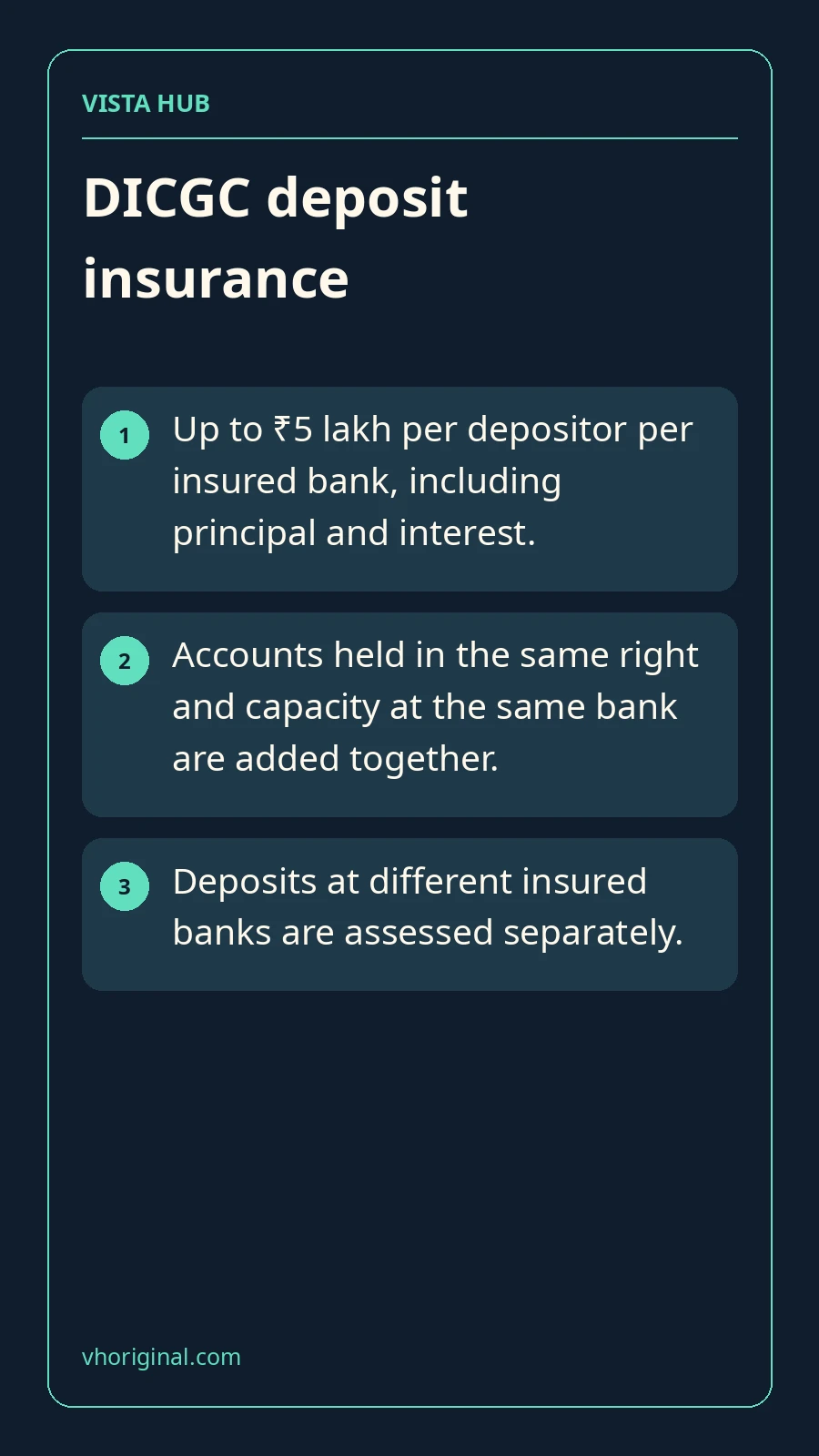
The DICGC limit is ₹5 lakh per depositor, per bank. This limit includes both the principal amount and accrued interest. All your accounts within the same bank—savings, fixed deposits (FDs), recurring deposits (RDs), and current accounts—are aggregated for this limit.
Example: If you have an FD of ₹4.5 lakh and a savings account with ₹1 lakh in the same bank, the total is ₹5.5 lakh. DICGC will cover ₹5 lakh, leaving ₹50,000 uninsured.
A smart strategy is to keep your total deposits in any single bank, including interest, below ₹5 lakh to ensure full coverage.
DICGC Rules for Multiple and Joint Accounts
Same Bank, Different Branches: Deposits across different branches of the same bank are clubbed under the single ₹5 lakh limit.
Different Banks: Deposits in separate banks are insured independently. For instance, ₹5 lakh in SBI and ₹5 lakh in HDFC are both covered, effectively protecting ₹10 lakh across two institutions.
Joint Accounts: A joint account is treated as a separate entity from individual accounts. If you have a personal account and a joint account with your spouse in the same bank, both can be insured up to ₹5 lakh each, potentially covering ₹10 lakh in total.
The Claim Process: A 90-Day Timeline
Following a 2021 amendment to the DICGC Act, the claim process has been streamlined. Once RBI takes action against a bank (moratorium or cancellation), a 90-day period begins:
- RBI Action: Day 0.
- Bank Submits Data: The distressed bank must submit depositor data to DICGC within 45 days.
- DICGC Verification: DICGC verifies the submitted data.
- Payment: Eligible depositors receive up to ₹5 lakh within 90 days of the RBI’s initial action.
This significantly speeds up the process compared to the years it could previously take.
Bank Lockers and Loans: What Happens?
Bank Lockers: The contents of your bank locker (jewellery, documents) are your property, not the bank’s. If a bank fails, you will be able to access your locker under supervision to retrieve your belongings. DICGC does not cover locker contents; separate insurance might be needed.
Loans: If you have a loan from a bank that fails, your loan is not waived. A liquidator will be appointed to manage the bank’s assets and liabilities, and loan recovery will continue, often through another bank taking over the loan.
Strategies to Protect Your Money
- Diversify Banks: Keep no more than ₹5 lakh (including interest) in any single bank. Spread your savings across multiple banks.
- Be Cautious with Cooperative Banks: While covered by DICGC, they carry a higher risk. Consider keeping lower amounts here.
- Limit FD Amounts: Keep individual FDs below ₹4.5 lakh to ensure that even with accrued interest, the total remains under ₹5 lakh.
- Utilise Post Office Schemes: Schemes like PPF, SSY, and NSC have a direct government guarantee, offering an alternative safety net.
- Explore Beyond Banks: Consider investments in Mutual Funds (regulated by SEBI and held with custodians) and other instruments for diversification.
FAQs
Q1. How quickly will I get my money back if my bank fails?
Under the current DICGC rules (amended in 2021), eligible depositors should receive up to ₹5 lakh within 90 days of the RBI taking action against the bank. Amounts exceeding ₹5 lakh are subject to the bank’s liquidation process, which can be lengthy and may not guarantee full recovery.
Q2. Is my money safe in a Cooperative Bank?
Since 2020, Cooperative Banks are covered under DICGC up to ₹5 lakh. However, they historically have a higher failure risk than nationalised banks. It’s prudent to limit your exposure and consider diversifying funds to larger, more stable institutions or Post Office schemes.
Q3. What is the DICGC limit for a joint account?
A joint account is considered a separate entity. If you have both a personal account and a joint account in the same bank, each can be insured up to ₹5 lakh, potentially offering ₹10 lakh coverage in total for that bank.
Q4. What happens to Mutual Funds and Shares if a bank fails?
Mutual Funds and shares are not bank deposits and are not covered by DICGC. However, Mutual Fund assets are held by custodians separately from the Asset Management Company (AMC) and are regulated by SEBI. Bank failure typically does not directly impact your mutual fund or share investments.
Q5. What are the warning signs of a bank failure?
Warning signs include rising Non-Performing Assets (NPAs), RBI penalties or warnings, frequent negative news coverage, credit rating downgrades, or unexplained delays in withdrawals. If you notice these, consider moving your funds proactively.
Q6. Can SBI fail?
Practically, no. As India’s largest bank with millions of customers and government backing, SBI is considered ‘Too Big To Fail’. The government would likely intervene to prevent its collapse.
Q7. Can I negotiate my loan if the bank fails?
Limited negotiation for loan settlements (like One-Time Settlements) might be possible with the appointed liquidator, but there’s no guarantee. You will still be obligated to repay the loan.
Conclusion: Proactive Steps for Financial Security
While the DICGC provides a crucial safety net, relying solely on it is not advisable. Take proactive steps today:
- List all your bank accounts and their balances.
- Distribute savings across multiple banks to stay within the ₹5 lakh limit per bank.
- Consider shifting funds from cooperative banks to larger nationalised banks or Post Office schemes.
- Structure your Fixed Deposits to ensure total deposits per bank remain under ₹5 lakh, including interest.
- Diversify your investments beyond bank deposits into instruments like Mutual Funds and government-backed Post Office schemes.
Understanding your financial landscape and diversifying your savings are the most effective ways to ensure your money is protected.
Related reading
























Share Your Opinion
Comments are closed on this post.