Sharp chest pain at night: start with safety
You turn over in bed and feel a needle-like jab in your chest. In the quiet of the night, it is easy to jump to a frightening explanation. Is it a heart attack, reflux or something called precordial catch? The sensation alone cannot answer that question. Understanding the possibilities should support care, rather than delay it.
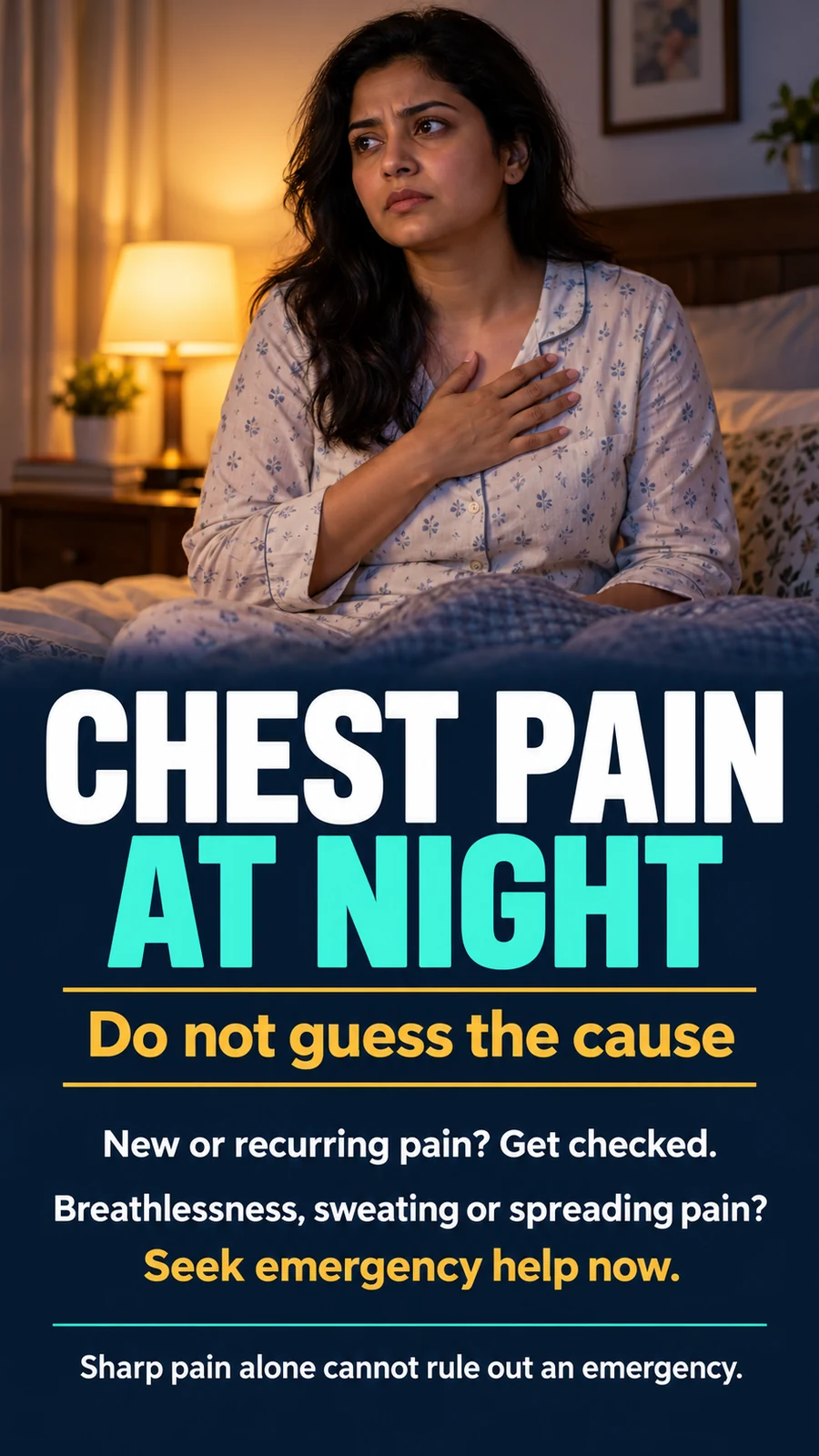
If you have new severe or persistent chest pain, or chest pain comes with breathlessness, cold sweating, faintness or pain spreading to an arm, jaw or back, seek emergency help now. In India call 112; elsewhere call your local emergency number. Do not drive yourself.
What is precordial catch syndrome?
Precordial catch syndrome (PCS) causes a sudden stabbing pain in a small chest area, more often in children and young adults. It may worsen on deep breathing and last seconds to about three minutes. Its precise cause is uncertain. See Cleveland Clinic’s explanation of PCS.
Confirmed PCS is harmless. Matching a description online does not confirm that you have it, however. A first episode, especially in an adult, deserves an assessment rather than a confident label borrowed from a search result.
Heart attack or gas: why a home comparison is unreliable
Heart attacks may involve pressure or discomfort, breathlessness, sweating or nausea. Symptoms can start mildly or come and go. Having a sharp pain, being young or noticing symptoms at night does not reliably exclude an emergency. Read the American Heart Association warning signs.
Do not treat burping or improvement after a home remedy as proof that the pain was “just gas.” Describe what happened to a clinician without needing to supply your own diagnosis. You can say, “I felt this pain, at this time, with these other symptoms.”
Why does deep breathing or lying down make it worse?
Chest-wall problems such as costochondritis can hurt with movement, pressure or deep breaths. The NHS costochondritis guide describes this pattern. Tenderness when pressing the area is still not a reliable home test for excluding other conditions.
Pericarditis, inflammation around the heart, can also cause sharp pain that worsens with deep breathing or lying down. Breathing-related pain therefore does not establish that the heart is uninvolved. See NHS information on pericarditis.
FACT: Stabbing chest pain describes a symptom, not a diagnosis. The time on the clock does not identify its cause either.
Could acid reflux explain pain when lying down?
Reflux may cause central chest burning and a sour taste, often worse after eating or lying down. For established reflux, avoiding food within three to four hours of bed can help. The NHS reflux guide gives further advice.
That is not a reason to test new chest pain with an antacid and postpone care. Follow an existing treatment plan if one has been prescribed, and report a changed symptom pattern rather than assuming every episode has the same explanation.
Advice: what to do and what to tell the clinician
Stop exertion and rest in a comfortable position. Call for help immediately for warning signs; do not wait for a set number of minutes to pass. Even pain that resolves should be discussed if it is new, unexplained or recurring. The NHS chest-pain guide advises assessment for recurring or worrying brief pain.
Without delaying help, note when it started, how long it lasted, the location, what you were doing and whether breathing or turning changed it. Mention associated symptoms, existing conditions and medicines. Bring a medication list if practical.
Useful questions include: What explanation fits my assessment? Do I need any tests? What should I do if it happens again? Ask for instructions specific to you instead of copying another person’s prescription or interpreting their test report as your own.
Related reading: Sudden Anxiety and a Racing Heart at Night: Causes and What to Do
Related reading: Waking Up Gasping or Choking in Your Sleep: Causes and When to Get Help
Frequently asked questions
Is every needle-like chest pain PCS? No. PCS is one possibility; a clinician needs to establish the cause.
Does pain disappearing in 30 seconds prove it was harmless? No. Duration alone is not a safety guarantee. Discuss new or recurring symptoms.
Does relief after turning over prove it was gas? No. Position-related changes are information to share, not a final diagnosis.
Can I assume panic if I already have anxiety? No. A history of anxiety does not remove the need to assess new physical symptoms.
Which emergency number should I use? India: 112. Outside India, use your local emergency number. For non-emergency assessment, contact an appropriate healthcare service.
Sources and medical disclaimer
This is general health education, not an individual diagnosis or treatment plan. It does not replace an examination. Do not start, stop or change medicines based on this article. Source links accompany the relevant sections. India’s emergency response service: ERSS 112.