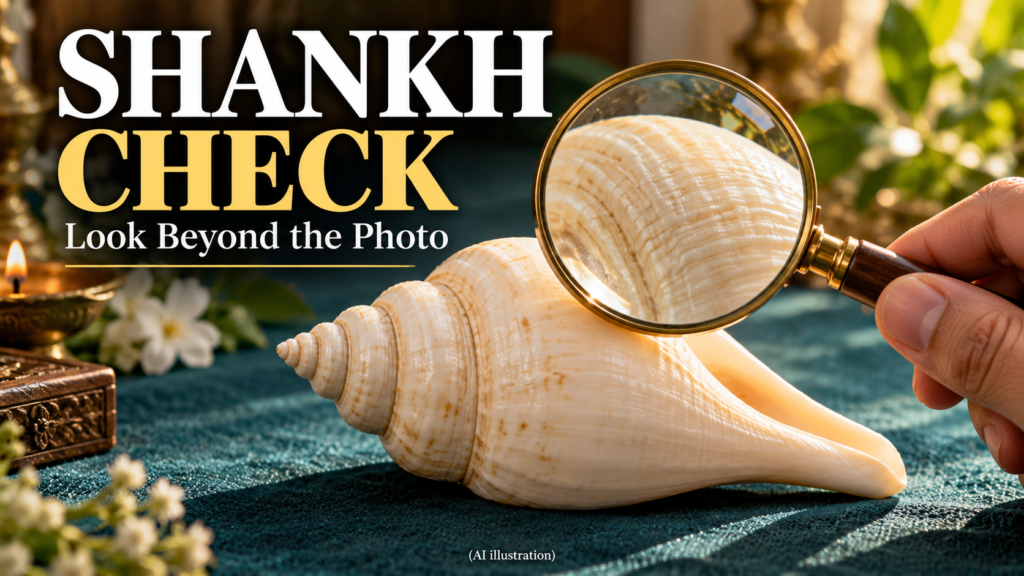
Dakshinavarti shankh identification starts with the claim
A glossy photograph cannot settle Dakshinavarti shankh identification. A photo may be mirrored, a natural shell may belong to a different species, and an authentic shell may have repairs or coatings. First ask exactly what the seller is claiming about species, direction and condition. Then collect evidence for each claim separately.
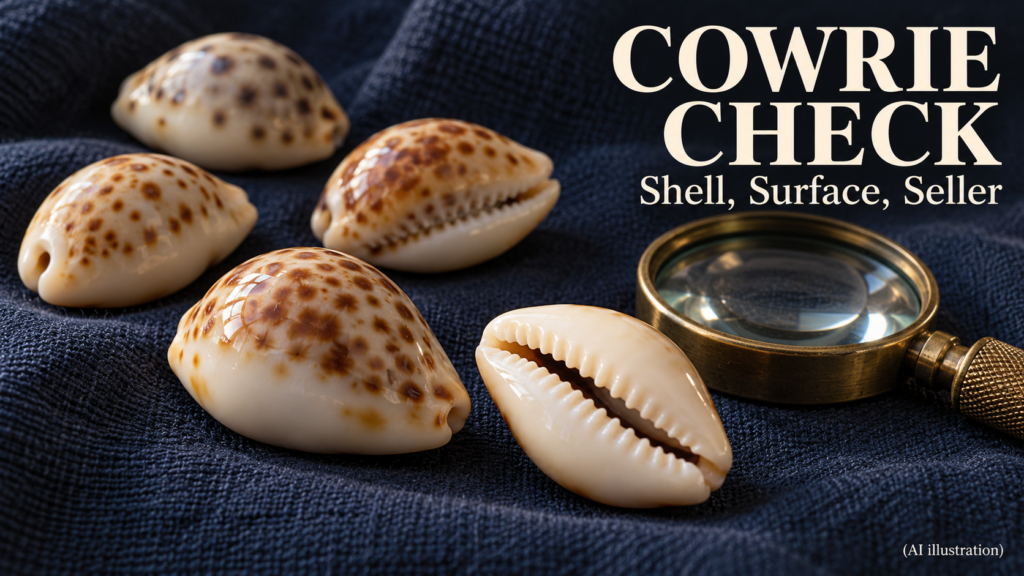
This guide explains an initial inspection and useful buying questions. All three images are fictional AI illustrations. They are not photographs of authenticated rare specimens and must not be used as a diagnostic reference. A particular shell may require direct examination by an appropriate specialist.
Use a consistent view to describe shell direction
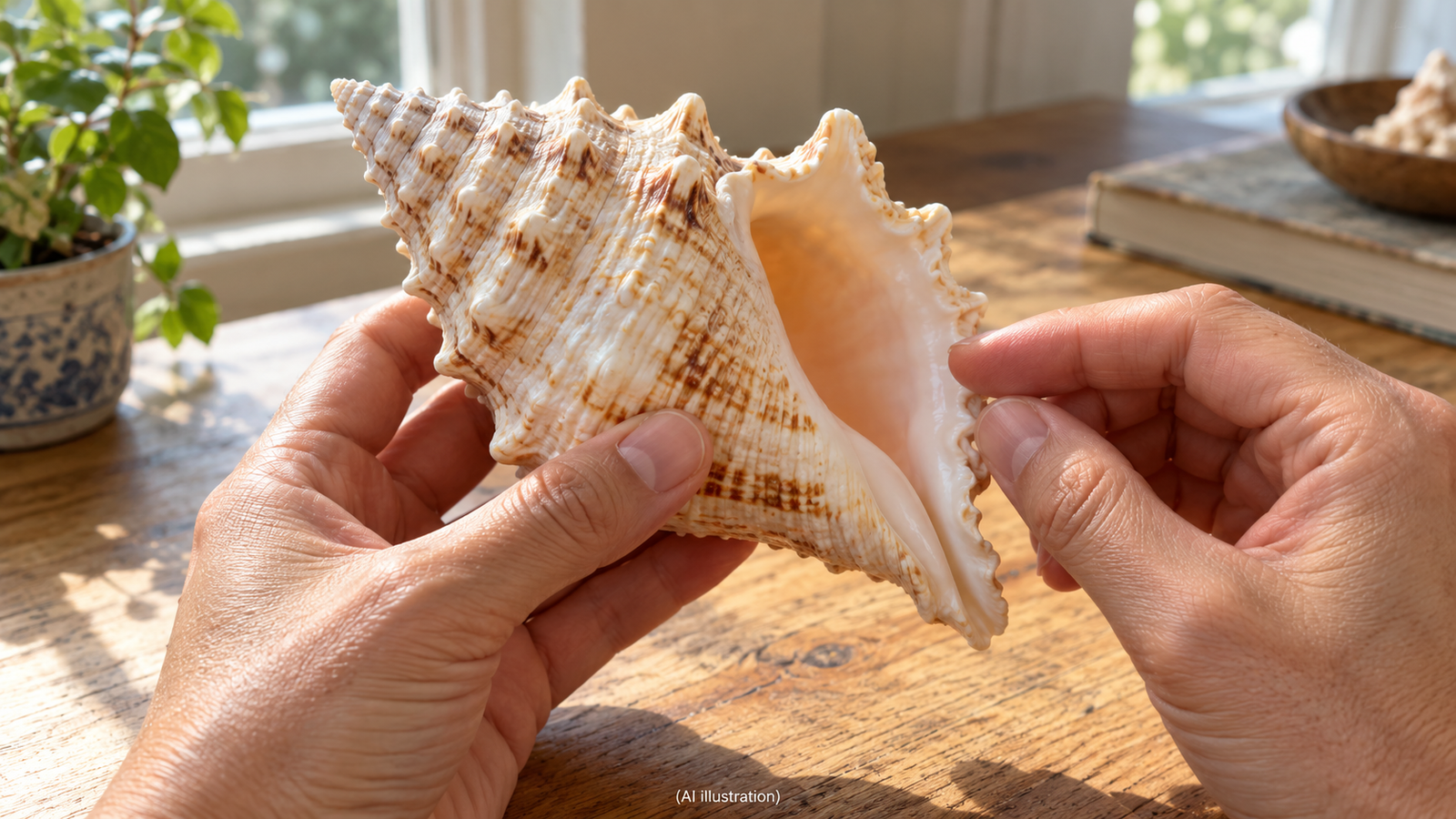
For the usual gastropod viewing convention, hold the pointed apex upwards and face the aperture, the shell opening, towards you. If the opening is on the observer’s right, the shell is described as dextral in this view. If it is on the observer’s left, it is described as sinistral.
The Bishop Museum field guide and published research explain this convention. A view from above, a photograph of the back or a tilted specimen can make casual comparisons confusing. Keep the position consistent before recording which side the aperture occupies. State that you mean the observer’s side.
Do not rely on text or a hand in the picture to establish orientation conclusively. Editing and selfie modes can reverse an image. Ask for original photographs and a continuous video that rotates the shell and returns to the agreed viewing position. Video helps connect views but is not an authenticity certificate.
Why religious names and scientific handedness get confused
Retail descriptions such as right turning, Dakshinavarti and left opening are not always written from the same viewpoint. Do not automatically translate a religious or trading name into dextral or sinistral. Ask the seller to demonstrate the opening with the apex up and the aperture facing the viewer.
The Chennai Government Museum describes rare, venerated sinistral sacred chanks with the aperture on the observer’s left. That limited statement does not identify every left-opening marine shell as a rare sacred chank. Species identification and shell direction remain separate questions.
FACT: Mirroring a photograph reverses its appearance, not the physical shell. A side visible in a listing cannot independently prove rarity or price. Respect the religious tradition while asking for a precise, testable description of the physical item being sold.
Real versus fake involves four separate questions
Ask four questions: Is this a natural marine shell or a manufactured replica? If natural, what species is it? What is its coiling direction within that species? Has it been repaired, coated, cut or otherwise altered? Answering one question does not automatically answer the other three.
Turbinella pyrum is known as the sacred chank and is the subject of CMFRI fisheries and biological research. Similar-looking shells should not all be assigned that species from a shopping photograph. Common trading names may cover different things; request the scientific name and the basis for that identification.
Colour, shine, weight, sound and an unusually smooth surface are not decisive standalone tests. A visible seam, uneven coating or worn patch can justify a question about condition. It does not justify declaring a particular adhesive, material or fraud from one picture. A pale natural shell is possible; whiteness alone is not a verdict.
Breaking, burning, scraping aggressively or applying acid is unnecessary for simply describing shell direction. Such experiments can damage the item while leaving its species unresolved. Start with a non-destructive inspection and ask an appropriate expert about the next step.
Ask for photographs of the actual available shell
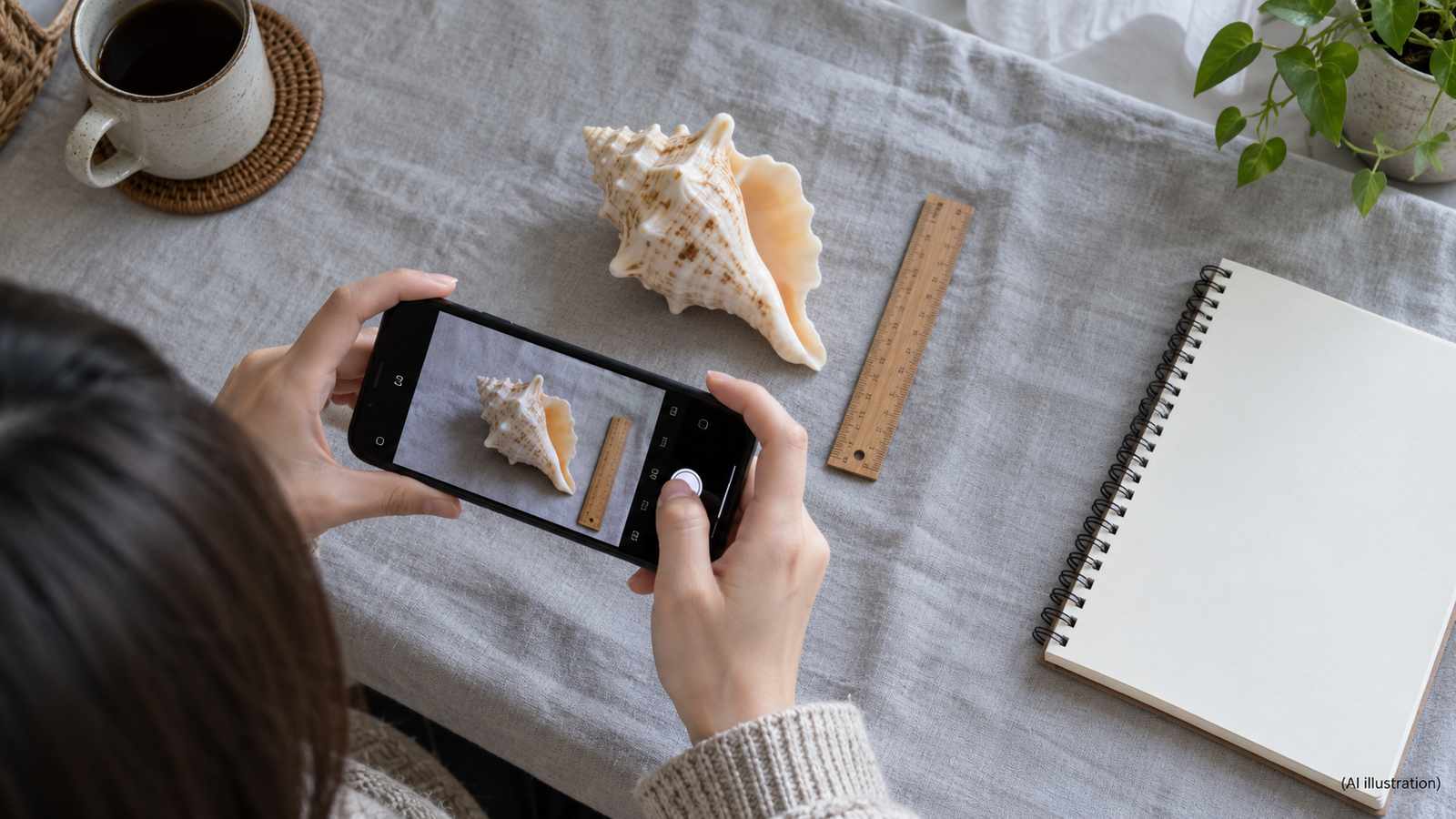
Request front, back, both sides, apex and lower-end views. Include a clear aperture close-up, the visible internal folds and the outer lip. Natural light and no beauty filter make surface details easier to compare. Place a scale beside the shell in approximately the same plane to reduce misleading measurements.
Ask for one continuous video rotating the actual piece. A handwritten current date and order reference beside it can help connect the recording to the offered item. The card is not proof of authenticity. Make sure the seller is showing the available shell rather than a generic specimen.
Compare photographs, dimensions, weight and visible marks with the delivered item. If several listings reuse the same stock picture, ask for new views of your piece. The phrase original photo does not itself establish provenance. Neither an AI illustration nor another specimen’s photograph verifies your order.
Advice before an expensive purchase
Send a written question: “Please provide the scientific name, unmirrored views of this exact piece, measurements and details of repairs or coatings. What precisely does your Dakshinavarti description claim? What return terms apply if independent inspection does not support that claim?” Keep the invoice and reply.
For a costly or supposedly rare shell, ask a suitable malacology specialist or museum whether they offer specimen identification. Not every museum provides commercial certification or valuation. Confirm the service and the limits of any written opinion before paying or sending an object.
A certificate saying natural shell does not necessarily establish species, rarity, age, geographic origin and market value. Find the issuer’s contact independently, confirm the link to this shell and ask which conclusions were actually reached. A logo cannot extend the scope of a report.
Treat religious use and the purchase decision separately. This article respects belief but does not guarantee wealth, a medical cure or supernatural effects from owning a shell. Establish identity, condition and return terms before considering the asking price.
Frequently asked questions
Does opening direction prove authenticity? No. Direction, species and material are different questions.
Can a mirrored photo turn a common shell into a rare one? No. Only the image appearance changes.
Does a white shiny shell mean a replica? Not by itself.
Is a sound or water test sufficient? Do not treat either as proof of species or rarity.
Are these real reference photos? No. All three are AI illustrations; consult institutional sources and a relevant specialist for an actual specimen.
Sources and illustration disclosure
General identification and buying information, not certification or valuation of a particular shell. Sources support the stated viewing convention and limited biological facts; no seller is endorsed. Checked on 24 October 2026.
- Bishop Museum: shell orientation and terminology
- Research: shell chirality and the standard aperture view
- Chennai Government Museum: rare sinistral sacred chank
- ICAR-CMFRI: sacred chank Turbinella pyrum
- WoRMS: Turbinella pyrum taxonomy
Rudraksha identification and the limits of household tests