School not giving TC because of pending fees: what to do
Admission at the new school is approaching, but the previous school says it will release the transfer certificate only after full payment. Start a written request, seek a separate fee statement and complain with evidence to the competent education authority. Explain the immediate educational harm. Verbal arguments and a promised seven-day solution are not a reliable plan.
The direct answer is that fee recovery and release of a child’s TC are distinct issues. Several High Court decisions have granted relief against withholding while preserving lawful recovery of dues. Age, class, state, recognition and board rules matter. Obtaining the certificate does not automatically cancel the outstanding fee liability.
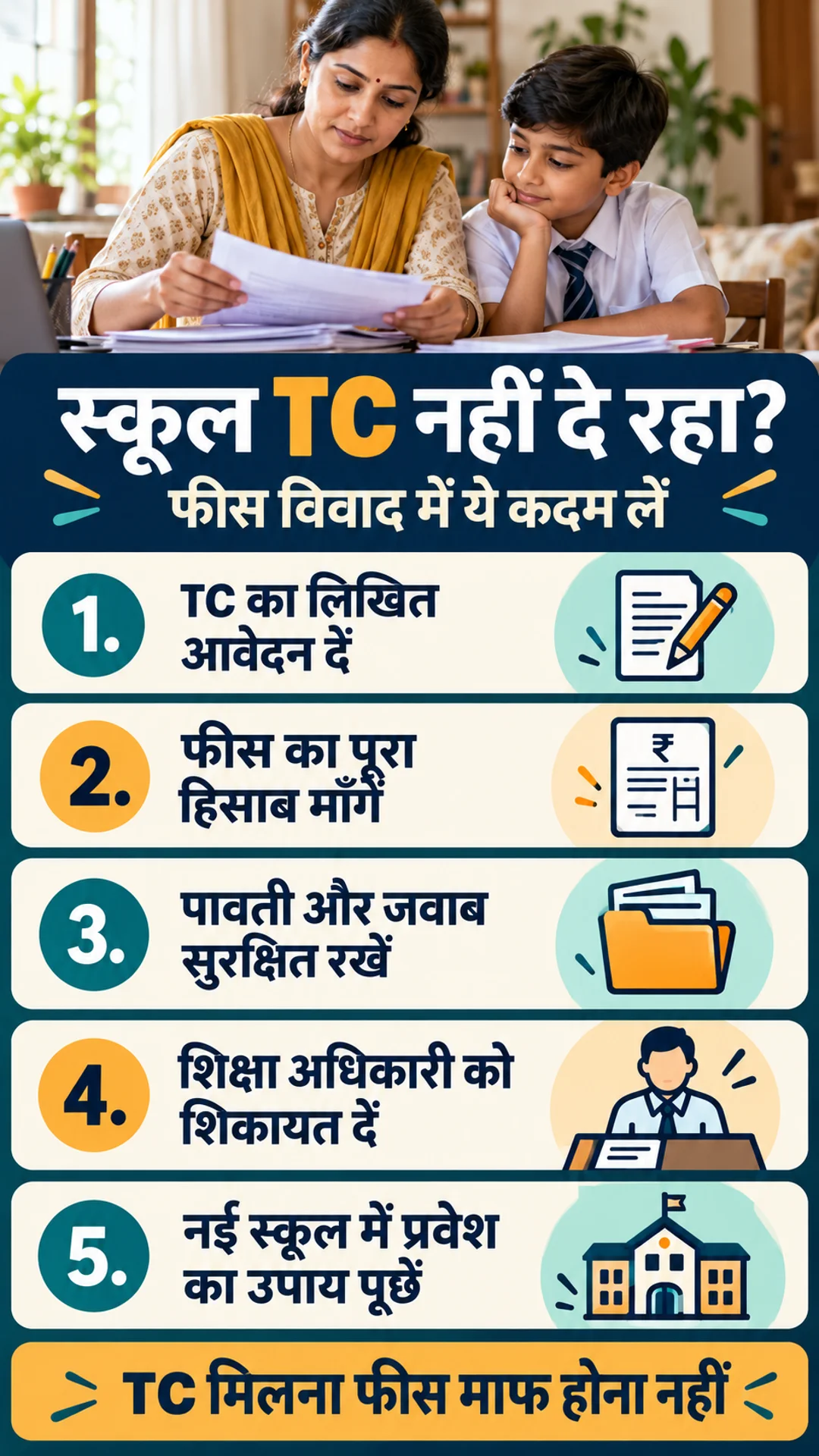
- Apply to the principal in writing with the admission deadline.
- Request a month-wise and head-wise fee ledger.
- Keep receiving, emails and the school’s reply.
- Seek urgent educational intervention from the competent district/state authority.
- Ask the new school about lawful provisional or non-delayed admission.
RTE section 5(3): the rule and its limits
The TC provision is in section 5(3), Right of Children to Free and Compulsory Education Act, 2009. It requires immediate issue in the covered transfer context and says delay in producing TC should not delay or deny admission in the receiving school. Applicable service rules can provide disciplinary action against the head-teacher/in-charge for delayed issue. Citing only section 5(2) misses the relevant subsection.
The general RTE framework concerns children aged six to fourteen and elementary education, classes 1–8, with certain special statutory situations. Do not present it as identical automatic protection through class 12 regardless of age. Section 5 also excludes specified destination-school categories from its transfer entitlement; it does not guarantee admission to every chosen unaided private or specified-category institution.
School category, recognition, minority-institution status and applicable judicial decisions can affect the legal position. For classes 9–12 or situations outside direct RTE coverage, examine state education law, board rules and relevant judgments. The child’s welfare matters, but identifying the right provision and forum remains necessary. RTE does not automatically waive every private-school fee.
What High Courts have said about TC and fee recovery
In Amit K. Togi (Minor) v. Director of Education (CBSE), 17 September 2025, 2025:KER:69076, the Kerala High Court directed issue of the TC despite the school’s dues and bye-law argument. It preserved the school’s right to recover lawful dues separately. The relief was therefore not a cancellation of every payment obligation.
The Madras High Court’s W.A. No.3075/2021 decision of 19 July 2024 addressed Tamil Nadu admission and stigmatising fee entries on TCs. It treated fee recovery as a separate lawful process and directed action concerning admission barriers and unnecessary entries. Use it as a relevant judicial authority, not as an identical circular for every class and board throughout India.
FACT: Check the law and binding authorities in your jurisdiction first. A decision from another state may be useful, but its facts and subsequent orders need review. TC relief can leave the payment dispute unresolved. “You never need to pay anything” is not a sound conclusion from a certificate-release judgment.
The fee ledger, withdrawal date and CBSE guidance
Separate tuition, transport, hostel, annual charges, late fees and payments already credited. Preserve the date on which withdrawal/transfer was communicated. Stopping attendance and formally notifying withdrawal are not necessarily the same event. Request the records instead of relying on an uncertain oral arrangement.
CBSE’s published refund-of-fee information, clause 7.4, says that unless otherwise provided by the appropriate government, dues should be collected up to the month of discontinuance/migration, rather than the later month in which TC is requested, for all fee heads. Examine the actual dates, state provisions and facts before concluding the final treatment of an annual charge or refund.
Dispute an incorrect amount by month and fee head. Where appropriate, discuss a realistic arrangement for undisputed dues without misdescribing disputed charges as admitted. Obtain a receipt and written settlement for payments. Simply writing “under protest” does not automatically create a refund or suspend an obligation.
CBSE has withdrawn countersignature for transfers between two CBSE-affiliated schools and reiterated it in its 2025 reminder. Ask for the applicable basis if unnecessary countersigning is demanded in that situation. Transfers from another board, state requirements or special admission conditions need separate review. A school TC and board migration certificate are different documents.
Admission at the new school and the education complaint
Give the receiving school available report cards, age/identity evidence, class records and acknowledgment of the TC request. In a covered RTE situation, refer to section 5(3) when TC delay is used to block admission. Outside direct coverage, ask the competent authority about available provisional admission or record verification. Seat availability, class eligibility and board requirements are separate questions.
The correct office may be DEO, DIOS, BEO or a directorate depending on the state and school category. Use recognition/affiliation information and official district/state directories to identify it. Describe the school, student, request date, refusal, fee dispute and impending deadline. Ask for urgent intervention rather than sending an unfocused allegation to many unrelated offices.
Request directions for TC/record release, a school response and a lawful arrangement to continue education. There is no nationwide rule that every DEO issues a “council TC” personally after seven days. PEN/UDISE updates can help in particular situations, but are not automatically an official TC substitute across all boards.
For an RTE-rights grievance, section 32 provides a written complaint to the local authority with jurisdiction. It specifies a decision within three months after hearing the parties. This does not require waiting three months before seeking urgent intervention. Appeal lies to SCPCR or the prescribed authority; identify the competent local body under state rules.
Adaptable letters to the principal and education authority
These are general samples, not universal prescribed forms. Use truthful facts and the applicable provision. Obtain receiving on a second copy or keep official email/portal acknowledgment. Avoid publishing the child’s DOB, student identifiers or documents publicly.
1. School request for TC and fee statement
To: Principal, [school/address]
Subject: TC and records for [student/class/admission number]
We notified withdrawal/transfer on [date]. Admission at [new school] has a deadline of [date]. Please issue the TC and relevant academic records promptly.
If there is a fee dispute, provide a month-wise/head-wise ledger, credited payments and the applicable basis for the demand. Our dispute is [specific facts] / payment difficulty is [brief truthful facts].
Please protect continuity of education and address certificate release and lawful fee recovery separately. [Where applicable, refer to RTE section 5(3); otherwise identify the correct state/board/judgment basis.]
Please state any obstacle or required document in writing. A reply by [reasonable date] is requested because of the admission deadline.
Name/contact/date/signature
Attachments: previous request, receipts and admission communication.
2. Urgent complaint to the competent authority
To: [competent DEO/DIOS/BEO/Local Authority], [district]
Subject: TC withholding affecting admission — urgent intervention
Student [name/age/class] studied at [school, recognition/affiliation]. TC was requested on [date], acknowledgment [ ]. The school’s response/demand is [accurate facts].
The admission/examination deadline is [date]. The fee dispute is [brief details]. Supporting records are attached.
Please obtain the school’s reply and issue appropriate urgent directions under applicable state/board rules and RTE provisions where relevant, for records/TC release and a lawful admission arrangement. Fee recovery can be addressed separately under law.
Please provide a complaint number, competent officer and written action/status.
Name/address/safe contact/date
Attachments: request/receipt, refusal, ledger/payments, report card and deadline evidence.
Your requested response date is not a universal statutory seven-day deadline. Review any written order and available next remedy. After a phone discussion, send a short factual follow-up so the conversation is not the only record of your request.
If unresolved: child-rights mechanisms and judicial relief
For a minor’s affected rights, approach SCPCR or the appropriate child-rights mechanism. NCPCR’s official e-BaalNidan is a complaint channel; give accurate details of earlier complaints and check coverage. Track the complaint reference. The portal does not automatically generate a replacement TC for download.
If admission or board registration is imminent, clearly identify the deadline and seek urgent/interim directions. Show the documents to a lawyer to determine whether administrative action is enough or judicial relief is needed. The proper court, maintainability and school/authority respondents must be examined. Filing alone does not guarantee a stay or admission.
If there are separate facts of violence, threats or harassment of the child, record and address them through appropriate safety and complaint channels. Do not label every billing dispute kidnapping or confinement without facts. Keep fee discussions between adults and avoid placing the child under public pressure.
Advice, related reading and five FAQs
Advice
Keep withdrawal notice, TC application, receipts and admission deadline in one file. Treat continuity of education and the family’s fee dispute separately. Do not fill an online blank and pass it off as a school-issued certificate. The real document must come through the school or competent authority’s lawful process.
View the blank TC format sample — The sample is not an official school TC or a substitute for admission law; the legal limits above and the lawful school process apply.
Are all outstanding fees waived?
No. Certificate relief and lawful fee recovery are separate.
Does RTE automatically cover every class-12 student?
Its general framework concerns ages six–fourteen and elementary education. Examine applicable state/board law for other situations.
Will the DEO create a TC after seven days?
There is no such universal rule. Seek written intervention under the applicable process.
Can no new school admit without TC?
A covered RTE admission should not be blocked by TC delay. In other situations, check provisional procedures, class and board requirements.
Is TC the same as a migration certificate?
No. The purposes and issuing authorities differ.
- RTE Act: sections 5, 17, 31 and 32 — statute text
- Kerala High Court: Amit K. Togi, 17 September 2025
- Madras High Court: W.A.3075/2021, 19 July 2024
- CBSE: published fee guidance, clause 7.4
- CBSE: 2025 reminder on TC countersigning
- NCPCR: e-BaalNidan
Disclaimer: General legal information for India. Age, class, state, school category and applicable orders affect procedure. Fact-checked: 13 October 2026.