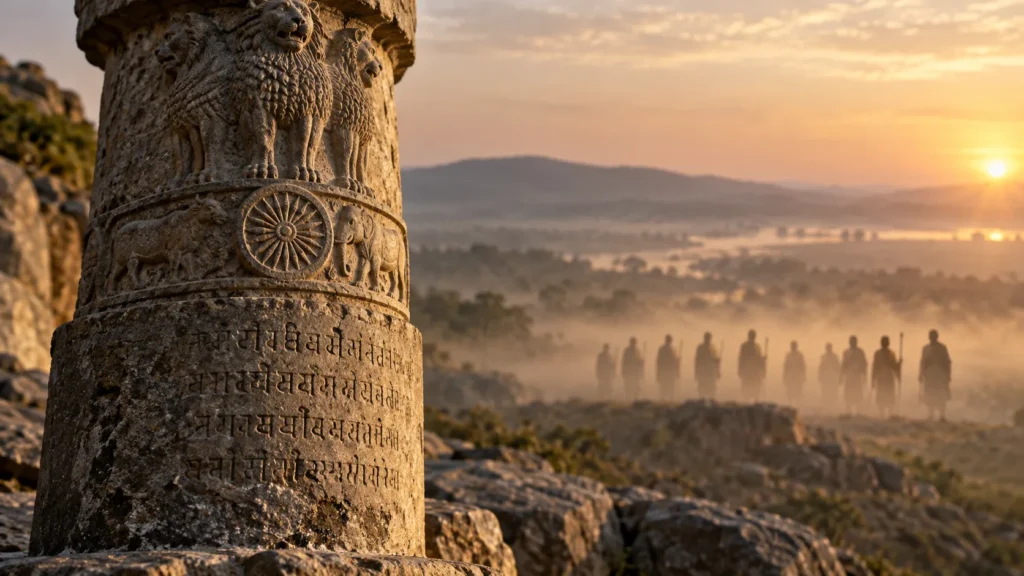
Nine nameless men, chosen after Kalinga, still guard books on propaganda, the death touch, alchemy, gravity and the rise and fall of empires. The story is tidy enough to be called “India’s Illuminati.” The audit is simpler: does any Ashokan stone mention them?
Ashoka is historical. His remorse after Kalinga is carved on rock. A two-thousand-year secret college of nine, holding weaponised science and quietly steering the world, is not in those inscriptions. That package is modern literature—named in a 1923 adventure novel and recast as hidden fact by a 1960 French bestseller.
What the legend claims
In the popular version, the Kalinga war breaks Ashoka. He decides some knowledge is too dangerous for ordinary rulers. Nine brilliant subjects are summoned. Their names stay unpublished. Each keeps one book and trains a successor. The cell never dies. Later tellings add a medieval pope who studied with them, temple gold from a “secret source,” judo and vimanas as leaks, even modern Indian scientists as members. Those last names are internet habit, not an archive file.
The legend works because it borrows a real emperor, then offers a flattering secret: India already had the dangerous sciences, and only a hidden board kept them from wrecking the world. Feeling is not evidence.
What the stones actually record
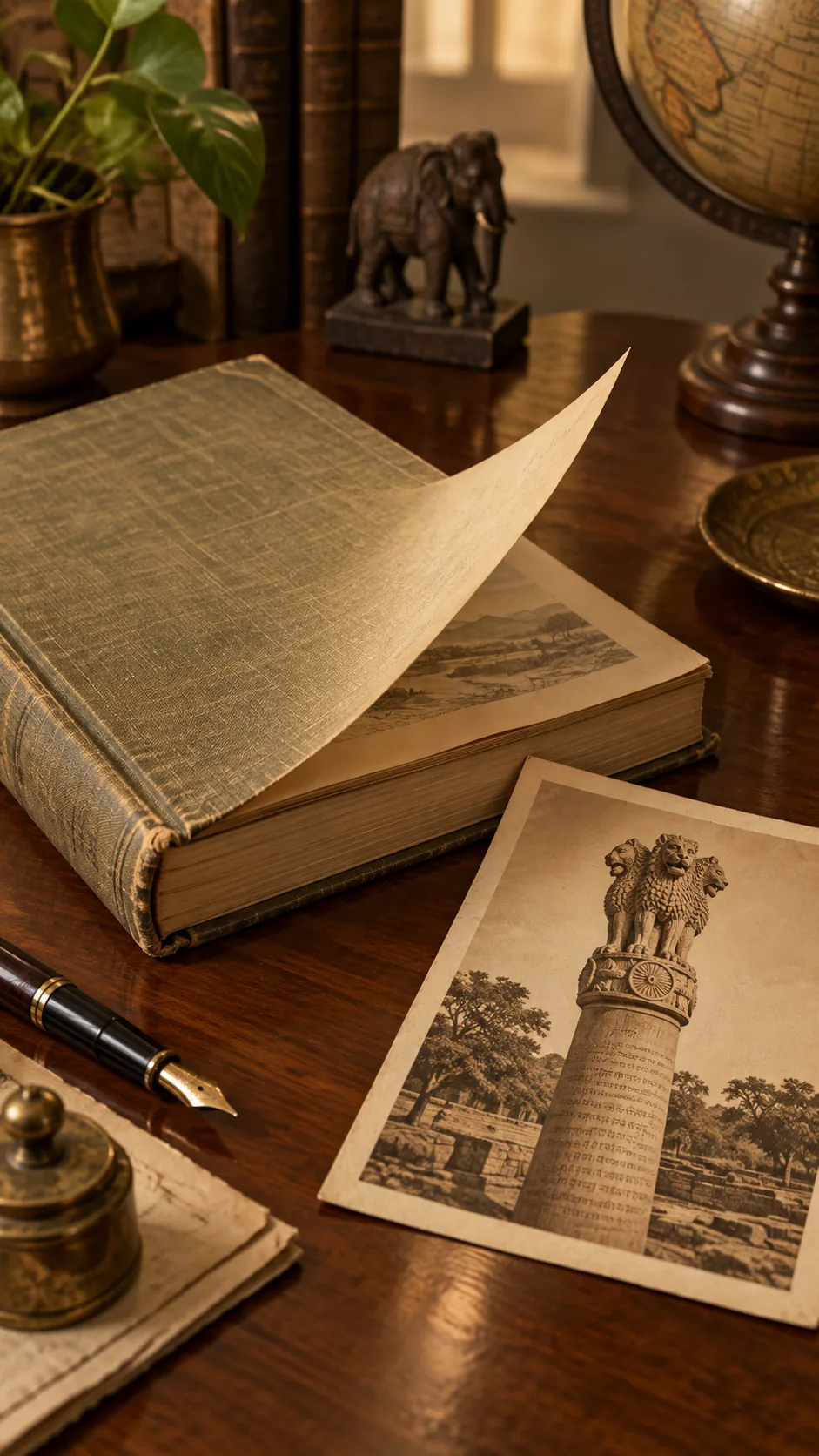
Ashoka, third Mauryan emperor, is usually dated about 268–232 BCE. His voice survives on rocks and pillars in Prakrit (Brahmi and Kharoshthi), with Greek and Aramaic at the edges of the empire. James Prinsep deciphered the “Devanampiya Piyadasi” inscriptions in 1837. A minor edict found at Maski in Karnataka in 1915 names him: Devanampiya Asoka. The king is not a rumour recovered from folklore. He signed the rock.
Major Rock Edict XIII is the key text for Kalinga. It speaks of the dead, the deported and those who died later, and of dhamma-conquest as the only conquest worth claiming. Other edicts restrict slaughter, praise tolerance among sects, and advertise wells, roads and care for people and animals. Buddhist tradition adds a Third Council and missions. The political style is publicity, not a sealed vault.
None of the surviving edicts mention nine anonymous guardians, nine forbidden manuals, or a ban on science. The silence matters because this is the same corpus that is willing to confess a war. A secret society that lasted twenty-three centuries should have cast some shadow on those stones, on coins, or on later travellers. It does not.
1923: Talbot Mundy’s novel
The modern name arrives as fiction. Talbot Mundy (born William Lancaster Gribbon, 1879–1940) had lived in India and later absorbed Theosophical ideas about hidden masters. The Nine Unknown ran in Adventure magazine from 20 March to 16 April 1923, then as a book in 1923–24. It belongs to his Jimgrim/Ramsden cycle: missing gold, rival cults, “ancient wisdom” rewritten as pulp science.
In the novel the Nine are benevolent keepers. A rival Shakta/Kali group impersonates them. Father Cyprian wants the books destroyed. There are openly supernatural turns, including a miraculous cleansing of the Ganges. In Caves of Terror (1924) Mundy lets a similar nine tilt toward menace. An author who can flip the moral sign of the same device inside a year is writing plot, not copying a Mauryan minute-book.
Mundy was not an epigrapher. Theosophy already supplied clandestine adepts. The novel simply parked that furniture in Ashoka’s reign. The emperor’s remorse is historical. The nine chairs are a story engine.
1960: fiction sold as secret history
Louis Pauwels and Jacques Bergier’s Le Matin des Magiciens (1960), in English The Morning of the Magicians, treated the Nine as real, founded by Ashoka around 270 BCE. They added Louis Jacolliot as a witness and Pope Sylvester II as a pupil. The book also mixed UFOs, alchemy and occult-Nazi lore; the authors said they wanted to provoke curiosity more than to close a case.
Jacolliot, a nineteenth-century French judge-writer on India, did write occult reconstructions, some later judged fabricated or mishandled. Jason Colavito’s source-check is blunt: Occult Science in India (1879) does not contain the Nine Unknown as a society. The nearest line is about nine Brahmins and their wives guarding a fire, attributed to a text Jacolliot himself put into circulation. The French phrase Neuf Inconnus tracks Mundy via Pauwels and Bergier, not a Mauryan Prakrit title.
Sylvester II (Gerbert of Aurillac) belongs to European stories about Arabic learning and a bronze talking head—not to a documented journey to an Indian cell. After 1960, English web articles often replay the same chapter in the same order: Kalinga, nine books, Jacolliot, the pope, a shrug. Repetition is not provenance.
FACT: Ashoka’s edicts do not list nine secret men or nine banned sciences. The public English name “Nine Unknown” comes from Talbot Mundy’s 1923 serial; The Morning of the Magicians (1960) recast the novel as ancient fact.
The nine-book list is a modern syllabus
The catalogue now circulating usually runs: propaganda; physiology and a “death touch”; microbiology; alchemy; communication (sometimes with non-human intelligences); gravity and vimanas; cosmogony; light as a weapon; sociology and the life-cycle of empires. Later sites call judo a leak from book two and the Vaimanika Shastra a fragment of book six.
That is not a Mauryan shelf-list. It is a twentieth-century worry-list—mass persuasion, microbes, transmutation, gravity, public opinion—filed under Ashoka. Judo has its own Japanese history. The Vaimanika Shastra surfaced in the early twentieth century and is not treated by aviation historians as an ancient flight manual. Drought gold, cholera serums and alien radio are ornaments on the same tree.
Names that get glued on — and do not stick
“The absence of evidence is the point” is not a method. It immunises every invented order. An organisation that minted gold in famines, tutored a pope and steered plagues should have left a fingerprint somewhere other than a pulp serial. Blogs that conscript Megasthenes, Xuanzang or Al-Biruni rarely quote a line. Claims that Jagadish Chandra Bose or Vikram Sarabhai sat in the nine seats are the same habit: famous names as props.
Later novels and shows are honest when they stay labelled as fiction: Clive Cussler’s Shadow Tyrants, Christopher C. Doyle’s The Mahabharata Secret, Shobha Nihalani’s Nine trilogy, Sapan Saxena, Anshul Dupare’s Ashok and the Nine Unknown, SonyLIV’s JL50. Anton LaVey listed the Nine in the 1969 Satanic Bible dedication. Writers on the series Heroes cited the tale as one influence on the number nine. Influence on pop culture is real. It is not an edict.
Why the story survives
Ashoka is rare enough without a shadow cabinet. A king who publishes remorse and calls dhamma a higher victory will attract extra myth. H. G. Wells’s line in The Outline of History—that among crowded royal names Ashoka shines almost alone—gets quoted into the legend as if praise were a footnote for the nine. It is praise for the public king.
India’s real knowledge traditions do not need a secret board. Mathematics, metallurgy, medicine and grammar survive in texts and practice. The Nine Unknown flatten that work into super-science behind a curtain. The curtain is entertaining. It also hides the stones that actually exist. The useful split is dull and clean: Ashoka on the rock; Mundy in 1923; Pauwels and Bergier in 1960; the reel after that.
FAQ
Did Ashoka found the Nine Unknown Men?
No contemporary inscription or excavation supports that society. His Kalinga remorse and dhamma policy are documented. The nine keepers are not.
Where did the story start?
As a public modern tale, in Talbot Mundy’s 1923 novel The Nine Unknown. Pauwels and Bergier’s 1960 book presented it as suppressed history. Most web versions copy that chapter.
Did Louis Jacolliot record the order first?
That is Pauwels and Bergier’s claim. The Jacolliot book usually cited does not describe this society. A line about nine Brahmins guarding a fire is a different, disputed passage.
Are the nine books ancient science?
They are a later popular syllabus, not a Mauryan catalogue. Vimanas, death-touch and alien communication thickened in twentieth-century retellings.
Do novels or a web series count as proof?
No. JL50 and later thrillers spread the motif. They do not replace the edicts.
Disclaimer: This piece separates Ashoka’s inscribed record from a modern legend. It is not a guide to find, join or petition any secret order, and it does not treat novels, web series or conspiracy videos as evidence. Do not attach invented membership lists to real scientists or to the historical emperor.