The thumbnail is always an iceberg. Google sits in the sunlight. “Level 5: Marianas Web” sits in the trench. A caption promises that the Hidden Wiki is the elevator. The question is simple: does the dark web have floors? The technical answer is no. The chart that taught a generation to count levels is a viral infographic from around 2011. The Hidden Wiki was never a magic key. It was a link directory whose name outlived any single site, then became a brand for clones and scams.
This article does not list addresses or tell anyone how to “go in.” It explains where the storey-building story came from, what the Hidden Wiki actually was in the public record, and why “go deeper” is now a sales pitch more often than a description of how networks work.
The clear answer: the dark web is not a building
People look for levels because a staircase is easy to remember — surface, deep, darker, forbidden basement. Movies and iceberg memes taught that shape. Networks do not use it.
Pages a search engine can index are the surface web. Email inboxes, logged-in bank pages, company portals, and anything behind a paywall are the deep web: unindexed, not automatically sinister. The dark web is a smaller slice of that unindexed space — sites that hide on overlay networks and unusual addresses on purpose. Three categories. Not five floors.
Calling Tor, I2P, or Freenet “lower storeys” is a bad map. They are separate overlay networks, not stacked slabs. There is no official gate that drops a visitor from one service into a deeper official layer. A page that says Level 4 unlocks Level 5 is selling a story, not a protocol.
So “what is the last level of the dark web?” is the wrong question. Better ones: which network is this on, who hosts it, and why trust the link? The last answer is usually: do not.
What the viral iceberg actually sold
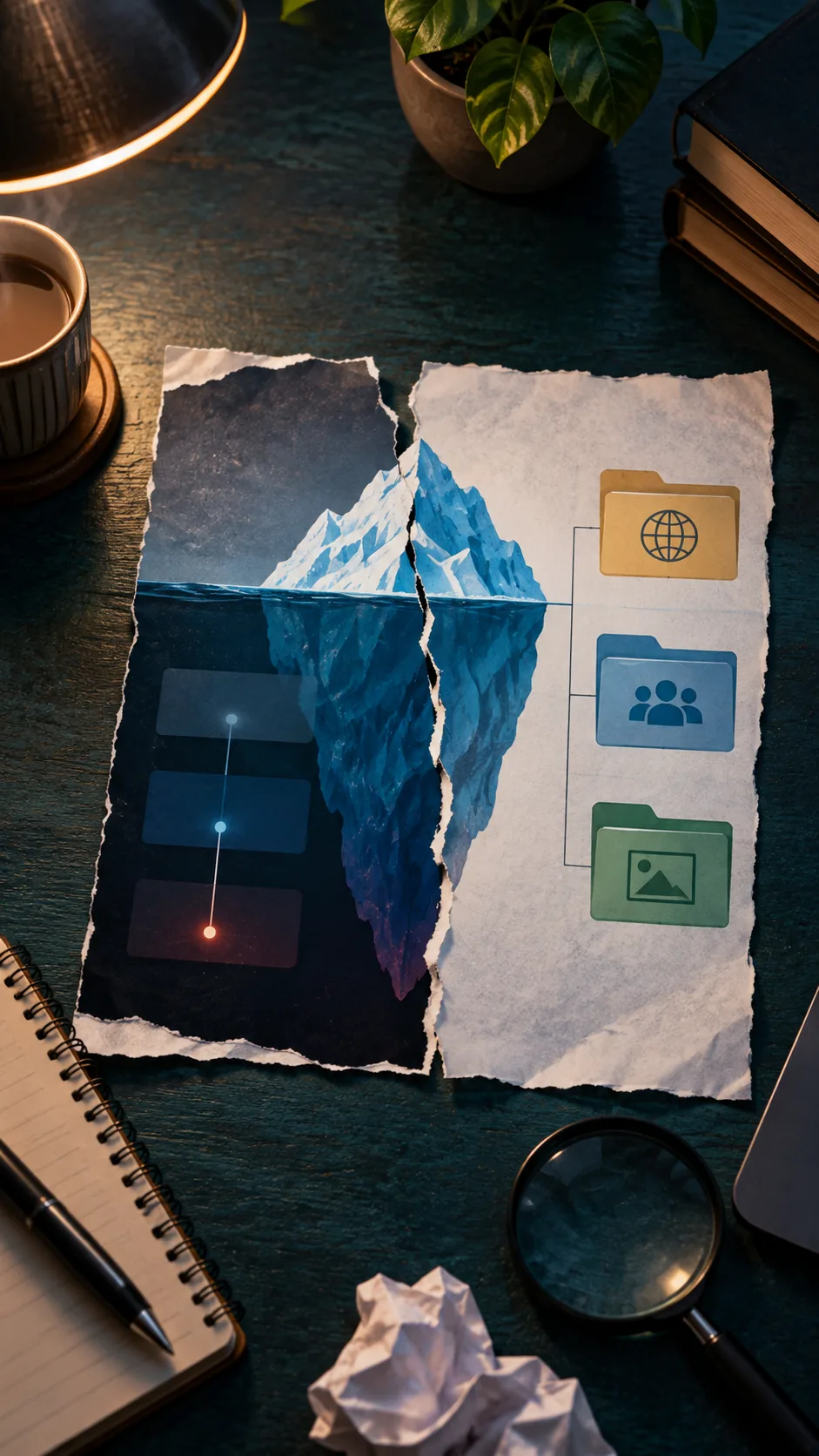
Around 2011 an Imgur infographic divided the internet into ocean or iceberg layers. The “common web” sat on top. Invented names followed. The dark web sat lower. At the bottom sat Marianas Web, named after the Mariana Trench. The graphic looked like research. The layers were arbitrary.
Later versions added floors — Charter Web, Mediator Layer, The Fog, Virus Soup, the Primarch System — plus a phrase that sounded scientific: Polymeric Falcighol Derivation. Search the phrase and the meme returns. No paper, no protocol, no lab. Engadget and a long Skeptics Stack Exchange thread filed it as urban legend. Scholar Robert W. Gehl, writing on the meme, treated the original graphic as a troll: bait to see who would bite.
After the joke spread, someone even stood up a novelty hidden service under the same name, stuffed with cat facts and a promise that reading them unlocked “deeper” pages. The name went viral first. A site chased the name. Most “Level 5–8” slideshows are that old picture with a new thumbnail.
FACT
The best-known source for “Marianas Web” is not a secret server. It is an Imgur infographic from about 2011. Extra levels were bolted on around 2014. “Falcighol” is meme jargon, not a documented algorithm. A well-known Hidden Wiki address was hacked in March 2014 and redirected to Doxbin. During November 2014’s Operation Onymous, some pages showed a law-enforcement banner. In 2021 Tor retired old v2 onion addresses, and large parts of those copied lists died overnight.
Marianas Web, the quantum lock, and the rest of the ghost story
The myth then grows teeth: Atlantis, a Vatican archive, a god-tier AI, or data that only a quantum computer can open. It survives because the story is circular. Evidence, it says, lives on the floor you cannot reach. A thing defined as invisible is hard to disprove and impossible to prove.
Public technology is a different subject. Quantum computing is real lab work. It is not a basement key for a fictional internet floor. No government white paper treats Marianas Web as a network layer. Tor’s design has no fifth storey. People who say they “went there” usually offer uncheckable screenshots or a clone that simply reused the name.
Red-room folklore often glues itself to the same chart: go deeper, watch a live crime. That is a separate myth, and public reporting has not produced a working “open the page and watch the show” product that matches the legend. A scary category list is not a police case file. A film poster is not a manual.
What the Hidden Wiki was — and why “official” died
Many readers treat the Hidden Wiki as a gateway: one page, whole hidden world. In practice it was a MediaWiki-style directory — categories, titles, lists of other hidden addresses. Not a search engine. An open-edit model, which filled the list fast and polluted it fast.
Public sources place the earliest mentions around 2007. During 2011–13, when Silk Road was in the news, the directory became a default “first map.” There was no magic key — only a pile of links. At one point before August 2013 it sat on infrastructure tied to Freedom Hosting, which law enforcement later dismantled. When hosting dies, directories shake.
In March 2014 a prominent address was hacked and traffic was sent toward Doxbin, a dump site for personal data. That November, Operation Onymous was announced against hundreds of onion addresses; researchers later noted that many were clones, so the count of unique sites was smaller. The political meaning was still clear: the claim of one true Hidden Wiki did not survive. The name remained. The centre did not.
The clone factory: same title, different job
After 2014, dozens of pages reused the title. Some copied old lists. Some stamped a year on the masthead so the page looked fresh. In 2021 Tor retired short v2 addresses. Huge stretches of copy-paste lists went dead. What remained was a mix of corpses, phishing clones, and pages whose product was not goods but the list itself — plus a request for crypto or a login.
That is where the level myth and the wiki myth feed each other. The chart says go deeper. The clone says this is the official gate. The visitor clicks. The scammer does not need a basement or inventory. Trust is the inventory. Public 2026 reporting on Germany and Europol’s Operation Alice described a huge farm of fraudulent dark-web pages built to take payment and identity, not to deliver what the listing promised. Those figures belong to a case file, not a viral survey — and they still show what a “directory” often is now: a trap with a familiar name.
Any page that calls itself the official Hidden Wiki is making a claim that cannot be notarised after 2014. This article will not publish addresses. A page that demands an address or a payment to “verify” you is worse.
Why the staircase sells — and how the hook closes
Curiosity is not a crime. Hidden things feel like a plot. A half-true schoolyard line — “Google only sees a sliver” — is then dressed as an eight-floor monster. The deep web really is large, because logins and private databases are not meant for public search. Turning that fact into a dungeon is a different trade.
Thumbnails do the easy work: count layers, darken the words, end on “nobody came back.” Some viewers then search for a wiki link and land on a clone. Nothing loads, or a page asks for money, a wallet, or a download. A crime door and a fraud door can look the same. Fraud does not need a real floor.
The same loop runs on Indian forwards and “I unlocked Level 5” reels, followed by a stranger who offers to teach. The lesson for sale is usually fear plus trust, not a network map. The law is not subtle: hunting or buying illegal goods and services is already on criminal ground. An explainer is the right tool for curiosity. A list is not.
FAQ
Are there five or eight levels of the dark web?
No. The viral layers are not protocol floors. Surface, deep, and dark are categories. Marianas Web and the later names come from 2011–14 memes.
What was the Hidden Wiki?
A wiki-style directory of hidden-site links, with public mentions from around 2007. After the 2014 hack and redirect, no single official centre remained. Most pages using the name now are clones.
Does the Hidden Wiki take you “deeper”?
No. A directory is a list, not an elevator. “Next level” pages are stories. Many clones lead to scams, phishing, or dead links.
Is Marianas Web real?
There is no public evidence. The name is a trench metaphor. Claims that quantum machines or invented algorithms unlock it are circular folklore, not a documented layer.
Is it a crime to read about this?
Reading a public explainer is not the same as seeking or buying illegal goods or services. This article is not a visit guide.
Disclaimer
This page is not a guide to visiting the dark web, opening any Hidden Wiki, finding markets, or using hidden addresses. It publishes no onion links, setup steps, or buying methods. Red-room pages and “Level 5–8” claim pages are typically scams or fiction. Seeking illegal goods or services is a crime. Do not treat folklore as a case file.