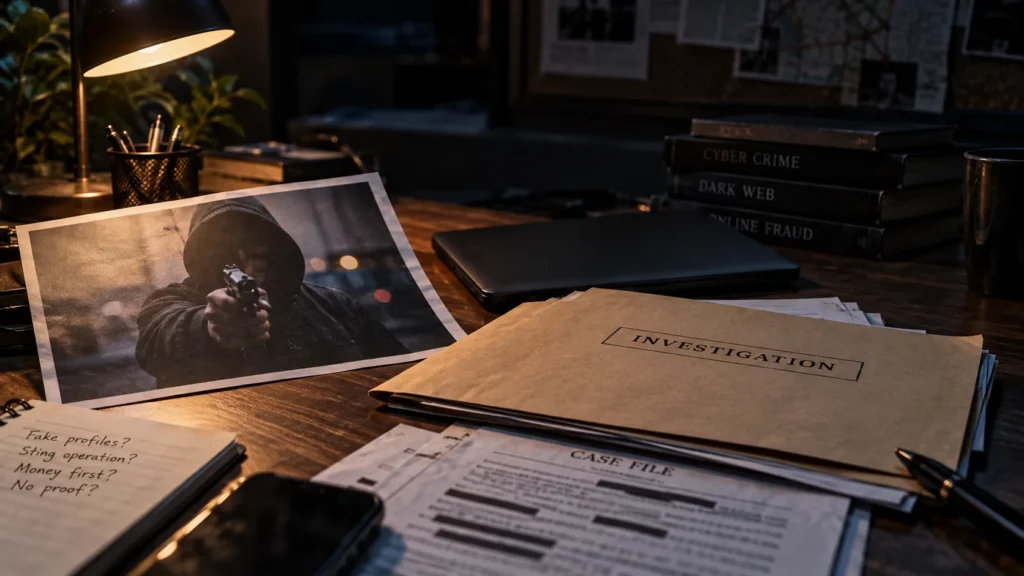
The thumbnail is always the same: a hood, a pistol, a promise that a killer is one anonymous payment away. The question underneath is simpler. Are those pages real contractors, police traps, or a bitcoin rake aimed at people who cannot complain to a bank?
Public reporting and court files point the same way. Storefronts that advertise murder-for-hire are, almost without exception, scams. The danger is not a cinematic assassin stepping off a network. It is the buyer — the person already angry enough to place an order. This is not a guide to visit anything. It is a map of a myth that keeps getting people arrested.
The short answer: the ad is real, the hitman is not
In 2020 the New York Times put the research consensus in one line: experts and investigators who study these pages say they are scams, and no known murder has been attributed to them. What you see is a menu, a fake escrow story, and a demand for cryptocurrency up front. What you do not see is a completed contract carried out by the site.
The business logic is ugly and obvious. A real crew does not run a public shop window. A scammer does, because the customer arrives pre-guilty. They will not call the police when the job fails. They can be stalled, upsold, and discarded. That is the product.
Law enforcement uses a different product: the undercover “hitman.” That tactic is older than hidden networks. It shows up in prison phone calls and ordinary chats. So the honest model has three layers — the scam page, the sting or informant, and the client’s own intent. Confusing those layers is how the legend survives.
What the pages actually sell
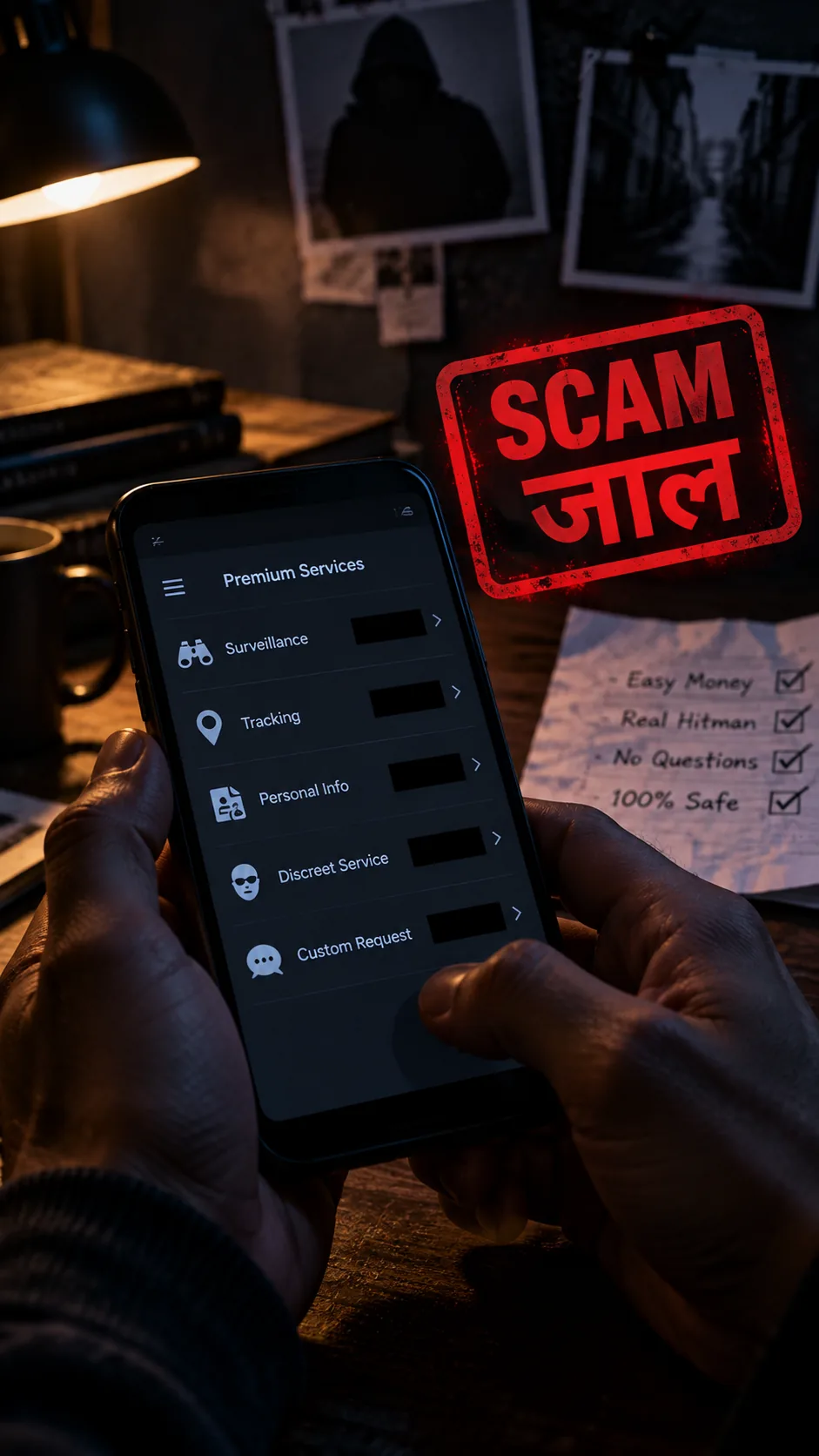
Vice, Wired, and later podcast reporting describe a template. Stock photos of armed men. Broken English. A price list that pretends professionalism. Pay first to “prove seriousness.” Then the excuses: the operative got lost, a weapon was seized, the target had unexpected security, a “premium team” needs more coin. Refund language appears. Money does not.
Chris Monteiro, the London researcher who spent years on these sites, pulled internal mail that gave the game away. An operator asked a freelancer for proof videos that would make the brand look real — without killing anyone. In another message the same voice said he was not a murderer and did not want anyone murdered. That is not a syndicate memo. That is a fraud memo.
Hold the distinction. The customers uploaded names, photos, routines. Their intent was genuine. The service was not. Journalism on this beat keeps repeating that split because it is the only way the story makes sense.
Besa Mafia and the operator called Yura
The brand that stuck in public memory is Besa Mafia. “Besa” is an Albanian word associated with a pledge. The site borrowed a mob costume and a homepage line: if you want someone killed or beaten, we are the right guys. Behind the costume sat an admin researchers call Yura, described as a Romanian-linked scammer who recycled the shop under other labels — Crime Bay, Camorra Hitman, and similar skins.
Yura sold narrative as hard as he sold fear. Edits appeared on encyclopedia-style pages claiming every hitman site was fake except his. Quora answers from invented experts pointed at the same door. There was even a mock campaign demanding police shut “the real site,” which doubled as advertising. Carl Miller later called him a gifted digital marketer, not a killer broker.
In 2016 Monteiro used a messaging flaw to read the archive. Conversations followed one script: take payment, stall, demand more. Some admin notes said the point was to drain criminals. Eileen Ormsby recorded a second pose that same year — the admin sometimes claimed the page was a honeypot that forwarded unpaid orders to police. That claim is the operator’s own. Treat it as self-serving, not a medal. Convenience let him play thief one hour and vigilante the next.
FACT: The New York Times reported in 2020 that Monteiro reviewed records on 283 people who had paid for supposed hits and had, by then, identified nine commissioning cases that led to arrests. The same article said no known murder was attributed to the sites themselves. Later reporting by Miller’s team, in 2024, described a further dump of orders and a string of arrests and convictions across multiple countries. Those figures belong to the journalists and researchers who published them — not to an invented survey.
When the fake killer never arrived
A scam page can still sit next to a real death. The heaviest public example is Stephen and Amy Allwine of Cottage Grove, Minnesota. In 2016 the FBI found a Besa Mafia user, “Dogdaygod,” who had paid thousands of dollars in bitcoin — published accounts differ on the exact figure, usually in a range from about six thousand to about twelve thousand — to have Amy killed. Agents warned the couple together.
No contractor from the site appeared. Amy was later found dead. The investigation fixed on her husband. Wired and subsequent court-facing coverage drew the line that matters: the marketplace was fake; the client was not; when the purchase failed, he carried out the killing himself. That is not evidence that a dark-web shop delivered a professional hit. It is evidence that a buyer with intent remains dangerous after the fraud.
Researchers return to this point because audiences want a monster in a hood. The documented monster is often closer. Divorce, money, humiliation, a wish that someone would “just handle it.” The page launders the wish into a checkout flow. When checkout fails, some people look for another tool. Police are already listening for that sentence.
Stings, informant scammers, honeypots
Classic stings do not need a hidden site. An officer pretends to be available, records the ask, takes a token payment, and closes the case. Forbes added a darker twist in 2021: a person running a dark-web murder-for-hire scam became an FBI tipster. In Washington state the tip described a roughly five-thousand-dollar order, an address, and a message that asked for a killing as soon as possible. The shop window said “assassin.” The operator, at least that week, said “informant.”
Department of Justice releases show the same skeleton. James Wan, in the Northern District of Georgia, placed an order and sent bitcoin in 2022 to have his girlfriend murdered. Agents warned her. He admitted the payments and cancelled. In January 2024 he was sentenced to seven years and three months. A separate public thread around Ronald Ilg, a Spokane physician, involved dark-web orders and a crypto trail for kidnap and assault-for-hire. The Times also recorded an Illinois nurse sentenced to twelve years after sending about twelve thousand dollars in bitcoin to a site styling itself as a Sicilian hitman network. In none of these files does the storefront have to complete a killing. The messages and the money are the crime.
Dutch coverage in 2025, drawing on Monteiro’s older data, named ordinary targets — a teacher, a nurse, a civil servant — and noted convictions such as Imran M. of The Hague, who had paid toward having an ex-wife killed. Police treated the plots as serious even where no attack landed. Intent plus payment was enough.
An assassination market is not a hitman shop
A second myth rides along in search results. An “assassination market,” as sketched in Jim Bell’s 1990s essay “Assassination Politics,” is a prediction pot on the date of a death — not a contractor roster. A 2013 crypto-anarchist page tried the idea with bitcoin. Wikipedia’s public summary notes that listed names were still alive years later. That is a separate, ugly thought experiment. It is not the same object as a page with a beating-and-killing menu.
Do not staple this to Silk Road either. The original Silk Road ran from 2011 until October 2013. Ross Ulbricht was arrested on 1 October 2013, convicted on seven counts on 4 February 2015, and sentenced on 29 May 2015 to life plus a forfeiture of $183,961,921. Murder-for-hire allegations were part of that era’s record; they were not carried out and were not the New York conviction’s spine. That is marketplace history. Hitman ads are a fraud-and-sting history.
Jamie Bartlett asked Miller the blunt version: did anyone actually buy a completed hit on those public pages? Miller said he never saw it there. He allowed that closed criminal forums are a different habitat. The loud shopfronts are not that habitat.
Why the story travels so well
The legend is useful to three groups. Scammers need frightened, silent customers. Some investigators need a mailbox where intent announces itself. Media needs a picture that looks like a thriller. The person who loses twice is the reader who treats a thumbnail as a field report.
Cryptocurrency does not wash the fingerprints off. Court narratives keep listing exchange records, wallet links, phone screenshots, and confessions. “No one will know” is part of the sales copy, not a finding of fact. Soliciting a killing is still a crime if the contractor was a thief or an officer. A fake shop does not mint a real defence.
The healthier frame is the same one that applies to red-room pages and fake “levels” of a hidden internet. A story can be loud and still be a trap. Curiosity belongs in court papers and long reporting. It does not belong in a checkout form.
FAQ
Can you actually hire a hitman on the dark web?
The pages that advertise that service have been documented as scams. The Times and the researchers who opened those archives found payments and intent, not a completed hit delivered by the site.
So is every listing a police sting?
Not every listing. Many are private frauds. Some operators have fed tips to police. Separate from the pages, undercover officers have posed as hitmen for decades. From the buyer’s seat, the difference is academic. The chat is evidence either way.
Did Besa Mafia kill anyone?
Reporting on the site describes delayed jobs and extracted coin, not a staff of travelling assassins. In the Allwine case the site failed; the husband was convicted of the murder that followed.
Is an assassination market the same thing?
No. That phrase refers to a prediction-style bounty on a date of death, an old cypherpunk idea. A hitman ad is a fake storefront. Mixing them flatters the myth.
Should someone open a page “just to see”?
No. This article is not a map. Those pages are built for theft, leverage, and legal exposure. Read the cases. Do not audition for them.
Disclaimer: This is not a guide to visit the dark web, find markets, or contact illegal services. Claim pages that sell hitmen or “red rooms” are, on the public record, scams or traps. Seeking a killing, paying toward one, or supplying a target’s details is a crime even when the other side is a fraudster or an undercover officer. If you are in danger, go to local police and qualified legal help — not a thumbnail.