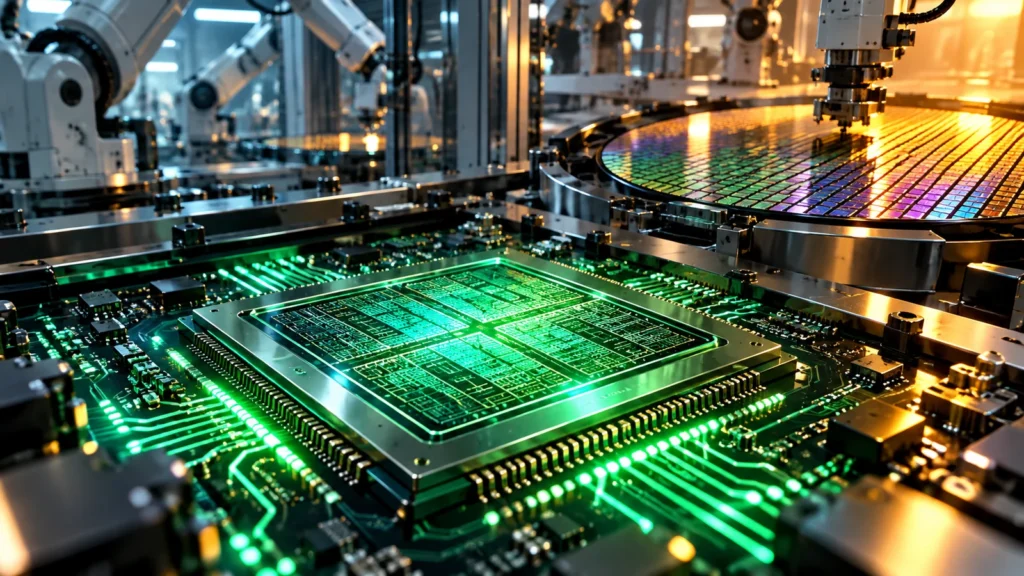
Jensen Huang’s recent comments about China are best understood as an argument about industrial capability and computing working together. Reporting on his remarks describes China as strong in manufacturing and computer science, alongside a discussion of Germany and Japan’s industrial strengths. That is more specific than an alarmist claim that Nvidia has admitted defeat in artificial intelligence.
The useful question is what happens when physical production, software and advanced computing develop as one system. This article explains that connection, separates reported remarks from our analysis, and avoids presenting a paraphrased headline as a verified verbatim quotation.
What Huang was reported to have said
October reporting described the Nvidia chief discussing advanced manufacturing in a conversation with German Chancellor Friedrich Merz. The account identified Germany, Japan and China as important manufacturing powers and highlighted China’s depth in both manufacturing and computer science. A separate report of his CNBC comments addressed how US restrictions had encouraged China’s domestic semiconductor efforts.
Those are related themes, but they should not be compressed into an invented sentence about China “catching up in both manufacturing and code.” A quotation mark promises the speaker used those words. When the evidence supports only the substance of a statement, a clear paraphrase is the more accurate choice.
Manufacturing is a system, not simply a factory building
Advanced manufacturing depends on more than the final assembly line. It involves materials, precision tools, production planning, quality control, suppliers, skilled workers and the ability to repeat a process reliably. A product demonstrated once in a laboratory is different from a product manufactured consistently at commercial scale.
Computing can support several parts of that system: design software, simulation, machine control, fault detection and planning. None of those functions means that all industrial problems disappear. Software must operate within real limits such as energy use, physical tolerances, maintenance and the reliability of the underlying equipment.
Our analysis is that the significance of Huang’s manufacturing-and-computing argument lies in this connection. A country or company with strengths in both may be able to move ideas between design and production more effectively. That is a framework for understanding competition, not a ranking proved by one interview.
Why this matters for AI beyond chatbots
Consumer conversation often treats AI as a chatbot that answers questions. Industrial uses can look very different. A manufacturer might explore visual inspection, equipment monitoring, design assistance or simulation. Each application has its own requirements, and the right answer is not always the largest language model available.
Training a model, running a model and connecting its output to a real process are also separate tasks. A convincing demonstration does not establish that a factory has safely deployed the system at scale. Data quality, testing, integration and the ability of workers to understand the output remain important.
This distinction helps explain why a discussion of manufacturing matters to a company associated with AI processors. The potential computing workload is not limited to writing text. Still, no specific deployment, revenue forecast or factory result is being claimed here without evidence.
Export controls and domestic chip development
In reporting on his CNBC remarks, Huang argued that US export restrictions had accelerated China’s push to develop its own semiconductor capabilities. This is a reported assessment by a business leader with a direct commercial interest in the sector; it should be read with that context in mind.
Export restrictions and domestic investment can affect incentives, procurement and research priorities. But a stronger incentive does not automatically establish technical parity. Semiconductor capability includes design, fabrication, packaging, memory, equipment and software, and progress in one area does not prove equal progress in every other area.
Likewise, saying that restrictions encouraged domestic efforts is not the same as proving the restrictions achieved no policy purpose. Evaluating policy outcomes would require a wider evidence base than the remarks considered in this article. We are explaining the distinction rather than declaring a policy winner.
Four distinctions that keep the debate useful
Manufacturing capacity versus leading-edge fabrication: a broad industrial base and the ability to make the most advanced chips are different claims. The first cannot be used as automatic proof of the second.
Computer science versus one benchmark: research depth, engineering talent and a particular model score measure different things. A single leaderboard does not settle the strength of an entire technology sector.
Domestic alternatives versus complete independence: a company may develop substitutes while still relying on some international inputs. Self-reliance is not always an all-or-nothing condition.
A CEO’s assessment versus an audited market result: commentary can identify an important strategic issue, but it is not a substitute for product evidence, filings and independently described performance.
What readers and businesses can take from the remarks
For a business evaluating AI, the practical lesson is to identify the actual task before choosing a supplier. Ask what data is required, where it will be processed, how outputs will be reviewed and whether the system works with the tools already in use. National competition headlines do not answer those operational questions.
Advice: treat an industry leader’s comments as a starting point for understanding a trend. If you are considering a purchase or investment, look separately at the product’s documented capabilities, contractual limits and costs. This article does not recommend buying Nvidia shares or choosing a particular AI platform.
Frequently asked questions
Did Jensen Huang say Nvidia had lost the AI race?
The reporting discussed here does not establish that claim. His remarks addressed manufacturing, computing capabilities and the effects of restrictions on domestic development.
Why were Germany, Japan and China mentioned?
The reported discussion concerned established manufacturing strengths and how those strengths connect with computing. It was not a complete ranking of every country’s technology sector.
Does strong manufacturing prove the best AI chips?
No. Industrial scale, semiconductor fabrication, model performance and deployment capability are distinct subjects. Evidence is needed for each claim.
Are the words “catching up in manufacturing and code” a verified quote?
This article does not present that wording as a verified verbatim quotation. Its headline uses a paraphrase consistent with the reported subject.
Why does this discussion matter outside chip companies?
Computing increasingly supports design, inspection and industrial workflows. The connection is relevant to businesses adopting technology, although outcomes depend on the application.
Conclusion: the important argument is about the relationship between making things and computing well. Understanding that relationship is more useful than turning a nuanced industry discussion into a declaration that one country has definitively won.