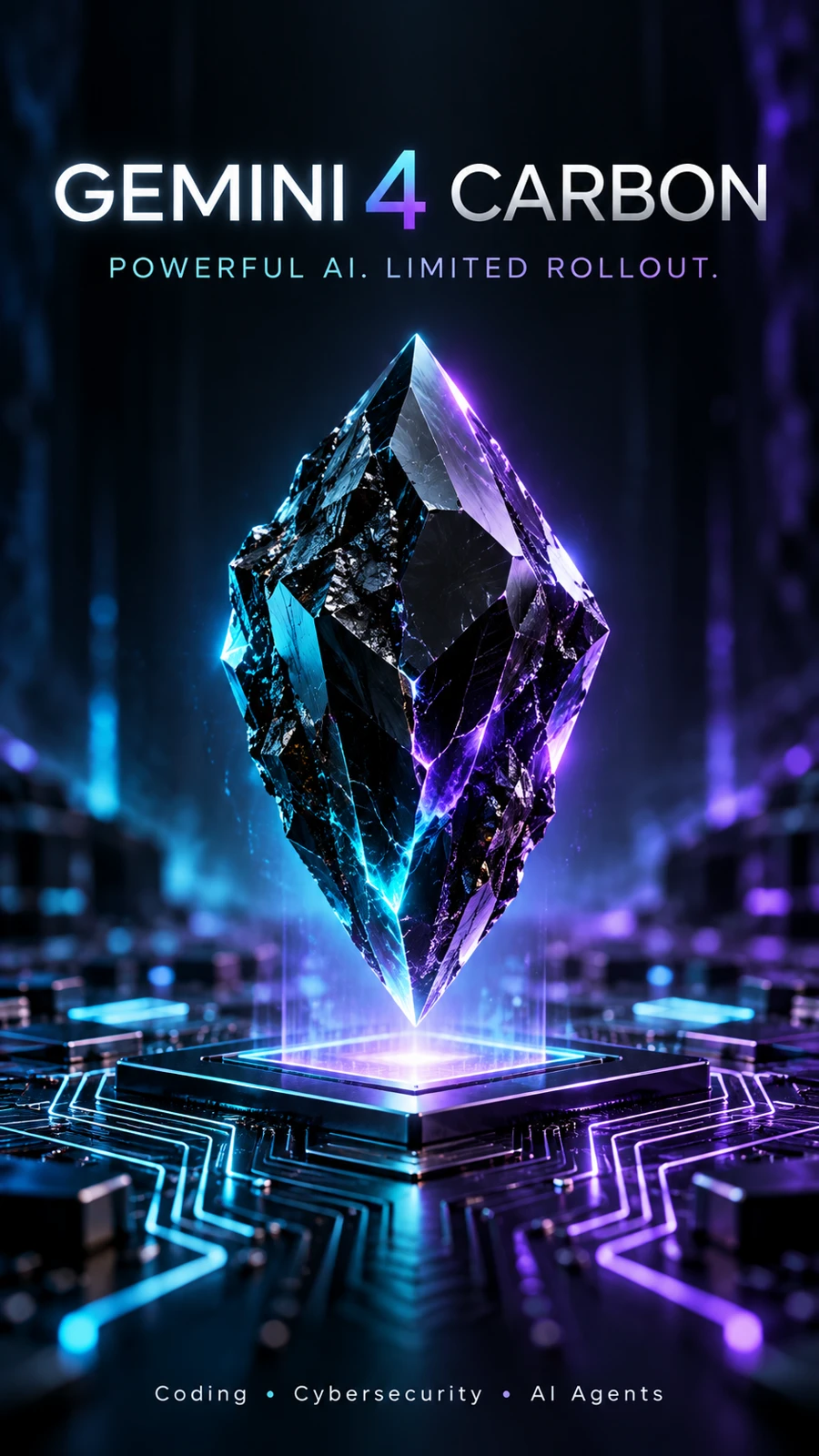
Gemini 4 Carbon is Google’s newly announced frontier AI model, introduced on 28 October 2026. The question for most readers is practical: what does this announcement change for the tools they can actually use? The answer depends on access, workload and the difference between a model announcement and a general product release.
Google describes Carbon as a step forward for coding, cybersecurity and tasks that require an AI agent to keep working through several stages. However, the company is beginning with selected cyber defenders and trusted partners. A public announcement does not mean the model is already selectable in every Gemini account.
Gemini 4 Carbon release: what is confirmed?
According to Google’s official announcement, Carbon builds on Gemini 4 Argon. Google reports improvements in software engineering and security evaluations, while describing a phased rollout through its Fairwind Program. These are manufacturer-reported findings; this article is an announcement explainer, not our own hands-on benchmark.
The important distinction is between announced capability and verified usefulness for your own work. A coding assistant can look impressive in a demonstration yet still need careful instructions, a representative repository and human review before its output becomes useful. Treat launch claims as questions to investigate rather than a substitute for evaluation.
If you are searching for a Gemini 4 Carbon release date, separate three events: the announcement date, initial partner access and broad availability in consumer or developer products. Only the first two are described in the announcement. Do not assume a public launch date that Google has not specified.
Can you use Gemini 4 Carbon in the Gemini app?
At announcement, Google said access would start with a subset of cybersecurity defenders, with additional trusted partners added gradually. Wider developer, business and consumer availability is planned, but should be checked on official product surfaces when it arrives. A paid subscription by itself should not be treated as proof of access.
For an ordinary user, the sensible first check is the model selector and release information in the product already being used. If Carbon is absent, do not install a browser extension or pay a stranger who promises to unlock it. Product names are easy to copy; access claims require an official explanation.
For developers, check the actual model identifier, account eligibility, regional availability and supported endpoint before changing an application. Keep the existing working configuration until a small test succeeds. A model name in a news headline is not a valid API identifier, and inventing an identifier can turn a routine update into a broken integration.
Why coding and AI agents are the main story
A conventional chatbot response is one piece of output. An agent workflow can involve reading a brief, finding relevant files, proposing changes, running checks and revising a failed attempt. The practical appeal is continuity: less time spent manually passing information between each stage. That appeal is different from a promise of flawless autonomous work.
Consider a website with a broken image upload. A useful evaluation task would provide a reproducible example and ask the assistant to identify the cause, propose a minimal change and explain how to verify it. The winning output is not necessarily the longest answer or the largest patch. It is a change that solves the problem without introducing a new one.
For a blogger or small publisher, another useful test is an article preparation workflow: collect official sources, identify unsupported statements, build an outline and flag anything requiring an editor’s decision. Evaluate source accuracy separately from writing style. A smooth paragraph can still contain an invented date, an outdated price or an incorrect product name.
Related reading: our ChatGPT vs Gemini comparison explains how to choose around the work you actually do rather than a single headline ranking.
FACT box: announcement, access and price
Announcement: 28 October 2026.
Initial access: selected cyber defenders and trusted partners.
Announced introductory token rates: $2 per million input tokens and $10 per million output tokens.
Important: token pricing is different from a consumer subscription price. Confirm current terms and eligibility before budgeting.
To understand token billing, imagine a test that sends 100,000 input tokens and generates 20,000 output tokens. At those introductory rates, the simple token calculation is $0.20 plus $0.20, or $0.40. This is an illustrative calculation, not a quotation for a complete product or a promise about every charge. Tool calls, taxes, different service tiers or changed terms can affect a real bill.
How to read cybersecurity and benchmark claims
Benchmarks answer a narrower question than “Which AI is best?” They measure performance on a selected collection of tasks under specified conditions. A security evaluation may emphasize finding a vulnerability, checking whether a weakness is real or producing a patch. Those stages are related, but they are not interchangeable.
A team evaluating a security assistant should ask for evidence it can inspect: the affected code, a reproducible test, the boundaries of the finding and a proposed correction. A confident description without supporting evidence is not enough. Equally, a patch that removes functionality to make a test pass is not necessarily an acceptable fix.
Permissions matter as much as capability. Use a controlled test environment, remove unnecessary secrets and keep deployment decisions with an authorized reviewer. An assistant does not need unrestricted production access to demonstrate whether it can understand a codebase. Start with the smallest task that can produce an independently checkable result.
The same principle applies to everyday writing. Ask the tool to label uncertainty and show the source for changing facts. When two sources disagree, preserve the disagreement until it can be resolved. A model that clearly identifies a missing fact is more useful than one that silently fills the gap with a plausible sentence.
Advice: a simple evaluation before switching tools
Choose three tasks you already understand well: one writing task, one research task and one technical task if relevant. Save the same brief for each assistant. Include the intended audience, the required output and clear limits. Comparing different prompts mostly measures the prompts, not the models.
Check five things: factual accuracy, completeness, time spent correcting the output, total cost and whether the result can be reused. Record specific failures. “It felt smarter” is harder to act on than “it invented two URLs” or “it fixed the bug but removed the upload size check.” Repeat only when a changed task or updated product justifies another test.
Do not cancel a useful subscription or rebuild an entire publishing system because a new model has been announced. A small pilot gives better information. If your current process already combines research, editing, image creation and WordPress publishing reliably, a new model needs to improve a concrete part of that process to earn its place.
Frequently asked questions
What is Gemini 4 Carbon?
It is a frontier AI model announced by Google, with an emphasis on coding, cybersecurity and sustained agent workflows.
Is Gemini 4 Carbon available to everyone?
The announcement describes limited initial access. Check official Gemini and developer release information for later availability changes.
Is Carbon included in my existing paid plan?
Do not infer that from the model announcement. Inclusion depends on the product, plan and current rollout terms.
Does a benchmark lead guarantee better articles?
No. Evaluate research accuracy, language quality and editing effort using representative articles. A coding or security score does not directly measure editorial quality.
Should I enter an API key on a Carbon access website?
Verify the destination and its purpose first. Do not share credentials merely because a page uses a familiar model name.
Editorial note: based on information checked on 29 October 2026. Availability and pricing can change. The visuals are AI-generated conceptual illustrations. This article does not claim hands-on access to Carbon.