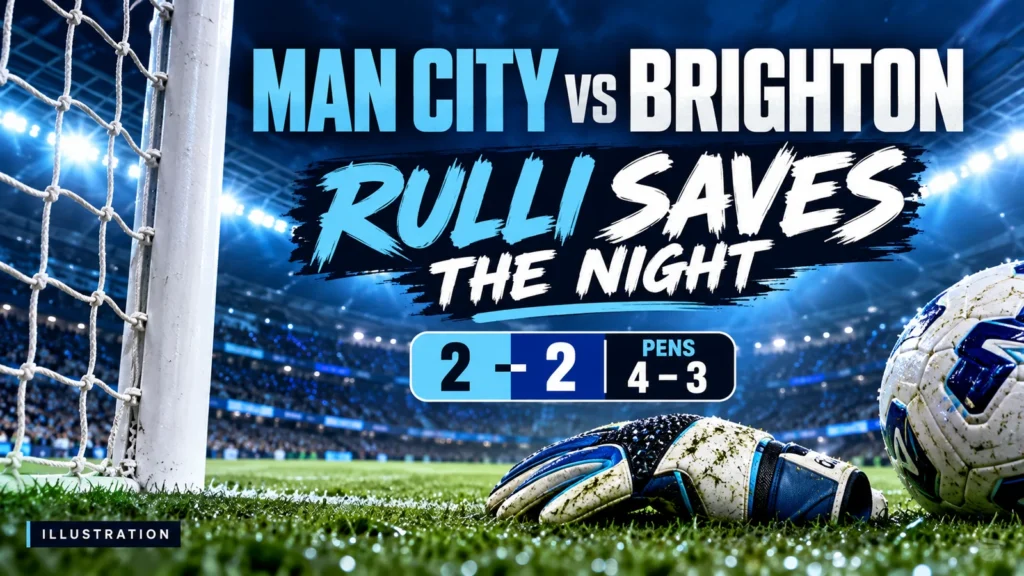
Man City vs Brighton ended 2–2 on 28 October 2026, before Manchester City won the Carabao Cup shootout 4–3. Gerónimo Rulli saved Brighton’s final two penalties as City recovered from falling behind twice during normal time. It was a night decided by a goalkeeper’s response when the tie appeared to be slipping away.
The main result should be read as two separate scores: a 2–2 draw across 90 minutes and a 4–3 shootout victory for City. The reward was a place in the quarter-finals. Brighton’s two leads made this a demanding knockout match rather than a comfortable progression for the holders.
Man City vs Brighton score and goalscorers
The official Manchester City match report lists Malick Yalcouyé’s opener at 30 minutes, Mateo Kovačić’s equaliser at 40, Georginio Rutter’s goal at 47 and Vitor Reis’s reply at 72. The match was played at the Etihad Stadium in the Carabao Cup fourth round.
Those four moments explain the shape of the contest. Brighton established the first lead, City restored parity before half-time, Brighton moved ahead again soon after the restart and City needed another response. No late winning goal separated the teams, so the outcome moved to the penalty mark.
For anyone checking the result from India, remember that the UK evening fixture continued into the early hours of 29 October IST. A report dated Thursday in India and a fixture listed for Wednesday in England can describe the same game. Match date and timezone should be checked together.
How City twice recovered against Brighton
City’s report describes Kovačić equalising with a low shot from outside the area. The second equaliser came when Reis redirected Rayan Cherki’s free-kick. The club identifies that finish as Reis’s first City goal. Those were different routes back into the match: a midfielder’s strike and a defender’s contribution at a dead-ball situation.
Our analysis is that a comeback has two separate demands: creating the equaliser and keeping the contest within reach before it arrives. The latter receives less attention in short highlight packages. A side chasing the game can expose itself, so the saves and defensive actions between scoring moments are part of the comeback too.
Brighton’s willingness to threaten again after being pegged back is also central to the story. A report focused only on City’s eventual win risks presenting Brighton as passive opposition. The visitors led twice and carried the tie to penalties, where the margin between advancement and elimination narrowed to individual actions.
Why Rulli became the decisive player
The EFL’s official roundup highlights Rulli’s second-half stop from Rutter as well as his two shootout saves. That connects the regulation-time performance with the final result. Without keeping the score manageable earlier, a goalkeeper may never receive the opportunity to decide a shootout.
This does not mean one player did everything. Kovačić and Reis supplied the goals, teammates converted penalties and the team still had to survive Brighton’s attacking periods. The useful judgment is narrower: Rulli delivered the specific interventions that prevented the shootout from ending in Brighton’s favour.
A goalkeeper’s contribution can be obscured by a match score that shows two goals conceded. Context matters. The score alone does not tell a reader which saves were difficult or which actions changed the result. It is better to examine the verified sequence than to assign a rating based only on the final number.
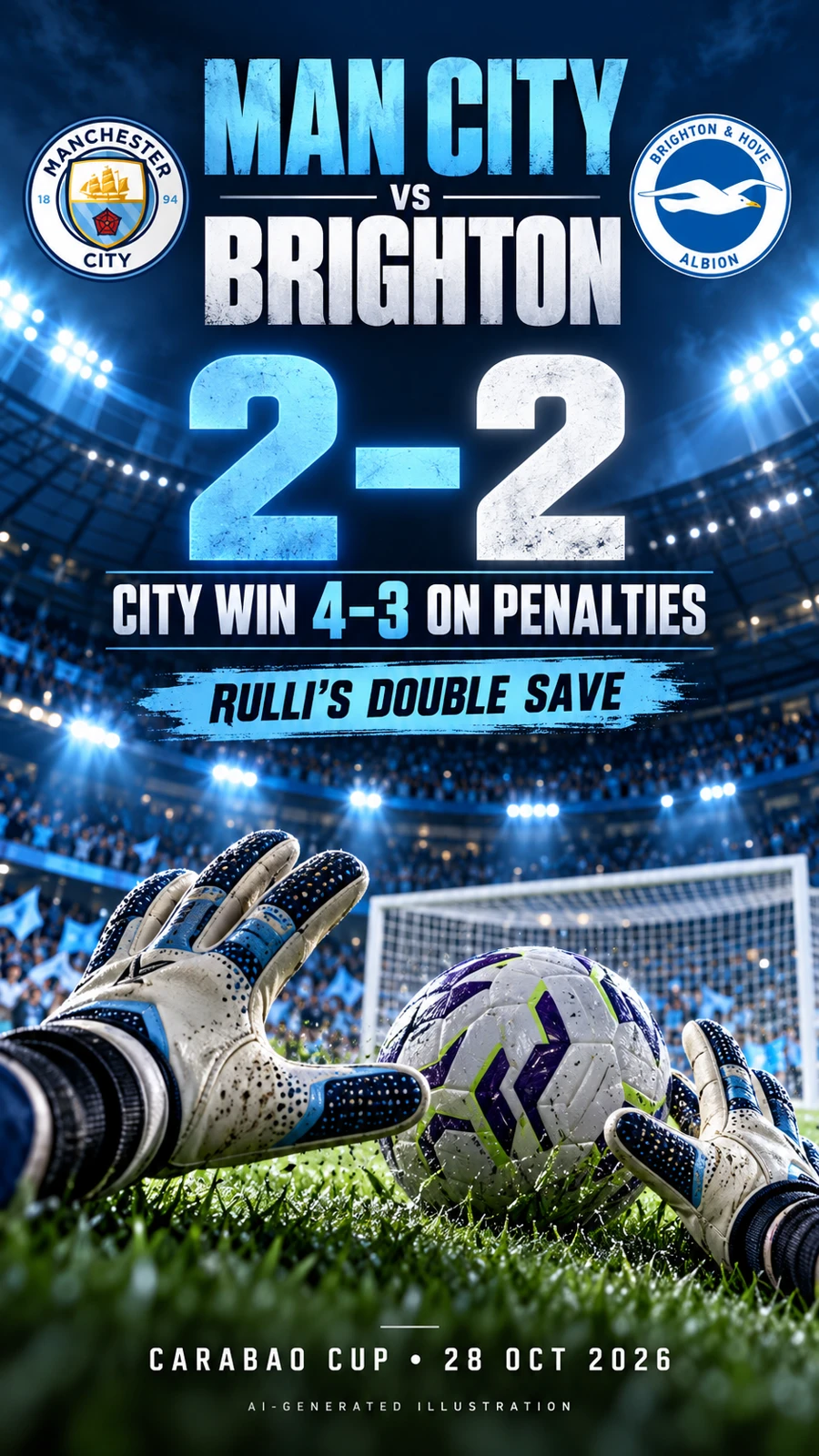
FACT box: the Carabao Cup result
Match: Manchester City vs Brighton & Hove Albion.
Date: 28 October 2026, UK.
Venue: Etihad Stadium.
After 90 minutes: 2–2.
Penalties: Manchester City 4–3 Brighton.
Outcome: City through to the quarter-finals.
Key shootout moment: Rulli saved Brighton’s fourth and fifth attempts.
The penalty shootout: how the momentum changed
In the club’s post-match account, the opening three attempts from each team were successful. Jason Steele then saved Kovačić’s effort. Rulli responded by denying Yasin Ayari, Cherki converted City’s fifth and Rulli stopped Lewis Dunk to complete the win.
The order matters. Kovačić’s miss created an opening for Brighton, but it did not settle the contest. Rulli’s next save restored the immediate balance. Cherki’s conversion then gave City a lead that Brighton needed to match, and Dunk’s saved attempt completed the result.
A short clip of only the first missed kick can therefore tell an incomplete story. Penalty shootouts are not decided by who misses first; they are decided by the completed sequence under the competition’s rules. The following kick can reverse the situation, which is precisely why the final score should accompany any highlight.
Rulli’s interview also emphasized the home supporters’ contribution. That is the player’s account of his experience, not a measurable claim that crowd noise caused a particular miss. Separating a participant’s reaction from statistical evidence keeps a dramatic report accurate.
What City and Brighton can take from the result
For City, the immediate benefit is survival in a knockout competition and another fixture in the cup run. The official match centre lists Bradford City as the quarter-final opponent, with the round scheduled for the week commencing 14 December. Check the confirmed fixture notice for the precise date and kick-off.
For Brighton, the defeat ends this cup campaign but does not award or remove Premier League points. The two leads demonstrate that they created a real contest. Whether that performance carries into the next league fixture depends on future selection and execution; one shootout cannot answer that question in advance.
The result also offers a useful way to assess cup rotation. A team can advance while still revealing areas to improve, and a team can lose while performing competitively. “Through” and “out” are decisive tournament outcomes, but they are incomplete descriptions of performance.
The same evening produced another close tie. Read our Liverpool vs Chelsea penalty-shootout report for the separate 1–1 match and Liverpool’s 6–5 win. Keep the two fixtures’ scorers and shootout totals separate when comparing them.
Advice: checking highlights, ratings and statistics
Start with the official club and EFL reports linked here. If watching highlights, pay attention to the clock and competition label so an older league meeting is not mistaken for this cup tie. Search results often place several matches between the same teams together.
Treat numerical player ratings as an author’s judgment unless a method is explained. We have not invented possession, expected-goals figures or a complete statistical comparison. A reliable recap can describe the confirmed events and give clearly labelled analysis without pretending to possess a data feed it has not checked.
When saving the result for later, include the competition and date with the score. The 4–3 penalty total belongs to this shootout and should never be added to the teams’ league goal tallies.
Frequently asked questions
Who won Man City vs Brighton?
Manchester City won the shootout 4–3 after a 2–2 draw in normal time.
Who scored for City?
Mateo Kovačić and Vitor Reis scored City’s goals.
Who scored Brighton’s goals?
Malick Yalcouyé and Georginio Rutter put Brighton ahead on separate occasions.
Which penalties did Rulli save?
He denied Yasin Ayari and Lewis Dunk at the end of Brighton’s shootout sequence.
Was the match a Premier League fixture?
No. It was a Carabao Cup fourth-round tie.
Editorial note: checked on 29 October 2026 against official Manchester City and EFL coverage. Interpretations are labelled as analysis. Both visuals are AI-generated editorial illustrations, not match photographs.