US elections impact on Indian stock market: what matters in 2026
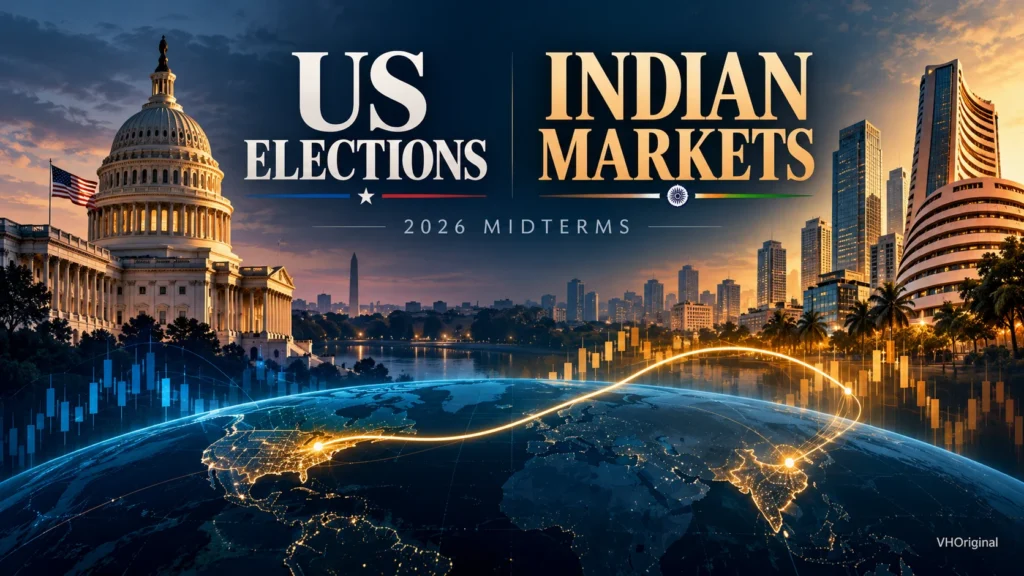
The US midterm elections on November 3, 2026 could influence Indian market sentiment, but a Republican or Democratic victory cannot by itself tell investors where the Nifty or Sensex will trade. The useful question is how the result changes expectations for trade, US interest rates, the dollar, energy costs and corporate earnings.
Updated October 27, 2026. This is a scenario-based explainer, not a live market report or a price forecast.
The election changes Congress, not the presidency
The Federal Election Commission confirms November 3 as the regular federal general election date. All 435 voting House seats are contested, alongside Senate elections. President Donald Trump’s term continues after the midterms. A change in Congress can affect legislation, funding negotiations and oversight without automatically reversing existing executive policies.
For the political background, read our Hindi explainer on the 2026 midterm election date and major issues. This article focuses on the possible transmission to Indian equities.
Five channels connecting Washington to Dalal Street
Our analysis: These are economic transmission channels, not assumptions that the election will move each variable in a particular direction. Their importance will depend on the policies announced, market expectations and developments in India.
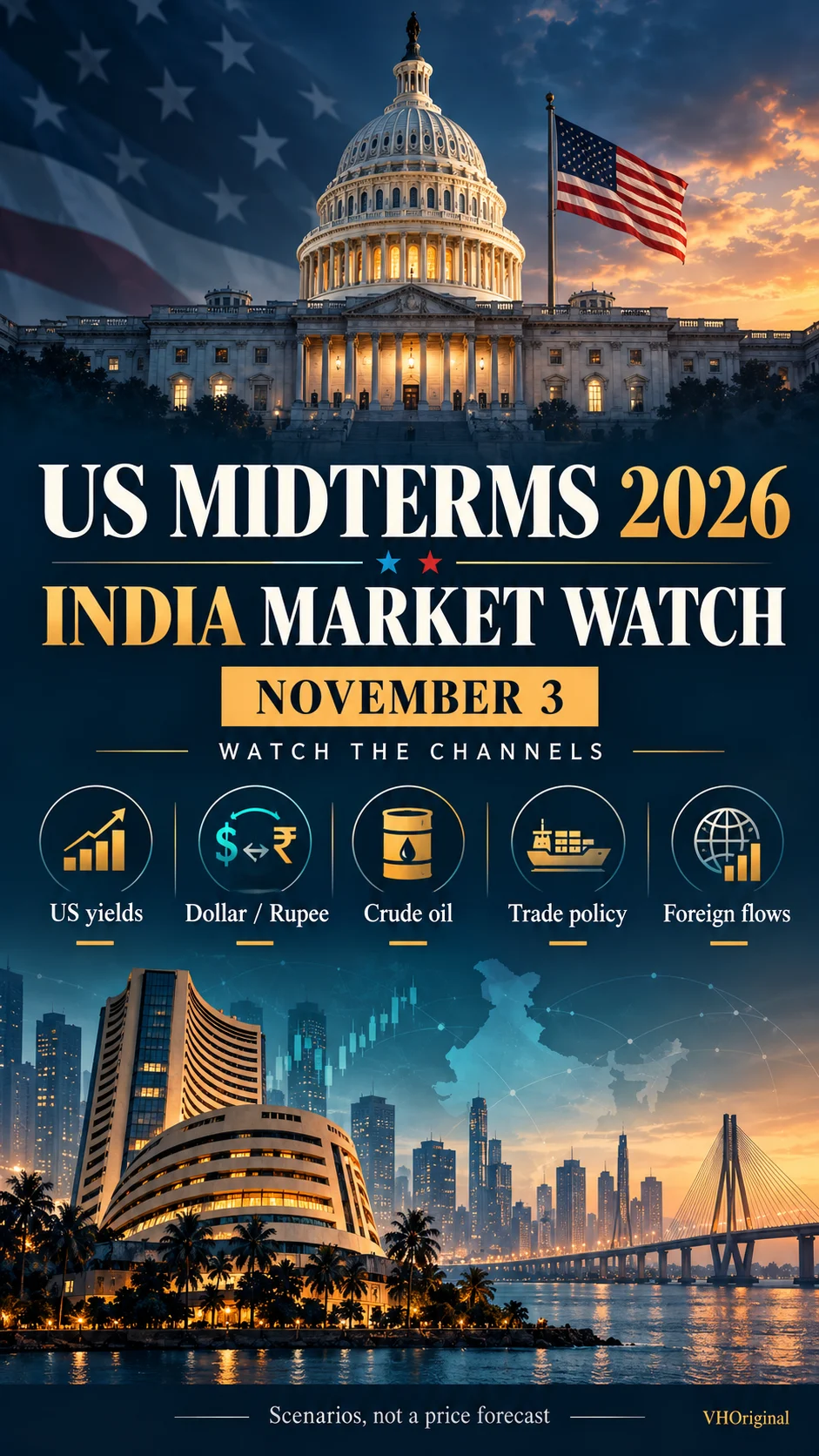
| Channel | What to monitor | Possible relevance to India |
|---|---|---|
| US bond yields | Changes in yields and rate expectations | Relative appeal of equities and borrowing costs |
| Dollar and rupee | Dollar strength and USD/INR | Foreign investor returns, import costs and export receipts |
| Crude oil | Oil prices and supply risks | Input costs, inflation and margins |
| Trade policy | Actual tariff or regulatory announcements | Market access and sector earnings |
| Foreign portfolio flows | Dated equity and debt flow reports | Buying and selling pressure, alongside domestic flows |
Republican control versus a Democratic gain: three scenarios
Morgan Stanley Research’s 2026 analysis argues that the executive branch will retain substantial influence over trade, immigration and foreign policy even if Congress changes hands. Its assessment is that a change in congressional control need not produce a major shift in the broader policy backdrop. This is an institution’s assessment, not an assured market outcome.
Scenario 1 — Republicans retain both chambers: Investors would examine whether the majority can pass its priorities and how those measures affect expected deficits, business costs and growth. For India, the relevant evidence would be the resulting policy details rather than the party label.
Scenario 2 — Democrats gain one chamber: Divided government could create more bargaining over legislation and funding. Additional oversight is possible. It would be premature to assume that this alone removes tariffs or changes visa rules; the legal route and executive response would still matter.
Scenario 3 — Democrats gain both chambers: Congress could set different legislative and oversight priorities, while the president retains veto powers. Indian sector performance would depend on what becomes law, what agencies implement and what investors had already priced in.
These scenario implications are our analysis. None establishes that one result is automatically bullish or bearish for Indian stocks.
Why the Fed and foreign flows deserve separate attention
The Federal Reserve describes its monetary policy framework as operationally independent, with objectives established by Congress. A midterm result is therefore not an automatic instruction to raise or cut US interest rates. Inflation, employment and policy expectations still need to be assessed separately.
For foreign institutional investment, use dated FPI reports rather than a social media headline. SEBI’s FPI information page links to NSDL and CDSL reporting. Compare equity with equity, distinguish daily from monthly totals, and check whether a number includes primary-market transactions. A single day’s selling does not establish an election-driven trend.
Nifty, Sensex and sectors: avoid one-direction conclusions
Our analysis: Indian IT exporters may be sensitive to US client spending, currency changes and immigration implementation. A weaker rupee can lift translated export revenue while also increasing some costs; it does not guarantee higher profits. Pharma investors would need to distinguish trade headlines from product approvals, pricing and company-specific execution.
Oil-sensitive businesses can respond differently to the same crude move. Higher oil may raise costs for some companies while supporting revenue for others. Banks and domestic consumption companies also depend on Indian credit conditions, demand and earnings. Those domestic factors can outweigh a US political headline.
For the indices, sector weights and large-company results matter. Even if several exporters benefit from a particular development, that is insufficient to calculate a reliable Nifty or Sensex target.
A practical checklist before and after November 3
Before the vote, record the date and source of each market observation. After the vote, distinguish projected winners from certified results, then separate campaign proposals from enacted measures. Watch whether yields, currency, oil and foreign flows confirm the narrative being offered.
When reading a stock market prediction for November, look for its assumptions and what would invalidate them. A target without a timeframe, valuation basis or downside scenario adds little to an investment decision. This article intentionally does not publish an unsupported index target.
For another example of separating an informal indicator from a confirmed outcome, see our Jio IPO GMP and expected listing price explainer.
Frequently asked questions
Will the US elections make the Indian stock market rise?
No result guarantees a rally. Expectations, policy details, valuations and domestic earnings all matter.
Could FIIs return after the midterms?
Flows could change, but the vote alone is insufficient evidence. Check dated official FPI reports and the wider currency and yield environment.
Will a Democratic win remove US tariffs?
A congressional victory does not automatically repeal tariffs. The applicable legal powers and subsequent decisions matter.
When should Indian investors watch for results?
Several US races may show trends during the Indian morning of November 4. Close contests and official certification can take longer.
Sources and investment note
Election date: FEC. Congressional process: USAGov. Market policy assessment: Morgan Stanley Institute. Monetary framework: Federal Reserve. Official flow-report links: SEBI FPI information.
Educational information only; not personalised investment advice or a recommendation to buy or sell. Scenario analysis can be wrong, and markets can move for reasons unrelated to elections. Illustrations are AI-generated conceptual artwork.