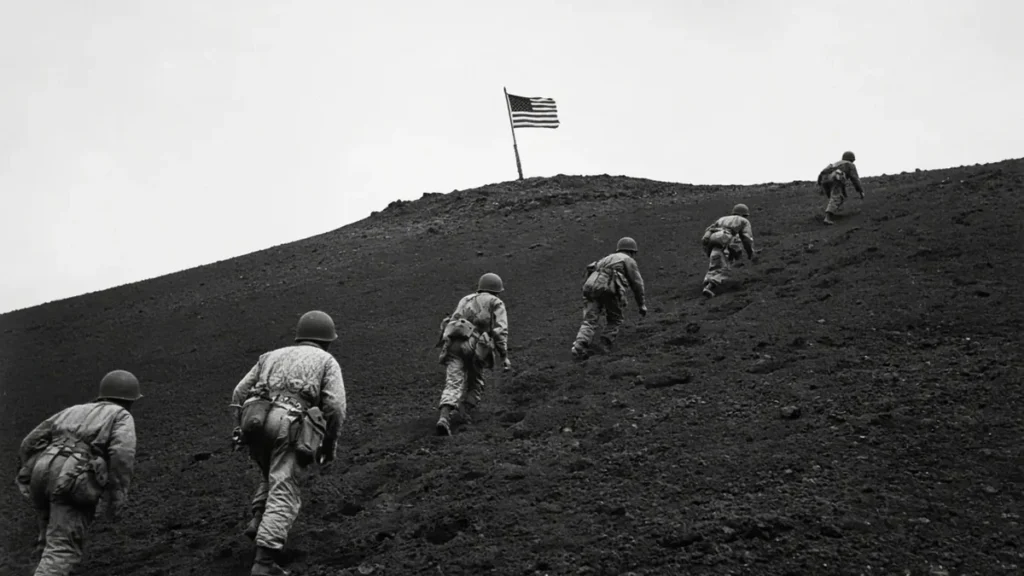
On the afternoon of 23 February 1945, Mount Suribachi was black ash and smoke. Iwo Jima had been invaded only four days earlier. The world kept a flag. Raising the Flag on Iwo Jima is Joe Rosenthal’s Associated Press frame. It won the 1945 Pulitzer. Fewer people know it is not the first flag of that morning.
The first flag was smaller. A patrol under 1st Lt. Harold Schrier took the crest and put it up. Sgt. Louis R. Lowery of Leatherneck photographed that first raising. Ships could barely see the cloth. A larger flag followed in the afternoon — about 56 by 96 inches, sent from LST-779. Rosenthal arrived for that second pole.
The Iwo Jima flag went up twice in 1945
The landing began on 19 February 1945. The battle ran 36 days. Suribachi is a corner of the island, not the island. After the flag, caves and fire kept going. The photograph reads like an ending. The ground was not finished.
Rosenthal was asked if he posed the lift. He said he saw the pole rising, raised a Speed Graphic, and did not even use the viewfinder. Marine cinematographer Bill Genaust cut color film at nearly the same angle. That is why the “staged” charge returns, and why the answer stays narrow: the second flag was meant to be seen. The combat under it was not invented for the camera.
Rosenthal thought he had missed the moment. He made a group picture later called “Gung Ho.” That frame did not travel. The six-body cluster with almost no faces did. Textbooks say a good news picture needs a face. This one built a nation without one.
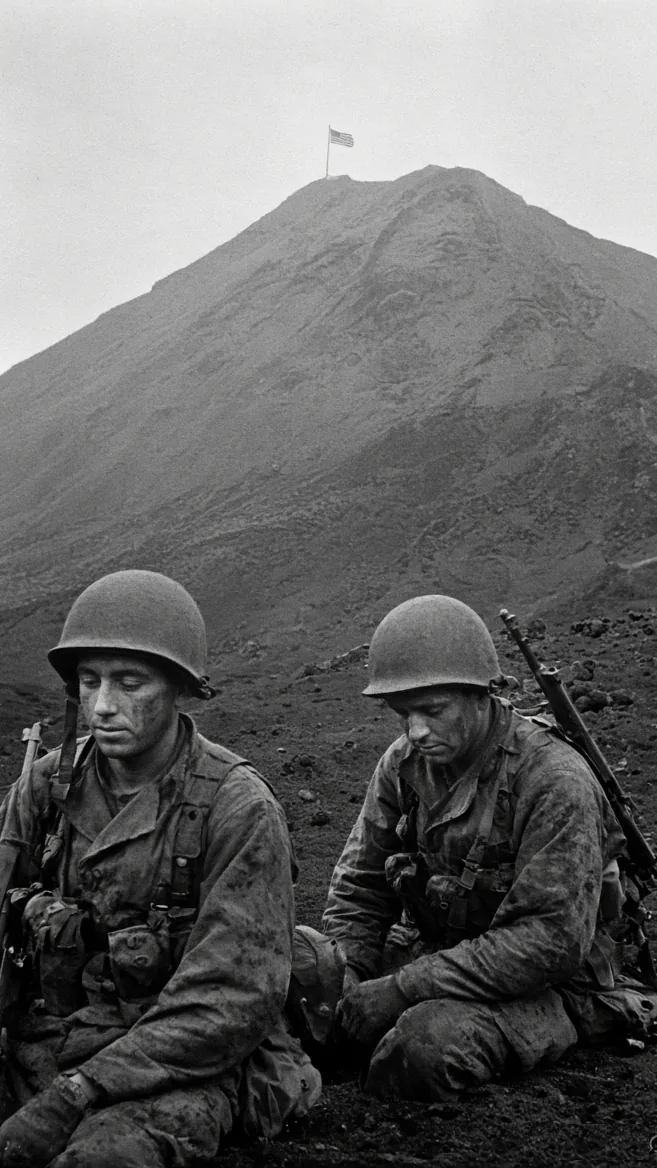
The flag was up. The island was not finished.
Who is in the frame — the names changed three times
Early credits ran Michael Strank, Franklin Sousley, Ira Hayes, Rene Gagnon, John Bradley and Henry Hansen. In 1947 the Marine Corps replaced Hansen with Harlon Block, who had already been killed on the island. His family fought the error for years.
A 2016 board removed Navy corpsman John Bradley and put Harold Schultz in his place. In 2019 Harold Keller replaced Rene Gagnon. The six names now on the record are Harlon Block, Harold Keller, Franklin Sousley, Michael Strank, Harold Schultz and Ira Hayes.
Strank, Sousley and Block died on Iwo Jima after the picture. Hayes went home carrying the photograph. Bradley and Gagnon lived for decades as flag raisers and were then taken off the card. The revisions do not fake the exposure. They show how easily a one-second body takes the wrong name.
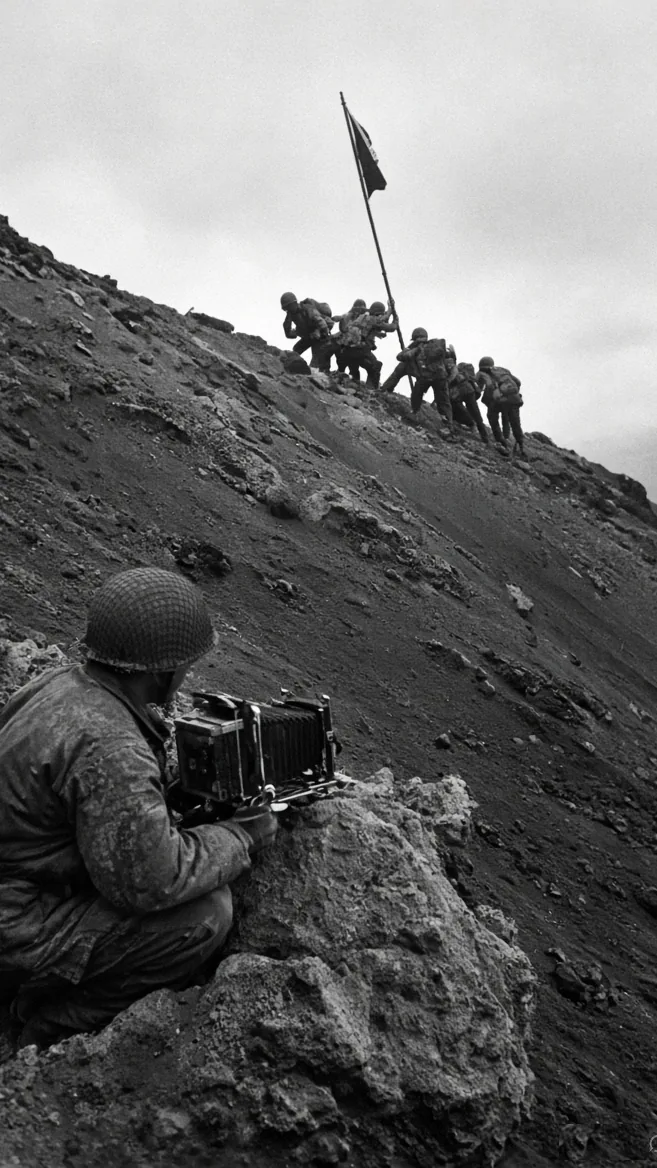
Joe Rosenthal’s Pulitzer frame is the second, larger flag. The first went up that morning.
What the picture bought
The Seventh War Loan sent surviving faces on tour. The drive sold bonds in the billions. The same cluster later became bronze at the Marine Corps War Memorial in Arlington. Metal froze an afternoon that the island itself had not finished.
In India the frame arrives as a victory still. The accurate sentence is smaller: it is a summit picture, not a map of the island. Japanese soldiers were in the same ash. The dead on both sides are heavy. The photograph lifts a flag. It does not do the arithmetic.
The images here are not copies of Rosenthal’s copyrighted six-man silhouette. They stay on that slope, that date, that black volcanic dust. They do not claim to be the AP negative.
What people type now
Some search Iwo Jima flag raising 1945. Some search Joe Rosenthal. Some search the first flag versus the second. All three open the same 23 February.
Suribachi is quiet. The memorials stand. The roster has been corrected. The frame is unchanged — cloth in wind, boots in ash, a hard sky. Raising the Flag on Iwo Jima lasts because it looked like victory before the island did. History added the footnote later: the symbol arrived early.