 Vista
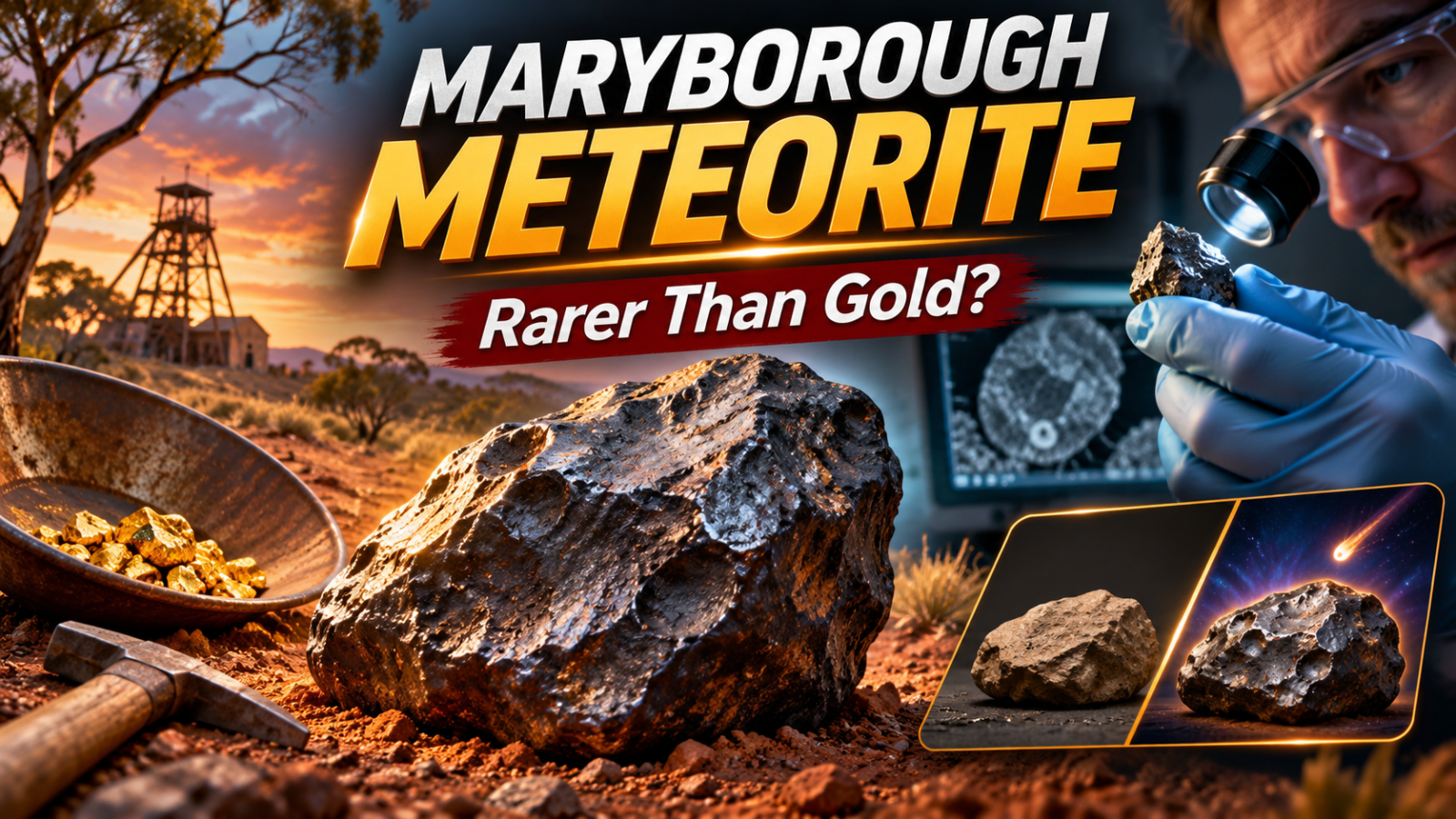
The Maryborough meteorite is a 17-kilogram, roughly 4.6-billion-year-old space rock that a gold prospector, David Hole, found with a metal detector in Maryborough Regional Park, Victoria, Australia, in May 2015. He assumed it held a gold nugget and spent years trying to break it open before a museum identified it as an H5 ordinary chondrite meteorite. The story keeps going viral under headlines like “rock rarer than gold”, but it is important to be clear: this is not a new 2026 discovery. The find dates to 2015, the museum identification came in 2018, and the scientific paper was published in 2019. This article explains the discovery, the science, why the story trends again, how meteorites are identified, and why nobody has given the rock an official price tag.
Is the Maryborough Meteorite a New 2026 Discovery?
No. The meteorite was found in May 2015, taken to Museums Victoria in Melbourne in 2018, and described in a peer-reviewed paper in 2019 titled “Maryborough, a new H5 meteorite find from Victoria, Australia”. Since then, news and social media sites have republished the story many times, including in late 2025 and through 2026, usually with a fresh headline. A republished article is not a new discovery. If a post claims that a prospector “just found” this rock, it is misleading.
The Discovery Story: From Gold Prospecting to Meteorite
Maryborough sits in the Victorian Goldfields, where thousands of gold nuggets have been found since the 1850s. In May 2015, David Hole was sweeping a metal detector through bushland near the town when he found a reddish rock sitting on yellow clay. It was far heavier than its size suggested, which is exactly how a gold nugget behaves, so he took it home.
Gold is soft and can be cut with ordinary tools. The rock refused to open. Reports say Hole tried a rock saw, an angle grinder, a drill, acid and a sledgehammer, without success. In 2018 he took it to Museums Victoria. Geologist Dermot Henry, who had examined thousands of rocks over decades, said only two had ever turned out to be real meteorites, and this was one of them. The dimpled, sculpted surface was an early clue.
What Is the Maryborough Meteorite? Type, Age and Composition
| Feature | Detail |
|---|---|
| Name | Maryborough meteorite |
| Found | May 2015, Maryborough Regional Park, Victoria, Australia |
| Finder | David Hole, gold prospector |
| Mass | About 17 kg |
| Class | Ordinary chondrite, H5 (H chondrite group) |
| Age of the rock | About 4.6 billion years |
| Time on Earth | Carbon-14 dating suggests it fell between 100 and 1,000 years ago |
| Likely origin | Asteroid belt between Mars and Jupiter, according to Museums Victoria |
| Observed fall? | No, it was a find, not a witnessed fall |
What does H5 ordinary chondrite mean?
Chondrites are stony meteorites that contain chondrules, tiny round grains that formed as molten droplets in the early solar system and were never remelted into a planet. “Ordinary” is the most common class. “H” means high iron content, and “5” is the petrologic type, a measure of how much the rock was heated and changed on its parent asteroid. The Maryborough rock contains dense iron and nickel and visible chondrules when cut open.
How old is the Maryborough meteorite?
The material is about 4.6 billion years old, roughly the age of the solar system itself. This is different from the time it has spent on Earth: carbon-14 dating suggests it landed here only between 100 and 1,000 years ago. Local newspapers reported bright meteor events between 1889 and 1951, but the researchers caution that none can be tied to this stone.
Why Is It Called a Rock “Rarer Than Gold”?
The phrase comes from a comparison of how many have been recorded. Thousands of gold nuggets have been found in Victoria, while the Maryborough meteorite was reported as only the 17th meteorite recorded in the state, and the second largest after a 55 kg specimen identified in 2003. That makes it rare in a discovery-count sense and valuable to science, since meteorites preserve information about the early solar system.
The phrase does not mean the rock has a fixed market price above gold. Experts have not assigned a monetary value. The meteorite was acquired by Museums Victoria for the State Collection, so it is not an item on the open market, and any dollar figure you see online is speculation.
Meteorite vs Gold: A Quick Comparison
| Question | Gold nugget | Stony meteorite like Maryborough |
|---|---|---|
| Hardness | Soft, can be cut with tools | Hard, resisted saw, drill and acid |
| Colour | Yellow metallic | Dark or reddish weathered exterior |
| Surface | Irregular or water-worn | Dimples and sculpted look from atmospheric melting |
| Inside | Solid gold | Chondrules with iron-nickel flecks |
| Main value | Market price of gold | Scientific value |
How to Identify a Meteorite
This is general guidance, not a lab test. Most rocks people send to museums turn out to be ordinary Earth rocks, so be realistic.
- Weight: noticeably heavy for its size because of iron and nickel.
- Surface: a thin dark crust or smooth dimpled pits (regmaglypts) caused by melting during entry.
- Magnetism: most meteorites attract a magnet, though many Earth rocks do too.
- Interior: a fresh cut or chip may show metal flecks and small round chondrules.
- No bubbles: real meteorites usually do not show the gas bubbles of volcanic rock.
Do not cut, acid-test or hammer a suspected meteorite as David Hole did. Contact a university geology department or a state museum, photograph the rock with a scale, and record exactly where it was found.
Scientific Importance
Chondrites are among the most primitive solid material available to study. Their chondrules record conditions in the early solar system, and some meteorites contain grains older than the solar system. The Maryborough study used carbon-14 and other analysis to describe the stone, and its main significance is as a carefully documented sample added to Victoria’s collection.
Frequently Asked Questions
What is the Maryborough meteorite?
A 17 kg H5 ordinary chondrite found near Maryborough, Victoria, Australia, in 2015.
Who found it?
Gold prospector David Hole, using a metal detector.
How old is it?
About 4.6 billion years old, though it reached Earth only 100 to 1,000 years ago according to carbon-14 dating.
What is the Maryborough meteorite worth?
No official monetary value has been assigned; it is in a museum collection and valued for science.
Is this a 2026 discovery?
No. It was found in 2015 and published in 2019. The story is simply being shared again.
How can I tell a meteorite from an ordinary rock?
Look for unusual weight, a dark crust, dimples and a metallic interior, then have it checked by a museum or geologist.
Conclusion
The Maryborough meteorite is a real and well-documented find, but the viral framing needs care. It is a 2015 discovery, a 4.6-billion-year-old stony meteorite, and “rarer than gold” refers to how few such finds exist, not to a stated price. Its lasting value is scientific, and the best lesson for readers is to preserve and report an unusual rock rather than break it.
Sources: Museums Victoria and Proceedings of the Royal Society of Victoria (Birch et al., 2019); ScienceAlert; Futura-Sciences; Wikipedia summary of the find.

















Share Your Opinion
Comments are closed on this post.