 Vista
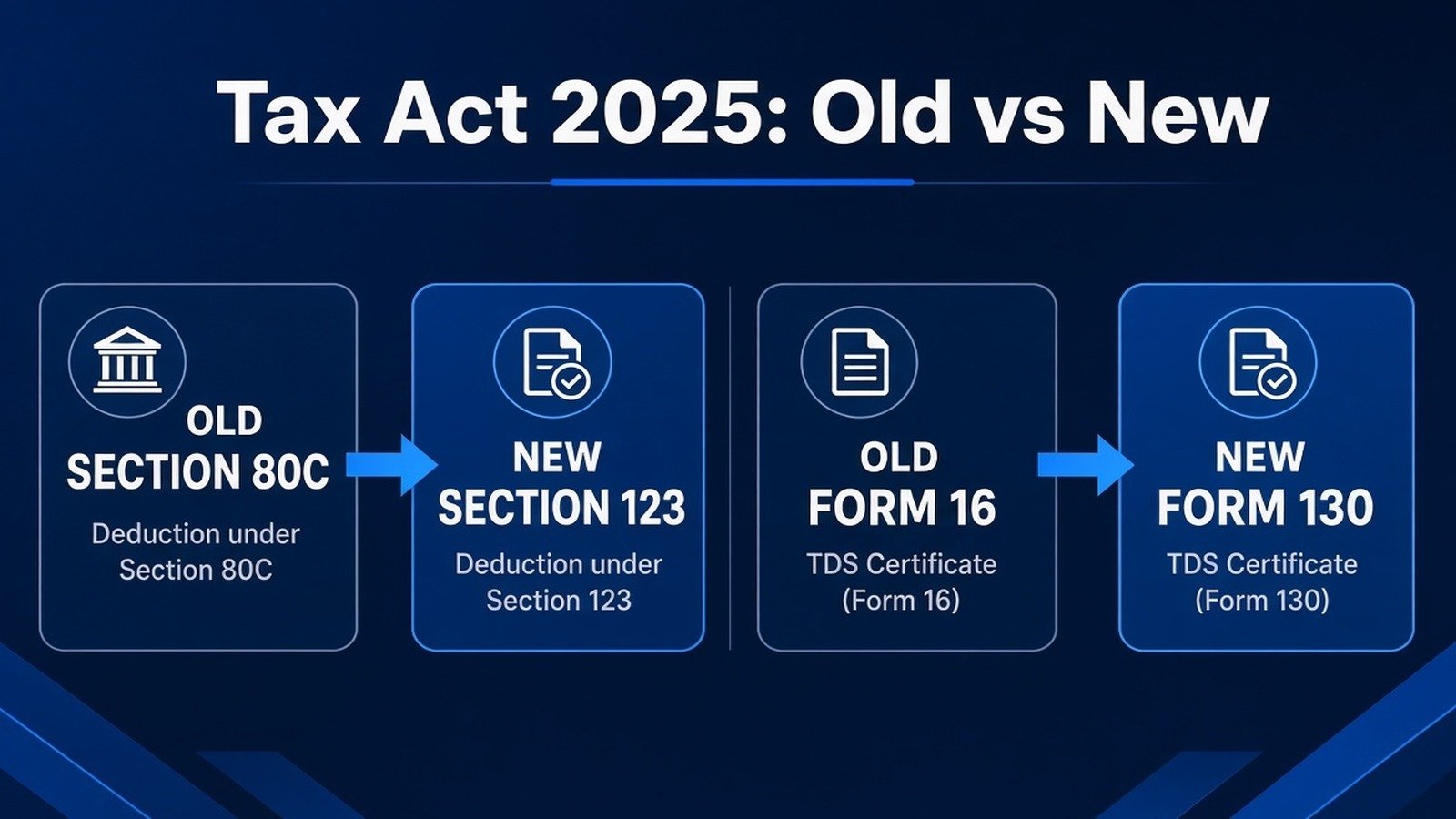
Income-tax Act 2025 vs 1961: From 1 April 2026, India has a new tax-law framework, but the old AY 2026–27 and the new Tax Year 2026–27 are not interchangeable. Here is a careful old-vs-new comparison of Section 80C/123, salary forms, statements and Form 141.
Updated: 22 November 2026
Income-tax Act 2025 vs 1961: what actually changed in 2026?
India’s Income-tax Act, 2025 took effect on 1 April 2026, replacing the 1961 law for the tax years to which the new Act applies. The important change for most readers is not that every deduction vanished or every tax rate was replaced overnight. Much of the legal language, section numbering and compliance framework was reorganised, and the law uses the simpler expression Tax Year for the April-to-March period. The rules and forms accompanying the Act also introduced renumbered documents.
People encounter the change when employers request a new section number for an investment declaration, when a property buyer files TDS, or when their tax records display Tax Year 2026–27 instead of a familiar assessment-year label. This comparison explains the most searched changes without pretending that every old section has a one-line new equivalent. Forms have different legal purposes and transitional cut-offs, so a number-only chart must be read alongside the relevant tax year.
The most important distinction: AY 2026–27 is not Tax Year 2026–27
Income earned between 1 April 2025 and 31 March 2026 belongs to FY 2025–26, assessed as AY 2026–27. The return for that income is filed under the Income-tax Act, 1961, even if filing takes place after 1 April 2026. It uses the old framework and the returns applicable to that assessment year. Existing assessment, appeal or correction proceedings for earlier years may continue under the old law.
By contrast, income earned from 1 April 2026 through 31 March 2027 belongs to Tax Year 2026–27 under the Income-tax Act, 2025. The annual return for that tax year falls in the 2027 filing season, subject to prescribed dates. During late 2026, both old-law AY 2026–27 and new-law Tax Year 2026–27 can appear on the same e-filing portal. Selecting the wrong one can lead to confusing payment or TDS reconciliation problems.
Old Section 80C vs new Section 123: a practical savings comparison
The 1961 Act’s popular Section 80C was the heading many taxpayers used for eligible investments and specified payments. Under the new law, the department refers to Schedule XV read with Section 123 for the corresponding savings deduction. The Income Tax Department states that the aggregate deduction of ₹1.5 lakh continues under the relevant conditions. A new number does not mean an automatic increase or an additional allowance.
This deduction remains tied to tax-regime eligibility. The department’s FAQ says Section 123 is not claimable under the concessional new tax regime governed by Section 202. This is a critical detail for anyone comparing payroll declarations: a tax-saving instrument may be eligible under one regime without reducing taxable income under the other. Check chosen regime, the particular instrument’s conditions and the applicable tax year rather than using the heading from an old screenshot.
Form 16 and Form 130: salary TDS certificates
The familiar Form 16 is the employer-issued salary tax deduction certificate associated with the old framework. Under the new Income-tax Rules 2026, Form 130 is the salary TDS certificate for the relevant new tax-year framework. The change is mainly important for employers’ payroll and certificate issuing procedures. A salary employee should continue to obtain the correct year’s certificate from their employer rather than downloading a lookalike certificate from an unrelated website.
An employee checking FY 2025–26 salary and AY 2026–27 return data should not assume that an old Form 16 is invalid merely because the calendar says November 2026. Tax year determines the legal format. Likewise, Form 130 does not permit a taxpayer to skip checking Form 168, available statements or bank records when reconciling TDS, salary components and employer declarations. The official portal and TRACES are preferable to unofficial generators.
Form 26AS, AIS and Form 168: do not mix up the statements
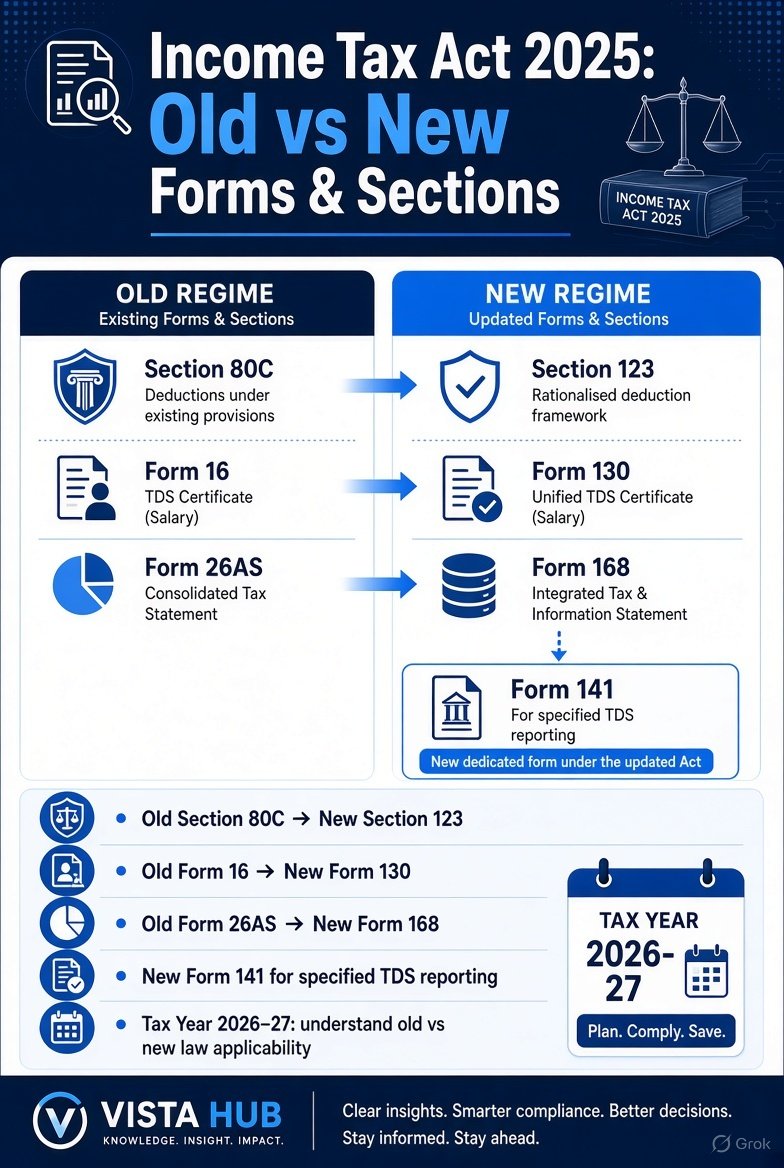
Income-tax records can describe a tax-credit or annual tax statement as Form 26AS and refer to the wider Annual Information Statement as AIS. Under the new Act, the department’s compliance FAQs identify Form 168 as the Annual Information Statement for Tax Year 2026–27, while the older AY 2026–27 is presented under the earlier statement framework. The transition requires careful attention to which statement you are viewing.
One widely shared old-to-new graphic simply prints ‘Form 26AS → Form 168’. That is too compressed to describe every service: Form 168 is specifically the new annual information statement; Form 26AS or annual tax statement functionality and older records may also appear separately on the tax services interface. Compare TDS, TCS, advance tax, refunds and reported financial transactions against the year and statement you actually need. If a credit is missing, first ask the deductor to check its filed return.
Form 141: the new unified challan-cum-TDS statement
Several old PAN-based TDS forms—26QB, 26QC, 26QD and 26QE—were consolidated into Form 141 for specified transactions under the 2025 Act. Depending on the schedule, this covers rent, transfer of immovable property, payments to contractors or professionals by certain individuals or HUFs, and virtual digital asset transfers. Official guidance also describes Schedule E for qualifying immovable property transfers involving a non-resident deductee, effective 1 October 2026.
Form 141 does not impose one universal TDS rate on every transaction. The underlying type, threshold, residential status and any valid exemption or certificate determine the applicable rate. A person buying property should not casually choose a rent schedule, and a payment that belongs to the old-law period may still require the earlier form. The portal explicitly maintains separate routes for older Form 26QB/26QC/26QD filings and the new-law Form 141.
Salary TDS and other old vs new section numbers
For salary payments under the old law, the familiar TDS provision was Section 192. The department’s transition FAQ explains that salary TDS for relevant payments from April 2026 under the new framework falls under Section 392(1). For income that triggered TDS before 1 April 2026, the old-law provision continues to govern the earlier event even when money is later deposited or a return is corrected.
Other new-law sections also appear in employer software. Section 393 covers specified deduction transactions, Section 394 broadly deals with TCS, and relevant withholding obligations have revised references. Rather than relying on a viral table that lists dozens of section numbers without context, use a searchable official section reference for the transaction and the Tax Year. A renamed provision need not change the transaction’s economic tax outcome.
What happens to old ITRs, losses, appeals and revisions?
The repeal of the old Act does not automatically erase earlier returns or pending matters. According to the department’s transition information, income and proceedings tied to FY 2025–26 and older years continue under relevant provisions of the 1961 Act. Corrections to old TDS statements follow their applicable old-law form and limits even if the correction is filed after April 2026.
Business losses or credits validly carried forward from a year under the older Act can, subject to statutory conditions, be recognised in a later Tax Year under transitional provisions. This does not mean that every historical deduction or expired business benefit receives a fresh full term under the new law. Businesses should maintain a documented bridge between old-year records and new-year claims, especially for payroll, TDS, tax audit reports and carried-forward amounts.
How to pick the correct form on the e-filing portal
Start by asking which income period or transaction date the document covers. If it relates to FY 2025–26 income and AY 2026–27, use the portal’s old-law section and applicable form. If the underlying transaction belongs to Tax Year 2026–27, look under the Income-tax Act, 2025 forms. The department’s official mapping guide explains that the portal separates ‘Forms as per Income Tax Act 2025’, ‘Forms as per Income Tax Act 1961’ and ‘Forms as per other Acts’.
Before paying tax or submitting a form, check PAN, the selected Tax Year or AY, the legal category, the transaction type, the form’s exact description, and any schedule. Maintain both the downloaded acknowledgement and payment receipt. When a dropdown label is unfamiliar, search the official user manual by purpose such as salary TDS, rent TDS or Annual Information Statement rather than guessing a number.
Three realistic examples of the 2026 tax transition
Example 1: an employee received March 2026 salary in March. Its salary TDS is dealt with under the old-law framework. Example 2: a similar payment made for April 2026 under the new framework. The new law’s salary TDS rules and Tax Year are relevant. The department specifically uses payment timing to explain this distinction.
Example 3: a family bought a residential property in November 2026. Its buyer-side TDS reporting may require Form 141 Schedule B where the new-law conditions apply; simply copying Form 26QB from a 2024 blog post can cause confusion. A purchase from a non-resident seller can involve a different schedule and compliance conditions. These examples explain where to begin, but the actual transaction and applicable provisions must determine the form.
A safe checklist for taxpayers and employers
Keep FY 2025–26/AY 2026–27 paperwork separate from Tax Year 2026–27. Ask HR to reflect the correct Section 123 and other payroll references for the relevant regime. Compare salary and TDS credits with the right annual statement; ask the deductor to correct any incorrect PAN, year or reporting code. Check Form 141 schedule carefully if you are depositing PAN-based transaction TDS.
Be especially alert to social media charts that call every renumbered provision a ‘new tax’. Neither the law’s title nor an old-to-new form mapping proves a tax rate increased. Use the official e-filing portal and primary FAQs for compliance, and seek professional help for multiple incomes, foreign assets, a changed residency status, business losses or disputed tax credits.
Frequently Asked Questions (FAQs)
When did Income-tax Act, 2025 become effective?
It came into force on 1 April 2026. Earlier-year returns and proceedings follow relevant transition provisions.
Does Section 80C exist under a new number?
Official guidance references Schedule XV read with Section 123 for corresponding savings deductions, subject to regime restrictions.
Is Form 130 the new Form 16?
Form 130 is the salary TDS certificate for the new framework; FY 2025–26 records remain subject to the old rules.
Is Form 168 exactly the same as Form 26AS?
No. Official FAQs describe Form 168 as the Annual Information Statement for Tax Year 2026–27; distinguish this from Form 26AS and older-year records.
What replaced 26QB and 26QC?
Form 141 consolidates specified PAN-based TDS statements with different schedules for different transactions.
Which law governs AY 2026–27 ITR?
The FY 2025–26 return for AY 2026–27 remains governed by the Income-tax Act, 1961.
Conclusion and primary official sources
The first question is not just which number replaced which form, but which legal year and transaction type the filing concerns. Check the latest portal form and official FAQ before paying or submitting.
- Income Tax Department: TDS compliance and transition FAQs
- Income Tax Department: old/new law and transition FAQs
- Income Tax Department: income-tax returns and dual tax years
- Income Tax Department: section 123 deductions and old regime
- Income Tax Department: Form 141 consolidated TDS statement
- Income Tax Department: official form mapping guide
Disclaimer: General information only, not professional tax or legal advice. Seek qualified advice for your individual circumstances.



























Share Your Opinion
Comments are closed on this post.