 Vista
Quick answer: The NATO phonetic alphabet is the international A–Z radio spelling system: A is Alfa, B is Bravo, C is Charlie and Z is Zulu. Official spellings include Alfa (not Alpha) and Juliett (not Juliet). Aviation also has special digit pronunciations such as TREE, FIFE and NINER.
Updated: 21 November 2026.
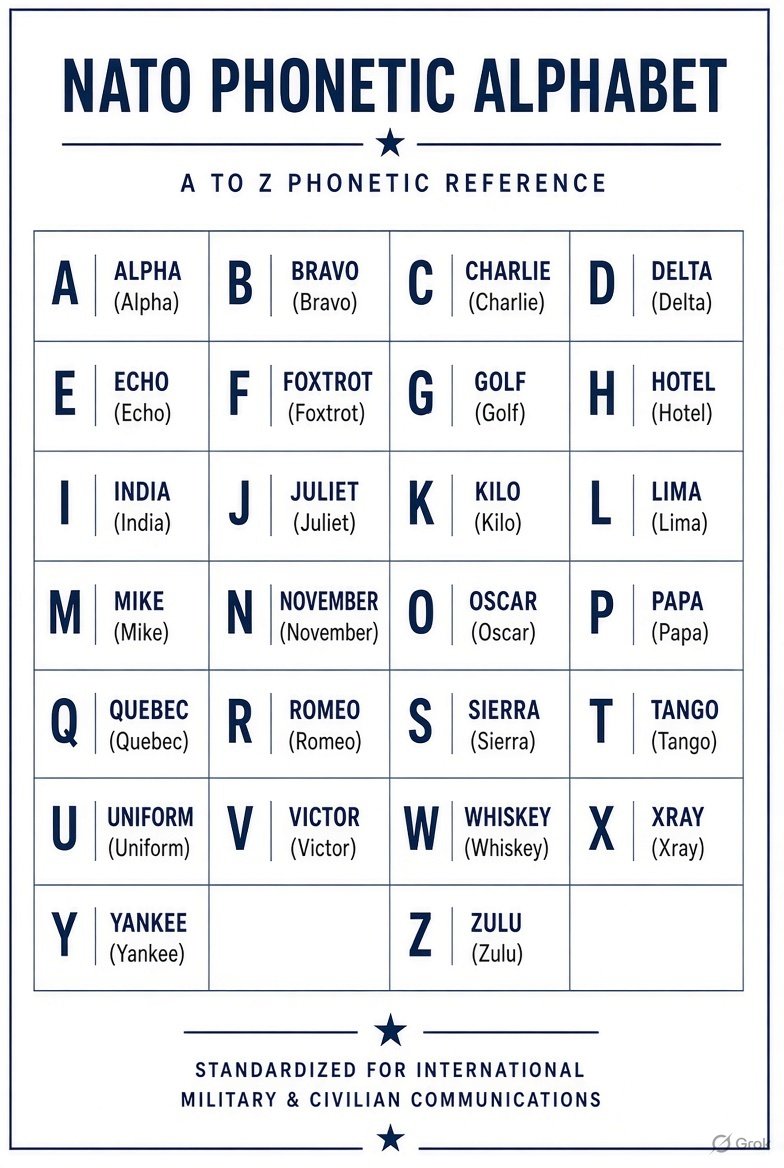
NATO Phonetic Alphabet A–Z: full official code words
| Letter | Code word | Approx. radio pronunciation |
|---|---|---|
| A | Alfa | AL-FAH |
| B | Bravo | BRAH-VOH |
| C | Charlie | CHAR-LEE |
| D | Delta | DELL-TAH |
| E | Echo | ECK-OH |
| F | Foxtrot | FOKS-TROT |
| G | Golf | GOLF |
| H | Hotel | HOH-TELL |
| I | India | IN-DEE-AH |
| J | Juliett | JEW-LEE-ETT |
| K | Kilo | KEY-LOH |
| L | Lima | LEE-MAH |
| M | Mike | MIKE |
| N | November | NO-VEM-BER |
| O | Oscar | OSS-CAH |
| P | Papa | PAH-PAH |
| Q | Quebec | KEH-BECK |
| R | Romeo | ROW-ME-OH |
| S | Sierra | SEE-AIR-RAH |
| T | Tango | TANG-GO |
| U | Uniform | YOU-NEE-FORM |
| V | Victor | VIK-TAH |
| W | Whiskey | WISS-KEY |
| X | X-ray | ECKS-RAY |
| Y | Yankee | YANG-KEY |
| Z | Zulu | ZOO-LOO |
Aviation Numerals 0–9: spoken pronunciation table
| Digit | Word | Radio pronunciation |
|---|---|---|
| 0 | Zero | ZEE-RO |
| 1 | One | WUN |
| 2 | Two | TOO |
| 3 | Three | TREE |
| 4 | Four | FOW-ER |
| 5 | Five | FIFE |
| 6 | Six | SIX |
| 7 | Seven | SEV-EN |
| 8 | Eight | AIT |
| 9 | Nine | NIN-ER |
NATO phonetic alphabet versus ICAO spelling alphabet
The familiar Alfa–Zulu list is often called the NATO phonetic alphabet, but it is technically an international radiotelephony spelling alphabet rather than a transcription of speech sounds. It was developed and adopted through international work, including the International Civil Aviation Organization (ICAO), and was adopted for NATO and other organisations. Its purpose is to make individual Latin letters understandable when radio static, accents and background noise make ordinary letter names difficult to distinguish.
A, M and N may sound similar over a poor radio channel, but ‘Alfa’, ‘Mike’ and ‘November’ are much easier to tell apart. NATO and ICAO are not two separate alphabets that need separate A–Z charts for their standard code words. However, organisations can have different communication procedures and rules for numbers, call signs, distress messages and punctuation. A reference sheet gives the code words; it does not qualify its reader to operate aircraft radio or professional military equipment.
Complete Alfa to Zulu A–Z table and pronunciation
The table above gives all twenty-six Latin alphabet letters with their standard code words. The spellings of ‘Alfa’ and ‘Juliett’ may surprise readers who expect the ordinary English ‘Alpha’ and ‘Juliet’. Those alternative spellings are common in informal articles but not the official ICAO written words. Accurate spelling matters for printable posters, signage and study materials because it prevents learners from copying a widely repeated mistake.
Approximate English-language pronunciation guides help learners, but accents and local phonetics affect how a word sounds. The International Civil Aviation Organization and the FAA publish recognised radiotelephony pronunciations. You can start slowly with each letter, keeping the stressed syllables clear and avoiding rushing through similar words. For example, ‘Sierra’ is not the same as ‘Sirius’, while ‘Quebec’ is a standard Q code word rather than an optional translation. Refer to the official chart whenever a source offers conflicting variants.
Why Alfa has an F and Juliett has two T letters
The spelling ‘Alfa’ with F makes the intended pronunciation clearer across languages where ‘ph’ is not automatically pronounced as an F. ‘Juliett’ with two final T letters was chosen partly for cross-language pronunciation consistency, including contexts where a single final consonant might be dropped. The words were selected and tested for international clarity rather than chosen simply to sound military. This is one reason the chart’s official typography deserves attention.
If a casual quiz asks whether A means Alpha or Alfa, the official radiotelephony written code is Alfa. It is still understandable when an informal speaker says Alpha, but for authoritative instructional material choose the official version. Likewise, write Juliett rather than Juliet. Do not replace Whiskey with Whisky or X-ray with ‘Xylophone’ in a standard table. The aim is agreement across speakers, not personal preference or an attempt to make the words look more stylish.
Aviation numbers 0–9: TREE, FIFE and NINER
A proper aviation communication guide also needs number pronunciation. The FAA table uses Zero, One, Two, Three, Four, Five, Six, Seven, Eight and Nine with distinctive approximations such as TREE for three, FOW-ER for four, FIFE for five and NIN-ER for nine. The special forms reduce confusion over noisy channels and across accents. They are pronunciations of the standard digit names, not separate code words like Alfa and Bravo.
Numbers are often spoken individually in identifiers: a string ending 319 may be read with ‘three’, ‘one’ and ‘niner’ pronunciations under applicable procedures. However not every number in aviation is read by a blanket ‘one digit at a time’ rule. Altitudes, flight levels, times and other values may follow specialised phraseology documented by the relevant authority. A school chart can show the 0–9 sound guide but should not pretend to be a complete air-traffic-control language manual. Learn number procedures from the applicable operating rules.
How to spell a name, booking reference or serial number
To spell ‘VISTA’ over a voice call, use Victor, India, Sierra, Tango, Alfa. A booking reference such as ‘Q7M’ becomes Quebec, Seven, Mike, with the number pronounced according to the relevant communication context. The advantage is not secrecy: each code word simply names the corresponding character. Many customer-support calls use these words to reduce mistakes in email addresses, account names, vehicle registration or technical part numbers.
When dictating something important, pause between characters and ask the listener to repeat the final text back. Do not say only an uninterrupted run of twenty long code words if the receiver is writing by hand. In a high-stakes official radio exchange, use the organisation’s exact repeat-back and acknowledgment procedure. Do not disclose passwords or sensitive account details to strangers merely because code words make them easier to pronounce. The alphabet improves clarity; it does not encrypt information or confirm the caller’s identity.
NATO alphabet versus Morse code and maritime flags
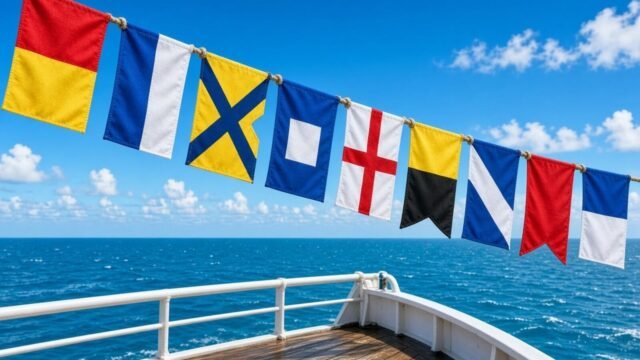
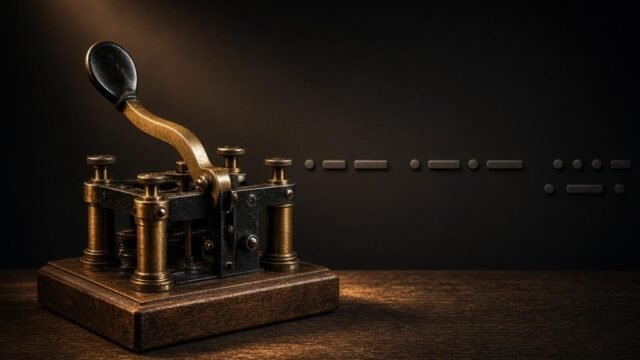
The NATO or ICAO code words are spoken labels for written Latin letters. Morse code is a distinct timed system of dots and dashes, while International Code of Signals flags are distinctive physical designs. Maritime semaphore uses positions of two handheld flags. These methods can represent letters and may appear together in naval reference charts, but they are not the same encoding scheme. A ‘Bravo’ flag’s standalone maritime operational meaning should not be confused with the B code word used in a voice spelling exercise.
A chart that mixes unrelated flags, Morse patterns and phonetic words without headings can be confusing. In a school project, give each method a separate labelled area. If the topic is the NATO alphabet, prioritise the A–Z code words and approximate pronunciation, then add a small section explaining differences. Readers who search ‘Alpha Bravo Charlie chart’ often want a practical spelling reference, not a full naval signalling manual. Keeping the article focused improves its usefulness for global readers and Indian students alike.
Practice exercises to remember all 26 letters
Divide the alphabet into groups of five or six and practise without looking at the chart. Have one person read a short fictional code such as ‘R4P’ and another write Romeo, Four, Papa back as R4P. Next practise names with easily confused letters, including M/N, B/D and P/T. Gradually increase the pace while maintaining accuracy. A two-way exercise with readback provides stronger feedback than trying to memorise the entire poster silently.
For a classroom activity, students can make cards with a letter on one side and the code word on the other. Pair them and exchange fictional registration numbers. Correct pronunciation matters more than shouting or adopting a theatrical military accent. Avoid using real passwords, phone numbers or private identifiers in public exercises. If different accents cause confusion, check the syllables against an official ICAO or FAA pronunciation table rather than inventing replacement words. Repeat unfamiliar code words regularly until the pairs become automatic.
Common chart errors and professional-use cautions
Look for the exact standard written list: Alfa, Bravo, Charlie, Delta, Echo, Foxtrot, Golf, Hotel, India, Juliett, Kilo, Lima, Mike, November, Oscar, Papa, Quebec, Romeo, Sierra, Tango, Uniform, Victor, Whiskey, X-ray, Yankee and Zulu. A poster generated by an image model may omit a letter, repeat one code word, misspell Juliett or assign the wrong pronunciation. Compare every cell against an authoritative text table before printing it as a reference.
The word ‘phonetic’ here refers to spelling clarity, not the International Phonetic Alphabet used by linguists. Learning NATO/ICAO code words does not replace a pilot’s radio certification, a maritime operator’s procedures or emergency communication training. If you are involved in professional aviation, use the current local authority’s prescribed phraseology. Treat this website’s chart as an educational and customer-service aid, and verify the underlying code before using an AI-designed image in formal training material.
Frequently asked questions
Is it Alfa or Alpha in the NATO phonetic alphabet?
Official ICAO/NATO radiotelephony spelling is Alfa with F.
Is the official J word Juliet or Juliett?
Juliett with two final T letters.
Why do pilots say niner?
The distinctive pronunciation helps separate nine from similar-sounding words in noisy international radio communication.
Does NATO phonetic alphabet mean military-only?
No. It is used in many civilian aviation, maritime, communications and customer-service contexts.
How do you spell VISTA with NATO code words?
Victor, India, Sierra, Tango, Alfa.
Is Morse code the same as NATO alphabet?
No. Morse uses timed dot-dash signals; the NATO/ICAO list uses spoken spelling words.
Conclusion
Learn all 26 ICAO/NATO code words accurately, keep official spellings and practise separate number pronunciations. Use a verified reference in training, and follow appropriate aviation or maritime procedures when safety is at stake.
Authoritative sources
- ICAO — Radiotelephony Alphabet History and Official Spellings
- FAA — ICAO Phonetics and Numbers
- NATO — Phonetic Alphabet Codes and Signals (PDF)
Educational and communication practice reference, not an operational aviation or maritime certification manual.














Share Your Opinion
Comments are closed on this post.