What are Parts of Speech and Why Are They Important?
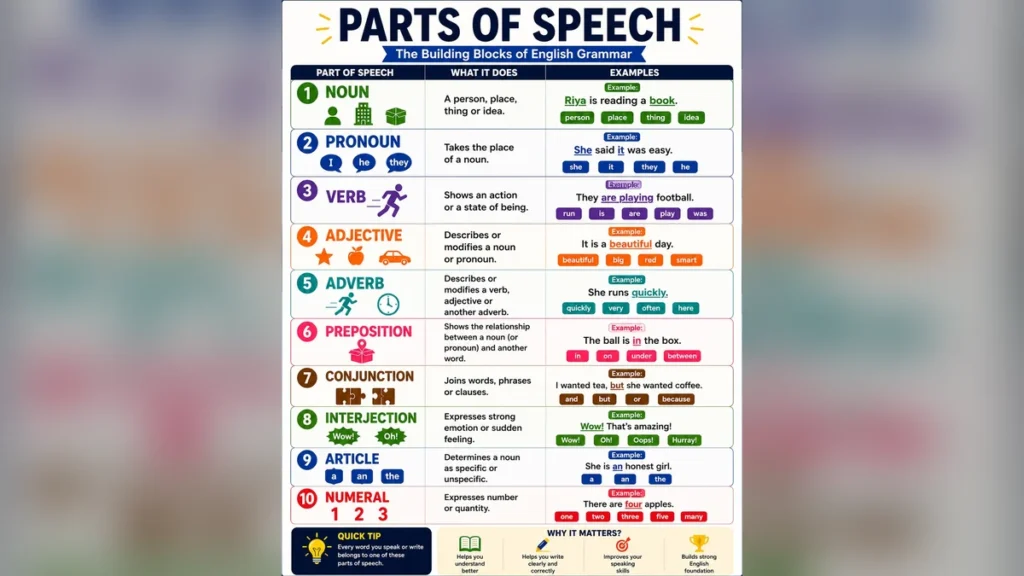
English, like any language, is built on the foundation of words working together. When we speak or write, each word plays a specific role. These roles are categorized into eight main groups, known as the Parts of Speech. Understanding these categories, often visualized in a parts of speech chart with examples, makes deciphering sentence structure incredibly easy. Many beginners try to memorize long sentences, which often leads to errors. Learning a language is like solving a puzzle; each piece has its place. Knowing which word performs an action and which describes a quality boosts confidence significantly. This fundamental understanding is crucial not just for exams, but for fluent, everyday communication.
Overview of the 8 Parts of Speech
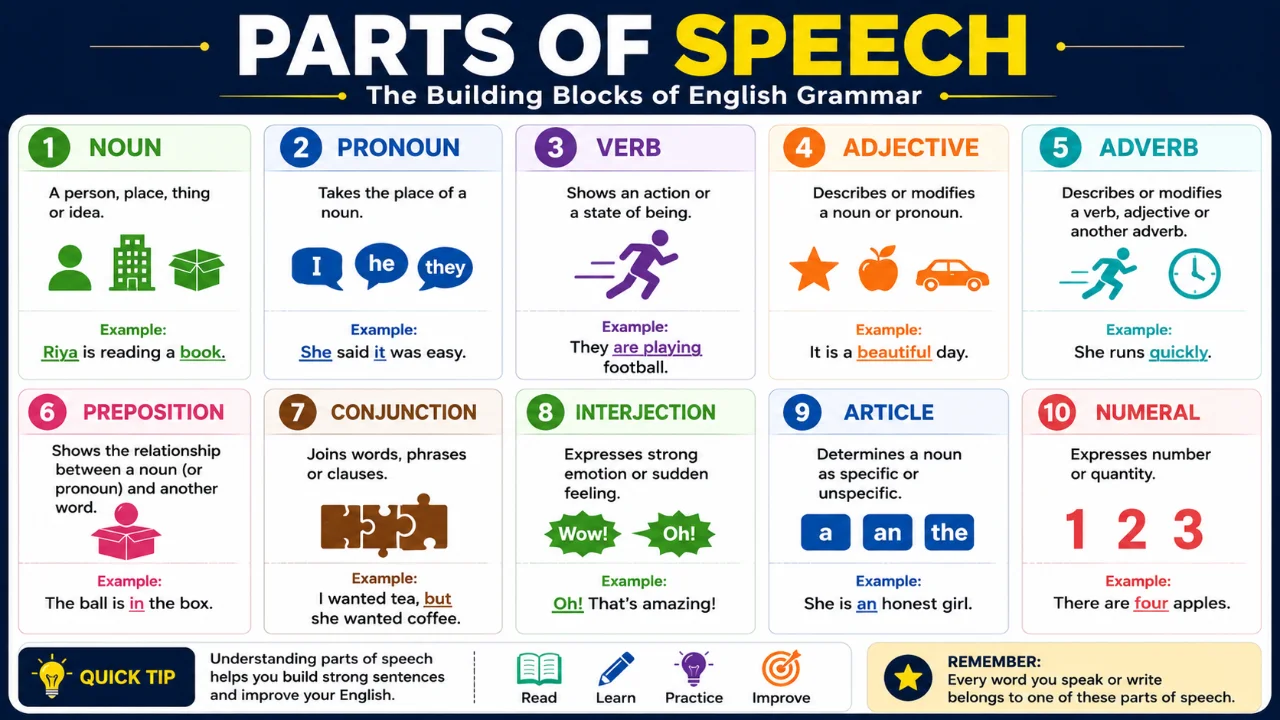
Seeing all eight parts of speech together and comparing them clarifies their functions. Here’s a quick look:
| Part of Speech | Main Function | Example |
|---|---|---|
| Noun | Names a person, place, thing, or idea | Rohan, Delhi, Book |
| Pronoun | Replaces a noun | He, She, They, It |
| Verb | Shows an action or state of being | Eat, Read, Is, Play |
| Adjective | Describes a noun or pronoun | Smart, Red, Fast |
| Adverb | Modifies a verb, adjective, or another adverb | Quickly, Carefully, Very |
| Preposition | Shows the relationship between a noun/pronoun and other words | On, In, Under, Behind |
| Conjunction | Connects words, phrases, or clauses | And, But, Because |
| Interjection | Expresses strong emotion | Wow, Alas, Oh |
This basic structure helps identify the role of each word in a sentence. The remaining four are Adverb, Preposition, Conjunction, and Interjection.
Noun and Pronoun: The Building Blocks of Sentences
A Noun is the most straightforward part of a sentence. It’s the name of anything we can see, touch, or feel – a person, place, thing, or concept. Without nouns, it’s almost impossible to start a conversation because they tell us what we’re talking about. For instance, ‘dog’, ‘London’, ‘happiness’, and ‘Maria’ are all nouns.
Pronouns, on the other hand, make language more elegant and less repetitive. Imagine saying, ‘Amit is a good boy. Amit goes to school. Amit’s studies are good.’ It sounds awkward. Pronouns like ‘he’ or ‘his’ replace ‘Amit’ to avoid this repetition. Maintaining the correct balance between nouns and pronouns is the first step to good sentence construction, preventing unnecessary heaviness in your writing.
Verb and Adverb: Actions and How They’re Done
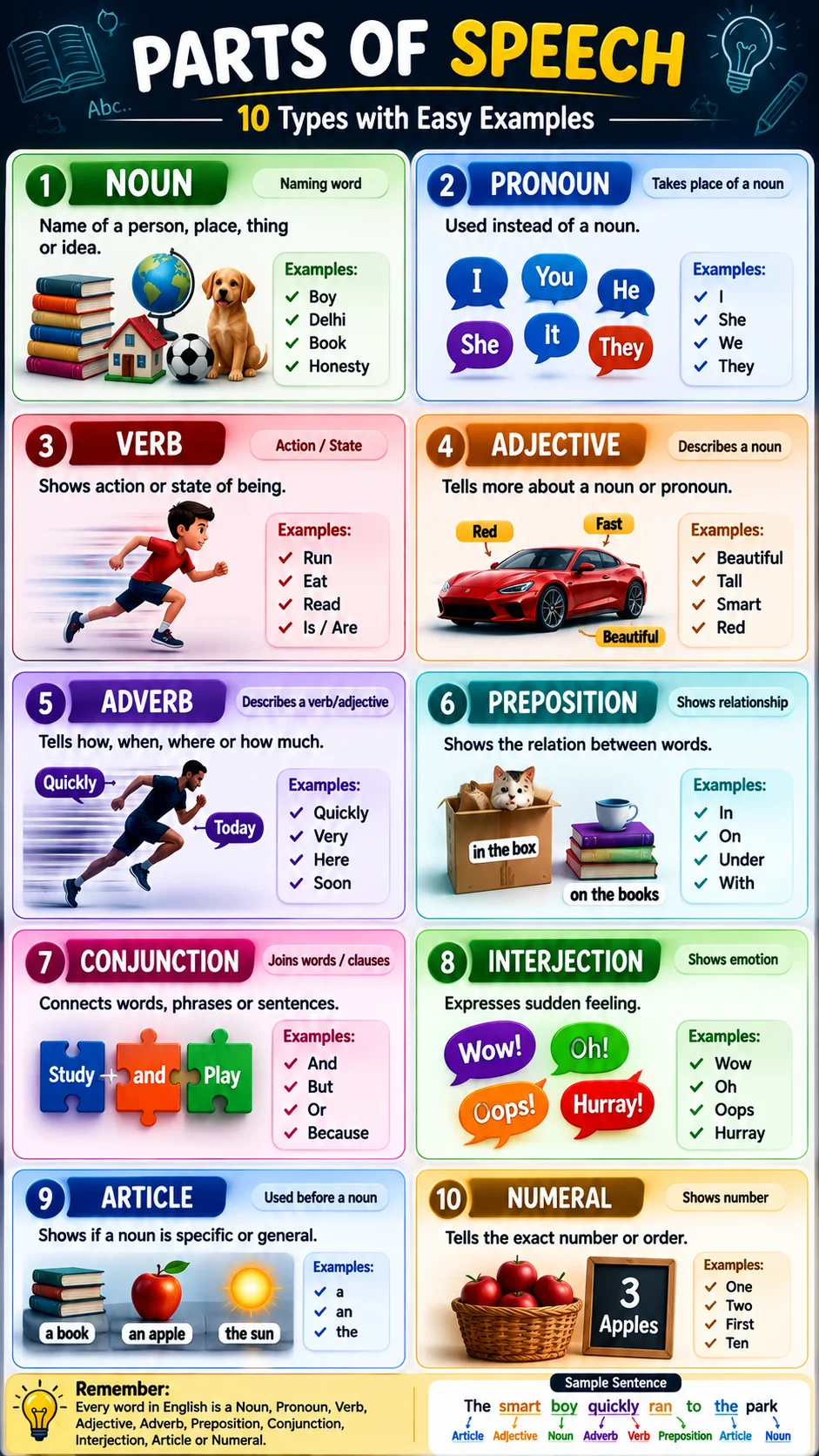
The Verb is the engine of any sentence. No sentence is complete without a verb because it describes an action or a state of being. ‘Writing’, ‘running’, ‘thinking’, or simply ‘is’/’am’/’are’ all fall under verbs.
An Adverb complements the verb, describing how, when, or where an action occurs. If someone is driving, are they driving ‘fast’ or ‘carefully’? The adverb provides this clarity. A common confusion is between adjectives and adverbs. The simple rule is: adjectives describe nouns/pronouns, while adverbs describe verbs, adjectives, or other adverbs, focusing on the manner or time of an action.
FACT: The English word ‘Run’ can function as both a noun and a verb depending on the context. This highlights that a word’s identity is determined by its function in the sentence, not just its spelling.
Adjective and Preposition: Describing and Relating
An Adjective adds color to a description. It provides details about a noun’s size, color, quality, or number. Saying ‘an old book’ or ‘fresh fruit’ creates a precise image in the mind, thanks to the adjective.
A Preposition establishes the relationship and direction between words. It tells us if an object is ‘on’ the table, ‘in’ the room, or ‘behind’ the wall. Misusing prepositions can completely alter the meaning of a sentence. Mastering these relational words is vital for fluency, as small errors here are often noticed.
Conjunction and Interjection: Connecting and Expressing
A Conjunction acts as a bridge, linking different ideas, words, or clauses. Words like ‘and’, ‘but’, ‘because’, and ‘although’ bring scattered thoughts together, allowing conversations to flow smoothly.
An Interjection stands slightly apart from strict grammar rules. It instantly expresses sudden human emotions like joy, sadness, surprise, or fear. Words such as ‘Wow!’, ‘Alas!’, or ‘Oh!’ convey direct feelings from the heart.
Together, these parts of speech add not just grammatical structure but also a genuine human touch to language.
Easy Ways to Remember the Chart and Avoid Mistakes
Instead of just memorizing grammar rules, apply them to your surroundings. When you read a new sentence, mentally identify the subject and the action. A common mistake is assigning a permanent category to a word. In English, a word can change its role based on context. Always prioritize the word’s function over its perceived identity. Analyzing simple sentences daily will make this process natural within weeks.
Vivek Bhai’s Advice
The biggest hurdle in learning English grammar is trying to memorize it like complex math formulas. Language is a tool for communication, not a cage of rules. Getting caught up in labeling every word can kill the spontaneity of speaking. Remember, a word doesn’t have a fixed identity; its role is determined by the sentence’s context. For example, ‘Water’ can be a noun (H2O) or a verb (‘Water the plants’). Understanding this difference is the real learning.
💡 Tip: Don’t memorize grammar rules; observe what each word does in a sentence. If you want to improve your English, spend ten minutes daily reading simple texts and notice how the author uses words. Gradually, your mind will pick up these patterns without stress.
Frequently Asked Questions
How many Parts of Speech are there in English?
There are primarily 8 Parts of Speech in English grammar: Noun, Pronoun, Verb, Adjective, Adverb, Preposition, Conjunction, and Interjection. Some modern grammars also count Articles and Determiners separately.
How does a word change its Part of Speech in a sentence?
A word’s category depends on its function. For instance, ‘Love’ can be a noun (e.g., ‘Love is blind’) or a verb (e.g., ‘I love pizza’), determined by its usage in the sentence.
What is the main difference between Adjective and Adverb?
An Adjective always describes a Noun or Pronoun. An Adverb, however, describes a Verb, Adjective, or another Adverb, clarifying the manner, time, or place of an action.
Can a complete sentence be formed without a Verb?
No, in English, a complete and meaningful sentence cannot be formed without a main verb or a helping verb.