Red velvet mite: the bright monsoon visitor
A tiny crimson animal moving over damp earth can bring back vivid monsoon memories. In parts of India, names such as Bir Bahuti are associated with red velvet mites. Recognising a familiar appearance is a starting point, but it leaves useful questions: is this an insect, what should you record, and how certain can a photograph be?
Local names are not universal species labels. This guide concerns red velvet mites; it cannot assign every red animal found in a garden to that group. Record the animal you actually saw before choosing a scientific name.
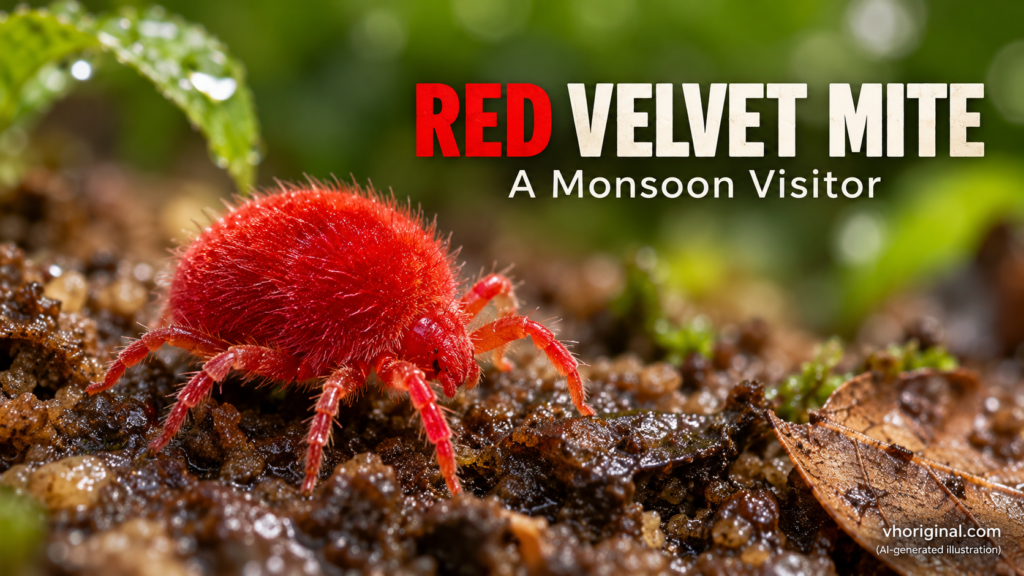
All three images are AI-generated conceptual scenes. They are not real field photographs, locality records or proof of species identity. Institutional source pages below provide real reference photographs.
Identification clues to look for
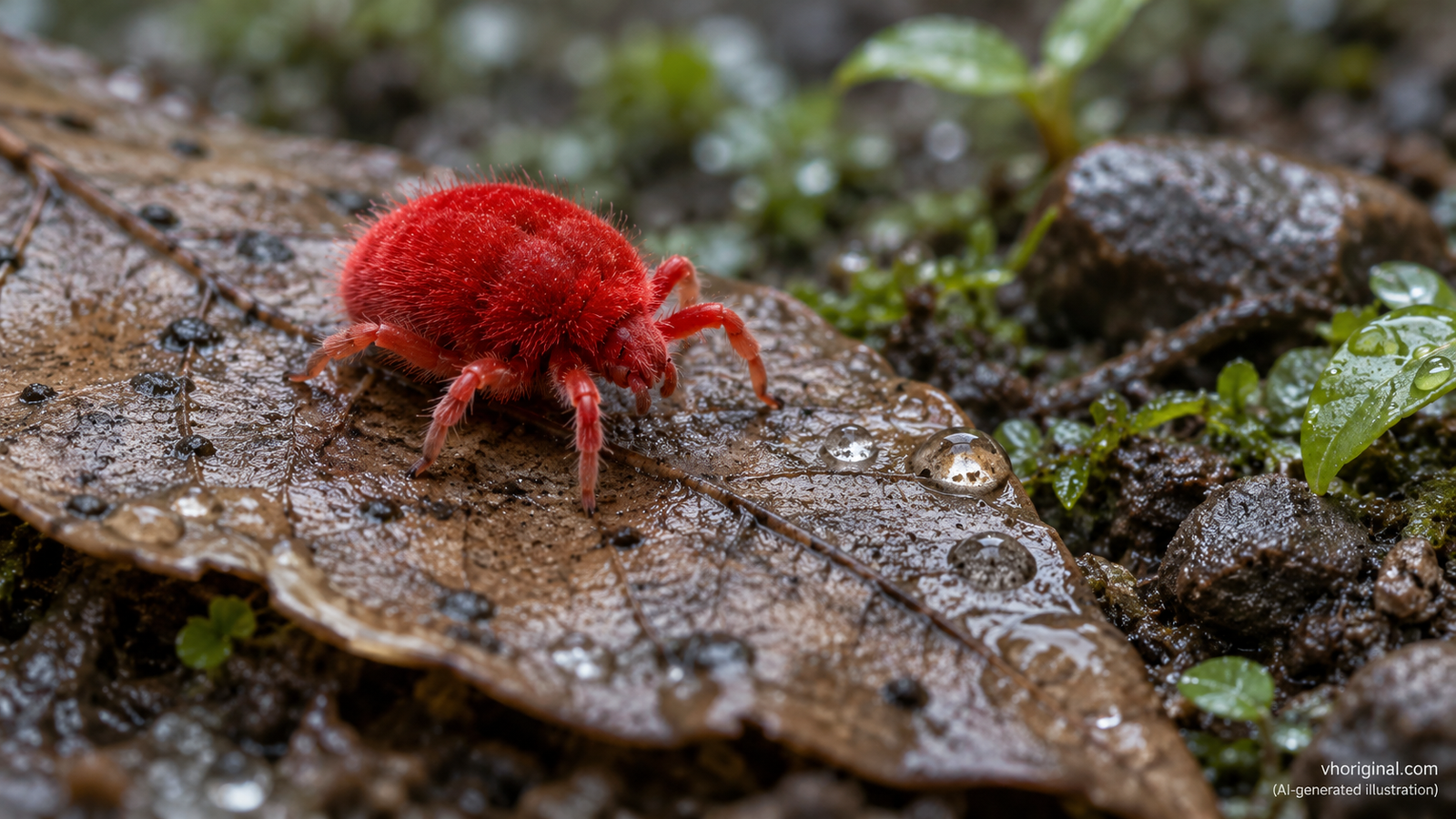
True velvet mites belong to the family Trombidiidae. A velvety covering, commonly bright red colour and rounded or oval body offer preliminary clues. No one colour or surface texture is sufficient by itself.
Adults have eight legs, unlike six-legged insects. Their larvae have six legs, so the adult rule is not a universal life-stage test. Legs may also be hidden in a blurred photograph.
Missouri Department of Conservation notes that specialists examine minute anatomical characters to determine genus and species. A generated image or a general phone photograph cannot reliably establish a name such as Trombidium grandissimum.
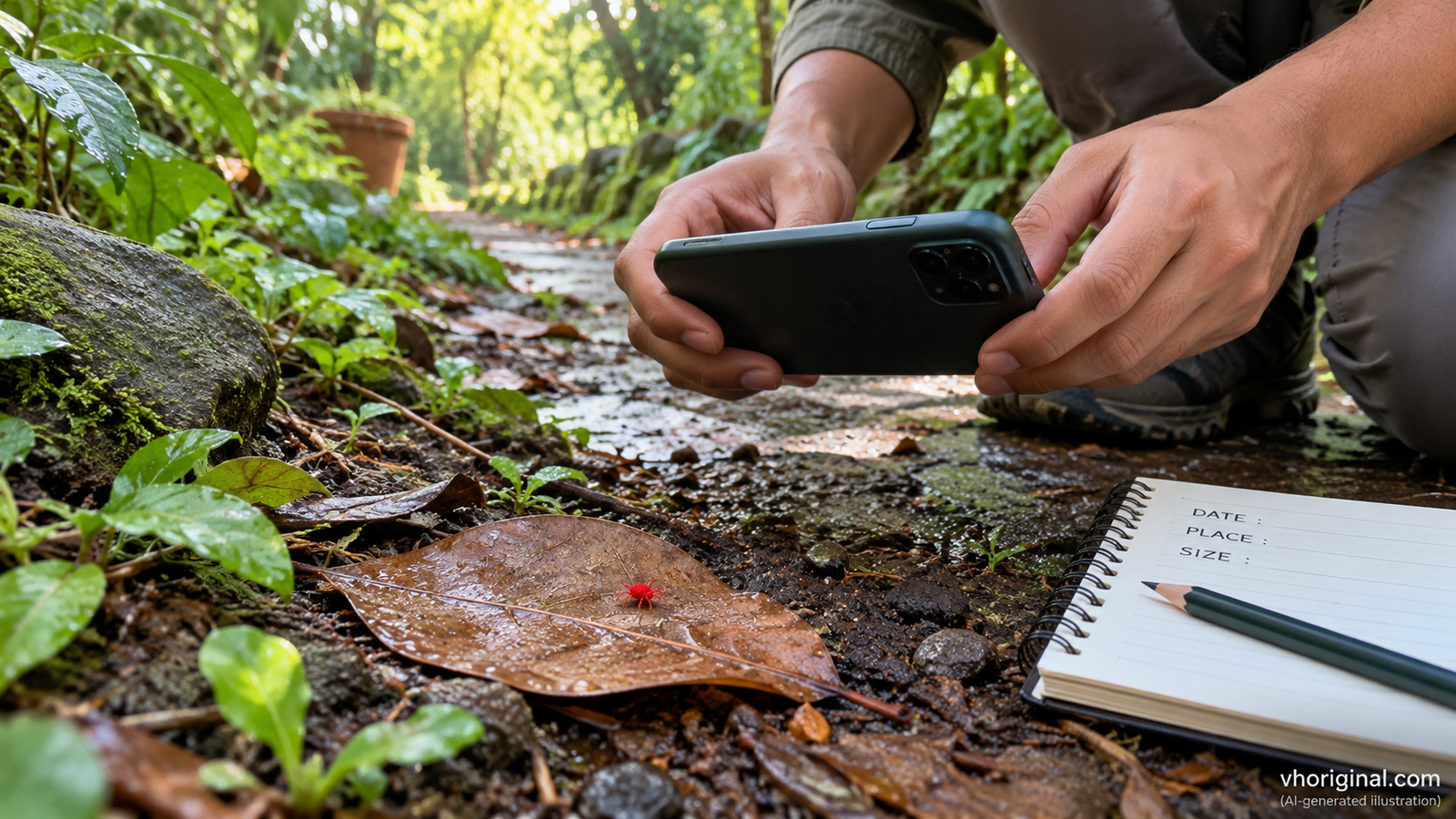
Do not estimate body size from a macro image filling the frame. Camera distance makes a small animal look enormous. An existing nearby object may provide context, but do not capture the animal or block its movement simply to place a ruler.
Why does it appear after rain?
The January 2018 issue of ICFRE’s Van Sangyan discusses an Indian red velvet mite and records names including Birbahut, Rani Kida and rain mite. It associates surface appearance with rain. That is Indian context, not a promise of the same timing or abundance everywhere.
A foreign guide mentioning spring or a particular month is not a calendar for Madhya Pradesh, Maharashtra or Bengal. Local habitat and species may differ. Your observation’s actual date and recent weather are more useful than importing a seasonal label.
An animal appearing after rain was not necessarily created by rainwater. Surface visibility and the beginning of a life are separate events. One sighting also cannot establish a regional population trend.
Are true velvet mites harmful to people?
University of Minnesota Extension describes correctly identified velvet mites as harmless to people and gardens. Adults consume small arthropods and eggs, while larvae may parasitise other arthropods. A red colour alone is not a reason to label the animal a crop pest.
Whether an unknown animal is safe depends first on identification. General information about true velvet mites is not permission to rub an animal on skin, pick it up or ingest it. Observation and photography do not require contact.
If itching or a skin problem follows time outdoors, do not assign the cause to a nearby red animal merely because you saw it. A nature photograph does not diagnose a skin condition. Seek medical advice if symptoms persist or worsen; this is not a treatment guide.
This article recommends no mite oil, home remedy or medicinal use. A traditional name or story is not clinical evidence for a treatment. Leave wildlife in its natural setting.
Not every red creature is Bir Bahuti
Chiggers are larval mites in the family Trombiculidae, distinct from true velvet mites in Trombidiidae. The MDC field guide explains the distinction. Similar family names can encourage an incorrect assumption that every red mite is a biting chigger.
Tiny red dots on foliage together with plant damage or fine webbing require their own investigation. Do not automatically apply a ground-dwelling velvet-mite description to a plant problem. A red beetle or another six-legged animal may belong to a different group altogether.
FACT: Red colour, recent rain and a local name are clues, not a final species identification. Do not use AI to invent missing anatomical detail and then treat it as evidence.
A cautious caption can say “resembles a red velvet mite; identification unconfirmed.” Add a species only when adequate expert confirmation supports it. A stock image from another location is not a record of your village.
Advice: photograph without disturbing
Take an environmental photograph showing the soil, leaf or surface first. Then obtain a sharp close-up and another angle if possible without touching. Retain original files; a heavily sharpened crop can remove important context.
Record date, district or region, recent rain, whether it was on soil or a plant, and the basis of any size estimate. A public post need not expose your exact home location. A short video may document movement.
Let children observe from a distance. Bottling animals, collecting them for sale, crushing them to inspect colour or repositioning them for a shot is unnecessary. Get an unknown animal identified before deciding that pesticides are warranted.
A local agricultural extension centre, university entomology department or biodiversity specialist may help. Send actual photographs with context, not one of this article’s AI scenes as though it were your specimen.
An honest caption might read: “Red velvet-mite-like animal on soil after rain; district recorded; species not confirmed.” Revise it when evidence improves. Do not label an AI scene an original zoom photograph for image search.
Five frequently asked questions
Is Bir Bahuti an insect? The red velvet mite is a mite in the arachnid group; everyday “bug” wording is less precise.
Are all red mites harmless? Colour alone cannot establish that.
Does rain create them? A post-rain sighting is not evidence of their origin.
Can a photograph prove exact species? Not always; specialist examination may be needed.
Are these authentic macro photographs? No; they are AI illustrations, with links to real reference sources below.
Sources and AI illustration disclosure
General nature education, not definitive specimen identification or medical advice. All three images are AI-generated conceptual illustrations; their anatomy and apparent scale are not reliable identification measurements. Sources checked: 24 October 2026.
- ICFRE / TFRI: Van Sangyan, January 2018, Red velvet mite, printed pages 5–6
- Missouri Department of Conservation: true velvet mites, anatomy and similar groups
- University of Minnesota Extension: velvet mites and their ecological role
- University of Maryland Extension: 26 May 2023 IPM report, mites active in landscapes
Understand the difference between illustrations and real-photo claims