
Nominee not getting money from the bank: what to do first
After a family member’s death, you are the registered nominee, but the branch demands a succession certificate or NOCs from every heir. Check the nomination record and submit the correct claim with an acknowledgment. Ask for the written basis of extra requirements. An eligible nominee deposit claim should not routinely be treated as a no-nomination succession case.
The direct answer: for an ordinary bank deposit with valid nomination, subject to death/identity verification and absence of a restraining competent-court order, routine succession, probate and indemnity/surety requirements should not be imposed. Submit the signed nominee/survivor claim form, death certificate and acceptable identity/address document. Nomination does not eliminate genuine verification or every lawful restriction.
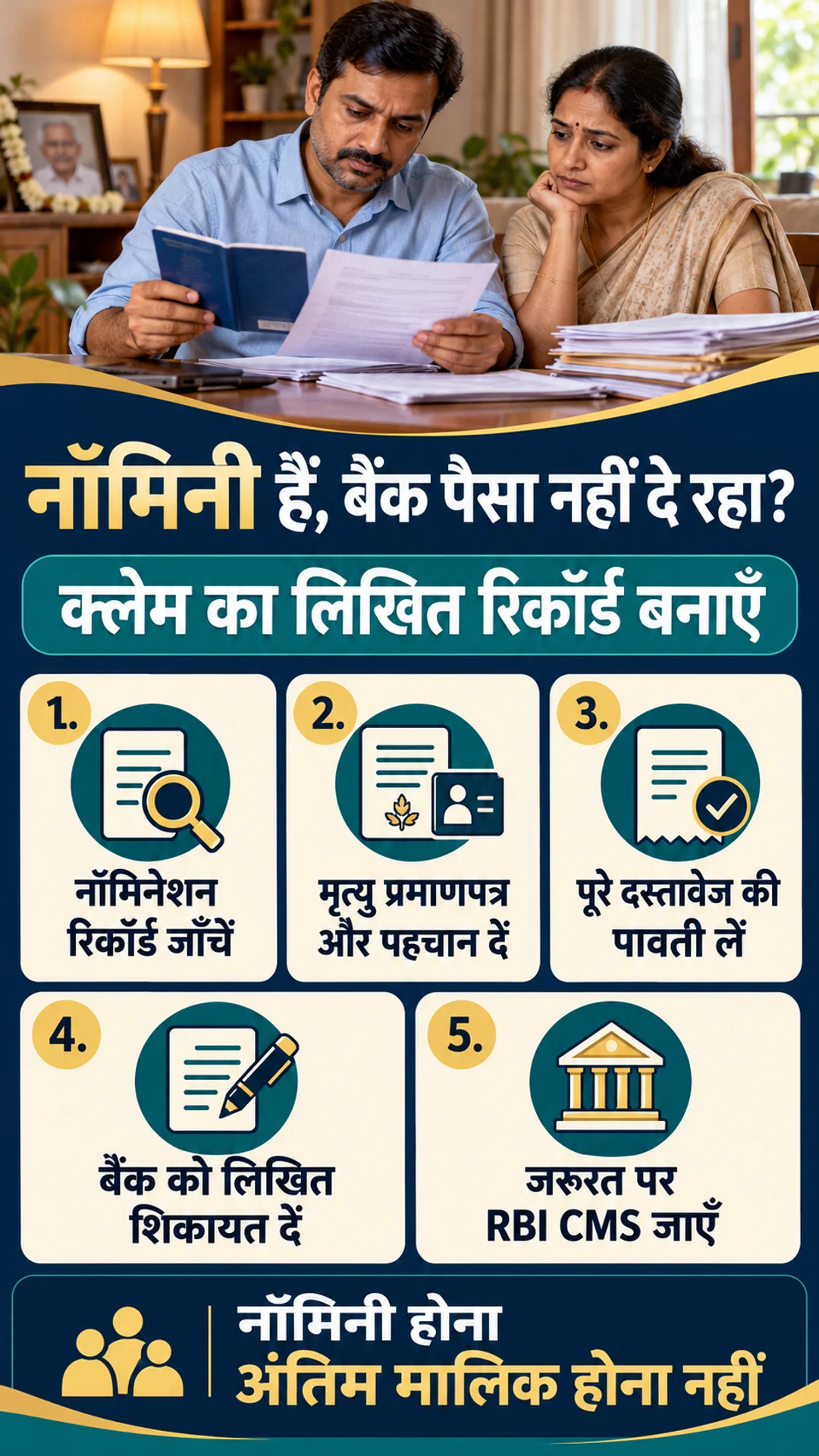
- Ask the bank to confirm the recorded nomination.
- Use its nominee/survivor claim form.
- Submit death and identity/address evidence.
- Obtain the complete-document receipt date and reference.
- Complain in writing about unsupported demands or delay.
RBI rules: the old circular and the position in 2026
The 2005 circular DBOD.No.Leg.BC.95/09.07.005/2004-05 is often quoted in older guides. The September 2025 deceased-customer directions standardised procedures and included repeal provisions for older instructions. Requirements were subsequently consolidated into bank-category Responsible Business Conduct Directions. Do not label the 2005 circular alone as the latest governing framework.
The RBI commercial-bank master-direction page reviewed for this article shows an update through 1 October 2026. Central Bank of India’s official 2026–27 policy also sets out nominee documentation, fifteen calendar days and delay compensation. Check the current directions for your bank category and its published claim policy. An annexure number used by one bank is not a universal numbered form for every institution.
This article concerns ordinary savings, current and term deposits. Government savings schemes administered through banks, such as PPF or SCSS, follow their respective scheme rules for deceased claims. Insurance, mutual funds, demat assets and pensions also have separate frameworks. Do not carry a bank-deposit rule across all products merely because each has a nominee.
Nominee, legal heir and joint-account survivor are different
FACT: nomination can authorise receipt from the bank without deciding final beneficial ownership against the legal heirs. The RBI process makes clear that the recipient holds the proceeds as trustee for the heirs and their claims are not extinguished. Applicable succession law, a will and competent orders govern eventual entitlement. Bank payment and distribution within the estate are separate questions.
For a joint deposit account, the nominee’s right generally arises only after all depositors have died. When one holder survives, examine the account mandate and survivorship clause. “Either or Survivor” and designation of a separate nominee are different arrangements. Do not tell a nominee that the first holder’s death always creates an immediate right to receive the whole joint balance.
Premature termination of a joint FD can also differ from payment at maturity. Consent of surviving holders and the deceased holder’s heirs, or a specific previously furnished mandate, may matter. Request separate clarification of maturity, early closure and survivorship instructions. A general nominee rule is not an unconditional right to break every joint FD immediately.
A minor nominee, identity mismatch or missing nomination entry may require appropriate guardianship or record verification. Any relative cannot receive a minor’s money merely by asserting the relationship. For multiple nominees, check the registered arrangement and payable shares; do not assume the first person named receives everything.
Documents to submit and additional demands to question
Complete the bank’s correct claim form with the deceased customer, death date, account/FD and claimant details. Death evidence and an Officially Valid Document establish death, identity and address. Provide accurate payment-account information. An available passbook, FD receipt and nomination acknowledgment help locate the records; missing personal copies should lead to examination of the bank’s nomination records.
- Signed nominee/survivor claim form.
- Death certificate of the depositor.
- Acceptable claimant identity and address document.
- Available deposit and nomination references.
- Applicable minor, overseas-death or court-order records where relevant.
Question a routine demand for NOCs from every heir that has been copied from a no-nomination procedure into an eligible nominee claim. Ask which category the bank has assigned and the current rule supporting the request. “That is our branch practice” is not a meaningful legal explanation. However, refusing legitimate identity verification can prevent completion of the claim.
A succession certificate and a legal-heir certificate are not interchangeable documents. Claims without valid nomination, disputed succession or other exceptional facts can follow different routes. If the nomination entry is missing, request examination of an old acknowledgment and underlying records. Never create a new nomination or sign in the deceased person’s name after death.
A competent-court payment restraint must be respected. A freeze, attachment, genuine verification issue or lawful adjustment/set-off also needs examination. Ask for the reason and applicable authority rather than assuming nominee status automatically removes every restriction or liability. Separate an unsupported paperwork demand from a documented legal obstacle.
Fifteen days and compensation for bank-caused delay
The ordinary deceased-deposit settlement period is fifteen calendar days from receipt of all required documents. Calendar days are not working days. An initial enquiry, incomplete form and complete claim are different milestones. Ask the bank to acknowledge completion and identify any remaining deficiency specifically. The documented starting date is central to a delay claim.
For delay attributable to the bank, the applicable framework provides compensation as interest on the settlement amount for the delayed period, at not less than the prevailing Bank Rate plus four percentage points per annum. Bank Rate is not the repo rate. The reference date for the amount and prevailing rate is receipt of all required documents; request the relevant rate and breakup.
This is not a fixed daily rupee fine for a bank deposit. Locker/safe-custody procedure and daily compensation are different and should not be applied to the deposit balance. Ask for the reason for delay, responsibility and the applicable calculation. A court restraint or genuinely missing claimant documents does not automatically establish bank-attributable delay.
Contractual FD interest, maturity/early-closure calculation and delay compensation are separate items. Request principal, ordinary interest, adjustments and eligible compensation separately in the final statement. Do not apply a guessed current Bank Rate to every historical claim or treat a compensation provision as automatic proof of a particular payment amount.
Adaptable letter to the branch and grievance officer
This general request supplements the prescribed claim form; it does not replace it. Use accurate facts and obtain receiving on a second copy or an acknowledgment through the bank’s official grievance channel. Do not publish account numbers or identity documents on public social-media pages.
To: Branch Manager / Grievance Officer, [bank/branch]
Subject: Deceased depositor [name], account/FD [last digits] — nominee claim and additional documentation
I am [name], the nominee recorded by the bank. The depositor died on [date]. I submitted the claim form, death certificate and identity/address documents on [date], reference [ ].
Please confirm valid nomination and the date all required documents were received. Provide an itemised written deficiency list if anything necessary remains outstanding.
I have been asked for [succession certificate/other document]. The current RBI process for an eligible nominee deposit claim does not routinely require additional succession/probate/indemnity formalities. Please explain the applicable rule and specific reason for this request. Identify any court restraint or other legal obstacle, if applicable.
Please settle within the applicable fifteen-calendar-day period from receipt of complete documents. If delay is attributable to the bank, provide the applicable Bank Rate plus 4% per annum compensation calculation and payment.
Please supply a written reply, settlement breakup and grievance reference.
Name, safe contact, date, signature
Attachments: claim and receipt, death/identity evidence and relevant correspondence.
Record the original claim date separately from the date of the formal service-deficiency complaint. If an unsupported demand is already clear, register the complaint and obtain proof immediately. A missed fifteen-day claim deadline can justify escalation within the bank, but it does not make every immediate CMS filing admissible without the required prior complaint.
RBI CMS: when and how to complain in 2026
First complain to the bank in writing and keep proof. An unsatisfactory reply/resolution may permit escalation. If there is no reply, examine the ordinary thirty-day requirement or an applicable longer RBI/NPCI/card-network timeline. The fifteen-day settlement deadline and the Ombudsman prior-complaint timeline are distinct.
RBI’s July 2026 FAQ confirms RB-IOS, 2026. A complaint must be filed within ninety days from expiry of the applicable response timeline or the bank’s last communication, whichever is later. Do not copy the old one-year limit into a new complaint. Earlier pending matters may follow transitional provisions; compare your dates with the current official FAQ.
On CMS, identify the covered bank and branch, claimant details, prior complaint reference/date, bank response, complete-document receipt and relief sought. Requests can include proper settlement, explanation of extra requirements, the balance/interest statement and eligible delay compensation. Follow current fields and attachment instructions, and preserve the acknowledgment. Filing is not an automatic award.
Complaint redress under the Scheme is free. Some entities are outside coverage, so check the FAQ. The same grievance pending before, or dealt with on merits by, a court or tribunal can affect maintainability. The Ombudsman addresses banking-service deficiencies; it is not a general replacement for resolving final inheritance shares between family members.
Advice, related reading and five FAQs
Advice
Keep submitted documents, receipts, emails and dates in one file. Ask for a written claim category and deficiency list instead of relying on repeated verbal visits. Receiving the money does not justify rejecting legal heirs’ rights. If there is a genuine estate dispute, obtain separate advice about distribution and bank claim processing.
- Cyber-cell bank account freeze: complaints and court relief
- Bank set-off and salary-account loan deductions
Must every nominee obtain a succession certificate?
Not routinely for an eligible valid-nomination deposit claim. Death, identity and payment restrictions still need examination.
Are NOCs from all heirs always necessary?
Do not treat them as a routine valid-nominee requirement. Other claim categories can require different documents.
Can the nominee keep all the money personally?
Nomination alone does not determine final beneficial ownership; heirs may retain rights.
Can I go directly to CMS after fifteen days?
Check prior bank complaint and current Ombudsman admissibility rules. Settlement and grievance deadlines differ.
Does a deposit delay mean ₹5,000 per day?
Do not import locker compensation into a deposit claim. Eligible bank-caused deposit delay has a separate interest-based rule.
- RBI: Commercial Banks Responsible Business Conduct Directions — current master page
- RBI: September 2025 deceased-claim framework and historical transition
- Central Bank of India: official 2026–27 deceased-claim policy
- RBI: Integrated Ombudsman Scheme 2026 FAQ
- RBI CMS complaint portal
Disclaimer: General legal and banking information. Bank category, mandate, nomination, court orders and scheme rules affect outcomes. Fact-checked: 13 October 2026.