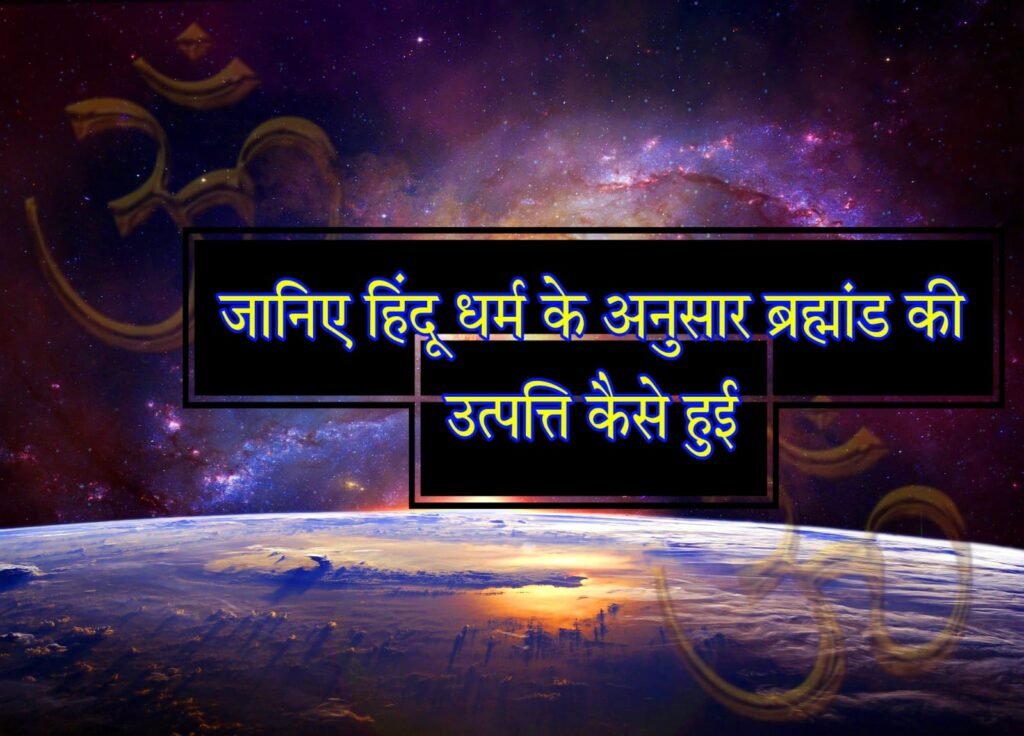
How did anything begin? That question is older than any one book. In Hindu cosmology, the creation of the universe is not told as a single blast that happened once and then stopped. Time is pictured as a wheel: the world is made, held, dissolved, and made again. This article stays with that Puranic and philosophical picture—as belief and traditional account, not as a laboratory result.
Every culture has tried to name the first moment. Hindu thought does it with a long memory of cycles, a formless source called Parabrahman, the sound Om, a golden womb called Hiranyagarbha, the three functions of Brahma, Vishnu, and Shiva, and five elements that become planets, stars, and living bodies. The scales are huge. The tone is spiritual as much as physical. Read it as a map of faith and story, then keep science in its own lane.
Why Hindu Cosmology Treats Time as a Cycle, Not a Straight Line
Many school textbooks treat time as a line: a start, a middle, an end. Hindu cosmology, as the source tradition tells it, does not work that way. Time is cyclic. The same three movements keep returning: srishti (creation), sthiti (maintenance), and samhara (dissolution). There is a beginning of a world-age, but not a final full stop after which nothing can ever exist again. When one universe-phase ends, another phase is said to follow.
That difference matters. On a straight line, creation is a one-time event and destruction is a last chapter. On a wheel, destruction is also a pause and a clearing. The source calls the great winding-down pralaya—the cosmos dissolving back into Brahma during his “night.” After that night, a day of making begins again. Even Brahma is not treated as the last word. After a full span of Brahma’s own life, tradition speaks of a still larger dissolution, mahapralaya, after which a new Brahma arises. The story is not “God made the world and closed the shop.” It is “the world keeps being breathed out and breathed in.”
This is a religious and philosophical claim, not a measured proof. It does not cancel physics. It also does not need physics to be meaningful to a believer. What it does give the reader is a different mood: the universe is not a dead machine that started by accident and will freeze into silence forever. In this telling it is a living process, tied to consciousness, and the human being is a small part of a drama that is older and larger than one lifetime. That mood is why the next units—kalpa, manvantara, yuga—are not just calendar trivia. They are the clock of that wheel.
Kalpa, Manvantara, and the Four Yugas
To talk about Hindu cosmology without the time-units is like talking about a clock without hours. The first large unit named in the source is the kalpa, also called one day of Brahma. The source gives a clear number here: one kalpa equals 4.32 billion human years. During that day, Brahma is said to fashion creation, and the created world lasts until that day ends. Brahma’s night is described as equally long. In that night the whole cosmos is said to merge back into Brahma. That night-phase is pralaya.
The same rhythm is said to run for 100 years of Brahma. After that span, Brahma himself is said to dissolve in mahapralaya, and a new Brahma arises. Again: this is traditional cosmology, not a dated astronomical observation. The source notes that the vastness of these numbers feels surprisingly close, in spirit, to modern talk of a universe that expands and later contracts. That is a comparison offered by the article’s own framing. Similarity of scale is not the same thing as identity of mechanism.
One kalpa is then cut into smaller ages. The source divides a kalpa into 14 manvantaras. Each manvantara contains 71 mahayugas. One mahayuga is a set of four yugas, named and characterised as follows:
Satyayuga (also called Krita): described as a golden age of dharma, knowledge, and tapasya. Tretayuga: dharma is said to decline somewhat; avatars such as Rama are said to appear. Dwaparyuga: dharma declines further; avatars such as Krishna are said to appear. Kaliyuga: dharma at its lowest, an age of adharma and conflict, and the age tradition says is running now.
The source does not list a separate year-count for each yuga. It only says these ages are measured on a scale of billions of human years, which is its way of stressing how large the Hindu clock is. Stay with that. Adding extra tables would be invention. What the four-yuga cycle does, inside the story, is moral as well as temporal: righteousness is not imagined as a flat line. It waxes and wanes. Avatars, in this telling, arrive when the balance slips. Kaliyuga is not “the world is worthless.” It is “this is the hard stretch of the wheel.” That is belief language. A reader can respect it without treating it as a news headline about the year’s crime rate.
Parabrahman and Om: How Hindu Cosmology Frames the Creation of the Universe
Here the source is blunt about a point many creation stories argue over. In this Hindu cosmology, the creation of the universe does not start from a blank nothing. It starts from a supreme consciousness named Parabrahman or Paramatma. That source is described as formless (nirakara), without attributes (nirguna), and indestructible. It is called the root of all that exists. So the first philosophical move is not “zero, then stuff.” It is “an unmanifest fullness, then expression.”
The first expression named is sound. When, in the story, there was not yet a formed world, only the resonance of Om is said to have been present. Om is treated as the first utterance of Parabrahman and as the seed-mantra of the cosmos. The vibration of that sound is called the base on which the rest of creation stands. This is a faith-claim about origin, not a recording from a microphone at the edge of space. Yoga and meditation traditions treat the chanting of Om as a way of aligning with that same primordial sound and with a wider cosmic energy. That is how practitioners talk about the syllable. It is practice and symbolism, not a substitute for astrophysics.
Hold the two layers together and the picture is clear. Layer one: a formless source that does not begin or end. Layer two: a first vibration that is already “something,” even before planets and bodies. Hindu cosmology uses that pair to answer a child’s question—“if God made the world, what was God standing on?”—without sliding into a cheap empty-void story. Parabrahman is not imagined as a person sitting on a chair outside the universe. It is imagined as the ground of being itself. Om is the first ripple on that ground. Everything that follows in the Puranic narrative—egg, gods, elements—grows from that ripple. Whether a reader takes this as metaphysics, poetry, or living shraddha, the source’s sequence should be kept intact and not mixed with later scientific slogans as if they were the same sentence.
FACT BOX
In the source’s traditional time-scheme, one kalpa—one day of Brahma—is given as 4.32 billion human years. Brahma’s night is described as equally long; during that night the cosmos is said to dissolve in pralaya. A kalpa is divided into 14 manvantaras, and each manvantara into 71 mahayugas. A mahayuga is the four-yuga set of Satya (Krita), Treta, Dwapar, and Kali. After 100 years of Brahma, tradition speaks of mahapralaya and the arising of a new Brahma. These figures belong to the religious calendar of the story. They are not laboratory measurements, and this article does not add extra year-counts the source does not give.
Hiranyagarbha: The Golden Womb in Puranic Accounts
After Om, the source names a second great image: Hiranyagarbha, the “golden egg” or “golden womb.” From Parabrahman, with the sounding of Om, Hiranyagarbha is said to arise. It is called the cosmic seed in which the whole of creation was already contained. The source also calls it a vast mass of energy from which the universe later expanded. Some texts, the source adds, speak of it simply as an anda—an egg—from within which Brahma appeared.
Read that slowly. The golden womb is not a farmyard metaphor for decoration. In the story it does three jobs at once. It is a container: everything that will be is already in it. It is a beginning: form starts here, after the formless. And it is an energy-image: not a cold stone, but a glowing mass that can unfold. When later writers compare this to a universe that expands from a dense early state, they are doing an analogy. The Puranic image is older than that analogy and does not depend on it. Hiranyagarbha remains a religious symbol even if a physicist never mentions it.
The egg also explains why Brahma can be “born” without making Parabrahman smaller. The source will next say that Brahma appears on a lotus from Vishnu’s navel, and that Vishnu himself is a form of Parabrahman. Those are stacked images, not a family tree of three unrelated gods fighting for credit. Hiranyagarbha sits in the middle of the stack: from the unmanifest, a seed; from the seed, a creator-function; from the creator-function, minds, gods, sages, and human beings. If the language feels layered, that is because the tradition is layered. Flattening it into one cartoon panel—“an old man hatched from a gold egg”—misses the point the source is making. The point is origin from fullness, not origin from trash-empty space.
The Trimurti: Creation, Preservation, and Dissolution
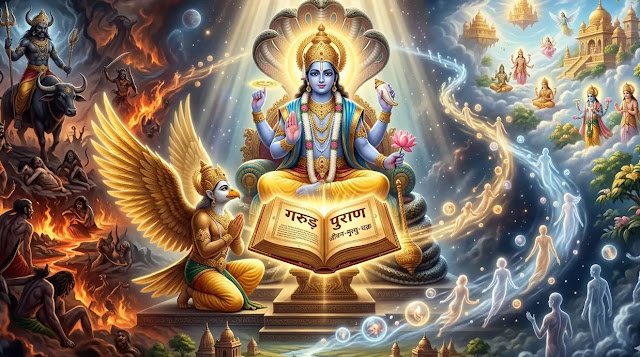
Once a world-phase exists, Hindu cosmology assigns three offices. They are the Trimurti. The source treats them as the deities responsible for running creation, not as three rival owners of the sky.
Brahma, the maker
After appearing from Hiranyagarbha, Brahma is given the work of building the world. He is called knower of the Vedas and a symbol of knowledge. In the Puranic narrative used here, Brahma appears on a lotus that rises from Vishnu’s navel. The source reads that image as a teaching: the root of creation is Vishnu, and Vishnu is himself a form of Parabrahman. Brahma then creates, from his mind, various prajapatis, deities, rishis, and humankind. Mental creation is part of the story. It is not a biology textbook. It is a way of saying that order, types of beings, and the possibility of knowledge come out of a conscious source, not out of a blind splash.
Vishnu, the holder
Vishnu is the preserver. He is said to keep the cosmos, hold its balance, and descend as avatars—the source names Rama and Krishna—when adharma rises and needs to be checked. His dwelling, in the same narrative, is on Shesha in the Kshirasagara, the ocean of milk, where he remains in yoganidra. When he wakes, the cycle of creation is said to start again. Preservation, in this telling, is not laziness. It is the long middle of the wheel: worlds need holding, not only making and breaking.
Shiva, the dissolver who makes room for birth
Shiva is named as the god of dissolution and of rebirth. At pralaya he is said to draw the entire creation back into himself so a new cycle can begin. The source is careful here: Shiva is not only an end. He is also change and renewal. His Tandava is described as the dance that shows rhythmic destruction and re-creation together. That is why calling him “only the destroyer” is thinner than the tradition the source is using. Without a dissolving function, the wheel would jam. Without a renewing function, dissolution would be mere ruin. The story holds both.
Taken as a set, the three offices match the three movements of time already named: make, hold, unmake. They are theological roles inside Hindu cosmology, not three lab departments. A respectful reading keeps them in that register.
The Five Great Elements and the Physical Cosmos
How does a mind-born order become mountains, rivers, stars, and bodies? The source’s answer is the panchamahabhuta, the five great elements, which Brahma is said to use, in coordination with the Trimurti, to shape the physical universe:
Akasha (ether/space): the subtlest element, named as the source of sound. Vayu (air): the element of motion and touch. Agni (fire): the element of energy, light, and heat. Jala (water): the element of fluidity and taste. Prithvi (earth): the element of solidity and smell.
These five, the source says, are the physical base of the whole cosmos, including planets, stars, galaxies, and all living beings. Notice the pairing: each element is linked to a quality the senses can know—sound, touch, heat-light, taste, smell—plus a state of matter or space. That is an old Indian way of classifying the world from the inside of experience, not from a particle collider. It is still a map of belief and philosophy. It should not be rewritten as a secret periodic table that modern chemistry “finally confirmed.” Chemistry has its own language. This list has another.
The list also ties back to Om. If sound is first, akasha as the field of sound sits at the subtle end of the chain. Earth sits at the gross end. Between them, air, fire, and water make a ladder from fine to solid. When the source says galaxies and creatures are built from these five, it is saying the visible world is not a fifth, alien stuff. It is the same elements, combined and coarsened. That is why the spiritual conclusion later in the article can claim that a person is not cut off from the cosmos. In this scheme, the body is made of the same five that make the stars. That is traditional cosmology speaking. It is a meaning-claim. Treat it as such.
Hindu Cosmology, Modern Science, and Honest Limits of the Comparison
The source itself makes a comparison and should be quoted in that spirit. It says the huge, cyclic time of Hindu cosmology lines up in a striking way with several ideas in modern cosmology: a very large time-scale, a universe that can expand and contract, and time that does not feel small. It names the astronomer Carl Sagan as someone who found Hindu time-scales compatible with modern scientific cosmology. It also names the Big Bang theory, ideas of expansion and contraction, and the sense of time’s vastness as notions that “somewhere” resemble kalpa, yuga, and pralaya.
That is the source’s claim. It is not a peer-reviewed finding invented here, and it is not a licence to say “the rishis published the Big Bang.” Science measures radiation, expansion rates, and models. Puranic time tells a moral and spiritual cycle with gods, yugas, and pralaya. A resemblance of size—billions of years, not thousands—is interesting. It is not identity. Expansion in physics is not the same event as Brahma opening his day. Contraction in some models is not the same act as Shiva’s Tandava. Keeping those sentences separate is not hostility to faith. It is honesty.
The source adds one more line of interpretation: that ancient rishis tried to understand cosmic puzzles through deep meditation and intuition, and that their conclusions still feel relevant. That is how the tradition describes its own knowing. A reader who lives inside shraddha will hear that as praise of inner seeing. A reader who lives inside the lab will hear it as a different method, not a data table. Both can exist in one article if the labels stay on. Hindu cosmology remains a religious account of the creation of the universe. Modern cosmology remains a scientific account of the early universe. Where the source hears an echo, this rewrite reports the echo—and stops before turning the echo into a press conference.
What This Creation Story Means Spiritually
The source’s last movement is not a formula. It is a meaning. In this Hindu view, the origin of the universe is not only a physical event. It is a spiritual process. The cosmos is called a living, moving whole that keeps passing through creation, nourishment, and change. Human beings are said to be part of that vast drama. The atman, the soul, is called a share of the same eternal cycle. None of that is a measurement. All of it is the teaching the story wants to leave in the chest, not only in the head.
What follows from that teaching, in the source’s own words of sense rather than of command, is a wider view of life. A person can see that a single lifespan is brief and still belong to something that does not look brief. The same thought is said to teach humility and to draw a person toward the supreme consciousness that this tradition names as the root of the cosmos. The story also says that the glory of the divine is boundless and that every divine act has some purpose. Those are statements of faith. They are not a sales pitch for a living guru, a paid ritual package, or a claim that one sect alone owns the sky.
If the wheel image has done its work, the reader is left with a simple pair. On one side: kalpa, Om, Hiranyagarbha, Trimurti, five elements—the furniture of the Puranic house. On the other: a reminder that in this house, time does not throw the furniture away forever. It stores it, opens the door again, and lets the play resume. That is the spiritual weight the source wants the cosmology to carry. Hold it as tradition. Let science do science. The two lights can sit on the same table without one pretending to be the other.
FAQ
- What is Hindu cosmology saying about the creation of the universe?
It is saying, as religious tradition, that the universe does not rise from empty nothing and does not run on a one-way line. A formless source, Parabrahman, expresses first as Om, then as Hiranyagarbha, then through Brahma, Vishnu, and Shiva, using five elements. Time moves in cycles of making, holding, and dissolving.
- What is a kalpa in this account?
A kalpa is called one day of Brahma and is given in the source as 4.32 billion human years. An equally long night follows, during which the cosmos is said to dissolve in pralaya. The larger life of Brahma is described as 100 such years, after which mahapralaya and a new Brahma are spoken of.
- Are we living in Kaliyuga according to this tradition?
Yes. In the four-yuga set inside a mahayuga, Kaliyuga is named as the age of lowest dharma and of conflict, and the source states that this is the age now running. That is a traditional periodisation, not a scientific epoch.
- Does this article claim that the Big Bang is the same as Hiranyagarbha?
No. The source notes a resemblance between huge cyclic Hindu time and some modern ideas—Big Bang talk, expansion and contraction, vast time—and it mentions Carl Sagan as finding Hindu time-scales compatible with modern scientific cosmology. Resemblance is not identity. The Puranic images remain faith and story.
- Is Om only a chant, or is it part of the creation story?
In this telling it is both. Om is named as the first expression of Parabrahman and the seed-mantra of the cosmos. Yoga and meditation treat its utterance as a way of linking with that primordial sound. The first is cosmology-as-belief; the second is practice-as-belief.
Disclaimer: This article explains a Hindu religious and Puranic account of origins. Names, numbers, and sequences follow the Hindi source and are presented as traditional belief, not as laboratory fact, medical advice, or a demand to accept one creed. Comparisons with modern cosmology are the source’s own interpretive remarks. They are not proof that scripture and physics are the same discipline.