
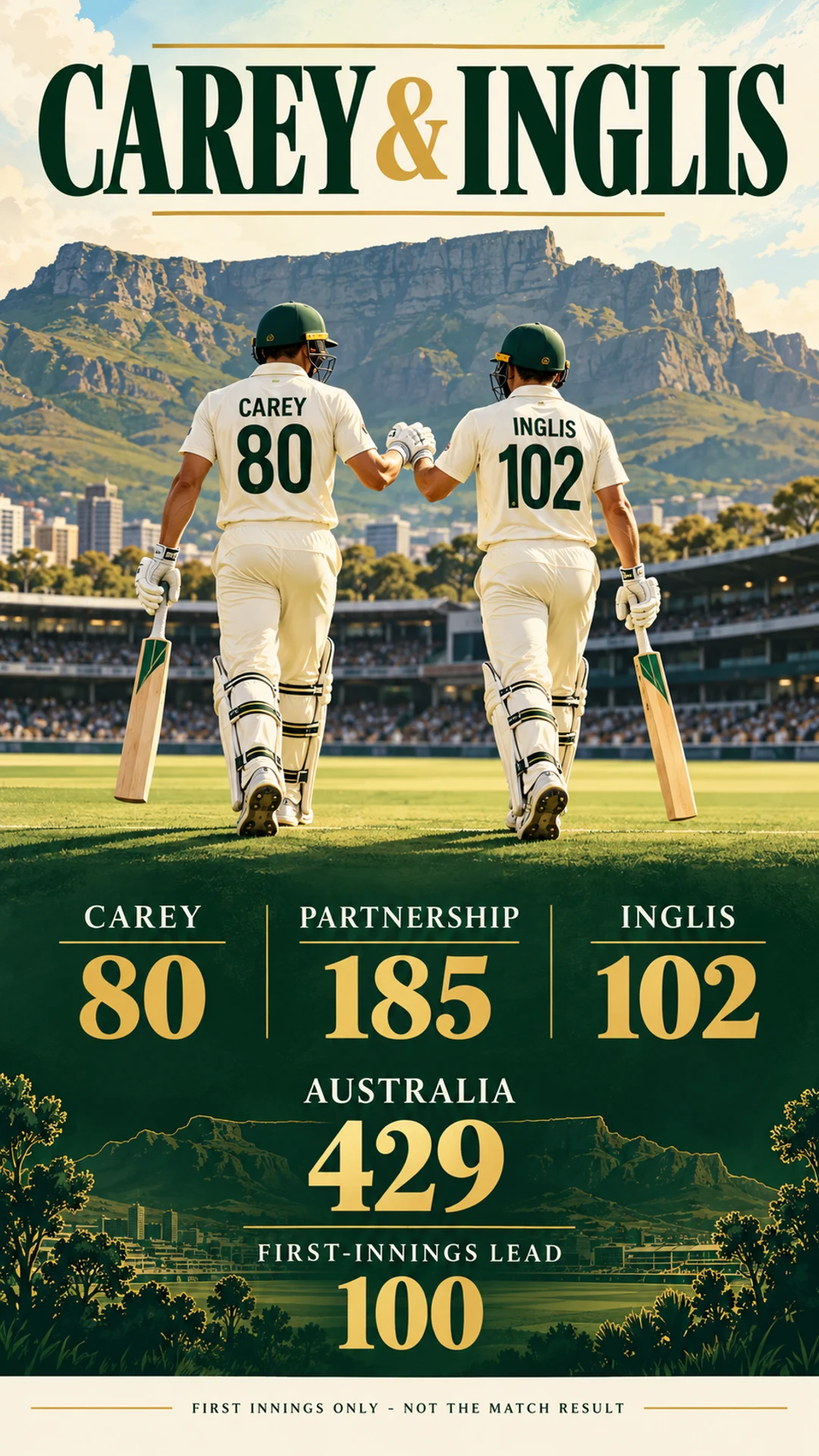
Alex Carey’s 80 and Josh Inglis’s 102 helped Australia turn a vulnerable first-innings position into a 100-run lead in the third Test against South Africa at Newlands. Their fifth-wicket partnership was worth 185. Australia eventually made 429 in reply to South Africa’s 329. Those figures describe the completed first innings; they are not the result of the Test or a claim that the series has been won.
The useful story behind the numbers is how two wicketkeeper-batters contributed differently. Carey provided a more watchful innings while Inglis supplied greater attacking momentum. Cricket Australia’s reporting highlights that contrast. This article examines the partnership and the first-innings position established on 29 October 2026, rather than presenting a changing second-innings score as a permanent live update.
Alex Carey’s 80: why an innings below a century mattered
Carey finished with 80 from 168 balls. A century attracts a headline, but the value of a Test innings also depends on the position in which it is played and the partnerships it supports. Here, remaining available at one end allowed a substantial stand to develop. A slower individual rate can be useful when the combined partnership keeps the innings progressing without a wicket.
That does not mean every defensive innings is automatically effective. The team still needs runs, and time spent at the crease has to serve a purpose. The relevant evidence in this case is the scale of the stand and the position Australia reached. A productive partnership gives the more assertive player opportunities without requiring both batters to take identical risks on every delivery.
A reader looking only at individual strike rates can miss that relationship. The question is not simply whether Carey scored as quickly as Inglis. It is whether their combined work improved the team’s position. Australia moved from 185 for four to 370 for five during their partnership, which is the central scoreboard fact behind the attention on both batters.
How the Carey–Inglis partnership changed the innings
The fifth-wicket stand added 185. At 185 for four, Australia still needed 144 to match South Africa’s first-innings total. When the partnership ended at 370, they had passed it and built an advantage. This comparison is a straightforward calculation from the scorecard, not a prediction model or a claim about the probability of winning the Test.
The stand therefore crossed an important threshold. It did more than improve the appearance of the batting card: it carried Australia from chasing the opposition’s total into setting a first-innings lead. Once that change happens, the next phase of the match begins with a different arithmetic problem for the side batting again. However, the opposition still has an opportunity to respond.
After Inglis departed, the rest of Australia’s innings added further runs before the total reached 429. It is important to separate the partnership’s contribution from the entire innings. Earlier contributions and later runs also mattered. A match report becomes less informative if it credits a single stand with every run or treats the remaining batting order as irrelevant.
FACT: the first-innings numbers in one place
Carey scored 80, Inglis scored 102, their partnership was 185, and Australia made 429. South Africa’s first innings was 329. Subtracting 329 from 429 gives Australia a first-innings lead of 100. Each number answers a different question: an individual contribution, a shared contribution, a team total or the difference between the teams’ first innings.
Individual scores should not be added together and automatically treated as the partnership score. A batter can score runs before or after a particular stand, while extras can contribute during it. The partnership begins when the previous wicket falls and ends when another wicket falls. The team score at those two moments determines the stand’s value.
This distinction is useful whenever a headline mentions a major partnership. To reconstruct it, check the fall of wickets as well as the batting card. For this innings, the movement from 185 to 370 establishes the 185-run stand directly. It avoids trying to infer the partnership from the two players’ final individual totals, which describe their complete innings instead.
Two approaches on the same surface
Cricket Australia described Carey as more restrained and Inglis as more assertive, particularly against spin. That contrast provides a better explanation than saying both played exactly the same kind of counterattack. Two batters can share the same objective while choosing different scoring opportunities. Handedness, preferred shots and the delivery being faced all affect the choices available.
There is no need to invent conversations between the players to explain that principle. We cannot know every discussion from a scorecard. The observable distinction is between the runs, the pace of the individual innings and the reported shot selection. Any broader interpretation should remain analysis rather than an imagined dressing-room instruction or a quote that neither player gave.
For viewers, partnership balance is often more revealing than the label anchor or aggressor. Those labels can change within an innings. A batter may defend a difficult spell and later attack a different bowler. The completed score gives an outcome, but not permission to assume the same tactical role applied to every over from beginning to end.
What a 100-run lead means, and what it does not
A first-innings advantage is valuable because the opposition must account for the deficit before setting a positive target. But the lead does not itself finish a Test. Conditions, time remaining, second-innings batting and the final chase still shape the result. Calling an advantageous position a confirmed victory would confuse the state of the match with its conclusion.
The figure also should not be converted into an automatic winning percentage without a model and supporting data. No such model is being offered here. A simpler, defensible interpretation is that the partnership helped Australia reach a stronger first-innings position. The eventual outcome requires subsequent cricket and an official result, not just confidence based on a substantial stand.
Similarly, a first-innings report and a day-end report are different products. This article is deliberately about the completed Australian innings and the Carey–Inglis partnership. Readers who need the current second-innings position should use a match centre. That keeps a durable explanation separate from numbers that may change while someone is reading the page.
Advice: how to read a Test partnership beyond the headline
Start with the score when the pair came together. Then compare the score when the partnership ended. Ask whether they were rebuilding, reducing a deficit or extending a lead. Those questions reveal the problem they solved. An identical partnership size can have different importance depending on the match position, so the raw number alone is not a complete explanation.
Next, read individual contributions alongside the fall of wickets. Look for who continued batting after the stand ended and whether extras were involved. Finally, distinguish reported observations from tactical inference. A scorecard can establish runs, balls and dismissals, but it does not by itself reveal every intention, instruction or change in approach behind those outcomes.
For a young player, the transferable lesson is cooperation rather than imitation of a single innings. Partners need to recognise the situation, communicate and select scoring options suited to the delivery. Copying a professional’s scoring rate without the surrounding circumstances is less useful than understanding why a partnership can combine different approaches successfully.
Frequently asked questions
How many runs did Alex Carey score at Newlands? Carey made 80 from 168 balls in Australia’s first innings of the third Test. This article concerns that completed innings, not a later innings or the final match result.
How large was the partnership with Josh Inglis? Their fifth-wicket stand was worth 185. Australia moved from 185 for four to 370 for five during the partnership.
Did Inglis score a century? Yes. Inglis finished with 102. His individual score and Carey’s final score are separate from the partnership figure and should not be used as a substitute for it.
What was Australia’s first-innings lead? Australia’s 429 was 100 more than South Africa’s 329. That establishes the first-innings advantage, rather than an eventual victory margin.
Did this partnership win the Test? It improved Australia’s position, but a first-innings partnership cannot by itself establish the final result. Check the completed match scorecard for the outcome.
Conclusion: Carey’s value was not limited by finishing short of a hundred. Together with Inglis, he helped move Australia past South Africa’s first-innings total and towards a 100-run advantage. The most useful reading of the innings combines individual contributions, partnership arithmetic and the match position without turning a strong phase into an invented result.
Related reading: England vs Sri Lanka: Duckett’s 167 and the Lahore innings.
Sources: Cricket Australia: Carey and Inglis’s contrasting approaches, first-innings scorecard. First-innings analysis as of 29 October 2026; it is not a live-score service. Images are conceptual AI illustrations, not match photographs.