Focus keyword: how to read an editorial
Category: 78 Education & Knowledge
Reading Promise: By the end of this guide, you will be able to read any news, opinion, or editorial quickly, objectively, and productively through the lens of claim, evidence, and missing context.
Introduction: Why Slow Understanding Matters in a Fast News Feed
In a mobile feed, a headline about an event appears in seconds, but understanding its true meaning often takes much longer. On a single issue, you might see breaking news, an explainer, a columnist’s opinion, and a newspaper’s editorial all at once. All four differ in language, purpose, and level of evidence. If we take the headline as the final conclusion, we risk taking numbers out of context, mistaking an opinion for a fact, or drawing an incomplete picture of a policy’s pros and cons.
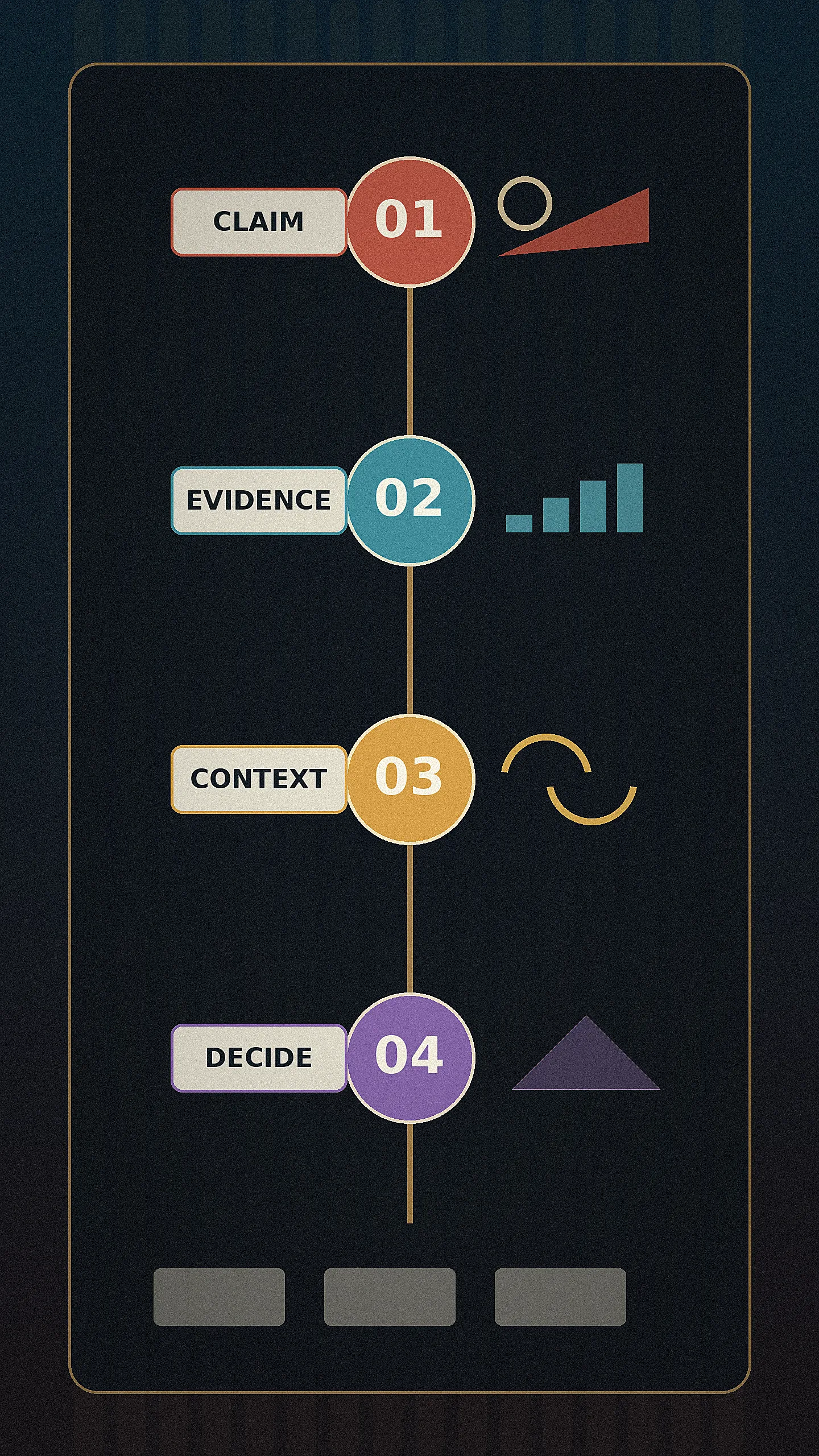
Instead of memorising rules, this article provides a practical reading method for “how to read an editorial.” Suppose you have only 20 minutes. You will first identify what claim is being made, then ask what evidence supports it, and finally look for what missing context could change your conclusion. These three questions form a solid starting framework to differentiate between news and analysis.
Here, “news” primarily refers to reporting of an event, decision, or verified information; “analysis” unpacks the meaning, cause, impact, and potential outcomes of that information; “opinion” provides the writer’s evaluation; and an “editorial” represents the institutional stance of a publication. Real-world articles sometimes blur these lines, so reading labels is helpful, but not enough.
The First Three Words: Claim, Evidence, and Missing Context
1. Claim: What is the article actually saying?
A claim is not just the headline. It is a statement that can be proven true, false, incomplete, or debatable. “The government has formed a committee on the new education policy” is a reportable fact. “This committee will bring major education reforms” is a prediction or opinion. “Forming a committee is not enough to fulfill the mandate” is an argument.
To spot a claim while reading, pay attention to verbs like: increased, decreased, occurred, proves, causes, is necessary, failed, is possible, should be. Then write down the claim in your own words in a short sentence. If you cannot write it down, you might just be absorbing the tone or headline. An article may have one main claim and several supporting claims. Identifying the main claim sets the direction of your reading.
2. Evidence: On what basis does the claim stand?
Evidence is not just seeing a random number. Check who the source is, what period the data covers, what comparison is used, what the methodology is, and whether the evidence directly supports the claim or merely talks about something related. Government reports, court orders, budget documents, peer-reviewed studies, official datasets, on-record interviews, and ground reporting are all different types of sources. If it says “Experts say,” the names, institutions, and relevant experience of those experts matter significantly.
To check the quality of evidence, keep these five questions in mind:
1. Is a link, name, or document of the original source available?
2. Are the figures raw numbers, percentages, or an index? What is the denominator?
3. Does it present statements from only one side, or are the voices of affected people and independent experts included as well?
4. Are the examples representative, or just a single dramatic case?
5. Is the author mistaking correlation for causation?
Even if the evidence is strong, the conclusion can still be limited. For example, if both rainfall and vegetable prices rise in a state, it shows co-movement; it does not alone prove that rainfall is the sole reason for the price hike. Transport costs, storage, seasonal supply, and demand must also be considered.
3. Missing Context: What has been left out?
No article can cover everything. Missing context does not mean the article is false; it means recognizing its boundaries. Dates, geography, baseline, sample size, legal status, counterarguments, and affected groups are frequently left out. Sometimes a headline shows current-year numbers without mentioning an unusually low baseline from the previous year. Sometimes a national average hides vastly different experiences across states. Sometimes a court’s interim observation is reported like a final judgment.
A simple way to find missing context is to list “What else would I like to know?” After reading a claim, ask at least: From when to when? For whom? Compared to what? Who measured it? Who loses or gains? What is the next step? Is there an alternative explanation? These questions form the core practice of media literacy.
Difference Between News, Analysis, Opinion, and Editorial
News Report: “What happened?”
The primary job of a news report is to provide verified information and relevant attribution. It includes details like location, date, official records, direct quotes, affected persons, and official responses. A good news report indicates its level of certainty in its language: markers like “according to police,” “preliminary investigation suggests,” “according to documents,” and “could not be independently verified” are crucial. A news report may include context, but its central focus remains on the event or new development.
Analysis: “What does it mean?”
Analysis connects known facts to explain causes, patterns, policy trade-offs, and possible outcomes. It features more charts, timelines, expert quotes, and background. Analysis must also provide evidence, but its central output is the interpretation of the event, not just the news itself. Questions like “If interest rates remain high for this long, how will it impact housing demand?” belong to analysis. If it includes a forecast, the level of uncertainty should be clearly stated.
Opinion: “What does the writer think?”
An opinion piece is an argument tied to a specific writer’s name. It may use first-person language, personal judgments, and persuasive phrasing. An opinion is not inherently wrong, but it should be read differently from a fact-checkable claim. “This policy is unfair” is a normative judgment; to support it, the writer should provide rules, impacts, comparisons, and a moral basis.
Editorial: “What is the publication’s institutional view?”
An editorial usually appears without a byline or under the name of the editorial board. It takes a clear stance on an issue, raises questions, and offers recommendations on behalf of the publication. Therefore, reading an editorial like a straight news report is a mistake. Its language can range from measured to strongly persuasive. A responsible editorial distinguishes between facts, counterarguments, and its own recommendations; readers should check whether facts are source-backed or have turned into rhetoric.
The 20-Minute Editorial Reading Method
This method works in three steps: “skim first, test second, reflect last.” If you want to use a timer, set it for 20 minutes. The goal is not to memorize every line, but to build a mental map of the argument.
Minutes 0–2: Identification and Purpose
Read the title, label, byline, date, update time, and publication name. Is it news, analysis, opinion, or an editorial? If there are subheadings or a deck, read those too. Ask yourself: “Am I here to collect facts or evaluate an argument?” In an older article, the current status may have changed, so check the date first.
At this stage, do not rely on the framing of a social media post. Open the original page and cross-check the headline with the article body. Often, a social post might say “X reversed the policy,” while the original article says “considering a review.” This two-minute check prevents you from starting with a false premise.
Minutes 2–5: First Skim and Main Claim
Read the intro, section headings, conclusion, and highlighted quotes. Instead of pausing at every paragraph, grasp the overall skeleton of the article. Then write down the main claim in one line: “The article argues that ___ because ___, therefore ___.” If filling in the blanks is difficult, the claim is still unclear—break it down into facts and recommendations.
Example: “The city lacks buses, so instead of spending only on flyovers, public transport capacity should be increased.” The first part is a factual claim, while the second is a policy recommendation. Both cannot be proven with the same piece of evidence.
Minutes 5–10: Evidence Audit
Now re-read the article and mark every major claim with E, A, or O: E = evidence/fact, A = analysis/inference, O = opinion/recommendation. Highlight numbers, documents, named sources, methodology, and direct observations. Then see which paragraphs contain evidence and where the writer is simply making assertions.
In an evidence audit, source hierarchy is not a rigid ranking; sources vary by context. An official number might be primary, but an agency’s self-reported performance can carry incentive bias. An NGO’s field report may give voice to affected people, but its sample size could be limited. An academic study may be rigorous, but its findings might not directly apply to this exact city or the current year. Note down both strengths and limitations.
When reading broadsheet-style articles like those in The Hindu or The Indian Express, you will often find policy documents, parliamentary records, court proceedings, data, and multiple viewpoints. This does not mean the brand name automatically turns content into proven evidence. Check the source list and attributions. Trusting a publication and accepting every sentence without verification are two different things.
Minutes 10–14: Find Missing Context
Create a short context checklist:
- **Time:** What is the baseline and latest date?
- **Location & Group:** What states, classes, or cities is the national average hiding?
- **Definition:** By what definition was “unemployed,” “poor,” “dropout,” or “crime” measured?
- **Comparison:** Compared to previous years, targets, peer countries, or the pre-policy period?
- **Cause:** Is there another plausible cause?
- **Legal Status:** Is it a proposal, notification, interim order, or final rule?
- **Stakeholders:** Where are the voices of those directly affected by the decision?
Finding a missing piece of context is not a reason to reject the entire article. A more balanced conclusion would be: “This claim is supported by available data to this extent, but without knowing X and Y, declaring a final judgment on its broader impact is premature.” This is calibrated reading.
Minutes 14–17: Counterargument and Recommendation Test
Editorials usually conclude with “what should be done.” Break that recommendation into three parts: What is the goal, what is the mechanism, and what are the costs/risks? In “The government should tighten regulation,” the goal might be public safety, the mechanism licensing or inspections, and the risk compliance cost or burden on small operators. Did the article address these trade-offs?
Next, frame the strongest genuine counterargument yourself—do not build a straw man. If an editorial argues for removing a subsidy, the counterargument is not just “people will suffer”; a better question is what targeted replacement will exist for the subsidy and who will bear the burden of transition. Write down the strongest evidence in favor of the author as well. This reduces confirmation bias.
Minutes 17–20: Conclusion, Confidence, and Next Steps
Finally, write three lines:
1. What I know: Two or three verified facts.
2. My working interpretation: The strongest inference from the article.
3. What I need to verify: A primary document, data table, or alternate perspective.
Then assign a confidence label: High, Medium, or Low. High does not mean “ultimate proof of truth”; it simply means the claim’s source, scope, and limitations are sufficiently clear. If confidence is Low, hold back from sharing, posting, or forming a strong opinion. For your next step, open an official document, check date updates, or compare different editorials and neutral reports on the same issue.
Illustrative Examples in the Style of The Hindu and The Indian Express
The examples below are not quotes from published articles. They are fictional, style-inspired mini-examples designed to explain argument styles seen in major Indian broadsheet traditions. Do not treat them as actual newspaper text.
Example 1: Reading a The Hindu-style Policy Editorial
Imagine the headline is: “On the water crisis, cities must look beyond demand management.” The opening references rainfall, reservoir data, and urban planning context. The editorial then states that tanker dependence will not decrease through emergency responses alone; pricing, leakage control, groundwater recharge, and transparent local governance must go hand in hand.
While reading this, split the claim into two parts: a crisis exists, and the recommended solution is integrated. An evidence audit should ask: As of which date is the reservoir data? How much below normal is the rainfall? Which agency provided the leakage estimate? How will pricing reform impact low-income households? Missing context could include informal settlements, inter-state water arrangements, climate variability, and municipal capacity. The conclusion is persuasive, but the reader also needs an implementation sequence and measurable targets.
Example 2: Reading an Indian Express-style Institutional Analysis
Now imagine the headline is: “The answer to transparency in judicial appointments is not just another committee.” The article connects constitutional provisions, recent court observations, appointment timelines, and institutional accountability. It tries to explain directly where friction exists in the process and what options for reform are available.
Its main claim is likely that to protect both transparency and independence, criteria, reasons, and timelines must be clearly defined. In an evidence audit, constitutional text and court records serve as primary material; treat unnamed sources as supporting, not decisive. Missing context would include pending cases, practical workload, data on vacancies, and the legal validity of proposed mechanisms. In the recommendation test, examine how confidentiality will be maintained while increasing transparency. This example shows that when reading institutional analysis, one should look at both design and accountability, not just pros and cons.
In both examples, brand reputation can serve as a useful signal, but the reading method remains the same: claim, evidence, context, counterargument. “It was published in The Hindu” or “It appeared in The Indian Express” is not a substitute for verification.
Media Literacy: Reading Speed, Bias, and Language
Language Indicates the Temperature of Certainty
Phrases like “stated,” “claimed,” “investigation revealed,” “indicates,” “possibly,” and “proven” carry different meanings. If an article uses less hedging, it may sound more confident, but the evidence might not be as strong. Absolute words—always, never, all, sole reason—warrant extra scrutiny. Similarly, broad nouns like “the public,” “experts,” “the market,” and “youth” can hide significant diversity.
Framing and Selection Bias
Selecting only certain facts, even if accurate, shapes framing. If an article highlights only success stories, the failure rate disappears. If capital city data is presented as national data, geographic nuances are lost. Photos, captions, and headlines also shape the reader’s first impression. Therefore, read the qualifiers in the body text, check chart axes, and look for correction or update notes on the page.
Avoid False Balance
Quoting both sides is good practice, but giving equal weight to every claim is not necessary. An evidence-backed scientific finding and an unsupported assertion should not be treated as equal under the guise of “two sides.” Balanced reading means examining relevant disagreement fairly, not erasing the weight of evidence.
Reaching Primary Sources
A reader does not need to conduct deep research for every article. Pick the most consequential claim first. Then use source links to check original documents, tables, judgments, notifications, or datasets. Look at dates, authoring institutions, scopes, and footnotes in PDFs. Search snippets do not provide context; always read the qualifications surrounding the main paragraphs in the original document.
FACT: Key Takeaways and Precautions
- News, analysis, opinion, and editorials are distinct genres; elements of each can appear on the same page.
- An editorial represents the publication’s institutional position, not a straight news report.
- Connecting claims to evidence is essential; attribution alone is not complete proof of evidence quality.
- Correlation does not automatically prove causation.
- When reviewing percentages, always check the baseline, time period, and denominator.
- Interim court observations, policy proposals, and enacted laws are not the same thing.
- Checking dates, corrections, and update notes is essential for accuracy.
- Identifying missing context does not mean declaring an article “fake news”; it means understanding its boundaries.
- Trusted outlets like The Hindu or The Indian Express are not above verification.
- For major public decisions, it is best to review primary sources and neutral reporting alongside editorials.
FAQ: Five Common Questions
1. Do editorials not contain facts?
They do. An editorial combines facts, interpretation, and recommendations into a single argument. Readers should evaluate all three separately. If facts are clear in source and scope, the argument becomes stronger; if opinions are presented as facts, caution is needed.
2. Is reading opinion less useful than reading news?
No. Opinion pieces can highlight ethical or policy angles and raise fresh questions. Just avoid treating them as the sole record of an event. First understand “what happened” through verified news or primary documents, then read competing interpretations in opinions or editorials.
3. Is fact-checking really possible in 20 minutes?
Checking every detail in an article isn’t possible, but a quick audit of the primary claim is. The 20-minute method establishes reading priorities. For high-stakes claims in health, finance, politics, or law, spend more time checking qualified primary sources.
4. If there is no source link, is the article false?
A missing link does not automatically make an article false, but it makes verification harder. Look for named sources, document titles, dates, and precise attributions. If a major claim lacks a traceable source, keep your confidence low and verify independently before sharing.
5. Should I compare editorials across different newspapers?
Yes, especially when the issue is controversial. Examine why different recommendations emerged from the same set of facts. Keep a neutral report and a primary document alongside them so your comparison isn’t just weighing two opinions against each other.
Conclusion: A Good Reader Doesn’t Rush; They Pause at the Right Place
The art of reading editorials is not about copying a publication’s style, but unpacking layers of reasoning. In 20 minutes, first identify the genre and date, write down the main claim, check the quality and scope of evidence, look for missing context, build the strongest counterargument, and determine your level of confidence. This method doesn’t slow your news intake down completely; it simply applies the brakes where a wrong conclusion could carry a high cost.
Next time you open an editorial from The Hindu, The Indian Express, or any publication, set up a three-column note: Claim | Evidence | Missing context. If you want a fourth column, add What would change my mind? That single question turns passive media consumption into active understanding. Keep the FACT guidelines in mind, apply advice to your context, and rely on primary evidence before accepting strong claims.
Disclaimer: Media literacy is an educational guide. Examples provided are illustrative.