 Vista
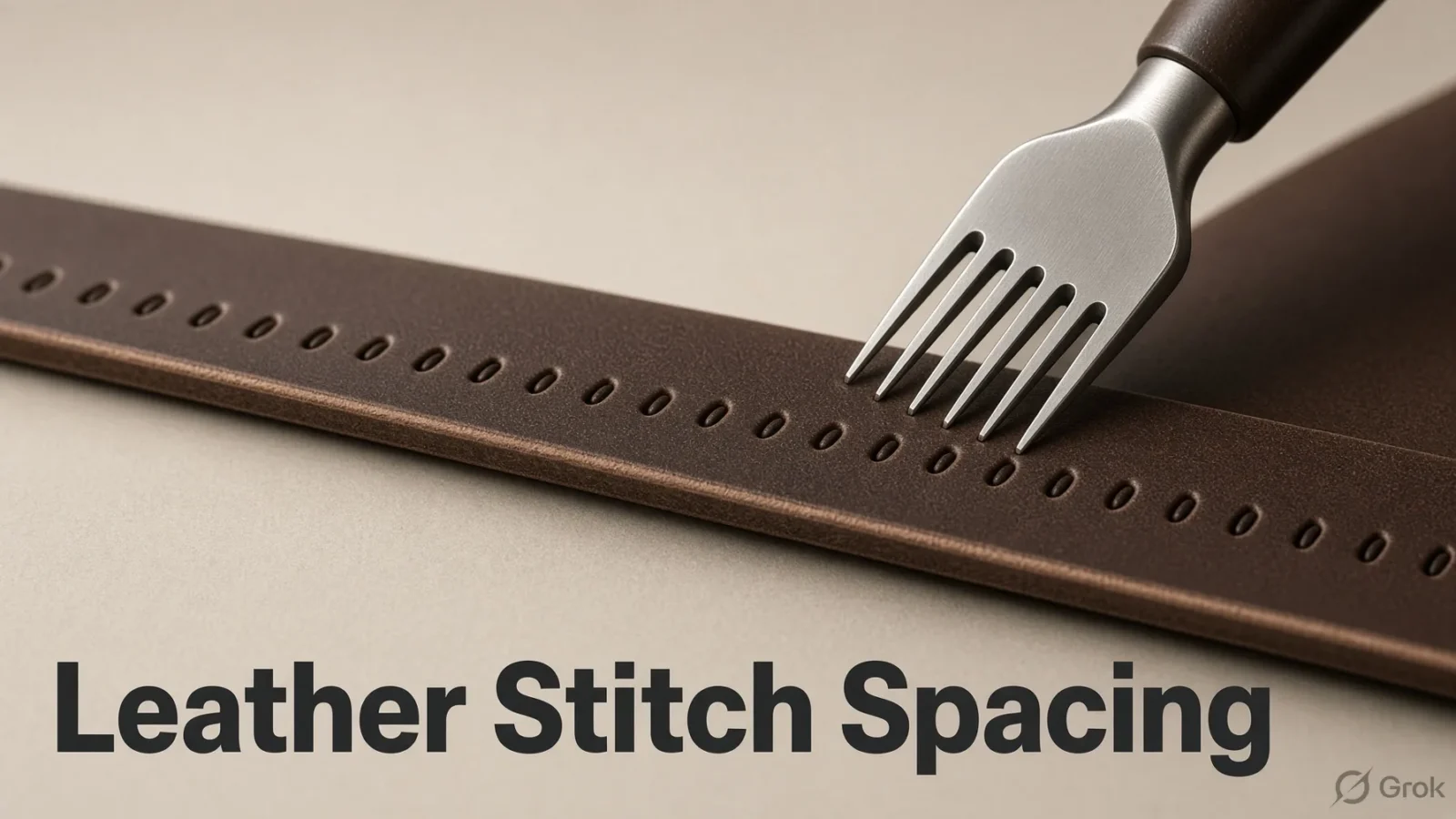
Pricking irons are sold by spacing in millimetres, by stitches per inch (SPI), or by an old French size number, and the three do not always line up neatly. This guide shows how to convert between them, lists common sizes, and gives example thread thicknesses as starting points. It does not claim a universal match between thread and leather thickness: stitch on a scrap of your own leather first.
Understanding stitch spacing in millimetres and SPI
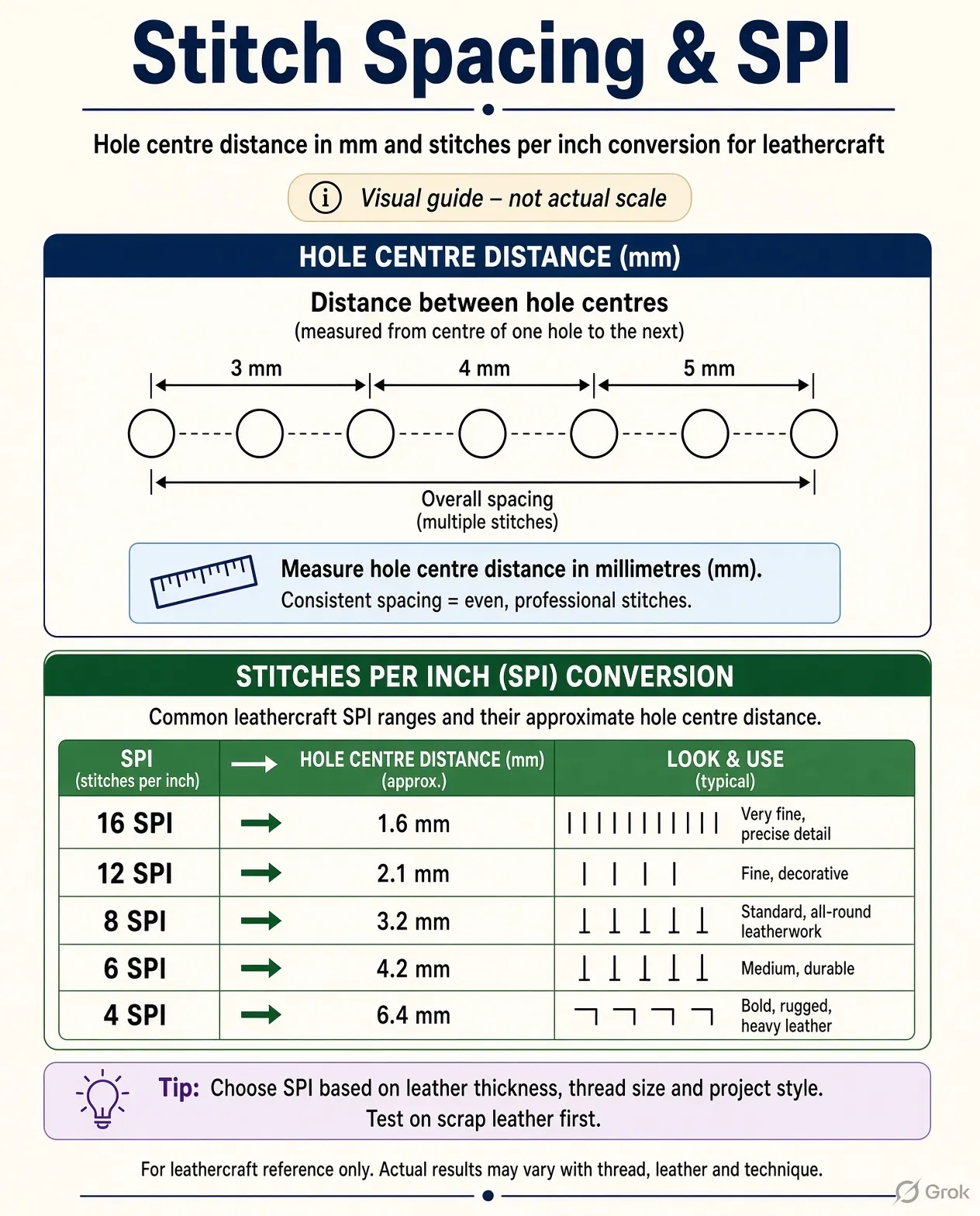
Spacing is measured centre to centre, from the middle of one tooth to the middle of the next. SPI is how many stitches fit in one inch (25.4 mm).
Converting spacing to stitches per inch
SPI = 25.4 ÷ spacing in mm. Examples: 25.4 ÷ 3.38 = 7.5; 25.4 ÷ 3.85 = 6.6; 25.4 ÷ 4.0 = 6.35. To go back, spacing = 25.4 ÷ SPI.
| French size | Spacing | SPI |
|---|---|---|
| #5 | 5.4 mm | 4.7 |
| #6 | 4.5 mm | 5.6 |
| #7 | 3.85 mm | 6.6 |
| #8 | 3.38 mm | 7.5 |
| #9 | 3.0 mm | 8.5 |
| #10 | 2.7 mm | 9.4 |
These values come from a Vergez Blanchard size table and match the arithmetic above. Some brands round or label differently; for instance one maker lists 3.38 mm as 7 stitches per inch and 3.85 mm as 6. Always check the millimetre figure, not just the label.
Pricking irons and stitch appearance
Irons come in several tooth shapes, including straight (flat), inverse, round-dent and diamond. The shape changes how the holes look and how the stitches lie, while spacing decides how dense the stitching is.
Spacing, hole shape and leather thickness
Tools have their own limits. One Japanese-style iron is sold as suitable for leather up to 6 oz (2.4 mm), and some makers describe their irons as marking tools rather than punches. Check your tool’s maker for its leather thickness limit before striking.
Choosing thread thickness for stitch spacing
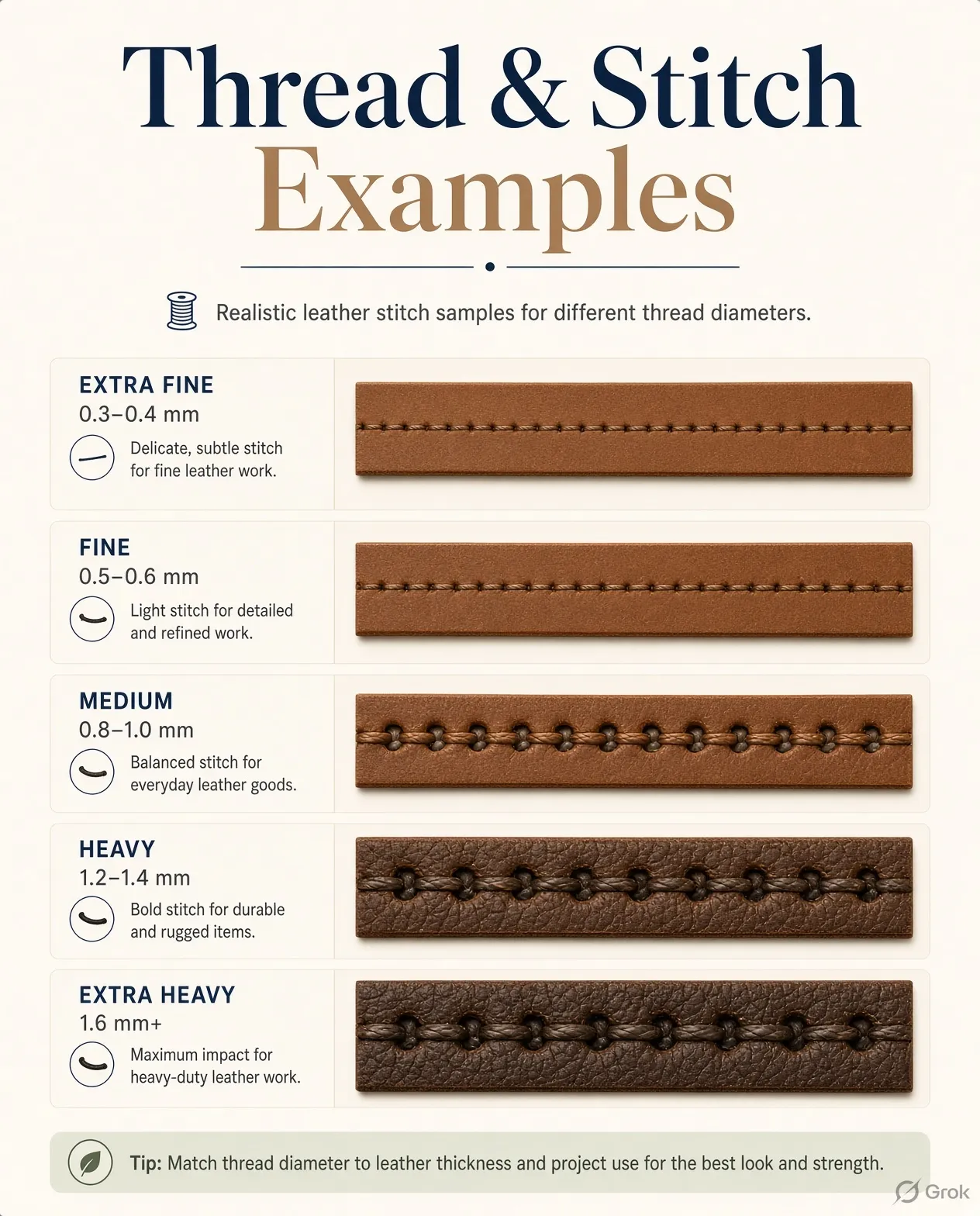
Thread choice depends on spacing, hole size, leather thickness and the look you want. Hand-sewing thread is commonly sold at around 0.6, 0.8 and 1.0 mm.
Examples rather than universal prescriptions
- One experienced maker on a leatherworking forum says 0.6 or 0.8 mm thread suits almost anything at 4 mm spacing, and moving to 5 mm spacing pairs with about 1.0 mm. This is an opinion, not a standard.
- For 3.38 mm irons, 0.6 to 0.8 mm thread is a reasonable range to test first, since it is slightly tighter than 4 mm spacing. Thinner thread looks finer; thicker thread looks bolder but can crowd the holes.
- Another forum answer notes that thread size is often the first decision, with spacing following from it and the leather thickness.
Reading a 1:1 leathercraft reference chart
A printable chart is only useful at true size. Print at 100% scale, with no “fit to page”, and check it against a ruler.
Test stitch, printer scale and measuring reference
Mark a 100 mm line on the printout and measure it. If it is not 100 mm, adjust the print setting. Then stitch a short test seam in scrap leather the same thickness as your project and compare the stitches with the chart.
Worked examples, practical checks and limitations
Example: a 100 mm seam at 3.38 mm spacing has 100 ÷ 3.38 ≈ 29.6 intervals, so about 30 stitches. At 4 mm spacing it is 25 stitches. Plan seam length so corners and ends land on a hole, and test on scrap.
Common mistakes and when to seek expert confirmation
- Trusting the SPI label instead of the millimetre spacing.
- Choosing thread only by leather thickness.
- Printing a chart at the wrong scale.
- Using an iron on leather thicker than the tool maker advises.
For load-bearing work such as straps or belts, ask a professional leatherworker about thread strength and stitch layout.
Frequently asked questions
What thread thickness goes with 3.38 mm pricking irons?
Test 0.6 to 0.8 mm thread first, then adjust to your leather and the look you want. There is no single correct size.
How do I convert mm spacing to SPI?
Divide 25.4 by the spacing in mm. 3.38 mm is about 7.5 SPI.
Is a 3.85 mm iron 6 or 6.6 SPI?
Arithmetically 6.6; some brands label it 6. Go by the millimetres.
Does leather thickness decide the spacing?
It is one factor alongside thread size and appearance. Test on a scrap.
Conclusion
Convert with 25.4 ÷ spacing, pick thread as a tested starting point, and let a scrap sample make the final call.
Sources
- R&M Leather Supply: Vergez Blanchard pricking iron sizes
- Tandy Leather: M-Series pricking iron specifications
- Tandy Leather: Japanese pricking iron specifications
- Leatherworker.net forum: pricking iron spacing and thread discussion















Share Your Opinion
Comments are closed on this post.