 Vista
Choosing bonsai wire is a balance: too thin and the branch springs back, too thick and it is hard to apply and can damage the branch. This guide compares aluminium and annealed copper, explains the common “one third of the branch” starting point, and shows how to read a wire size chart in millimetres. All sizes are approximate. Species, branch flexibility and the bend you want all change the answer, so test gently on one branch before wiring a whole tree.
Choosing bonsai wire material
Anodised aluminium and annealed copper are the usual choices. Sources agree that telephone, electrical or galvanised wire should not be used.
Aluminium versus annealed copper
| Feature | Aluminium | Annealed copper |
|---|---|---|
| Handling | Soft, easier for beginners | Harder to apply |
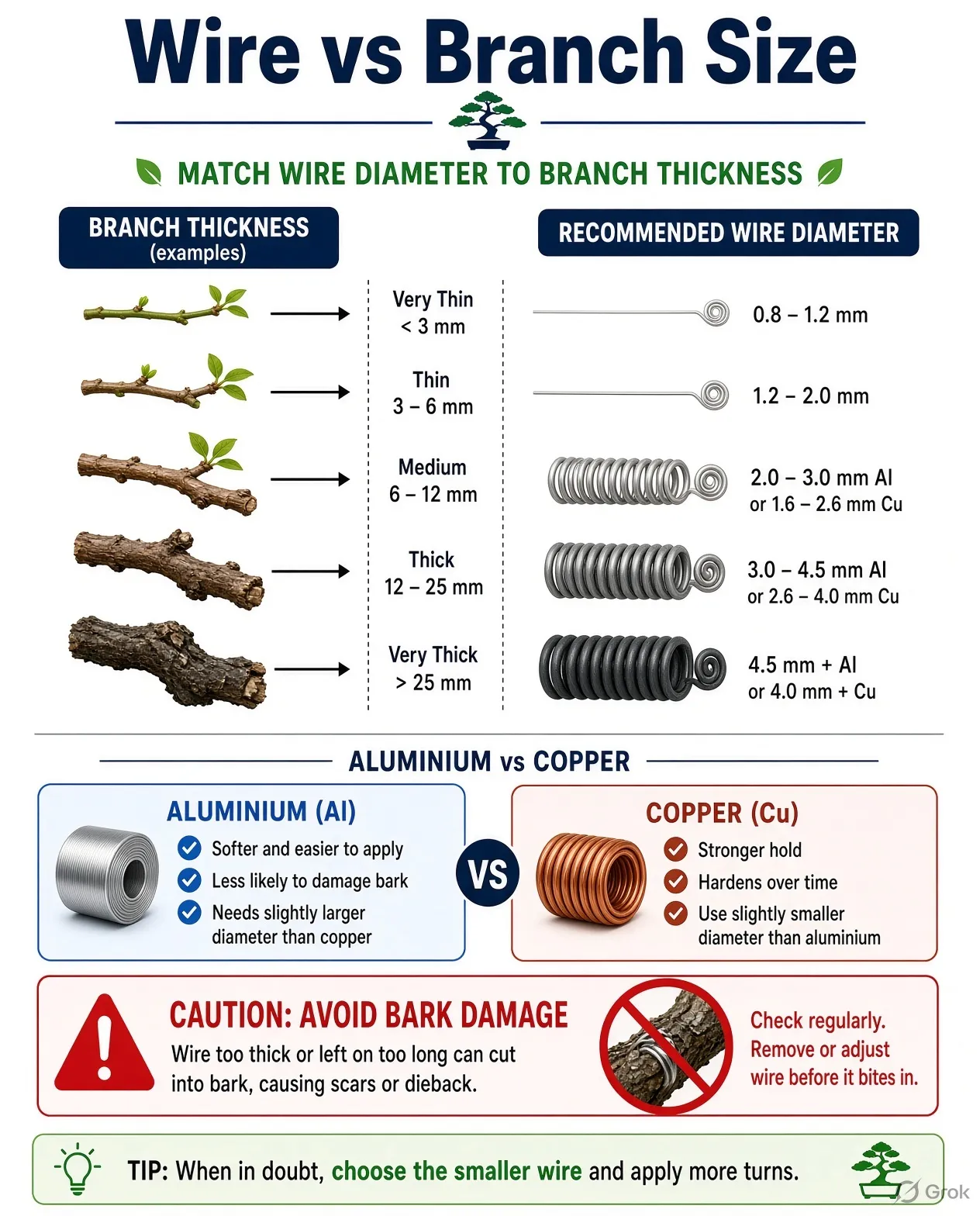
| Holding power per thickness | Lower, so a thicker wire is needed | Higher, so a thinner wire can be used |
| Typical sold sizes | 1 to 6 mm | 0.6 to 4 mm and more |
Wire diameter and branch thickness
A widely repeated starting point is a wire about one third the thickness of the branch. Copper suppliers and bonsai shops give the same rule, while some guides suggest roughly half for copper or “less than half” in general. Treat all of these as rough starting points, not standards.
Flexibility, species and strength differences
Stiff or old branches, strong bends and brittle species need more holding power. Young flexible shoots need less. If you expect a drastic bend, a heavier wire is required, but a wire that is too heavy for the branch risks damage.
How to read a bonsai wire gauge chart
Shops usually list millimetre diameters, where a bigger number means thicker wire. Some practitioners talk in gauge numbers instead, where a smaller gauge number means thicker wire, so confirm which system is being used.
Millimetre sizes and actual-size reference
| Branch thickness (illustrative) | Starting wire at about one third |
|---|---|
| 3 mm | 1 mm |
| 6 mm | 2 mm |
| 9 mm | 3 mm |
| 12 mm | 4 mm |
One bonsai site suggests starting a collection with 1, 1.5, 2.5 and 4 mm wire rather than buying every size.
Avoiding damage while wiring
Wrap the wire in a spiral at about 45 degrees to the branch, and anchor it firmly at the trunk or on a neighbouring branch. Avoid crossing wires, because where they cross they can dig into the bark quickly.
Bark protection, monitoring and removal timing
- Check the branch regularly: as it thickens, wire can bite into the bark and leave scars.
- How long wire can stay on varies by species and growth rate; there is no single safe number of weeks.
- Remove wire before it cuts in. Cutting it off in short sections is generally safer than unwinding it.
- Do not over-bend a branch that resists; stop and use a thinner or stronger plan instead.
Worked examples, practical checks and limitations
Example: a 6 mm branch suggests about 2 mm aluminium as a starting point (6 ÷ 3 = 2). With copper, a somewhat thinner wire may hold the same bend. If 2 mm aluminium will not hold, step up to 2.5 mm rather than forcing the bend.
Common mistakes and when to seek expert confirmation
- Using one wire size for the whole tree.
- Leaving wire on until it scars the bark.
- Assuming aluminium and copper of the same size hold equally.
- Wiring a stressed or recently repotted tree without advice.
For valuable trees, ask a local bonsai club or experienced grower before heavy bending.
Frequently asked questions
What size wire should I use for my bonsai branch?
Start at about one third of the branch thickness, then adjust for species, material and the bend needed.
Is aluminium or copper better?
Aluminium is easier for beginners; copper holds better at a thinner size but is harder to work.
Which wire sizes should a beginner buy?
One bonsai site suggests 1, 1.5, 2.5 and 4 mm.
How long can wire stay on?
It depends on the tree, so inspect it often and remove the wire before it marks the bark.
Conclusion
Use the one-third rule as a starting point, choose the material for your skill level, and watch the bark.
Sources
- Bonsai4me: wiring bonsai
- Bonsai Empire: wiring basics
- Bonsai Outlet: fundamentals of bonsai wire
- Miyagi Bonsai: bonsai training wire



















Share Your Opinion
Comments are closed on this post.