 Vista
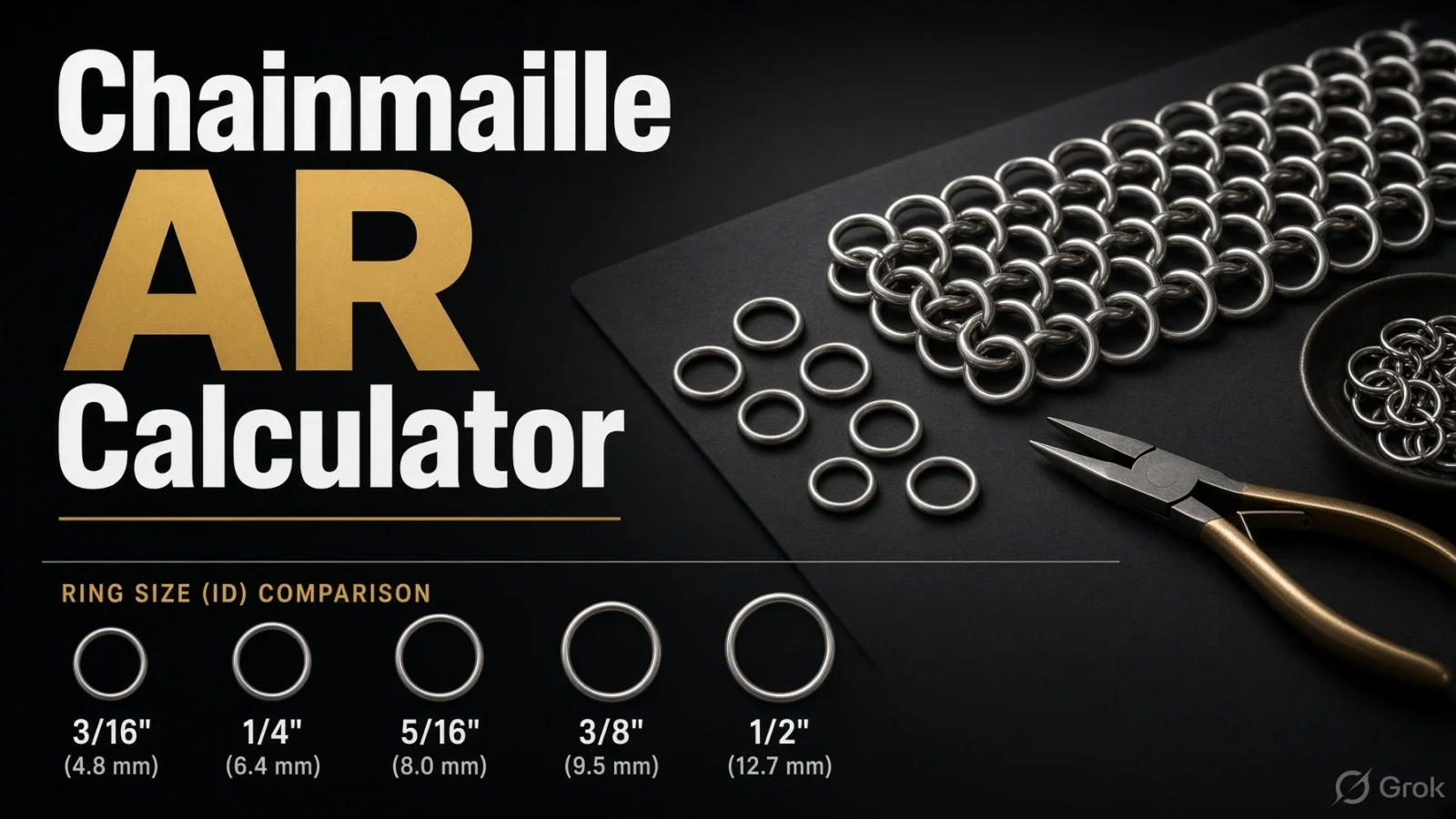
A chainmaille weave only works if the rings are the right size for the wire. The number that captures this is aspect ratio (AR): the ring’s inner diameter divided by its wire diameter. If you are looking for a chainmaille aspect ratio calculator, a chainmaille ring size chart, or the jump ring size for different weaves, this guide explains AR, why you should measure real rings instead of trusting labels, what published minimums say for several weaves, what a popular supplier tutorial gives for Byzantine, and how to work out the ring size from a target AR. Minimums show where a weave becomes possible, not what looks best, so always weave a short sample first.
Check a ring in seconds with the free chainmaille aspect ratio calculator.
What chainmaille aspect ratio means
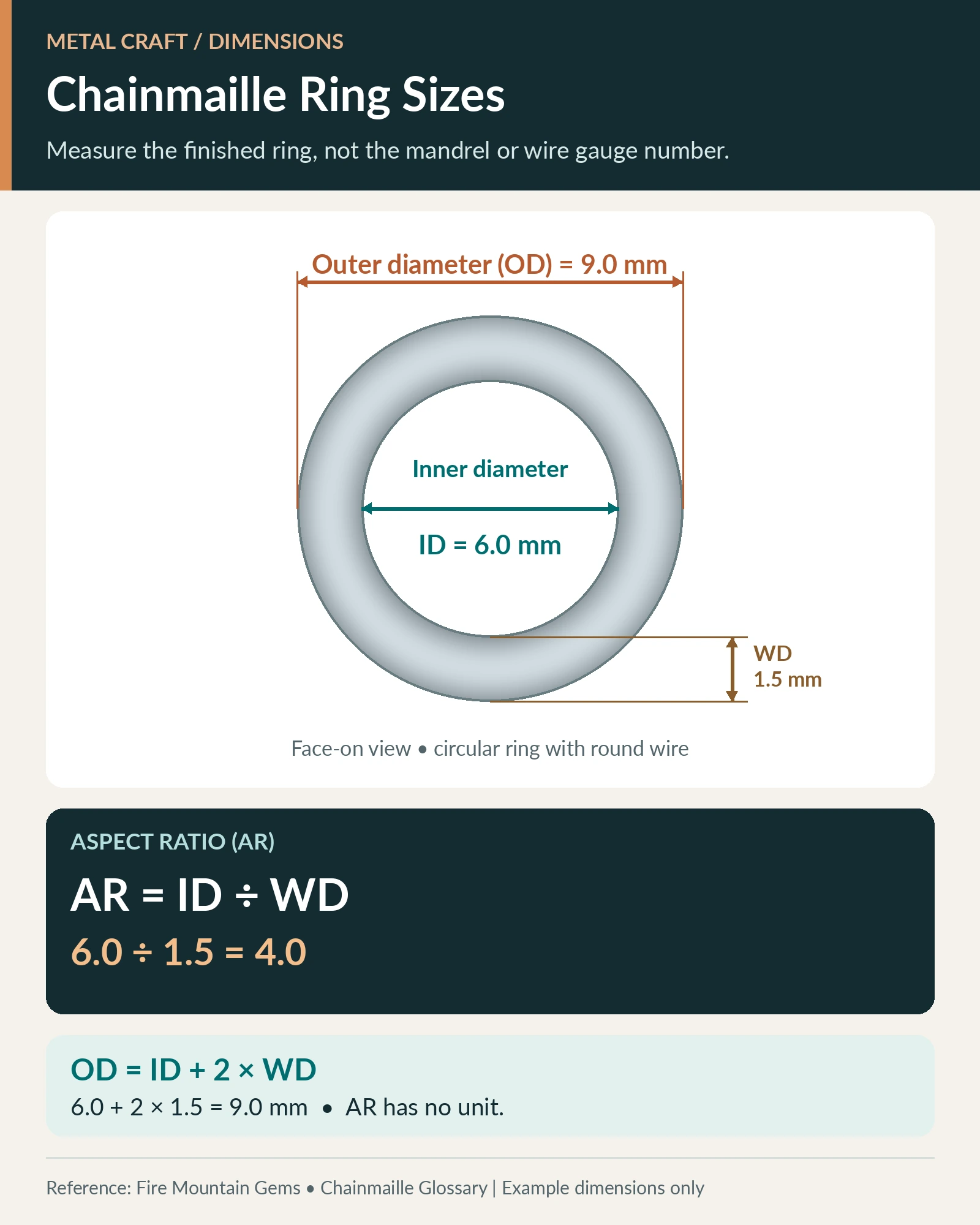
Think of a ring as a donut. The hole is the inner diameter (ID) and the thickness of the donut is the wire diameter (WD). Thick wire with a small hole gives a low AR and a tight weave. Thin wire with a big hole gives a high AR and a looser weave. Because AR is a ratio, the same AR behaves similarly in copper, steel or aluminium. A ring whose AR is below a weave’s workable range is too thick and the weave is impossible or stiff; a ring above it is usually weavable but looser.
Inner diameter divided by wire diameter
AR = ID ÷ WD, using the same unit for both. Example: ID 4 mm and WD 1 mm give AR 4.0. In inches, ID 0.335 and WD 0.062 give 0.335 ÷ 0.062 = 5.4. A supplier example: ID 8.20 mm and WD 1.74 mm give 8.20 ÷ 1.74 = 4.71.
Ring size, AWG and SWG
Suppliers list wire by AWG, SWG or millimetres, and the same gauge number means different thicknesses in different systems. Do not rely on the label: measure the actual wire diameter with calipers, and measure the actual ring inner diameter rather than assuming the mandrel size.
Actual wire measurements and springback
Wire springs back when it is coiled, so the real ID is usually slightly larger than the mandrel. One guide notes this seldom matters except for fussy weaves such as Jens Pind Linkage. Wire hardness and how rings are closed change the real ID too.
Aspect ratio ranges by weave
The Maille Artisans International League (M.A.I.L.) publishes minimum ARs on its weave pages, the point where a weave is just possible and may lock up after a few rings. The practical minimum, where you can keep weaving comfortably, is higher.
| Weave | Published minimum AR |
|---|---|
| 2 in 1 Chain | 2.0 |
| Japanese 3 in 1 | 2.0 |
| 4 in 2 Chain | 2.6 |
| Jens Pind Linkage | 2.7 |
| European 4 in 1 | 2.9 |
| European 6 in 1 | 4.3 |
| European 8 in 1 | 5.8 |
| European 12 in 2 | 6.9 |
Byzantine and other verified examples
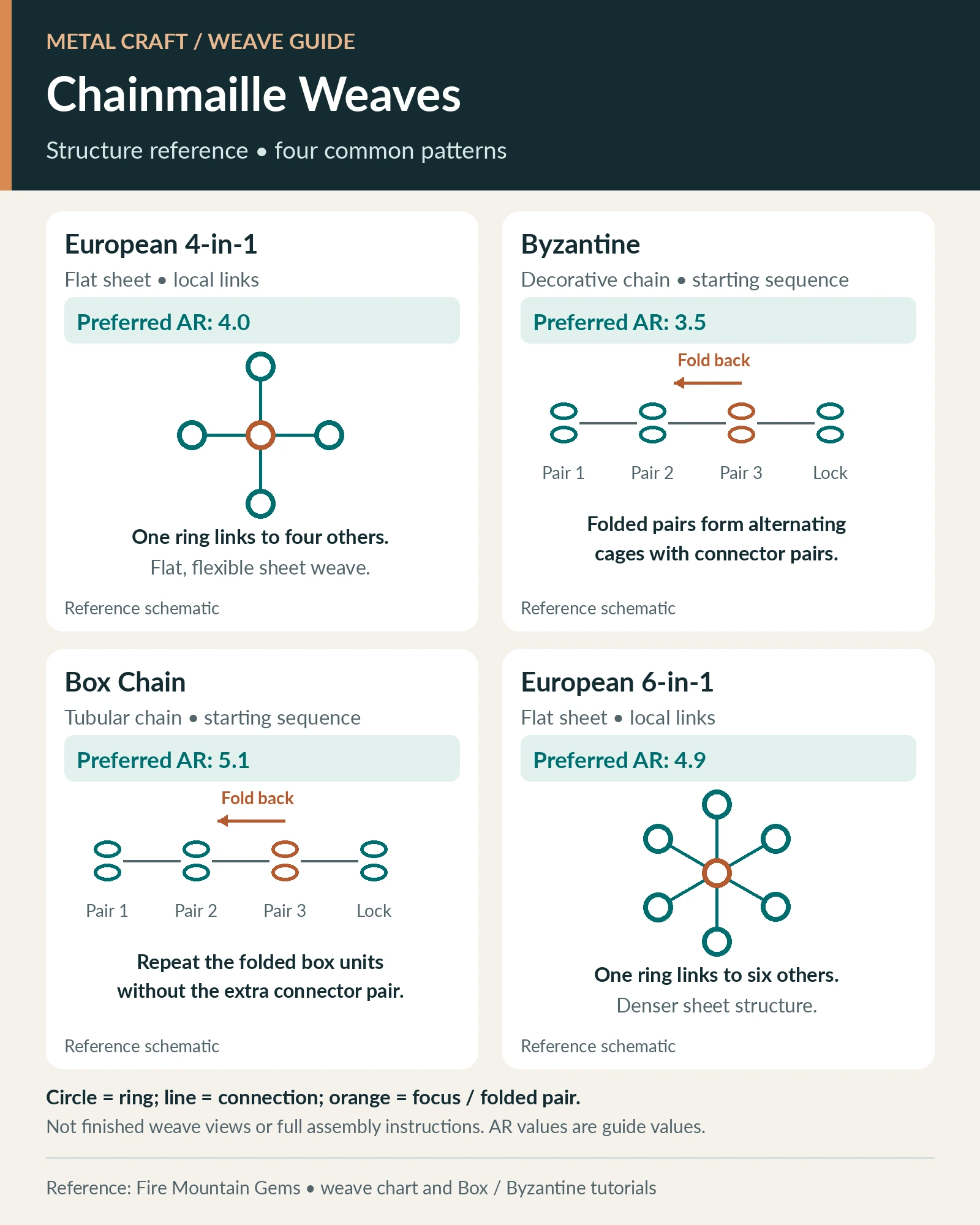
Byzantine is not in the minimums table above, so the tool does not check it. For a practical figure, jewellery supplier Artbeads says the best AR for Byzantine chain is a range from 3.2 to 4.2, and another tutorial author shows 3.2 as a very tight version of the weave with no big gaps. Treat that as a starting range from tutorials, not a standard, and confirm with a short sample in your own wire. The same goes for any weave not listed.
Worked example (illustrative, 1.6 mm wire): AR 3.2 gives ID = 1.6 × 3.2 = 5.12 mm and AR 4.2 gives ID = 1.6 × 4.2 = 6.72 mm. So rings with an inner diameter between about 5.1 and 6.7 mm fall inside that tutorial range. The 1.6 mm wire is only an example; use your measured wire.
Using the chainmaille calculator
In the chainmaille aspect ratio calculator, enter ID and WD, choose a weave and press Check. It shows the AR and whether it is at or above the published minimum. The second box works backwards: enter wire size and target AR to get the inner diameter you need.
Sample weave test and fit limitations
Make a 10 to 20 ring sample before cutting hundreds of rings. If rings bind, use a slightly larger ID or thinner wire. The tool lists minimums only; it does not know your wire hardness or ring closure.
Worked examples, practical checks and limitations
- Target AR 3.5 with 1 mm wire: ID = 1 × 3.5 = 3.5 mm.
- Default example, ID 4 mm and WD 1 mm, AR 4.0: above 2.9 (European 4 in 1) but below 4.3 (European 6 in 1), so it will not make that weave.
Common mistakes and when to seek expert confirmation
- Using the gauge label instead of a measured diameter.
- Mixing units between ID and WD.
- Treating a minimum as the ideal AR.
- Mixing ring or wire sizes inside one weave without checking.
For a pattern that lists a recommended AR, follow the designer, and test samples in your actual wire.
Frequently asked questions
What ring size do I need for Byzantine chainmaille?
A supplier tutorial gives an AR of 3.2 to 4.2 for Byzantine. Convert it with ID = wire diameter × AR, then weave a sample. For 1.6 mm wire that is about 5.1 to 6.7 mm.
What is the formula for aspect ratio?
AR = inner diameter ÷ wire diameter.
Does AR change with the metal?
No. It depends only on the two sizes, though springback differs by metal.
Why does my weave lock up?
The AR may be close to the minimum. Try a larger ID or thinner wire.
Can I use a higher AR than the minimum?
Usually yes. A higher AR makes the weave easier but looser, so many makers pick a value a bit above the minimum for a comfortable, attractive result.
Conclusion
Measure real wire and rings, compute AR, compare with a published minimum, and weave a sample before committing.
Sources
- M.A.I.L.: Aspect Ratio (AR) article
- M.A.I.L.: Minimum aspect ratios by weave
- M.A.I.L.: European 8 in 1, 12 in 2 and 6 in 1 minimum AR
- M.A.I.L.: 2 in 1 and Japanese 3 in 1 connector rings
- Chainmaillers Maillepedia: Japanese Pattern Linkage (JPL) 2.7
- Chainmaillers.com: Aspect Ratio Demystified
- Artbeads: How to create a Byzantine chain
- WireJewelry: Aspect ratio for Byzantine weave






















Share Your Opinion
Comments are closed on this post.