 Vista

The costliest mistake after a bounced cheque is delay. The law sets three separate time limits, and missing even one can get your complaint dismissed. This guide explains the Section 138 and 142 deadlines of the Negotiable Instruments Act with a dated example.
The three deadlines at a glance
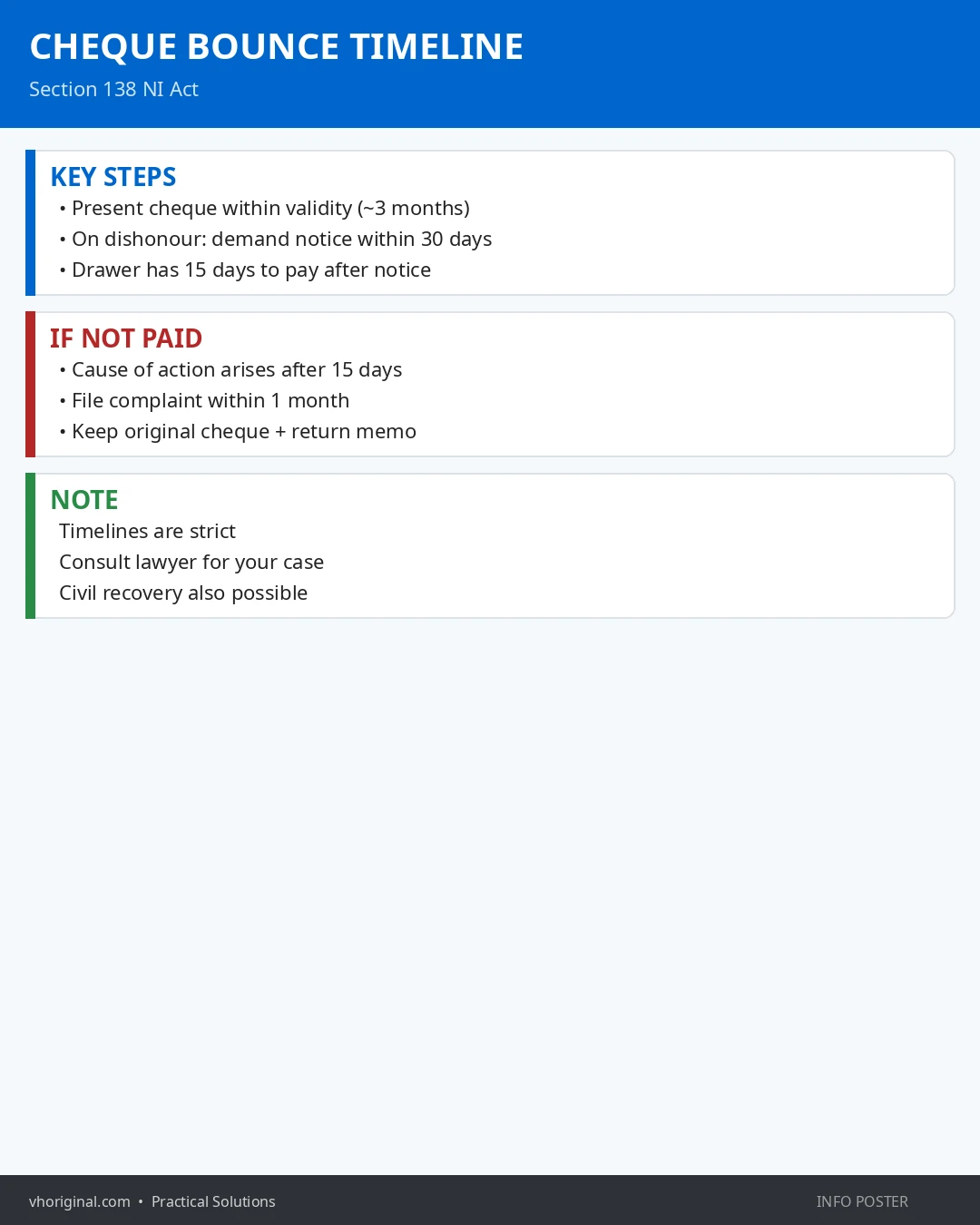
| Step | Time limit |
|---|---|
| 1. Written demand notice after the bank informs you of the dishonour | Within 30 days |
| 2. Drawer’s chance to pay after receiving the notice | 15 days |
| 3. Complaint in court if no payment in 15 days | Within one month of the cause of action arising |
Step 1: Notice within 30 days
You must demand the amount in writing from the drawer within 30 days of receiving the bank’s information that the cheque bounced. The count starts from the return memo or intimation date, not the date on the cheque. Keep proof of dispatch and delivery, whether post, courier or email.
Step 2: The 15-day wait
The drawer then has 15 days from receiving the notice to pay. If they pay, the matter ends. A complaint filed before these 15 days expire is not maintainable, as the Supreme Court held in Yogendra Pratap Singh v. Savitri Pandey.
Step 3: Complaint within one month
If there is no payment in 15 days, the cause of action arises. Under Section 142, the written complaint must be filed before the Magistrate within one month of that date, counted as a calendar month, not 30 days. If the complainant shows sufficient cause for a delay, the court may take it up, but do not plan around that.
In 2025 the Delhi High Court clarified that the “45 days” people mention is not one lump sum; it is 15 days to pay plus a separate 30 days to file.
A dated example
- 1 December: bank return memo received.
- By 31 December: the notice must go out. Say it is sent on 20 December.
- 24 December: the drawer receives the notice. The 15-day window ends on 8 January.
- 9 January: cause of action arises if there is no payment.
- About 8 February: last day to file the complaint. Confirm the exact date with a lawyer.
Penalty and protection of money
A conviction under Section 138 can mean up to two years’ imprisonment, or a fine up to twice the cheque amount, or both. During trial the court may order the accused to pay interim compensation of up to 20% of the cheque amount under Section 143A, though the Supreme Court has said it is not automatic in every case. In an appeal against conviction, the appellate court can require a deposit of at least 20% of the fine or compensation under Section 148. See also our guide on bail and settlement in cheque bounce cases.
Mistakes that weaken a case
- Sending the notice after 30 days.
- Filing the complaint before the 15 days end.
- Not keeping proof of notice delivery.
- Wrong amount or cheque number in the notice.
Frequently asked questions (FAQ)
Can I file a case without sending a notice?
No. The Section 138 offence is complete only if the drawer fails to pay within 15 days of receiving the notice.
What if the drawer refuses to accept the notice?
Notice sent to the correct address is generally treated as served, but it depends on the facts. Keep postal receipts and tracking records.
I missed the one-month window. What now?
You can explain the delay and ask the court to condone it, but the outcome is at the court’s discretion. Speak to a lawyer immediately.
Disclaimer: This is general information, not legal advice. Date counting depends on facts, so consult a lawyer before sending the notice.
Also read: Got a Legal Notice from Your Bank? What to Do: SARFAESI 60 Days, How to Reply and Your Rights | How to Write the Cheque Amount in Words in India: Lakh, Crore and Paise Examples
Sources
- Judicial training material: Time frames under Section 138 NI Act (cdnbbsr.s3waas.gov.in, eCourts)
- LiveLaw: Delhi High Court on 15 days vs 45 days (livelaw.in, 3 Sept 2025)
- Supreme Court: G.J. Raja v. Tejraj Surana (digiscr.sci.gov.in) and the October 2024 judgment (api.sci.gov.in)
- iPleaders: How to file a cheque bounce case under Section 138 (blog.ipleaders.in)
- Legal Service India: The three dates under Section 138 (legalserviceindia.com)
















Share Your Opinion
Comments are closed on this post.