 Vista
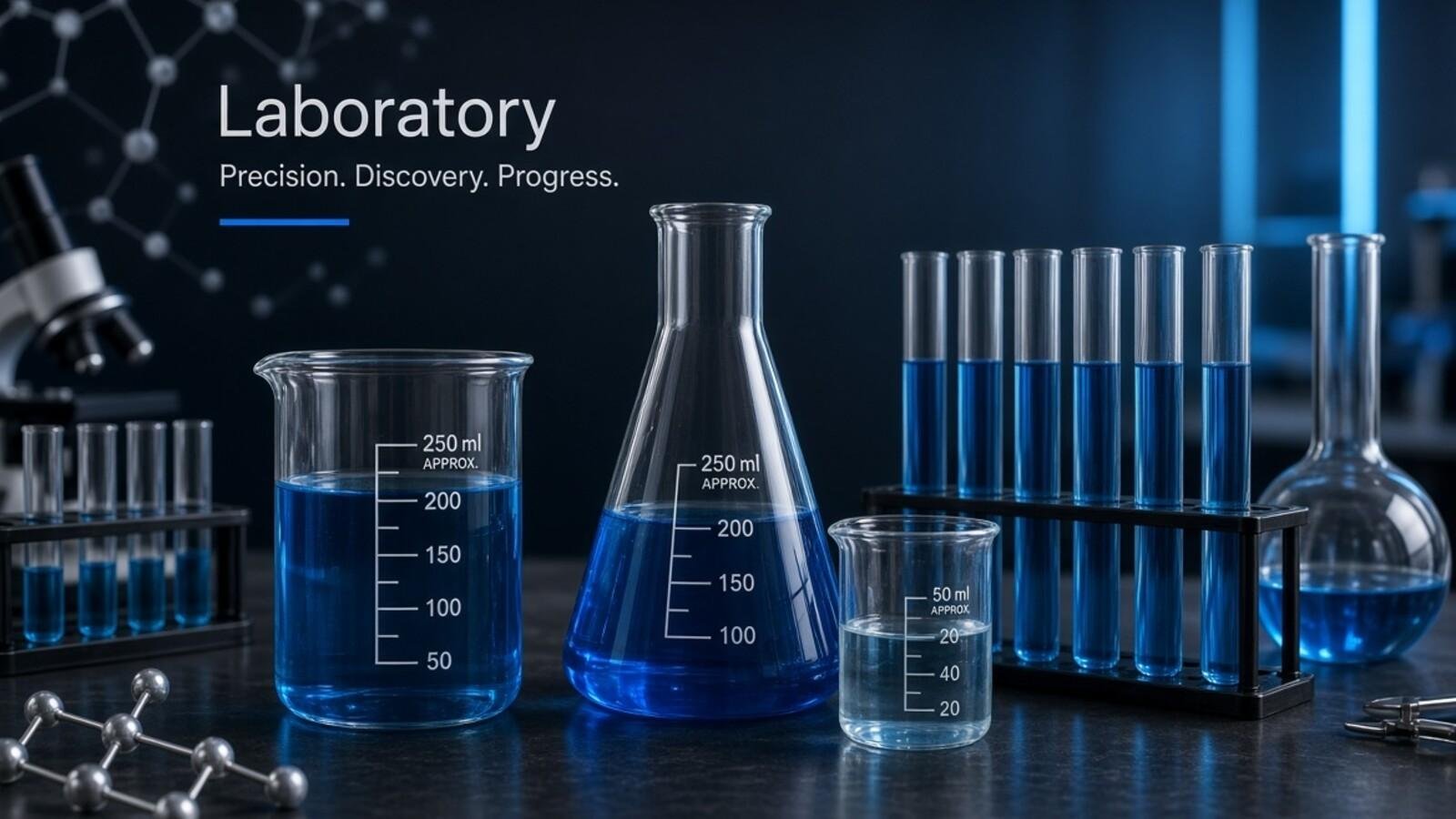
Quick answer: A laboratory glassware chart identifies common apparatus by shape and purpose. A beaker or conical flask holds and mixes liquids, while a graduated cylinder measures volumes more reliably and volumetric pipettes, burettes and flasks serve accurate measurement tasks. These differences matter in school chemistry: the presence of printed marks on a beaker does not make it a calibrated quantitative measuring instrument.
Updated: 21 November 2026.
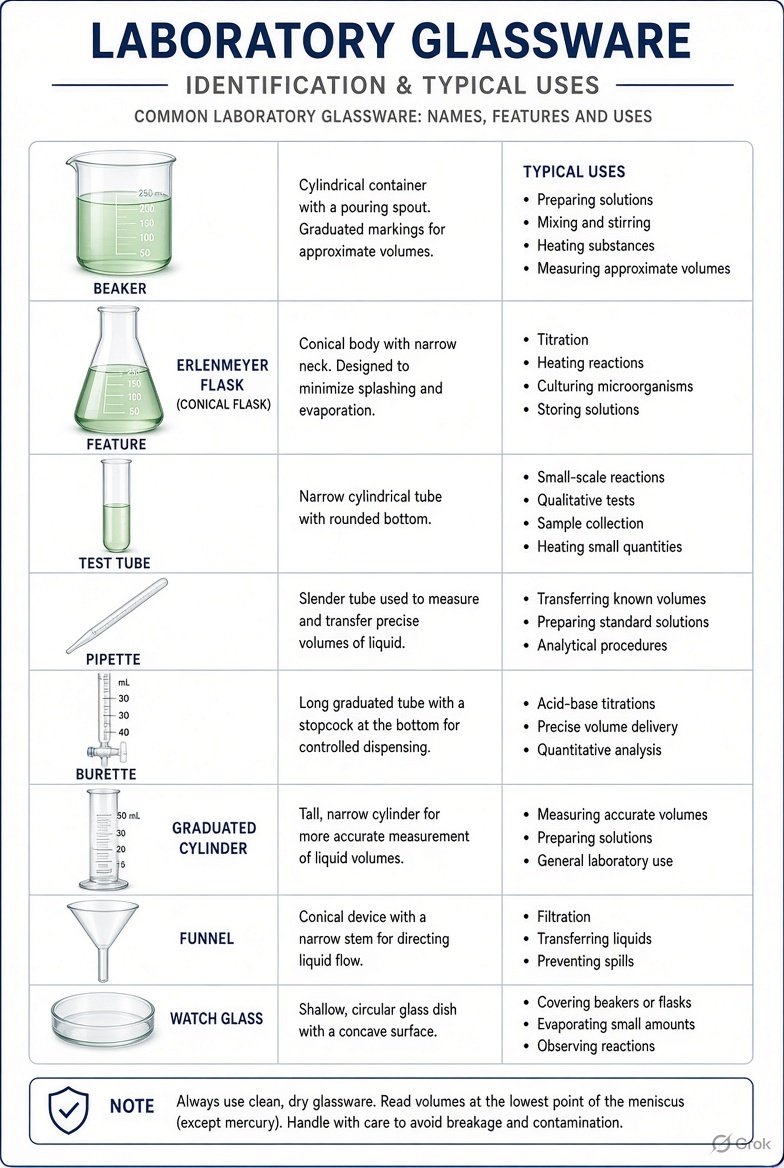
Chemistry apparatus names and uses reference table
| Apparatus | Typical role | Hindi identification |
|---|---|---|
| Beaker | Mixing, holding, heating compatible liquids; approximate volume only | बीकर: घोल रखना, मिलाना और उपयुक्त स्थिति में गरम करना; माप अनुमानित |
| Erlenmeyer / conical flask | Swirling and mixing, often in titrations; not precision measuring | कोनिकल फ्लास्क: टाइट्रेशन में घोल घुमाना; accurate volume मापने के लिए नहीं |
| Graduated cylinder | Measuring liquid volume more precisely than a beaker | मेजरिंग सिलिंडर: बीकर से अधिक सटीक volume मापना |
| Volumetric flask | Preparing solution to one calibrated contained volume | वॉल्यूमेट्रिक फ्लास्क: एक निश्चित calibrated volume का घोल बनाना |
| Volumetric pipette | Delivering one accurately specified volume using a safety filler | वॉल्यूमेट्रिक पिपेट: एक calibrated मात्रा देना, filler के साथ |
| Burette | Dispensing measured variable volumes in titration | ब्यूरेट: टाइट्रेशन में नियंत्रित, मापी हुई मात्रा देना |
| Test tube | Small reactions or sample holding; rack/holder required | टेस्ट ट्यूब: छोटे sample या reactions; rack/holder इस्तेमाल करें |
| Watch glass | Covering a beaker or holding small dry samples | वॉच ग्लास: beaker ढकना या सूखा छोटा sample रखना |
| Separatory funnel | Separating immiscible liquid layers under trained procedure | सेपरेटरी फनल: न मिल पाने वाले liquids की layers अलग करना |
| Round-bottom flask | Heating, reflux or distillation with suitable apparatus | राउंड-बॉटम फ्लास्क: सही setup में heating/reflux/distillation |
| Funnel | Guiding transfers and supporting filter paper | फनल: pouring और filter paper रखने में मदद |
Beaker and conical flask: everyday mixing vessels
A beaker is a broad cylindrical container with a pouring lip; some have printed graduation marks. These markings give rough estimates, not the controlled precision of specialized volumetric glassware. An Erlenmeyer or conical flask has sloping walls and a narrow neck, making it convenient to swirl a solution and help reduce splashing. Both can be used for holding or mixing solutions under suitable conditions, but neither should be the principal tool for accurately preparing a standard solution.
The container material matters. Borosilicate glass can tolerate many laboratory temperature changes better than ordinary household glass, but it is still breakable and can fail under thermal shock or chemical attack. A narrow-neck flask is not an automatically sealed pressure vessel. Do not cap glassware tightly while heating or use unknown glass over a flame. For a classroom demonstration, teachers should select the correct vessel and explain why its volume markings are only indicative.
Graduated cylinder versus a volumetric flask
A graduated cylinder is designed to measure different volumes from a scale along its vertical body. It is generally more suitable than a beaker for routine measurements. A volumetric flask has a round or pear-shaped bulb and a long neck with a single calibration mark, designed to contain a specific volume accurately at a stated temperature. It is useful when preparing a solution to a known final volume, but not for obtaining a large range of volumes.
Read the liquid meniscus at eye level with the glass held vertically and stable. For a typical colourless aqueous solution, the bottom of the curved meniscus is used according to the applicable instrument instructions. Viewing from above or below introduces parallax error. Check markings such as mL, tolerance, class, temperature and whether the equipment is marked TC (to contain) or TD (to deliver). A flask for ‘containing’ 100 mL is not necessarily calibrated to deliver exactly 100 mL when poured out.
Volumetric pipettes, graduated pipettes and safe fillers
A volumetric pipette transfers a single specified volume with high accuracy when used correctly. Graduated pipettes have a scale for variable transferred volumes, but calibration details and expected precision differ. A Pasteur or transfer pipette normally moves small quantities without promising a certified precise volume. These devices may look similar in photographs yet are chosen for different tasks.
Never pipette by mouth. Use a suitable pipette bulb, pump or dedicated filler. Read the label to know whether a calibrated pipette should drain naturally and whether the final drop is handled according to its designated method. Touching the tip incorrectly to a container, trapping bubbles or using a dirty pipette can compromise the measurement. For corrosive, toxic or biological material, additional safeguards and training are required. An identification chart is not authorization to handle hazardous substances.
Burette in titration: what the numbers actually show
A burette is a long graduated tube fitted with a tap or stopcock near the tip. In a titration, it delivers measured volumes gradually so a chemical endpoint can be observed under a controlled method. Its graduation scale often increases downward, unlike a measuring cylinder read from bottom upward. The delivered volume is calculated from the final reading minus the initial reading, not from a single photograph of the final liquid level.
Before use, a trained student checks for leaks, air bubbles in the tip, correct rinsing and a secure vertical clamp. The observer reads the meniscus at eye level and writes measurements to the precision justified by the apparatus. Excessive force on a glass stopcock or an unstable clamp can break the tube. A coloured indicator endpoint should be interpreted using the actual chemistry procedure; bright pink on a poster cannot substitute for understanding the solution and titrant.
Test tubes, test-tube racks, stirring rods and watch glasses
A test tube is useful for holding a small sample or observing a reaction. A rack keeps multiple tubes upright, while a suitable holder may be needed if a tube is handled under permitted heating conditions. A glass stirring rod helps mix a liquid or guide a controlled pour. A watch glass is a shallow concave disc used to cover a beaker or hold a small sample; it is not a substitute for a sealed reaction vessel.
Glass and plastic containers can both be used in science, but they have different chemical and temperature compatibility. A cap on a tube can be necessary for storage yet hazardous in an unauthorised heated experiment. Broken glass should be handled through designated sharps or lab-glass disposal procedures rather than picked up by bare hands. Clean reusable apparatus according to the laboratory’s instructions; residues left on one vessel can alter the next experiment even when the shape of the glassware is correctly identified.
Separatory funnel, filter funnel and round-bottom flask
A separatory funnel allows immiscible liquid phases to settle and be released separately through a stopcock in an approved procedure. A simple filter funnel supports filter paper and channels a liquid into a receiving vessel. A round-bottom flask suits certain controlled heating, distillation and reflux arrangements when supported by correctly assembled clamps and heating equipment. These pieces serve different chemistry steps and should not be grouped under one generic label ‘flask’ on an educational chart.
A separatory funnel may build pressure with certain liquids, and an improperly vented apparatus can be dangerous. Distillation setups have serious fire, pressure and chemical hazards. The shape of a flask does not prove it is safe for a particular reaction, temperature or vacuum. For school learners, focus on recognition and purpose; trained staff should supervise any real transfer, heating, extraction or distillation operation. Avoid giving a beginner a hazardous procedure merely because a picture shows the correct glassware.
How to choose precise equipment for a measurement
Ask what is being measured: an approximate amount for mixing, a measured variable volume, one precisely fixed contained volume, or an accurately delivered quantity. A beaker may be acceptable for a rough mixture, a graduated cylinder for an intermediate measurement, a volumetric flask for making up to a set final volume, and a calibrated pipette or burette for transfers requiring appropriate precision. The required error tolerance dictates the tool.
Good measurement also depends on cleanliness, temperature, calibration and user technique. A class A item generally has a tighter tolerance than certain class B products, but always consult the actual marked standard and manufacturer’s documentation. A student measuring 25 mL with the wrong type of vessel may obtain an acceptable visual result yet introduce systematic error. Record the apparatus and its calibration information in your lab notebook rather than treating all marked glass as equally accurate.
Reading chemistry apparatus diagrams without being misled
Image generators can draw convincing glass vessels while adding impossible double necks, incorrectly placing burette graduations or making a volumetric flask look like a beaker with a bulb. For a useful school reference, each item should have a clear silhouette, correct name and one realistic basic use. Do not label a test tube ‘graduated cylinder’ simply because it is tall and narrow.
A visual chart is best accompanied by text that makes the important distinctions explicit. The table in this article supplies those names independently of the illustration. When preparing a worksheet, compare figures with university chemistry manuals and, when appropriate, handle clean empty apparatus under supervision to appreciate scale and balance. The diagram is educational only, not a replacement for training, laboratory safety rules, chemical SDS guidance or the specific experiment protocol.
Frequently asked questions
Which glassware is used to measure one exact volume?
A properly calibrated volumetric flask is used to contain a fixed volume, while a volumetric pipette is designed to deliver a fixed volume.
Is a beaker accurate enough for titration?
Not for accurate quantitative measurement; the burette and suitable volumetric glassware are central.
What is the difference between a burette and a pipette?
A burette can dispense and measure variable volumes; a volumetric pipette delivers one specified volume.
Should I pipette liquid by mouth?
Never. Use an appropriate pipette filler.
Why do we read a meniscus at eye level?
To reduce parallax error and obtain the intended scale reading.
Conclusion
Choose glassware by purpose and calibrated accuracy, not by appearance alone. Practical chemistry needs supervised techniques, safety instructions and the correct equipment.
Sources
- Open University — accurate volumetric glassware
- Florida State University — beakers and flasks
- Michigan State University — measuring devices
- Chemistry LibreTexts — laboratory equipment
Educational identification guide only; no untrained chemical handling.


















Share Your Opinion
Comments are closed on this post.