 Vista
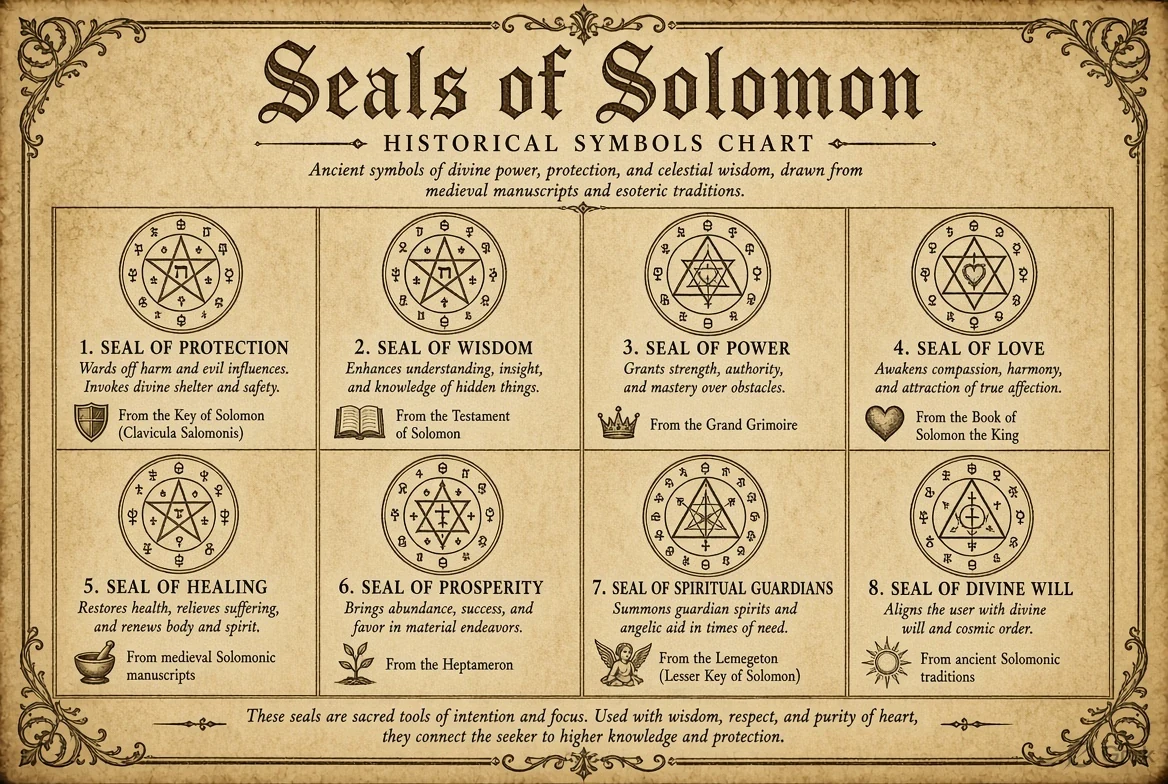
Direct answer: The Seal of Solomon is a name used for varying legendary and historical symbols, including star-shaped emblems and later manuscript diagrams. The Key of Solomon contains planetary pentacles, while the Lesser Key of Solomon is a different compilation. This illustrated Seals of Solomon historical symbols chart explains the distinctions and why no generic online image proves an ancient original.
Updated 20 November 2026. Historical, literary and visual reference only. Symbolic traditions are described, not presented as proven supernatural mechanisms.
Seals of Solomon historical symbols: three visual comparison charts
What is the Seal of Solomon? Meaning, history and symbols
The term Seal of Solomon refers to several related but not identical traditions about a sign, ring or emblem associated in later legend with the biblical King Solomon. In some artistic and literary settings it appears as a six-pointed star; in others a pentagram or a more complex geometric design is involved. The phrase is also used loosely online for drawings from later ceremonial-magic books. That is why a Seals of Solomon historical symbols chart needs labels, provenance and distinctions rather than one supposedly universal “original” design.
Readers commonly want to know whether a particular image is an authentic ancient seal. The safe historical answer is that modern internet diagrams cannot by themselves prove a direct connection to the historical Solomon. Legendary attribution and documented manuscript date are separate questions. A text copied centuries later may claim ancient authority, but the claim itself is not evidence that the pictured lines originated in the reign of a particular ancient monarch.
Seal of Solomon, Star of David and pentagram: are they the same?
A six-pointed star can be drawn using two overlapping triangles and is often called a hexagram. In Jewish symbolism the six-pointed star is widely known as the Star of David or Magen David, with its own historical and religious significance. A five-pointed star is a pentagram. The two shapes are geometrically different, even though both appear in varied cultural and historical symbolic contexts. They should not be presented as interchangeable forms of one ancient object.
Some later references use “Seal of Solomon” for one or the other shape. That variation reflects the development and borrowing of symbols across traditions, not an error that can be fixed by asserting a single invented secret origin. Avoid automatically calling every hexagram a magical Solomonic seal or every pentagram an evil sign. Consider date, material, script, accompanying inscriptions and the community using it. A symbol’s modern social meaning may also differ from what a particular manuscript illustrator intended.
Key of Solomon pentacles: what the manuscript tradition contains
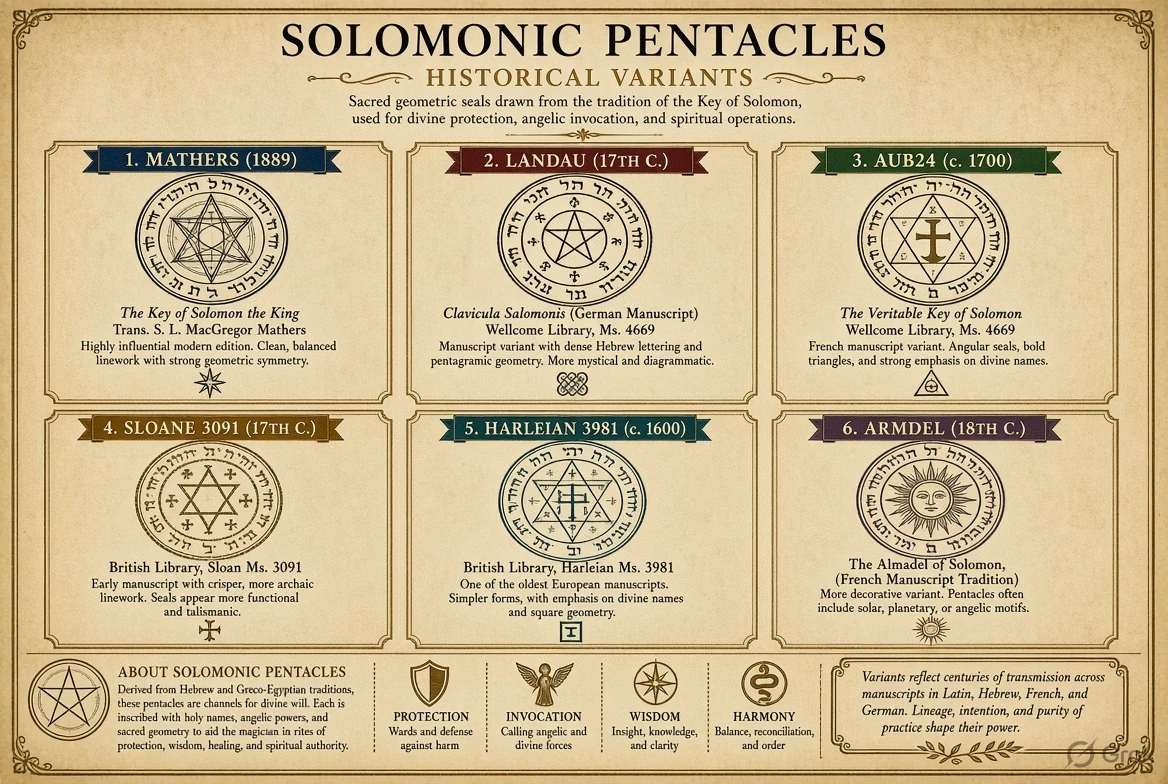
The Key of Solomon, also called Clavicula Salomonis, is a body of later magical literature attributed to Solomon in its titles and transmission. Its surviving manuscript and printed forms include diagrams conventionally called pentacles, often linked to planets and accompanied by writing or geometric arrangements. In the 1889 English edition edited by S. L. MacGregor Mathers, readers encounter a series of numbered planetary pentacles. That published arrangement should not be confused with a single ancient archaeological artefact.
When a modern chart labels a symbol “First Pentacle of Jupiter” or “Second Pentacle of Saturn”, the useful research question is “which edition or manuscript supplied the image?” Copyists made variations; printing can regularise handwriting; translators may interpret damaged letters differently. Even an influential printed source such as Mathers’s edition is a historical publication with editorial choices, not a guarantee that every glyph exactly reproduces all manuscript witnesses. A reliable picture guide should cite its basis and describe variants without inventing a definitive original.
Lesser Key of Solomon and Goetic seals: a different collection
The Lesser Key of Solomon, or Lemegeton, is a different compilation from the Key of Solomon, although popular websites repeatedly combine the two. Its best-known section is the Ars Goetia, which circulates seal illustrations associated with named spirits. An image described as a “Goetic seal of Solomon” therefore may come from a later textual tradition rather than from the planetary pentacles found in the Key of Solomon. Without that identification a chart can unintentionally compare unrelated drawings as though they were versions of one symbol.
There is also a distinction between the legendary story of Solomon’s ring, a diagram printed in an early modern edition and contemporary internet art inspired by either. They are different evidence categories. This guide focuses on recognising historical illustration styles and explaining manuscript relationships, not teaching ritual procedures. A chart featuring a circle and handwritten letters is insufficient evidence to attribute it to a specific manuscript unless a source, folio or archival catalogue supports that claim.
How to identify a Solomonic seal from an image
Start by separating the geometric framework from surrounding writing. Is it a hexagram, pentagram, circle, square or layered figure? Does the design contain Hebrew letters, Latin text, planetary signs or material copied from a modern illustration? Next record the source’s title, stated edition, date and page. If the diagram is a cropped social-media image, search for the same arrangement in a digitised edition and compare the inscription rather than relying on matching outlines alone.
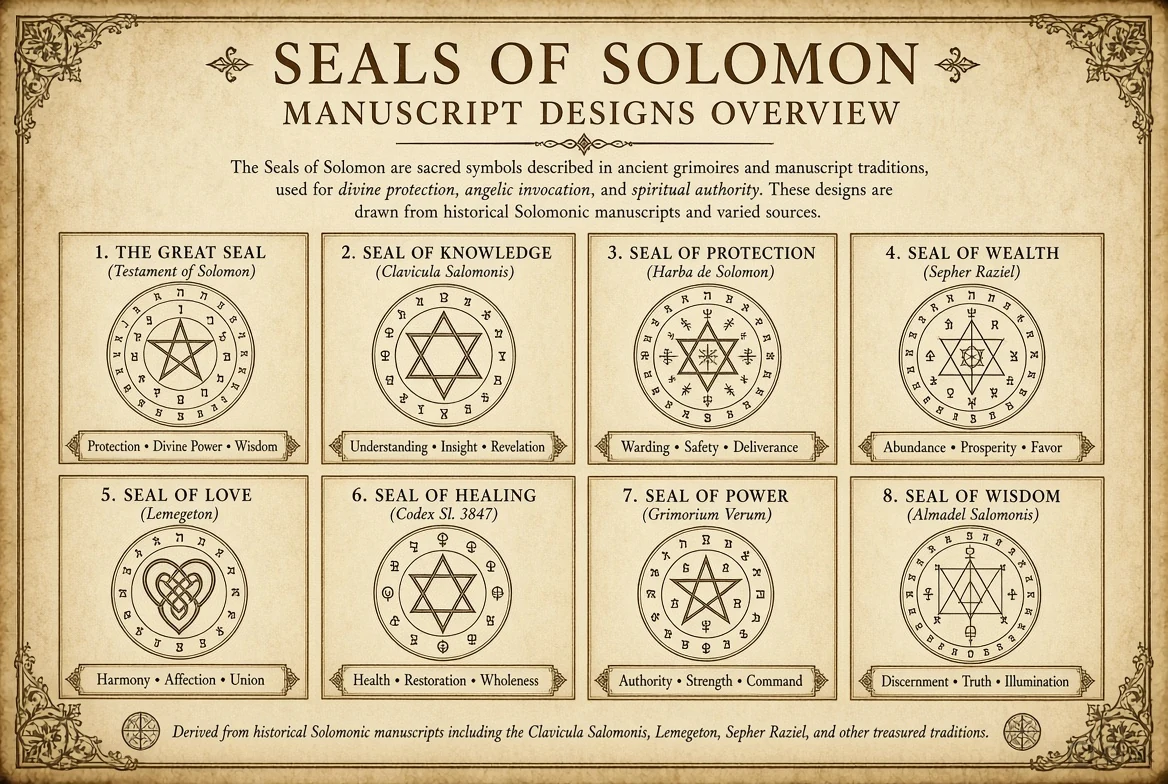
Look for features commonly removed by online redrawings: manuscript ruling, spelling inconsistencies, explanatory text, plate numbering and the sequence of neighbouring images. A 19th-century engraving can be much cleaner than its source manuscript, and a modern designer may silently change letterforms. That is why our three illustrated references are best treated as comparison prompts. They do not authenticate each pictured motif as an ancient seal, and viewers should not assume they constitute a scholarly facsimile.
What historians can verify—and what online claims exaggerate
Libraries and collections can verify the existence of particular manuscripts, their approximate dating, provenance when known and the image appearing on a folio. The Wellcome Collection holds the 1889 English edition of the Key of Solomon, which can be examined as a published source. Researchers can compare that edition with other textual witnesses. This offers a clear evidence trail for “the diagram appears in this edition”, but it does not establish that a seal possesses miraculous effects or can compel supernatural beings.
Claims such as “this is Solomon’s original ring”, “wear this and money will arrive” or “scientifically proven protection symbol” should be treated as unverified unless genuine evidence is supplied—and historical manuscripts are not experimental proof of such benefits. Discussion of the symbols can respect religious and folklore traditions without presenting supernatural efficacy as established fact. Readers seeking the real Seal of Solomon meaning deserve to know both what a text claims and what independent historical scholarship can substantiate.
Solomonic symbols in art, jewellery and modern tattoos
Today the images appear in graphic design, fiction, collectable books, jewellery and tattoos. Someone choosing a motif for art may be interested in its geometry rather than accepting the beliefs expressed in historic grimoires. That choice is different from making an archaeological claim. If you present an image as “historic”, include the edition and approximate date. If you redraw a design with altered letters or new ornaments, label it “modern interpretation inspired by…” rather than a verbatim historical seal.
Take extra care when a design borrows characters from a living religious tradition. A casual mirror flip, invented lettering or mash-up with an unrelated star may change or disrespect what people recognise. For tattoos, verify spelling and orientation before producing a permanent image. For museum-style educational materials, present a side-by-side comparison: historic source image, editorial copy and modern adaptation. That approach communicates more than a sensational “strongest secret seal” poster, and it is much easier for readers to evaluate.
Seals of Solomon chart: the three visual references
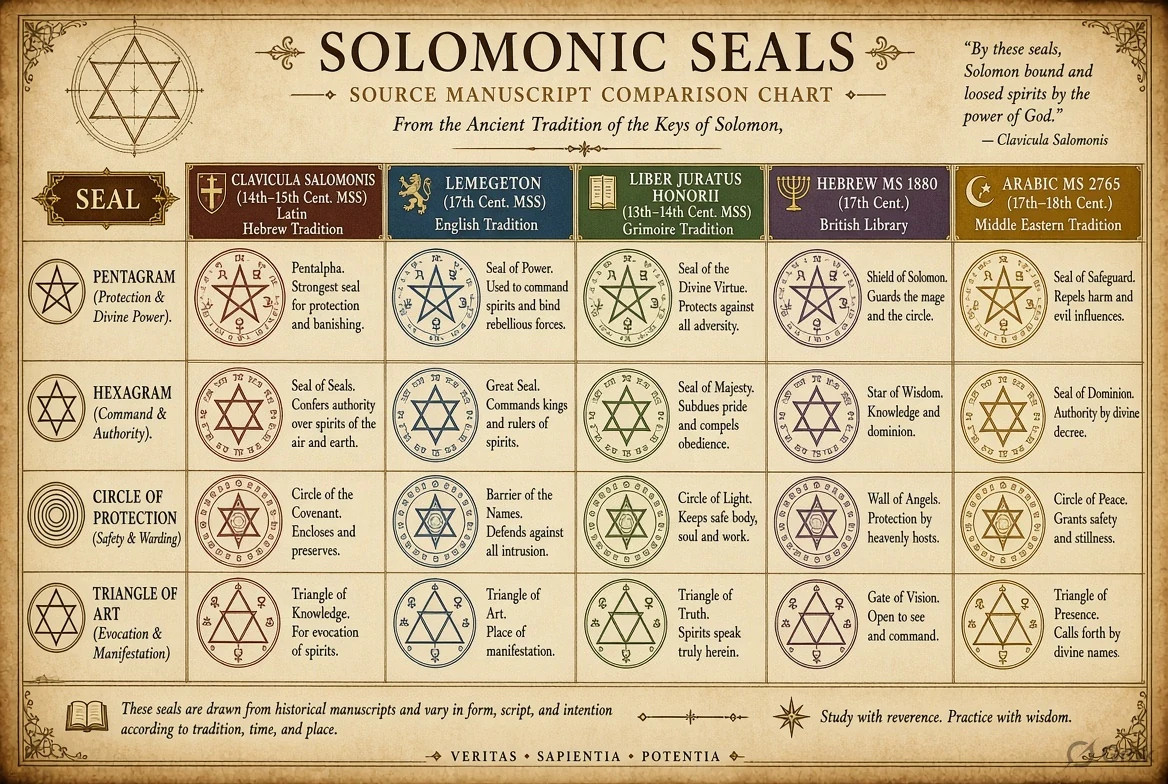
The first chart introduces manuscript-inspired designs and helps distinguish a geometric framework from a longer inscription. The second focuses on the Solomonic pentacles that circulate through later books and editions, encouraging comparison rather than presenting fixed universal meanings. The third shows why an explicit manuscript source matters: a design passed through a copyist, an editor and a modern illustrator may accumulate changes along the way.
When using these visuals, ask three questions: what does the image show, which textual tradition names it, and how secure is the attribution? A correct answer to the first is not automatically a correct answer to the second or third. These drawings are educational aids based on the iconography of the tradition. They should not be cited as new discoveries or as proof that a named king personally drew or used them.
FAQ: Seal of Solomon symbols and historical authenticity
Is the Seal of Solomon a pentagram or a hexagram?
Both forms have been associated with the name in different later traditions. The historical context of a specific example determines what the label means.
Is the Seal of Solomon the same as the Star of David?
Not simply. A hexagram may look identical geometrically, but its names, contexts and religious meanings cannot be reduced to one universal explanation.
Did King Solomon create the Key of Solomon?
The book is attributed to Solomon in later literary tradition; that attribution does not establish ancient authorship by the biblical king.
What is a Solomonic pentacle?
It is a symbolic design presented in versions of the Key of Solomon tradition, often in planetary groups. Images and numbering depend on the source edition.
Do Solomonic seals have scientifically demonstrated supernatural powers?
No reliable scientific evidence establishes the advertised magical effects. Historians can study texts and objects without validating such claims.
Conclusion: separate the legend from the documented image
Solomonic images are best understood through their different textual traditions. A hexagram, a pentagram, a planetary pentacle and a Goetic seal may all occur in conversations about Solomon, but they are not automatically interchangeable. A trustworthy symbols guide identifies the printed or manuscript source and clearly distinguishes later attribution from established history.
Sources and original editions
Wellcome Collection: The Key of Solomon the King, 1889 edition; Joseph H. Peterson: Key of Solomon textual manuscripts and editorial introduction; Historical edition and context of the 1889 Key of Solomon. The last two are sources for the history and text, not scientific validation of their claims.



















Share Your Opinion
Comments are closed on this post.