What is Trigonometry? A Brief Introduction
Trigonometry, derived from Greek words ‘trigonon’ (triangle) and ‘metron’ (measure), literally means ‘measuring triangles’. It’s a branch of mathematics that studies the relationships between the angles and sides of triangles, particularly right-angled triangles. It helps us find unknown side lengths or angles when some information is provided.
Key Trigonometric Ratios
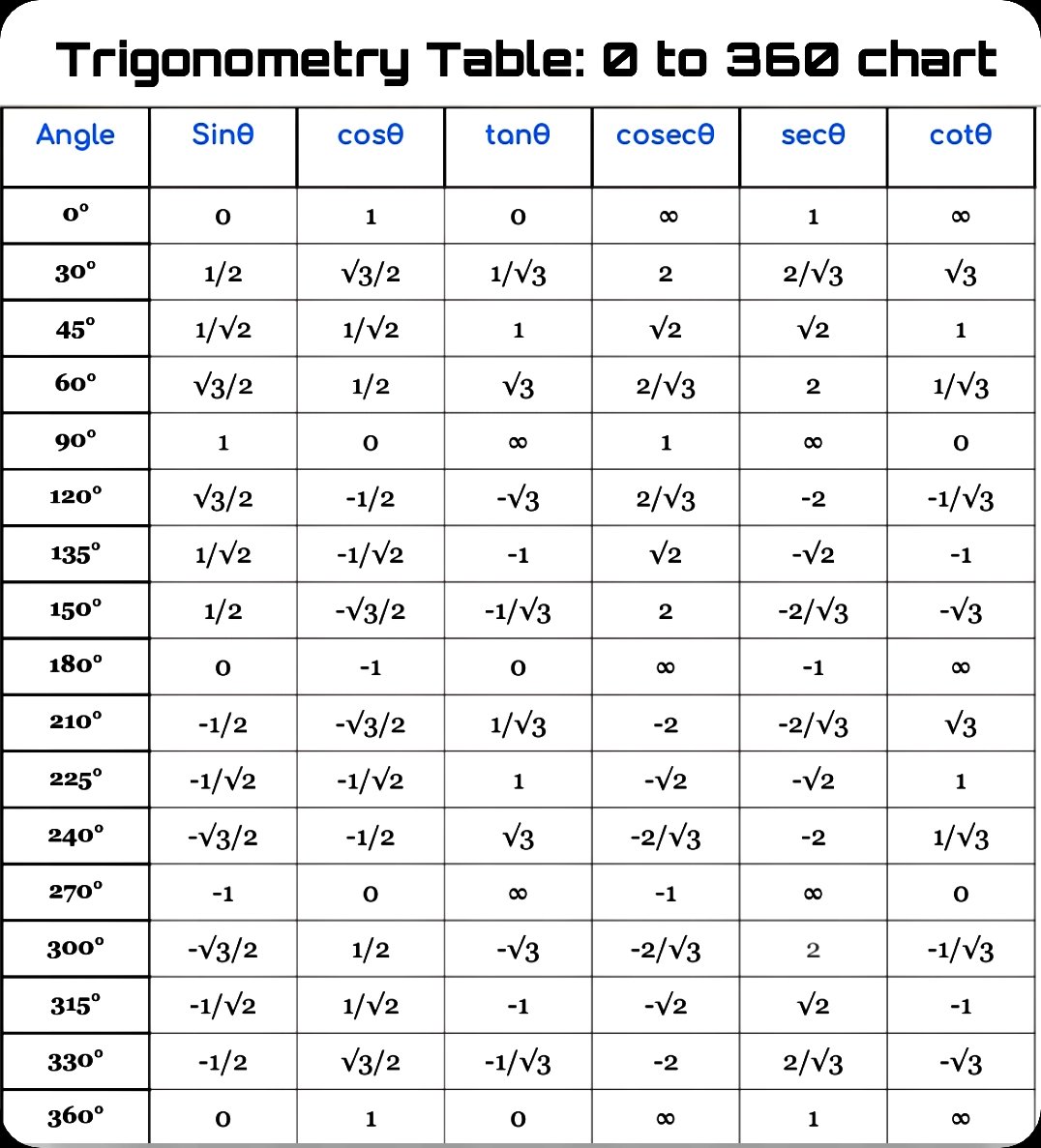
The six primary trigonometric ratios are sine (sin), cosine (cos), and tangent (tan), along with their reciprocals: cosecant (cosec), secant (sec), and cotangent (cot).
- Sin (Sine): Opposite side / Hypotenuse
- Cos (Cosine): Adjacent side / Hypotenuse
- Tan (Tangent): Opposite side / Adjacent side, or Sin / Cos
The Importance of the Trigonometry Table
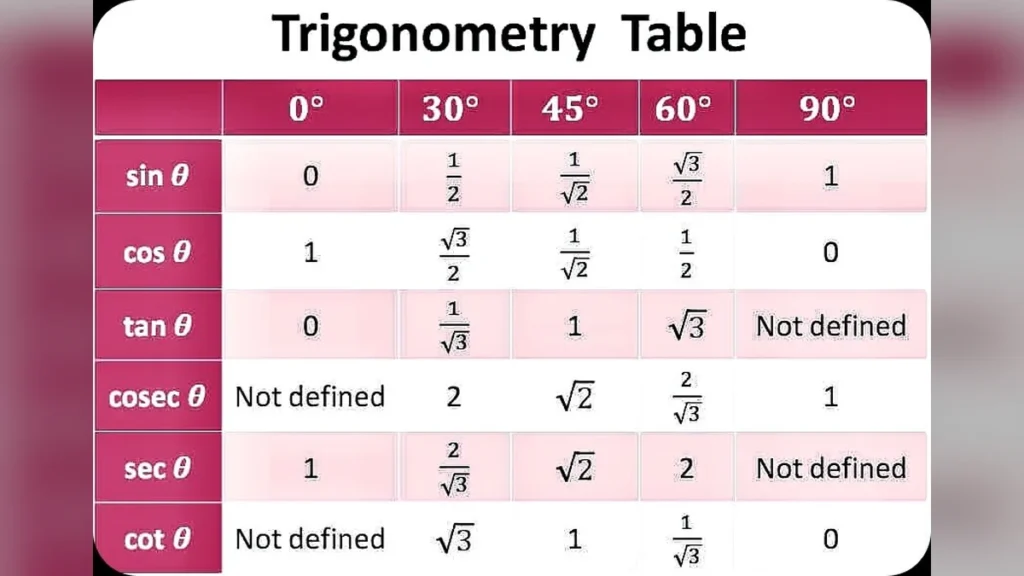
The trigonometry table provides precise values for these ratios at standard angles like 0°, 30°, 45°, 60°, and 90°. These values are fundamental for calculations in mathematics, physics, and various engineering disciplines. Understanding this table is crucial for students, especially in Class 10 and beyond.
Trigonometry Table: Values for Standard Angles
Here are the values for sin, cos, and tan at key angles:
Sine (sin) Values:
- sin 0° = 0
- sin 30° = 1/2
- sin 45° = 1/√2
- sin 60° = √3/2
- sin 90° = 1
Cosine (cos) Values:
- cos 0° = 1
- cos 30° = √3/2
- cos 45° = 1/√2
- cos 60° = 1/2
- cos 90° = 0
Tangent (tan) Values:
- tan 0° = 0
- tan 30° = 1/√3
- tan 45° = 1
- tan 60° = √3
- tan 90° = Undefined (1/0)
Values for Other Ratios (Reciprocals)
Once you know sin, cos, and tan, finding the others is straightforward:
- Cosec (Cosecant) = 1/sin (e.g., cosec 30° = 1/(1/2) = 2)
- Sec (Secant) = 1/cos (e.g., sec 60° = 1/(1/2) = 2)
- Cot (Cotangent) = 1/tan (e.g., cot 45° = 1/1 = 1)
Easy Ways to Remember Trigonometry Values
Memorizing these values can be tricky. Here are some popular and effective methods:
1. The Palm Method
This is a visual trick for sin and cos:
- Extend your left hand towards you. Your fingers represent angles: Thumb (90°), Index (60°), Middle (45°), Ring (30°), Little (0°).
- For Sin: Bend the finger for the desired angle. Count the number of fingers *below* it. The value is √(count) / 2. (e.g., for 30°, bend the ring finger; 1 finger below, so sin 30° = √1 / 2 = 1/2).
- For Cos: Bend the finger for the desired angle. Count the number of fingers *above* it. The value is √(count) / 2. (e.g., for 60°, bend the index finger; 1 finger above, so cos 60° = √1 / 2 = 1/2).
2. Spotting Patterns
- Sin & Cos Relationship: Sin values increase from 0 to 1, while Cos values decrease from 1 to 0. Crucially, sin(x) = cos(90°-x). For example, sin 30° = cos 60°.
- Tan Relationship: tan(x) = sin(x) / cos(x). If you know sin and cos, you can easily derive tan.
3. The Square Root Method (for Sin)
A simple numerical approach:
- Write numbers 0, 1, 2, 3, 4 for angles 0°, 30°, 45°, 60°, 90° respectively.
- Divide each number by 4: 0/4, 1/4, 2/4, 3/4, 4/4.
- Take the square root of each result: √(0/4)=0, √(1/4)=1/2, √(2/4)=1/√2, √(3/4)=√3/2, √(4/4)=1. These are your sin values.
- For cos values, simply write the sin values in reverse order.
Practical Applications of the Trigonometry Table
The trigonometry table is far more than a classroom tool:
- Engineering & Architecture: Designing structures, calculating distances and angles.
- Physics: Analyzing motion, waves, and forces.
- Navigation & GPS: Determining location and direction for ships, aircraft, and GPS devices.
- Astronomy: Estimating distances and positions of celestial bodies.
- Computer Graphics: Rotating 3D models, controlling animations, and managing camera perspectives.
- Surveying: Measuring land, heights, and slopes.
Common Mistakes and How to Avoid Them
- Confusing sin and cos values: Use the memory tricks consistently.
- Forgetting tan 90° is undefined: Remember it arises from 1/0.
- Ignoring reciprocals: Always recall that cosec=1/sin, sec=1/cos, cot=1/tan.
- Lack of Practice: Regular practice is key to mastering these concepts.
Frequently Asked Questions
What are the basic trigonometric ratios?
The basic trigonometric ratios are sine (sin), cosine (cos), and tangent (tan), along with their reciprocals: cosecant (cosec), secant (sec), and cotangent (cot). They define the relationship between angles and sides in right-angled triangles.
How can I easily remember the sin, cos, tan values for 0, 30, 45, 60, 90 degrees?
You can use methods like the Palm Method, the Square Root Method, or by spotting patterns. For instance, the Square Root Method involves writing 0, 1, 2, 3, 4, dividing by 4, and taking the square root for sin values, then reversing for cos values.
What is the relationship between sin and cos?
The fundamental relationship is sin(x) = cos(90°-x). This means the sine of an angle is equal to the cosine of its complementary angle (the angle that adds up to 90° with it). For example, sin 30° = cos 60°.
Why is tan 90 degrees undefined?
Tangent is defined as sin/cos. At 90°, sin 90° = 1 and cos 90° = 0. Since division by zero is undefined in mathematics, tan 90° is also undefined.
Where is the trigonometry table used in real life?
It’s used extensively in fields like engineering, physics, navigation, astronomy, computer graphics, and surveying for calculations involving angles, distances, and heights.
Conclusion
The trigonometry table is an indispensable tool in mathematics and its applications. While memorizing values might seem daunting, employing systematic methods like the Palm or Square Root techniques, understanding the underlying patterns, and consistent practice will lead to mastery. This knowledge not only aids in solving complex problems but also deepens your understanding of mathematical principles and their practical utility.