Updated: 30 October 2026, India time. Binance has acknowledged a security incident and temporarily suspended withdrawals during security checks. Its revised announcement says deposits remain operational. The company says it will cover losses using its SAFU fund and company funds. Those statements should be read alongside the current notice in your account, rather than a screenshot shared without a timestamp.
For a customer searching “Binance hacked”, the immediate question is practical: what should I check, and what should I avoid? A platform investigation does not require you to hand your login credentials to someone claiming to offer compensation. This guide separates the exchange’s reported findings from the steps an individual user can take to protect access, preserve records and avoid a second loss through an impersonation scam.
What Binance has confirmed
According to the exchange’s initial investigation, a compromised DevOps engineer’s laptop may have enabled access to a service container and unauthorised withdrawal transactions. Binance says it has found no evidence of a wallet private-key leak and will publish a technical post-mortem. The preliminary explanation is not the same as a completed forensic investigation.
The company puts the estimated impact at approximately $6.3 billion and says around $3 billion of affected assets had been frozen. These are company-reported estimates at the time of the notice. They do not establish the loss, balance adjustment or settlement position of every individual customer. Recovery figures can change as assets are identified, frozen and reconciled.
Deposits and withdrawals are different services
A deposit moves assets into an exchange account. A withdrawal sends them out. Restrictions on one service do not automatically describe the status of every other feature. This matters because older versions of an announcement can remain visible in reposts after an exchange changes its wording. The revised notice specifically says deposits are unaffected.
Read the latest announcement from the official app or a saved website address. If you have a pending transaction, check its own status rather than assuming every delay has the same cause. Network confirmation, account review and a platform restriction can produce different outcomes. A promised restart time from an unauthorised social account is not a reliable service commitment.
FACT: A security incident at an exchange, a stolen personal password and a pending blockchain transaction are separate events. One headline cannot diagnose all three.
Check account access before doing anything else
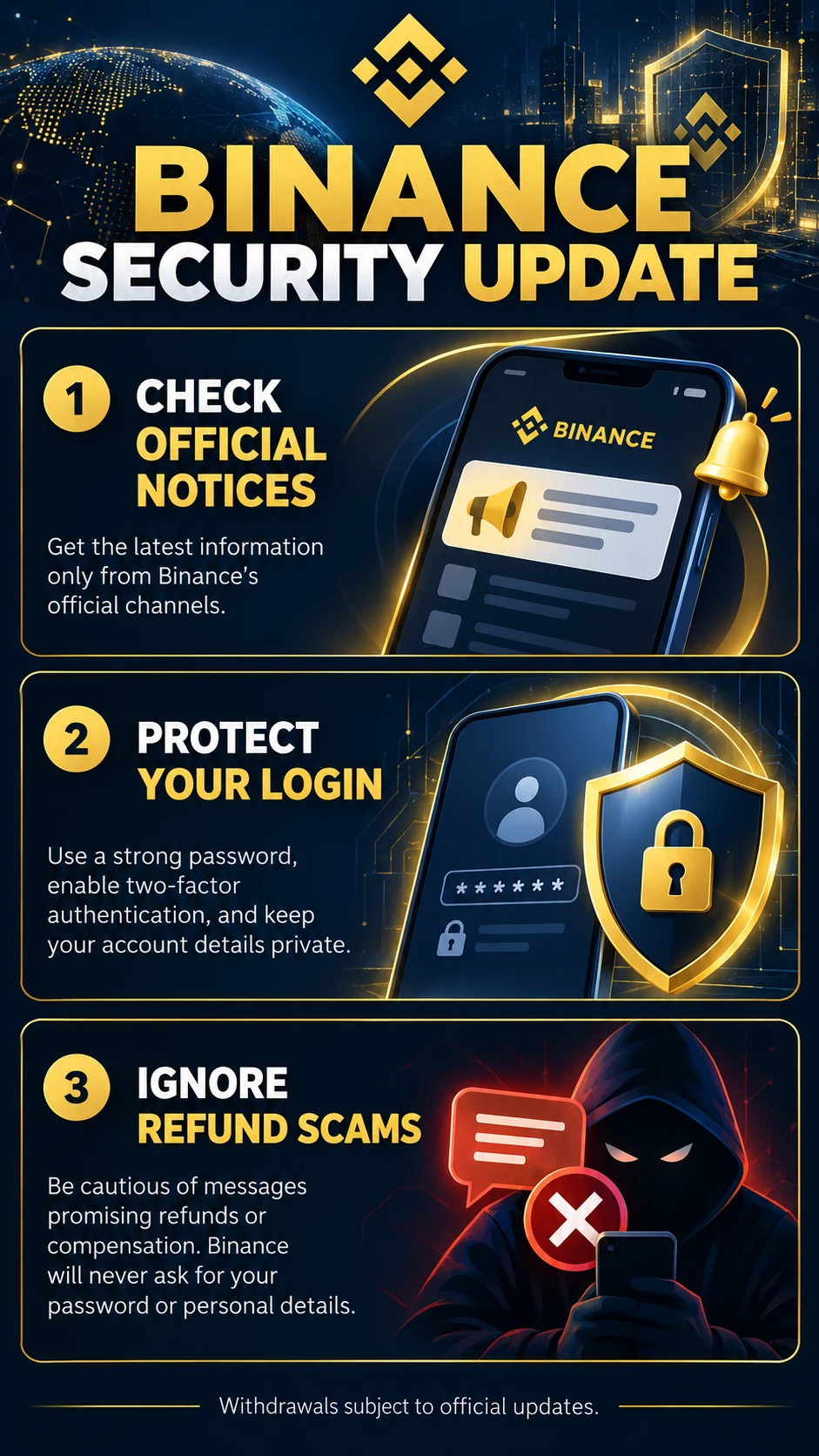
Open the app you already use or type the exchange address yourself. Avoid sponsored search links, direct-message login pages and newly circulated emergency support numbers. A familiar logo can be copied easily. The domain, the app publisher and the route you used to reach support matter more than the visual appearance of a page.
Review recent login activity and connected devices where these controls are available. If a session is unfamiliar, use the official account security tools to remove access and follow the platform’s recovery instructions. A password used on another website should be replaced with a unique one. Also secure the email account used for exchange access, because email recovery can become another route into a financial account.
Enable an appropriate second authentication factor. Understand the recovery process before changing it, and store backup codes somewhere private. Do not send an authenticator code to a person in chat. If changing a security setting introduces a temporary withdrawal restriction, read the explanation rather than repeatedly changing settings in an attempt to bypass it.
Recognise the compensation scam that follows the headline
Fraudsters often turn a public incident into a private emergency. An account may claim to represent a recovery desk and offer to unlock funds after you pay a small verification charge. Another may ask you to connect a wallet to a compensation website. The promised refund can be much larger than the requested fee, making the demand appear reasonable when it is not.
Be particularly cautious when a message combines urgency, secrecy and a new payment destination. An official promise to cover losses does not authorise a stranger to collect an activation deposit. Never disclose a wallet seed phrase, private key, login password or one-time code in a claim form. A request for remote control of your phone is another reason to stop.
Use support reached from the official app and keep the case reference. If someone contacts you first, independently return to the official support channel. Do not treat a search engine result or a social media verification badge as enough evidence that a financial support identity is legitimate.
Keep a useful transaction record
Write down the asset, network, amount, transaction identifier and the status displayed in your account. Preserve the time and any support reference. These details help distinguish a transaction waiting for blockchain confirmations from one that has not been broadcast or one awaiting an internal review. A vague statement that money disappeared is harder to investigate.
If a transaction hash is available, a relevant blockchain explorer may show its on-chain status. It does not necessarily show when the exchange will credit an internal balance. Avoid sharing unredacted screenshots publicly: they can reveal account identifiers, contact details and financial information that help impersonators target you more convincingly.
Advice: separate account safety from trading decisions
Securing access is a different task from deciding whether to buy, sell or hold an asset. Increasing leverage to recover a loss introduces another risk. So does borrowing money because someone says prices must rebound once withdrawals reopen. An operational update is not a forecast of market returns.
If you identify an unauthorised transaction, report it promptly through the exchange’s official support. Where a bank account or payment provider is involved, notify that institution too. Indian users can report financial cybercrime through the National Cyber Crime Reporting Portal. Keep evidence, but do not pay an intermediary who guarantees recovery. Reporting creates a record; it does not guarantee reimbursement.
Frequently asked questions
Is the Binance security incident confirmed?
Yes. Binance has published an official announcement. The preliminary technical explanation remains subject to investigation, so avoid treating every circulating theory as an established finding.
Are deposits suspended as well?
The revised notice reviewed for this article says deposits remain operational. Withdrawals are temporarily suspended during security checks. Check the latest account notice because service conditions can change.
Has Binance promised to cover losses?
The company says it will use SAFU and company funds. That statement does not itself verify an individual account’s settlement or establish a separate compensation process run by third parties.
Should I pay someone to unlock a withdrawal?
Do not pay an unsolicited recovery agent or share credentials. Open a case through official support and follow instructions that you can independently verify inside the platform.
When will withdrawals resume?
This article does not guarantee a restart time. Follow the current official announcement and account notifications for restoration updates, rather than a timer on an unofficial website.
The practical response is to verify the source, protect account access and maintain transaction records. Avoid allowing a broad headline to turn into a rushed transfer to an unknown wallet. The strongest security action is often a pause before clicking an urgent message.
Sources: Binance official incident notice, Binance support resources, India’s cybercrime portal. Disclaimer: Informational coverage, not investment advice or a promise of recovery. Visuals are conceptual AI illustrations, not evidence of the incident.
Related: How to identify a fake digital arrest notice.