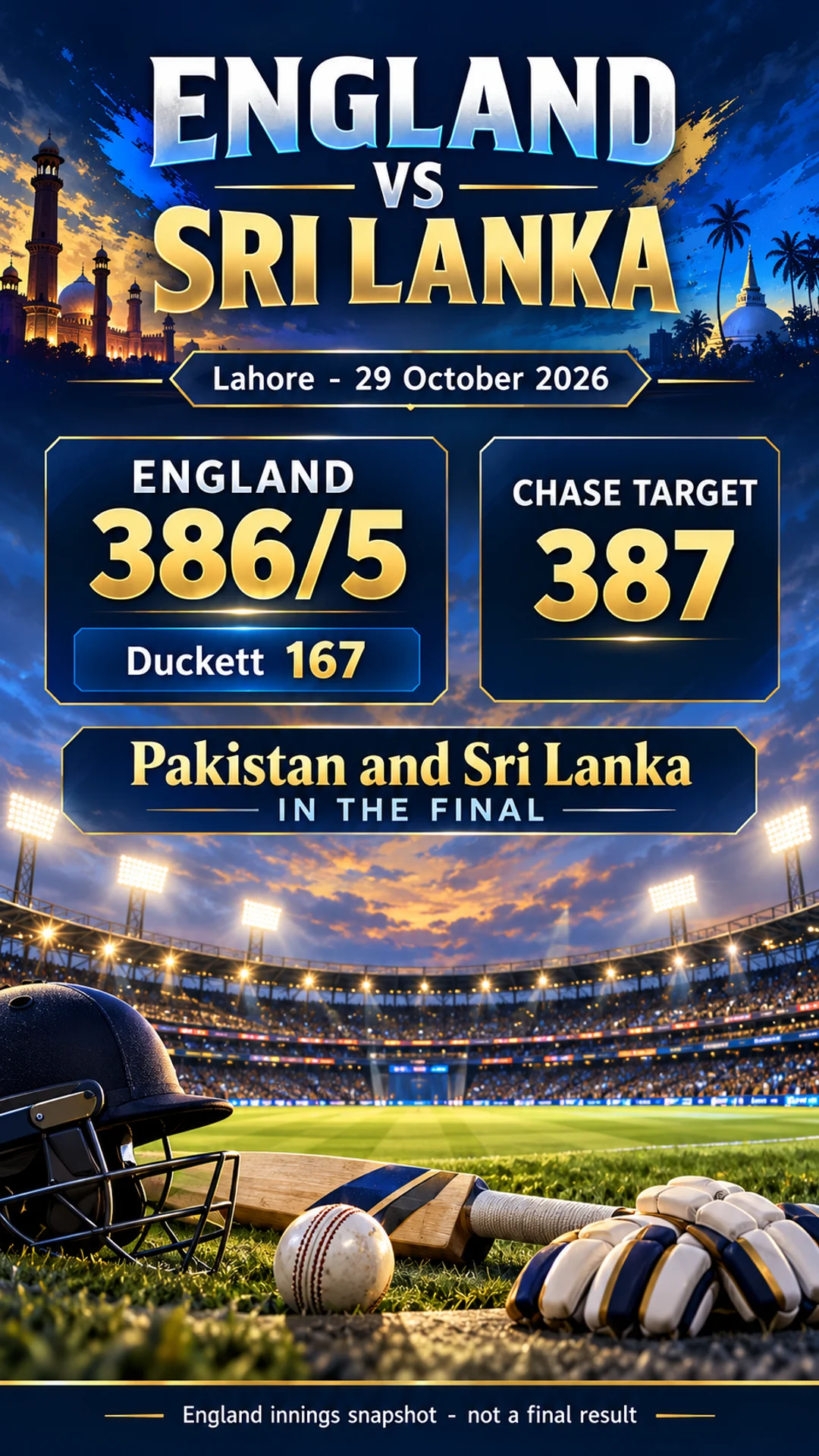
England posted 386 for five against Sri Lanka in Lahore on 29 October 2026, with Ben Duckett making 167 from 132 balls. That set Sri Lanka a target of 387. This is an explanation of England’s completed innings and what it says about the match; it does not present an innings-break position as the final result of the game.
The tournament context matters too. England had already been eliminated from contention for the final, while Pakistan and Sri Lanka were set to contest it. A large England total in the remaining group match could improve the performance story without reopening a qualification route that was already closed. The distinction prevents a strong batting innings from becoming a misleading qualification headline.
England vs Sri Lanka: what the Lahore score establishes
The match was the sixth game of the Pakistan ODI tri-series, played at Gaddafi Stadium. Sri Lanka chose to field. England used their full 50 overs and finished on 386 for five. Those facts establish the completed first innings. The target is one run more than the total, so Sri Lanka needed 387 for an outright win in a full, unchanged chase.
A target and a final result are different pieces of information. England’s innings can be described accurately before the chase ends, but it cannot be used to announce the winner. Weather, interruptions or the actual progress of the chase can also affect how a match concludes. This article therefore concentrates on a fixed innings snapshot rather than repeatedly inserting a partial chase score.
For readers comparing search results, first check the date and venue. England and Sri Lanka had already met elsewhere in the same competition. A result from an earlier match is not the result of this Lahore game. Similar team names make old scorecards easy to confuse with current ones, especially when a headline omits the match number or ground.
Ben Duckett’s 167: the innings that shaped the total
Duckett’s 167 was the largest individual contribution to England’s total. His innings contained 24 fours and no sixes in the host board’s scorecard. That is a useful reminder that a major ODI innings does not require a large six count. Boundary placement and sustained scoring can build a substantial total without every attacking shot clearing the rope.
There is a straightforward arithmetic perspective here: 24 fours account for 96 runs, leaving 71 of his 167 from other scoring. That calculation is not a detailed scoring map and does not tell us how every ball was played. It simply shows why counting sixes alone is an incomplete way to judge an innings or the pressure a batter creates.
Duckett was dismissed in the 42nd over, so the innings did not end with his departure. England still had a finishing phase to manage. That makes it useful to separate his contribution to the platform from the work of the players who completed the 50 overs. A headline can centre on the century while the report explains how the wider batting order used it.
Why the opening stand mattered
Tom Banton made 74 and England’s first wicket fell at 163. That opening partnership created the foundation for the rest of the innings. The significance is not just the runs on the board; it is also the number of wickets available to the middle order afterwards. A side with resources in hand can approach later phases differently from a side rebuilding after several early dismissals.
That is an analytical reading of the score progression, not a claim about private team instructions. A scorecard records outcomes, not every discussion between captain and batters. It is reasonable to explain the options a strong opening stand creates, but it would be misleading to invent a specific tactical conversation or attribute an unreported plan to the dressing room.
Banton’s innings also matters when evaluating the total fairly. Duckett made the largest score, but a partnership is shared work. Reports that mention only the century can hide the support that helped the innings develop. The batting card and fall of wickets together give a more complete picture than an isolated highlight clip of one player.
FACT: how 386 becomes a target of 387
England’s completed total was 386 for five from 50 overs. In an uninterrupted full-length ODI chase, 387 is the winning target. Dividing 387 by 50 gives an initial required rate of 7.74 runs per over. That is arithmetic from the target, not a forecast of Sri Lanka’s chances or a statement that every over must produce exactly eight runs.
A required rate changes during the chase. It rises when too few runs are scored and falls when the batting side gets ahead of the original pace. Wickets matter alongside the rate because they affect the resources available. A team can be near the required rate but lose too many wickets, or preserve wickets while leaving itself too much work later.
The first-innings total therefore frames a problem without solving the match. It creates pressure, but it does not prove that the fielding side will bowl well enough to defend it. Readers should keep that distinction in mind when a headline describes a huge total. Size is one part of the story; the chase supplies the rest.
What the middle order added
Harry Brook contributed 44, Will Jacks 30, Jordan Cox 43 and Sam Curran an unbeaten 21. These scores show that England received support beyond the opening pair. They should not be described as identical innings: the players arrived at different points and had different amounts of time available. Batting position and phase affect the job a player is asked to do.
A useful way to read this phase is to ask whether the side continued making use of its platform. The total reached 386 despite Duckett’s departure before the final overs. The scorecard establishes that outcome. It does not, on its own, prove that every shot choice was optimal or that an even bigger score was guaranteed if one event had gone differently.
Avoid treating a possible higher total as a fact that England threw away. Such a claim needs a clear argument about conditions, wickets, bowling and remaining deliveries. Without that evidence, the defensible conclusion is narrower: the top-order platform and later contributions combined to produce a substantial first-innings score.
Did this change the tri-series final?
England’s elimination meant this match did not offer a new route into the final. Pakistan and Sri Lanka were the finalists. The value of the game for England was therefore performance, execution and preparation rather than changing a completed qualification picture. A result can still matter to players and team planning even when it does not alter who reaches the next stage.
For Sri Lanka, the remaining group fixture was still a competitive international match. However, it is not necessary to invent a secret rotation plan or assume how seriously a team approached it. Assess what was announced and what happened. Tournament context explains the stakes, while the actual team selection and match events establish the cricket.
The broader lesson for readers is to separate three questions: who won the game, what the performance showed and whether qualification changed. They can have different answers. An eliminated team can bat impressively, a finalist can have a difficult phase, and the final pairing can remain unchanged. Good reporting keeps those threads clear.
Advice: use the right scorecard before sharing a result
Check the match date, ground and innings status. A page marked innings break or play in progress is not a final result. If a match centre displays an earlier England–Sri Lanka encounter, return to the competition schedule and select the Lahore fixture dated 29 October. This small check is more useful than trusting an incomplete search-result headline.
For a changing chase, use the host board or an official match centre rather than expecting a fixed analysis page to refresh every ball. This article’s figures are deliberately tied to England’s completed innings. It does not manufacture a final margin, player-of-the-match award or post-match quote while those details are not established in the source material used here.
Frequently asked questions
How many did England score against Sri Lanka in Lahore? England finished on 386 for five in 50 overs on 29 October 2026. That is the completed first-innings score described in this article.
What was Ben Duckett’s score? Duckett made 167 from 132 balls. The host board’s scorecard lists 24 fours and no sixes in his innings.
What target did Sri Lanka receive? The full-length target was 387, equivalent to an initial required rate of 7.74 per over. A live chase rate will change as runs and overs are used.
Could England reach the final after this innings? No. England had already been eliminated from final contention. Pakistan and Sri Lanka were set to contest the final.
Does 386 for five mean England won? No. It describes England’s batting innings, not the result. Use the completed match scorecard for the winner and margin.
Conclusion: Duckett’s 167 and the strong opening platform explain how England reached 386 for five. The total created a demanding chase but did not itself settle the game or change the final pairing. Keeping innings analysis separate from a live result makes the account useful without overstating what the scoreboard proves.
Related reading: Salman Ali Agha’s century in the tri-series opener and Carey–Inglis partnership at Newlands.
Sources: PCB host-board scorecard, ICC match centre listings, ECB tri-series schedule, Sky Sports tournament context. England-innings snapshot dated 29 October 2026, not a live-score service or final-result report. Images are conceptual AI illustrations, not match photographs.