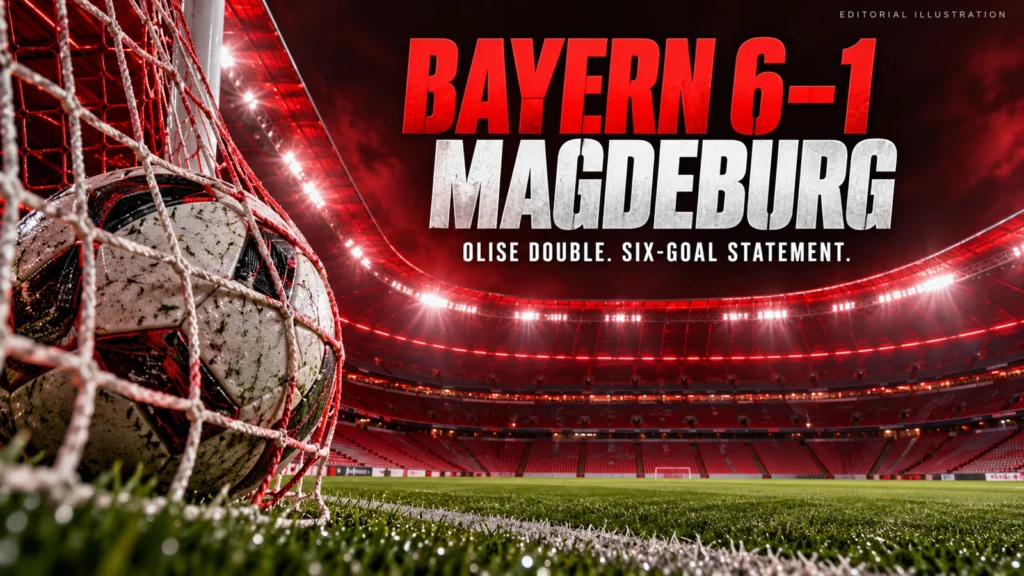
Bayern vs Magdeburg ended 6–1 at the Allianz Arena as Michael Olise scored twice and Bayern Munich advanced to the DFB-Pokal round of 16 on October 28, 2026. The final margin was emphatic, but the cup holders led only 2–1 at half-time. Four second-half goals turned a competitive opening into a comfortable finish.
For readers catching up with the result, this was a German Cup second-round tie rather than a Bundesliga fixture. Bayern progressed; Magdeburg were eliminated. The score does not mean six different Bayern players scored: Olise struck twice, with Ismael Saibari, Alphonso Davies, Nathaniel Brown and David Santos Daiber supplying the other four goals.
Bayern vs Magdeburg: how the first half stayed competitive
The Bundesliga’s match report records Olise opening the scoring in the 10th minute after Saibari supplied him. Mateusz Żukowski equalised five minutes later before Saibari restored Bayern’s lead in the 21st minute, this time from an Olise pass. Bayern therefore reached the interval one goal ahead rather than already out of sight.
That matters when describing the contest. A five-goal final margin can suggest uninterrupted control, but the early sequence included an equaliser and an immediate need for Bayern to respond. Magdeburg’s first-half contribution should not disappear simply because the score widened later. The match had distinct phases, with different levels of competitive tension.
From an analytical perspective, restoring a lead shortly after conceding prevents the equalising side from enjoying a long period of scoreboard advantage. It does not guarantee control of every passage that follows. A proper reading combines the timing of goals with the evidence from the rest of the game, rather than treating either the opener or the equaliser as the whole story.
Olise’s second goal and the four-goal second half
Olise converted an early second-half penalty after Davies was fouled in the area. Davies later scored in the 70th minute and helped create Brown’s goal three minutes later. Santos Daiber completed the scoring in stoppage time. These events took Bayern from a narrow interval lead to a result that left no doubt about who would progress.
The official match ticker lists Olise’s penalty at 50 minutes, while the report’s summary uses the 51st minute. Both identify the same early second-half goal. The distinction is a minute-label convention in the published coverage, not evidence of a second penalty or another scoring event.
The ticker also records Josip Stanišić setting up Santos Daiber’s late finish. For a substitute, a goal after entering late can provide a visible contribution even when the result is already secure. It adds to the individual story without changing the fact that Bayern’s progression had been effectively established before the sixth goal.
Kane stayed on the bench, while Bayern shared the goals
Harry Kane did not play in the tie, with the official ticker noting Bayern’s final substitution while he remained unused. Saibari had come into the starting side, alongside Hiroki Ito, as Bayern changed their team from the previous match. Olise’s two goals and assist made him central to the scoring sequence in Kane’s absence.
The distribution of goals is useful evidence of contribution from several parts of the side. It should not be stretched into a claim that a team no longer needs its leading striker. One successful match with a different selection shows that those players delivered on the night. A season-long judgement requires a much larger sample and attention to the quality of opposition.
There is also a difference between resting a player and proving he is injured. An unused substitute can remain available without being required. This report follows the recorded selection and does not infer a new medical issue from Kane’s absence on the pitch.
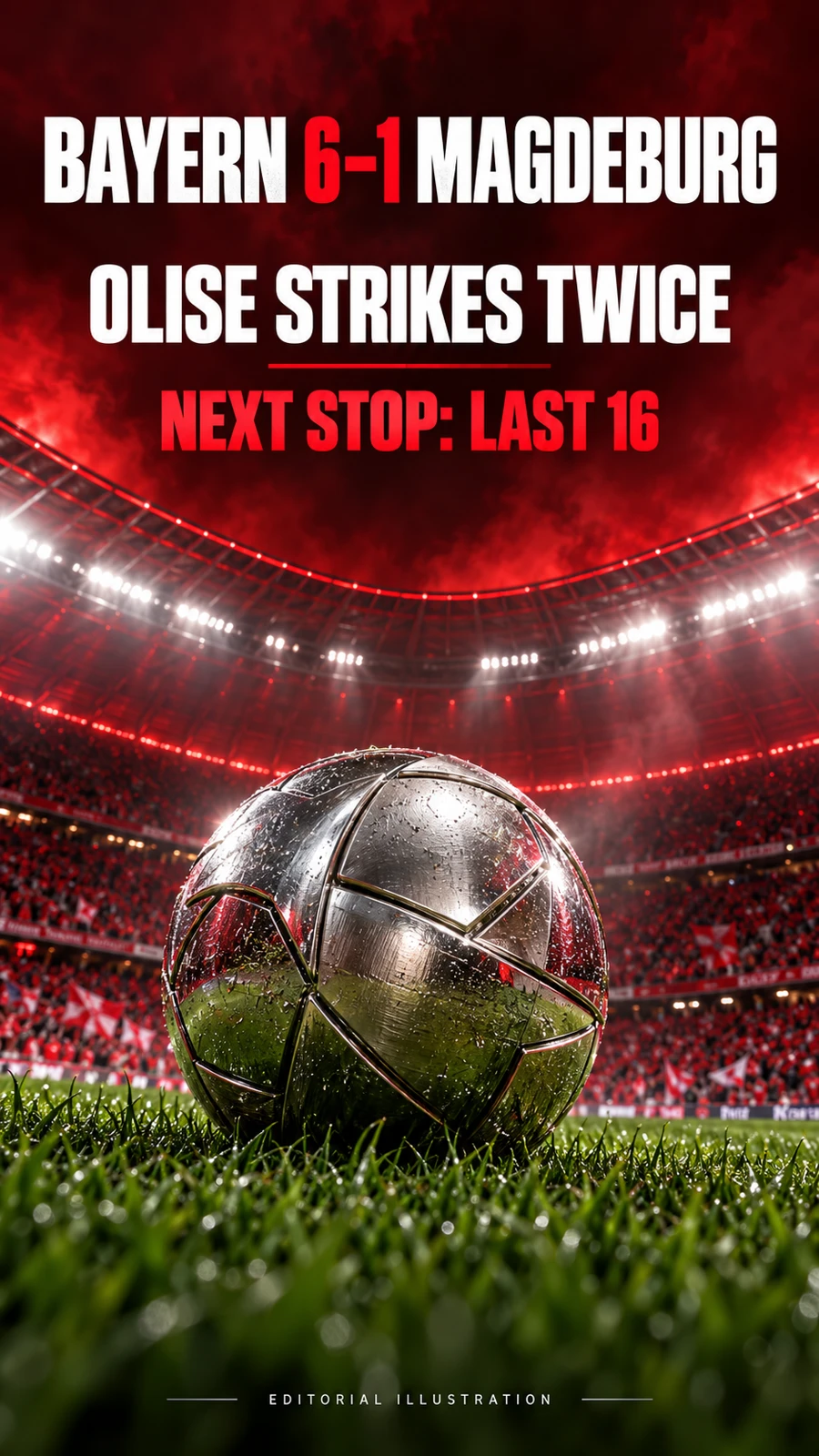
FACT box: score, scorers and competition
Result: Bayern Munich 6–1 1. FC Magdeburg.
Half-time: 2–1.
Competition: DFB-Pokal, second round.
Venue: Allianz Arena.
Bayern scorers: Olise twice; Saibari, Davies, Brown and Santos Daiber once each.
Magdeburg scorer: Mateusz Żukowski.
Outcome: Bayern into the last 16; Magdeburg out.
Match date: 28 October 2026.
What the coaches and players said about the performance
In Bayern’s official reaction roundup, assistant coach Aaron Danks described difficulties finding the right press before the team established its rhythm after the interval. Jonathan Tah also stressed the work behind a result that could look easy from outside. Their comments support a more balanced reading than the final margin alone provides.
Nathaniel Brown acknowledged Magdeburg’s quality and the time Bayern needed to get going, then turned attention to the next challenge. Magdeburg players in the same roundup described being within reach at the break and the damaging effect of the penalty. These are post-match assessments from participants, not neutral measurements of every tactical phase.
The visitors’ own official report also confirms the 1–6 defeat and 1–2 interval score. It records a sold-out crowd of 75,000 and highlights the support for Magdeburg. Coach Petrik Sander emphasised the side’s willingness to play bravely, while recognising how the third Bayern goal changed the contest.
Those perspectives can coexist. Bayern can deserve a large victory while Magdeburg can identify constructive elements in an unsuccessful performance. Cup analysis becomes less useful when it assumes that a losing side contributed nothing or that a winning side faced no problems.
Analysis: why the third goal changed the task
Moving from a one-goal deficit to a two-goal deficit changes the chasing team’s choices. More players may have to support attacks, while the leading side can find additional space if possession turns over. This is a general game-state explanation; it is not a claim that one adjustment caused every subsequent goal in this match.
The timing adds another layer. A goal shortly after half-time interrupts the trailing team’s opportunity to implement its interval plan while still close on the scoreboard. That can increase urgency and reduce patience. Conversely, the leading team gains a margin that can make it easier to manage substitutions and the pace of the remaining game.
Bayern’s late scoring should therefore be read alongside the earlier competitive period. The widening margin is evidence of finishing the job, not a reason to rewrite the first half. That distinction is especially useful in knockout football, where a brief spell can transform a tie that previously looked open.
It is also worth examining the connection between creators and finishers. Olise and Saibari each helped set up the other in the first half. Davies contributed both a goal and an assist after the break. Those relationships show more about the recorded attacking sequence than a list of scorers alone, although they do not replace a full tactical review.
Advice: what to look for when watching the highlights
Begin with the order of goals, then watch the actions leading into each chance. Notice the player who supplies the final ball and any movement that creates room for that pass. A short highlights package often centres on the finish, but the earlier action explains how the opening became available.
For Olise’s penalty, distinguish the decision awarding the kick from the quality of its conversion. For later goals, look at whether the opposition is protecting a compact shape or committing more players forward. Those observations help explain why the character of a game can change as the score changes.
Bayern’s official reaction page and the match ticker linked above provide places to verify the account. For another example of a cup tie with a very different ending, read our Manchester City vs Brighton shootout report. This Bayern match was decided in normal time; no shootout was required.
Frequently asked questions
What was the Bayern vs Magdeburg final score?
Bayern won 6–1 in the DFB-Pokal second round, after leading 2–1 at half-time.
How many goals did Michael Olise score?
He scored twice, including an early second-half penalty, and assisted Saibari’s first-half goal.
Did Harry Kane play?
No. He was on the bench but remained an unused substitute in this tie.
Who scored for Magdeburg?
Mateusz Żukowski scored the first-half equaliser before Bayern regained the lead.
What does the result mean?
Bayern advance to the round of 16. Magdeburg are eliminated from this season’s German Cup.
Editorial note: Checked on 29 October 2026 against the linked official reports and ticker. Analysis interprets the documented sequence and is separate from participant comments. Images are AI-generated editorial illustrations, not photographs from the game.