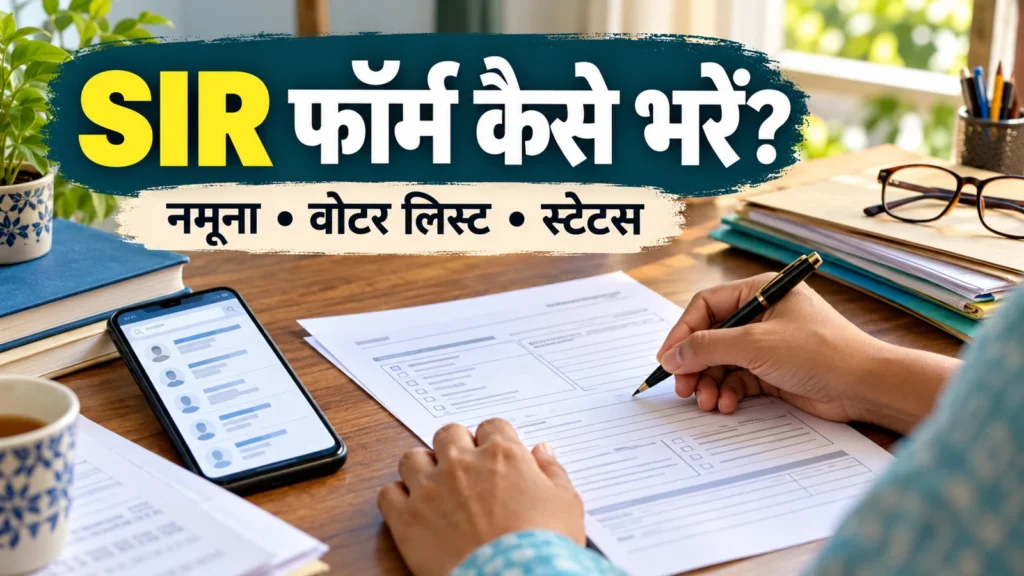
How do you fill the SIR form? Check your prefilled voter details, enter the applicable personal and previous-SIR information from verified records, read the declaration and submit through the authorised route. Save the acknowledgement. This guide covers the SIR full form, filled sample, PDF download, old voter list, documents and status checks.
Updated: 8 October 2026. Confirm your current state schedule. No single nationwide deadline or document requirement is assumed here.
What is the full form of SIR, and what is the SIR form?
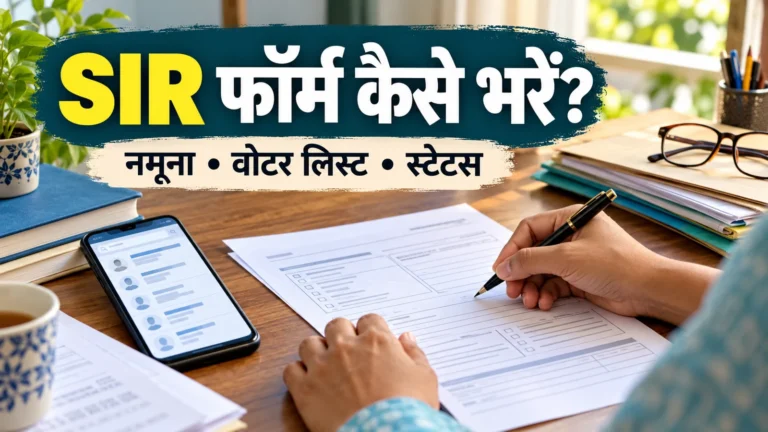
SIR stands for Special Intensive Revision. It is an electoral roll revision exercise. In this context, people searching for “SIR form”, “sir ka form” or “सर का फॉर्म” generally mean the Enumeration Form used in the applicable SIR process.
The form may ask for your current elector details and, where applicable, information linking you or a permitted relative to the previous SIR electoral roll. The exact layout, process stage and online options can differ by state. Confirm the current version with your Booth Level Officer (BLO).
Submitting a form is not the same as publication of your name in the final electoral roll. Keep your acknowledgement and check the relevant official record later. The examples in this guide are educational and must never be copied into a real application.
What should you keep ready before filling the SIR form?
Keep your current voter details or voter ID handy. Check the spelling of your name, address, date of birth and relevant family details against your records. EPIC is the voter identification number; it is not the serial number of your entry in an electoral roll.
If the form requires previous SIR details, find the correct state, assembly constituency, part number and serial number in that specified roll. Review the surrounding entries to avoid confusing two people with similar names. A matching name alone does not establish that you found the right relative.
For online submission, keep access to the mobile number used for authentication. Prepare clear photographs or document files only if the service requests them, and follow the size and format displayed on the portal. There is no universal file-size limit given here.
Confirm the current stage in your state: enumeration, draft roll publication, claims and objections, or response to a notice. An option shown in an old video may no longer be available for your case.
How to fill the SIR Enumeration Form: step by step
1. Check prefilled details. Review the elector name, EPIC, address and constituency information. If something is wrong, ask the BLO for the prescribed correction route instead of making an unauthorised alteration.
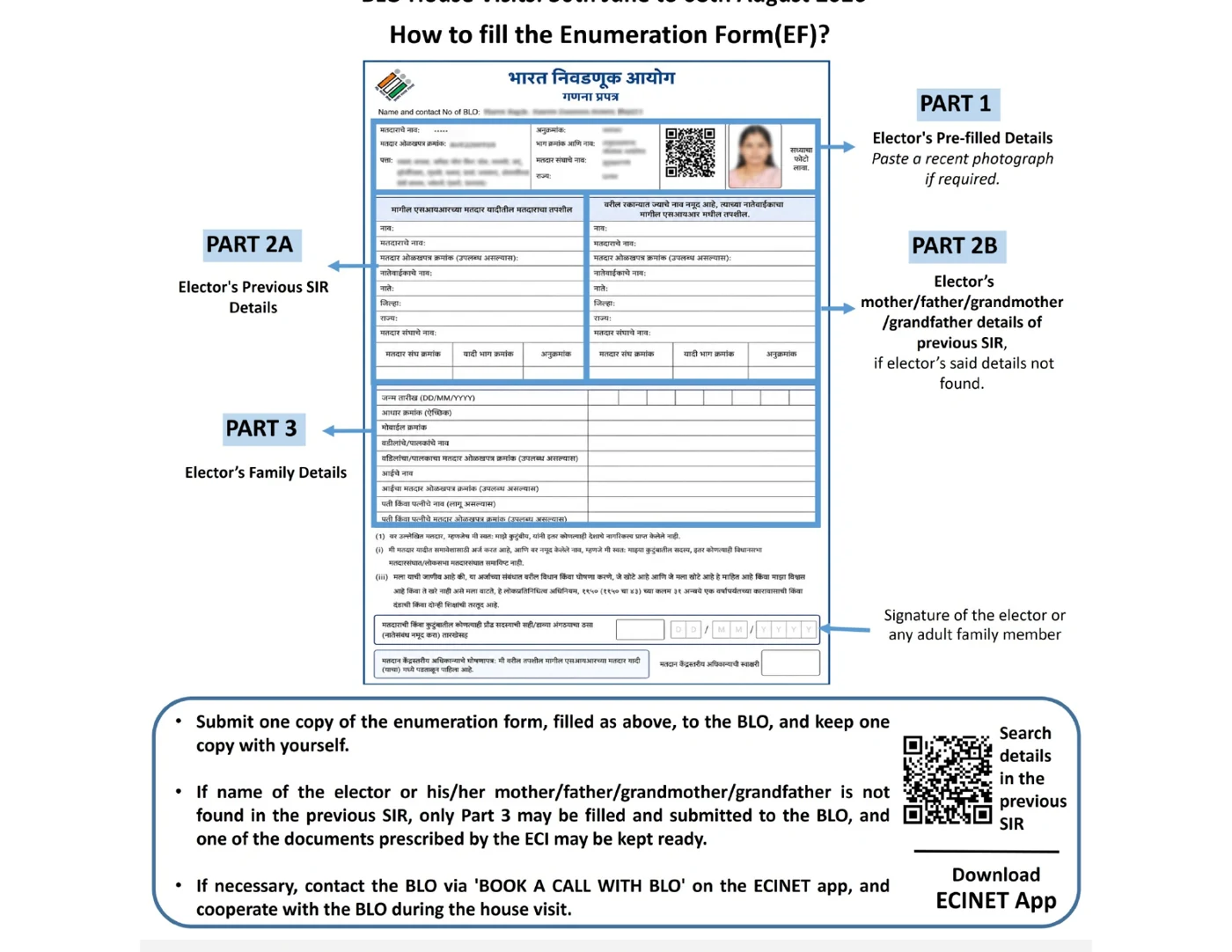
2. Fill the personal details requested. Enter your actual date of birth, contact and family information in the relevant fields. The Maharashtra government instructional example labels Aadhaar as optional. Do not assume that this describes every other application or state process.
3. Read the previous-SIR section carefully. Use the specified earlier electoral roll wherever applicable. Do not guess an old part or serial number from your current voter card.
4. Use a relative’s entry only where permitted. Verify the person and relationship and follow the current state form. A neighbour, friend or someone with the same surname is not a substitute for the relative the form asks for.
5. Read the declaration before signing. Follow the instructions for signature or thumb impression, date and who may sign. The Maharashtra example mentions the elector or an adult family member; check your own state form before applying that instruction.
6. Review, submit and keep proof. Check missing fields, digits and legibility. The Maharashtra poster instructs people to give one copy to the BLO and retain another. For online submission, save the available acknowledgement, reference or confirmation. Closing a page without a successful submission message does not establish that the form was submitted.
Filled SIR form sample: what goes in each field?
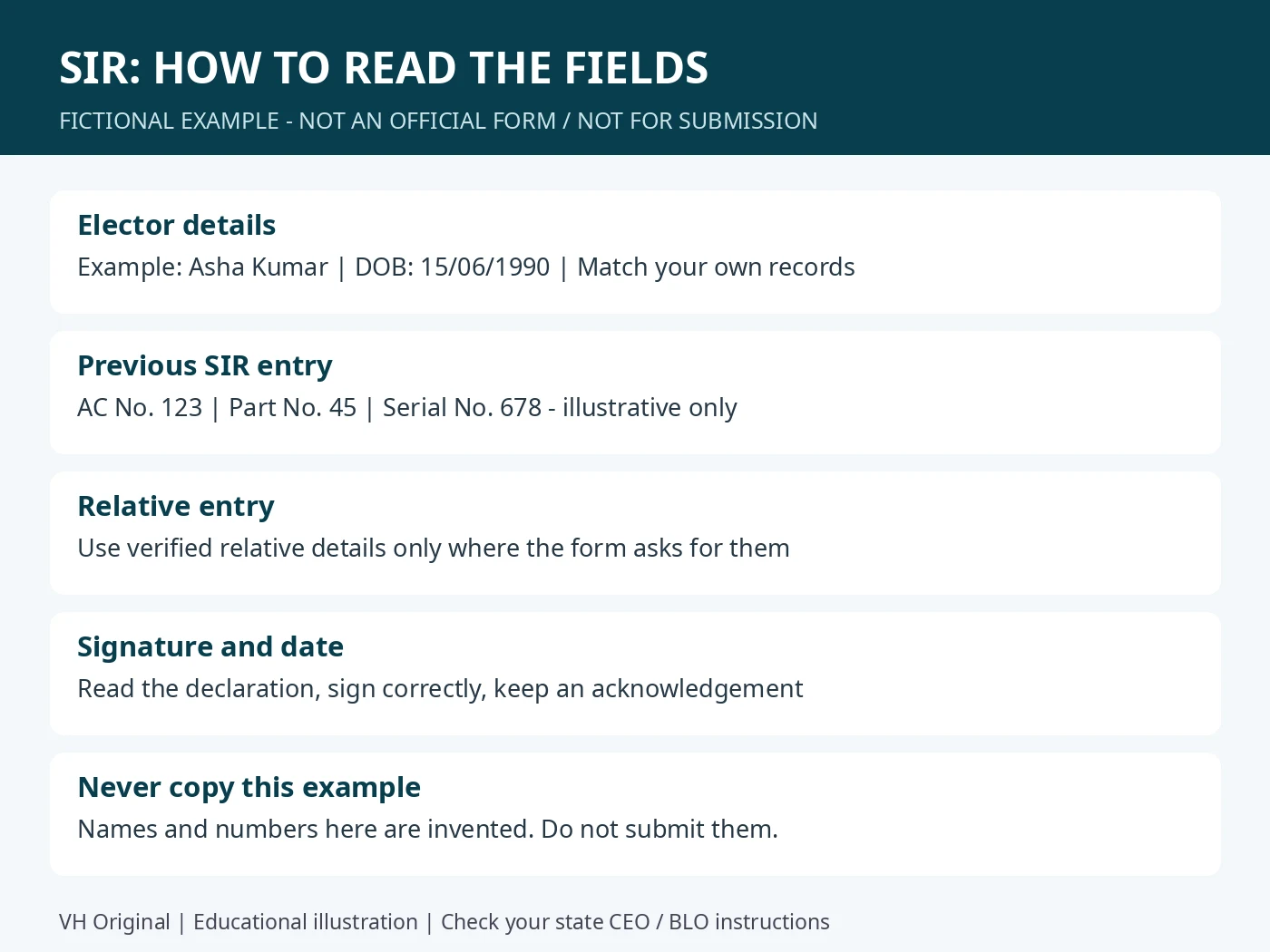
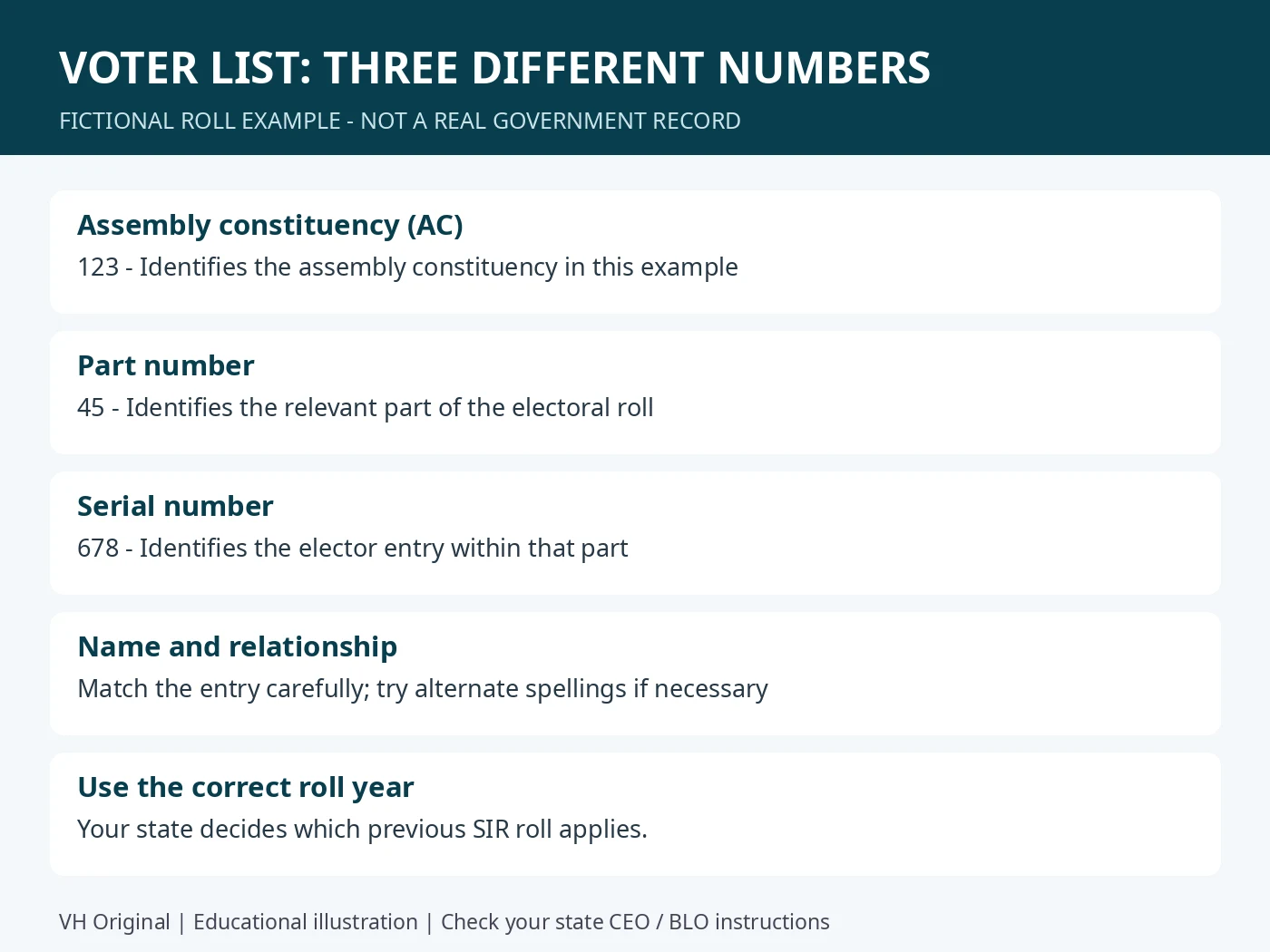
Imagine a fictional elector named Asha Kumar. The name field would contain her own actual recorded name, and the date-of-birth field would use her supporting records. If the applicable old roll showed AC 123, Part 45 and Serial 678, those numbers would go in three different fields. Every name and number in the illustration below is invented.
Do not automatically repeat the same information in separate elector and relative columns. Read which section applies to your circumstances. Fields labelled “if available” or “if applicable” must not be filled with invented data just to avoid leaving a space.
This is not an official form and is not suitable for submission. Obtain the actual blank or prefilled form from your BLO, state CEO or authorised service. Use a sample only to understand the fields.
Where can you download the official SIR form PDF?
Start with the Election Commission’s Voters’ Services Portal information and your state Chief Electoral Officer website. Look for the current SIR or Enumeration Form notice. A prefilled copy supplied through the BLO may be the appropriate version for your entry.
The District Gondia government SIR page provides Maharashtra instructions. The official English-Marathi instructional poster below is a state-specific example, not a universal Hindi blank form.
Open the government Enumeration Form instructions PDF. For a Hindi version, use your state’s official source or ask the BLO. Do not treat an unofficial download page as a reason to pay, install an unnecessary APK or send identity documents to strangers.
How to find your name in the previous SIR voter list: 2002 or 2003?
Distinguish the current voter list from the previous SIR electoral roll. Your current entry helps with current details; the old-record fields require the specified earlier roll. Do not assume that every state uses the same previous-SIR year.
Use the authorised “Search your name in last SIR” facility or your state’s older electoral roll PDFs. Select the correct area and try spelling variations if an exact-name search fails. The Commission’s old-roll search information notes that names can be spelled differently.
Check the PDF heading for the state, assembly constituency, year and part. A scanned PDF may not support text search, so you may need to inspect pages or ask the BLO for help.
If a parent lived somewhere else at the time, the earlier address may help locate the right constituency. Do not enter a guessed serial number. Save the relevant page and compare the details again.
What is the difference between AC number, part number and serial number?
The assembly constituency number identifies the constituency. The part number identifies a particular part of its electoral roll. The serial number identifies the elector entry within that part. EPIC is a separate voter identification number.
In the fictional example, AC 123, Part 45 and Serial 678 have separate roles. Serial 678 is not a voter ID number. Numbers can change between rolls, so use the specified previous roll for previous-SIR fields. The illustration is not a real government voter record.
What if your name or your parents’ names are missing from the old roll?
First check the correct state, year, earlier address and spelling variations. Then tell the BLO exactly which entry you could not locate. A failed search alone does not prove that your name has been deleted from the current voter list.
The Maharashtra instructional example explains a route for cases where the elector or the specified parents/grandparents are not found in the previous SIR: provide the family details to the BLO and keep a prescribed document ready. The permitted relationships and next steps for your case depend on your current state instructions.
If you receive a notice, read its reason, response procedure, required evidence and deadline. Keep proof of receipt and response. If your name is missing from a draft roll, ask the ERO/BLO about the applicable claim or inclusion procedure. A social-media claim that one document solves every case is not a reliable rule.
Which SIR documents are needed? Is Aadhaar compulsory?
Requirements depend on the state, individual circumstances and process stage. This guide does not say that every elector must submit every document. A notice may specify a particular requirement that you must read separately.
The official Gondia document poster lists examples including birth certificates, passports and educational certificates, among other documents, and describes Aadhaar as identity proof. Read the official document PDF. Do not assume that its list is an unconditional choice for every case across India.
Identity, date of birth, residence and other eligibility questions are different. A document accepted for one purpose does not automatically answer all of them. Match the requirement in your own form or notice and ask the BLO/ERO if uncertain.
Do not post complete identity numbers, OTPs or unredacted documents in public comments. We do not need your personal voter form to explain this general guide.
How to submit the SIR form online or through the BLO?
Visit the official Voters’ Services Portal and check the SIR service available for your state and current stage. Use the Enumeration Form route only where applicable. Follow the login, OTP, state, EPIC and other fields actually displayed.
Read the complete preview before final submission. If an error appears, note its exact text and time without sharing an OTP or full identity number publicly. Check whether an earlier submission succeeded before repeatedly creating another one.
For the offline process, ask your BLO for the correct form and submission arrangements. Keep a clear copy and the available acknowledgement. Verify your information yourself even if somebody helps you fill or deliver the form.
If access fails, try the normal service later or seek BLO/1950 assistance. A blocked page is not an application rejection. This guide uses official PDFs and labelled educational illustrations; it does not present a fabricated live portal screenshot.
How to check SIR form status, and what does “Already submitted” mean?
Keep the acknowledgement or reference provided after submission. Where the portal provides an SIR confirmation, check that record; the BLO can also help confirm receipt. Check your entry in the relevant draft or final electoral roll when published.
Do not confuse general “Track Application Status” with SIR Enumeration Form confirmation. Tracking a Form 6 or Form 8 application by its reference may be a different service. Use a number according to the instructions of the service that issued it.
For “Already submitted”, first look for the earlier confirmation and ask the BLO to verify it. Do not immediately send a duplicate. If a mobile number or submitted detail needs correction, explain the issue with the existing reference through official assistance.
Being in the current roll, having submitted an enumeration form and appearing in the final SIR roll are separate facts. Check the record relevant to your question.
SIR Enumeration Form vs Form 6 vs Form 8
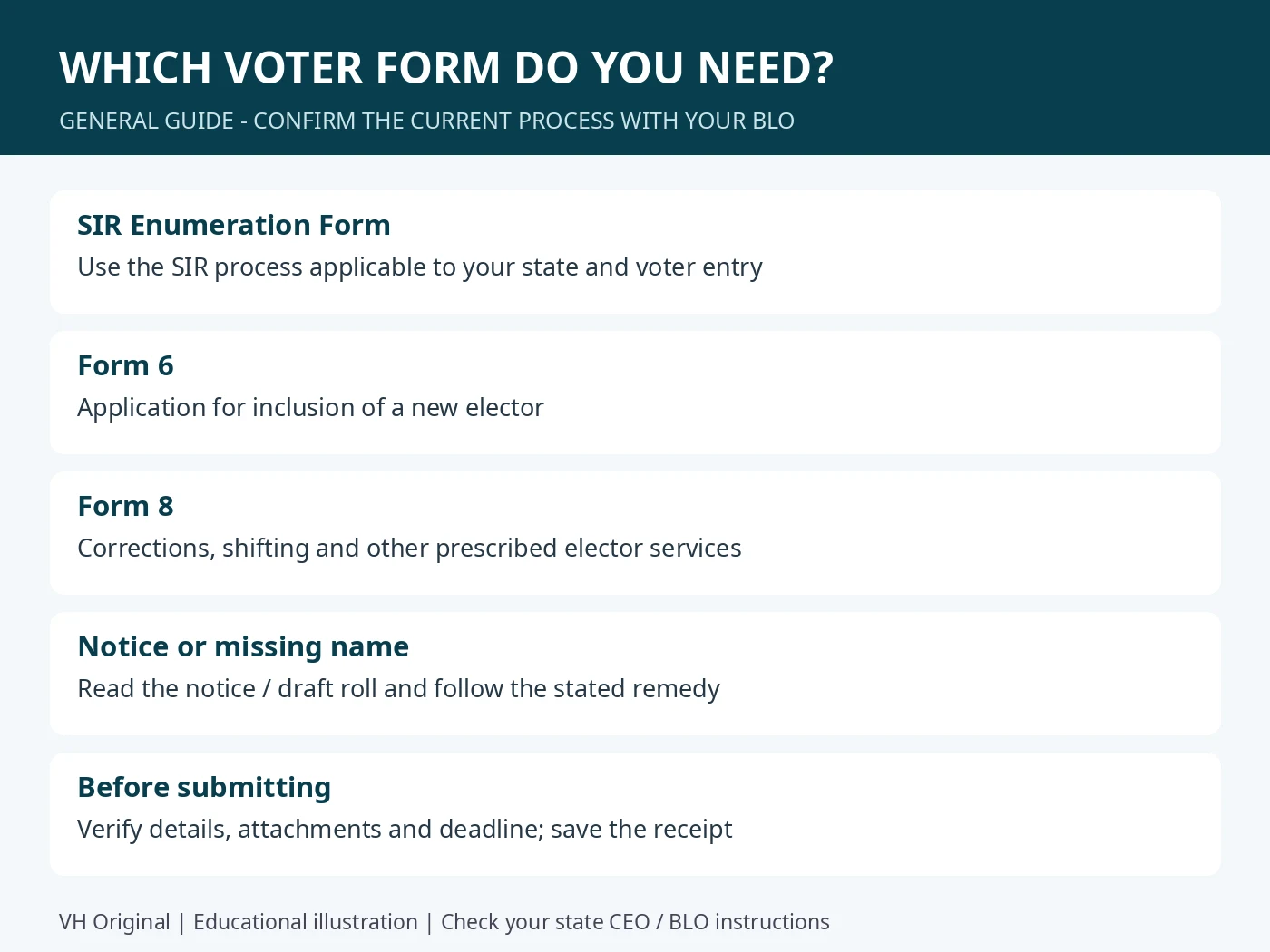
The SIR Enumeration Form belongs to the applicable special revision exercise. Form 6 is an application for inclusion as a new elector. Form 8 covers corrections, shifting and other prescribed elector services. They are not interchangeable merely because all concern voter records.
Some SIR processes can require an additional declaration or documents alongside a new enrolment or shifting application. Do not assume that filing Form 6 automatically satisfies every SIR requirement.
For the inclusion route, read our guide to adding your name to the voter list. The comparison image is general guidance; current official instructions take priority.
What is the SIR last date, and where can you get help?
There is no single all-India deadline provided here. Dates vary by state, stage and revised order. Check your state CEO website, current district notice or BLO, including the publication and revision dates of the PDF.
For the Maharashtra example, see the official revised SIR schedule. Use your own state’s notice for your application.
Contact voter helpline 1950 or your BLO/ERO for assistance. You can also use the official BLO call or grievance facilities where available. Explain the issue and application reference without sharing passwords or OTPs.
Frequently asked SIR form questions
Does “sir ka form” mean the SIR Enumeration Form? In an election-related search it commonly refers to this subject; adding voter list or enumeration helps distinguish it from other meanings.
Can I use the current voter card for old-roll numbers? It helps with current voter details. Where previous-SIR details are required, find the actual specified roll.
Can I use any relative? No. Follow the relationships and circumstances permitted in your current form.
Can I complete it on a phone? Where the applicable online service is available and you meet its requirements. Availability is not identical everywhere.
Can I copy the sample numbers? No. They are invented for explanation.
Does submission guarantee inclusion? No. Submission, scrutiny and electoral roll publication are different stages.
What if I cannot find a document? Explain your situation to the authorised officer and ask about the prescribed process. Do not invent information.
Should I upload my personal form in comments? No. Seek personal case assistance through the authorised electoral system.
Official sources, update note and disclaimer
Prepared using official information available on 8 October 2026. Sources: Election Commission — Voters’ Services Portal, official voter services portal, District Gondia SIR 2026, and the government instructional, document and schedule links above.
Disclaimer: VH Original is not a government website. This is general educational guidance, not a personal legal decision or official approval. Current state orders, your actual form or notice and authorised election-officer instructions take priority. Sample illustrations are fictional; the official poster is attributed to its state source. Rules, services and dates can change. Confirm your own case with the BLO/ERO or authorised government service.