 Vista
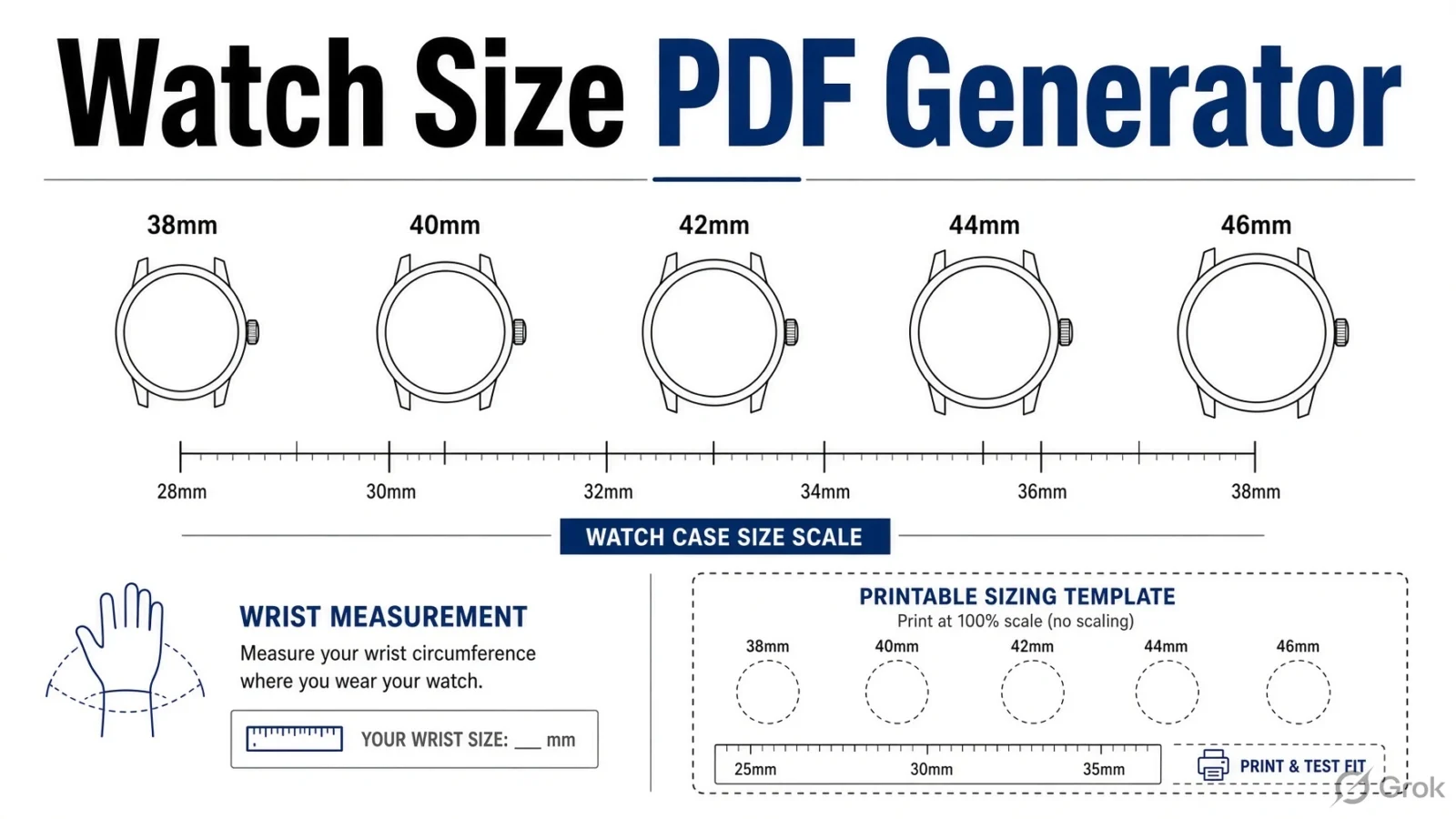
A watch listing says 40 mm, but whether that looks right on your wrist depends on more than one number. Case diameter is only the headline size; lug-to-lug length, strap width and your wrist’s flat width matter as much. This guide shows how to measure your wrist, how diameter and lug-to-lug differ, and how to check fit with an actual-size paper cutout. Paper shows footprint only, so it cannot promise a perfect fit.
Make a printable outline with the free actual-size watch case generator.
Measuring your wrist for a watch
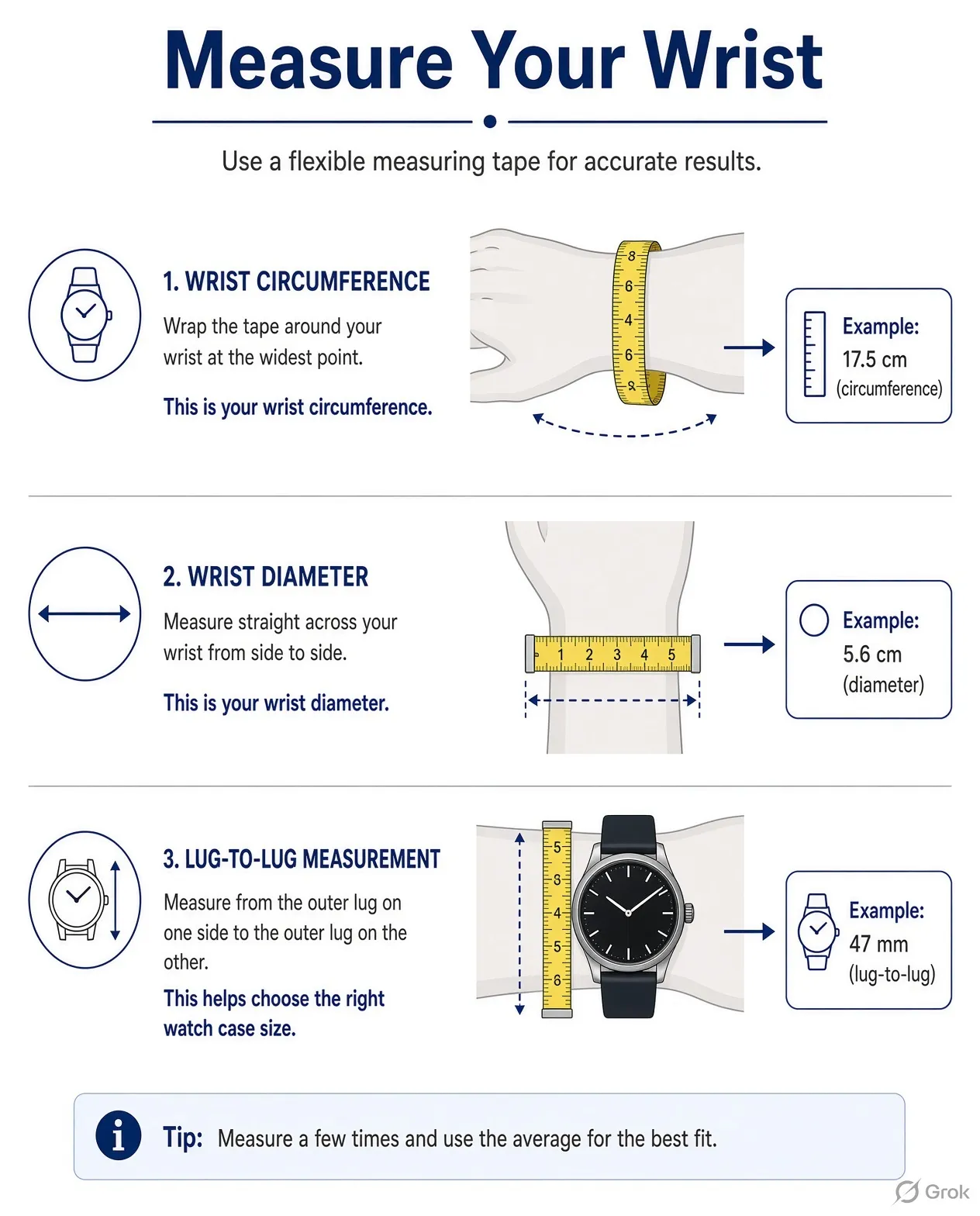
Retail guides usually start with wrist circumference, measured with a soft tape or a piece of string laid against a ruler. Another useful number is the width of the flat top of your wrist, from one side to the other.
Circumference versus flat wrist width
Circumference helps you pick a rough case range and strap length. Flat width tells you whether the lugs will sit on the flat top or overhang the edges. Measure the flat width with a ruler across the top of your wrist, just behind the wrist bone.
Case diameter and lug-to-lug length
- Case diameter: width of the case body, usually excluding the crown.
- Lug-to-lug: distance from the tip of the top lugs to the tip of the bottom lugs.
- Lug width: space between the lugs, which is the strap width.
Why the same diameter can fit differently
One watch retailer’s guide notes that a 45 mm dive watch with short, tight lugs measures about 47.7 mm lug-to-lug, so it wears smaller than its diameter suggests. A watch with long lugs can overhang a small wrist even at a modest diameter. Many retail guides say lug-to-lug tells you more about fit than diameter, though it is still a matter of taste.
Comparing 34mm to 44mm watch sizes
One jeweller’s sizing guide gives these starting ranges by wrist circumference. They are guidelines, not rules:
| Wrist circumference | Case diameter starting range |
|---|---|
| Under 15 cm (6 in) | 28 to 36 mm |
| 15 to 18 cm (6 to 7 in) | 36 to 40 mm |
| 18 to 20 cm (7 to 8 in) | 40 to 44 mm |
Case shape, dial and strap effects
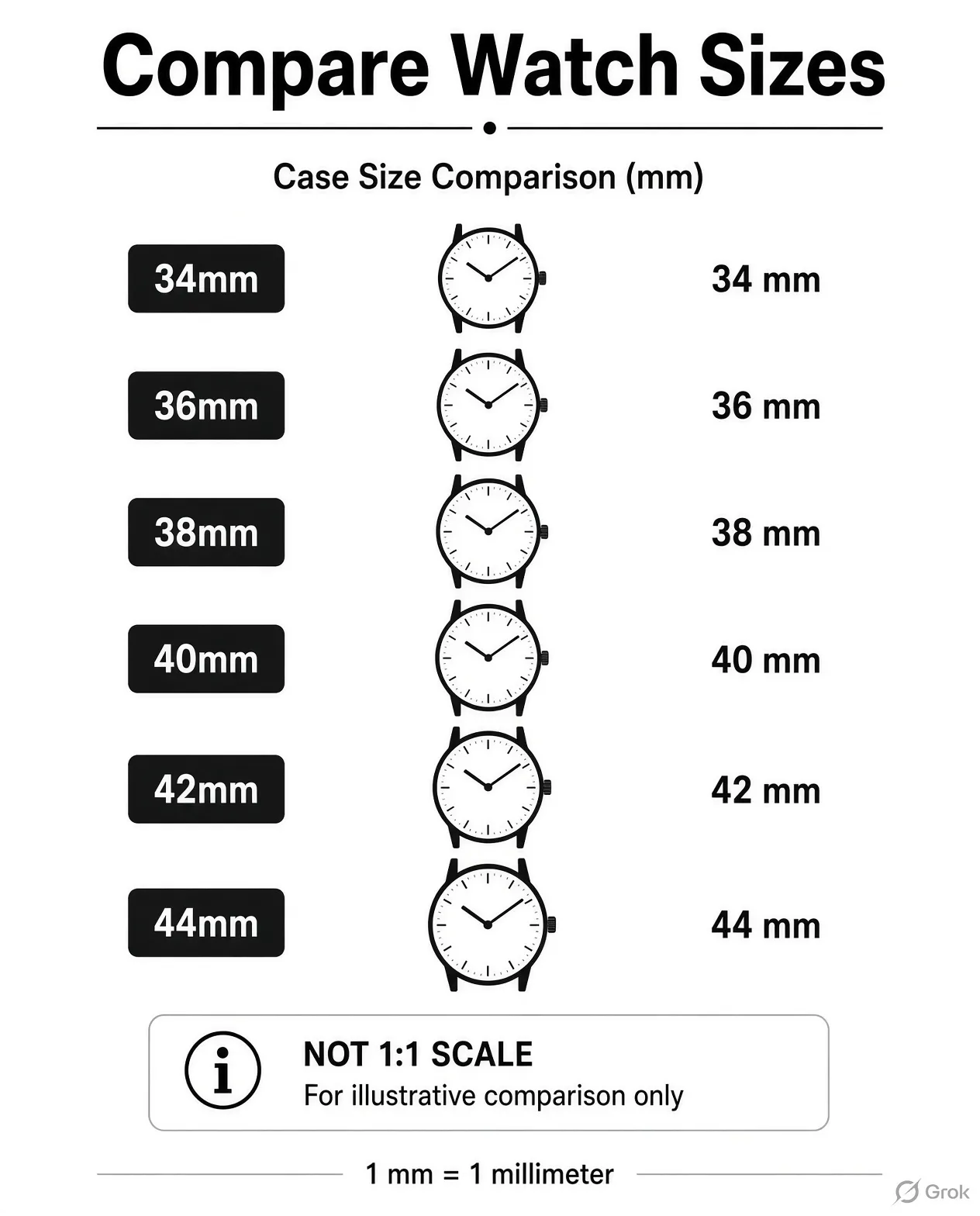
Thickness, a large dial and a wide strap all change how big a watch looks. Several guides suggest a strap about half the case diameter for balanced proportions, so a 40 mm case commonly pairs with a 20 mm strap. Non-round cases, such as the 46.7 × 43.8 mm GMC-2500 covered in our G-Shock GMC-2500 specs explainer, need their own length and width, not one diameter.
Using actual-size watch cutouts
In the actual-size watch case generator, enter case diameter (20 to 60 mm), lug-to-lug (20 to 70 mm), lug width (10 to 30 mm) and, optionally, your wrist’s flat width (30 to 80 mm). It draws a round case, a dashed lug-to-lug box and strap lines on A4, then lets you download a PDF or print. It draws round cases only and requires lug-to-lug to be at least the diameter, which catches typing mistakes.
Print at 100 percent and verify calibration scale
- Print at 100% or Actual size and turn off “Fit to page”.
- Use A4 where possible; other paper may crop or scale the page.
- Measure the 50 mm bar on the printout with a ruler. If it is not 50 mm, the printer scaled the page and the outline is not true size.
- Cut out the circle and lug box and hold it centred on your wrist with the lug-to-lug direction running along your arm.
Worked examples, practical checks and limitations
Example: a watch with a 40 mm case, 48 mm lug-to-lug and 20 mm lug width, and a wrist flat width of 60 mm. The printout shows a 40 mm circle inside a dashed box 20 mm wide and 48 mm tall, with a 60 mm wrist bar beside it. The lug-to-lug span is 60 − 48 = 12 mm shorter than the flat width, so the lugs stay on the flat top.
Limits: the drawing is a flat top view and does not show thickness, lug curve or the crown; paper does not curve like a wrist; and brands measure case diameter slightly differently.
Common mistakes and when to seek expert confirmation
- Choosing only by case diameter.
- Printing with “fit to page” turned on.
- Ignoring thickness, which a flat outline cannot show.
- Forgetting lug width when ordering a strap.
If you can, try the real watch in a shop; a paper outline is a screening tool, not a fitting.
Frequently asked questions
How will a 40mm watch look on my wrist?
It depends on lug-to-lug and your wrist’s flat width. Print the cutout at actual size and hold it on your wrist.
What is lug-to-lug?
The distance from the tips of the top lugs to the tips of the bottom lugs.
Is the PDF really 1:1?
Yes, when printed at 100% with no scaling; confirm with the 50 mm bar.
Can it draw square watches?
No, this version draws round cases only.
Conclusion
Measure the wrist, compare lug-to-lug with its flat width, print the outline at true size and try the watch in person before you commit.
Sources
- Borsheims: watch size guide
- Bob’s Watches: watch sizes
- Teddy Baldassarre: lug-to-lug explained
- Mappin & Webb: watch size guide
















Share Your Opinion
Comments are closed on this post.