 Vista
The best eyepiece depends on your telescope and on what you want to look at. Four numbers decide most of it: magnification, exit pupil, focal ratio and true field of view. This guide gives the formulas, worked examples for a common 100 mm f/10 telescope, and the limits of the simple method. Real views also depend on air steadiness, optical quality and your own eyes. A safety note first: never look at the Sun through any telescope or eyepiece unless you have the correct certified solar equipment.
Skip the arithmetic with the free telescope eyepiece calculator.
How telescope magnification works
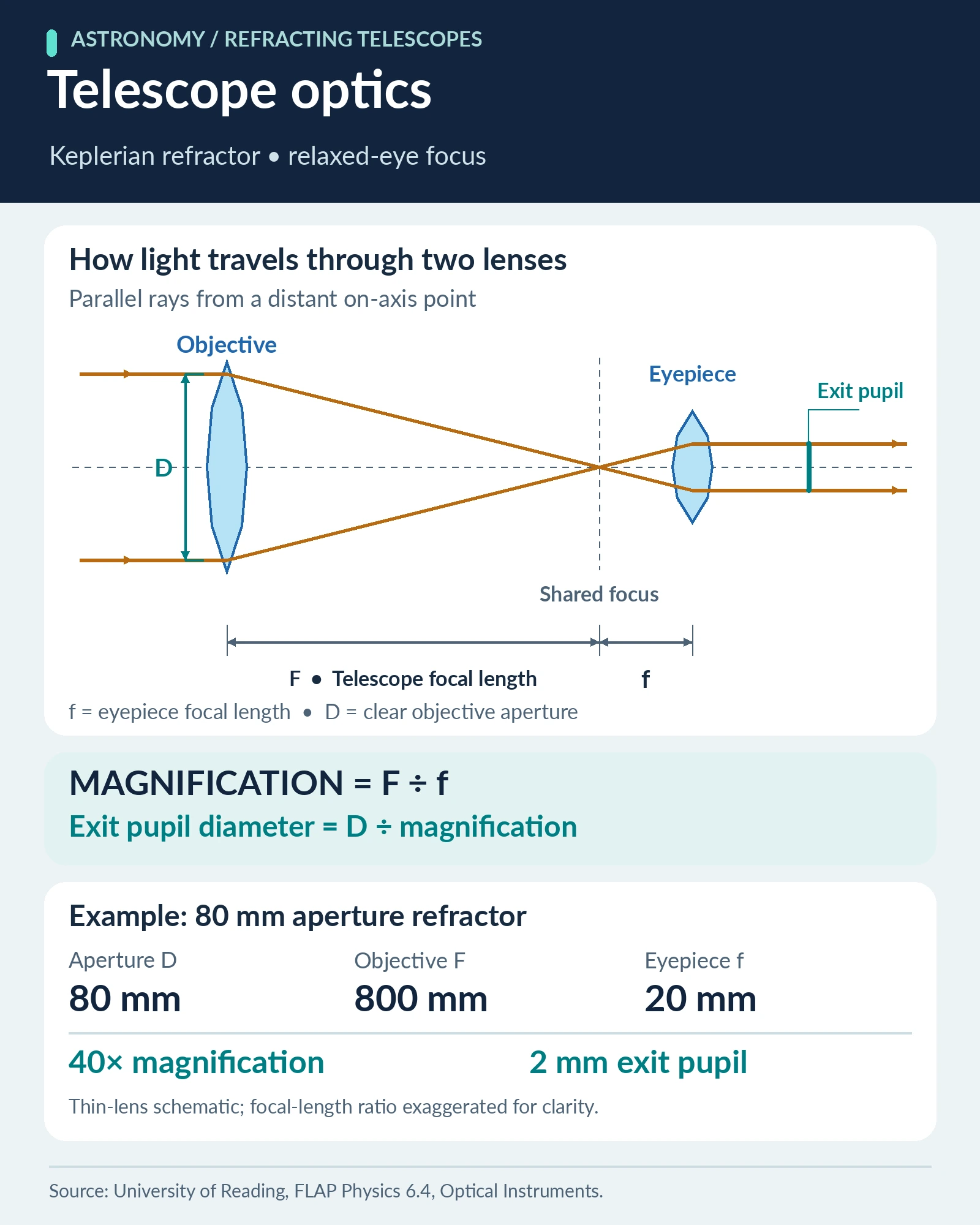
Magnification = telescope focal length ÷ eyepiece focal length. Telescopes have a fixed focal length, so you change magnification by changing eyepieces. Short eyepiece focal length means high power; long means low power.
Telescope and eyepiece focal lengths
For a 1000 mm telescope, a 25 mm eyepiece gives 40x and a 10 mm eyepiece gives 100x. A Barlow lens multiplies the telescope’s focal length: with a 2x Barlow, the 25 mm eyepiece gives 2000 ÷ 25 = 80x. A focal reducer (for example 0.63) does the opposite.
Exit pupil and image brightness
The exit pupil is the disc of light leaving the eyepiece. Exit pupil = aperture ÷ magnification, or equivalently eyepiece focal length ÷ telescope focal ratio. Lower magnification gives a larger exit pupil and a brighter, wider view.
Aperture, magnification and observing conditions
If the exit pupil is larger than your eye’s pupil when dark-adapted, some light is wasted. That is usually quoted as roughly 7 to 8 mm, and it varies with the person and with age. A very small exit pupil means a dim image and shows more of the limits of air and optics, so higher power is not always better.
Apparent versus true field of view
Apparent field is the width of the circle you see inside the eyepiece, printed in the maker’s specification (many standard eyepieces are about 50°). True field is how much sky you actually see.
Field stop calculation and approximate formula
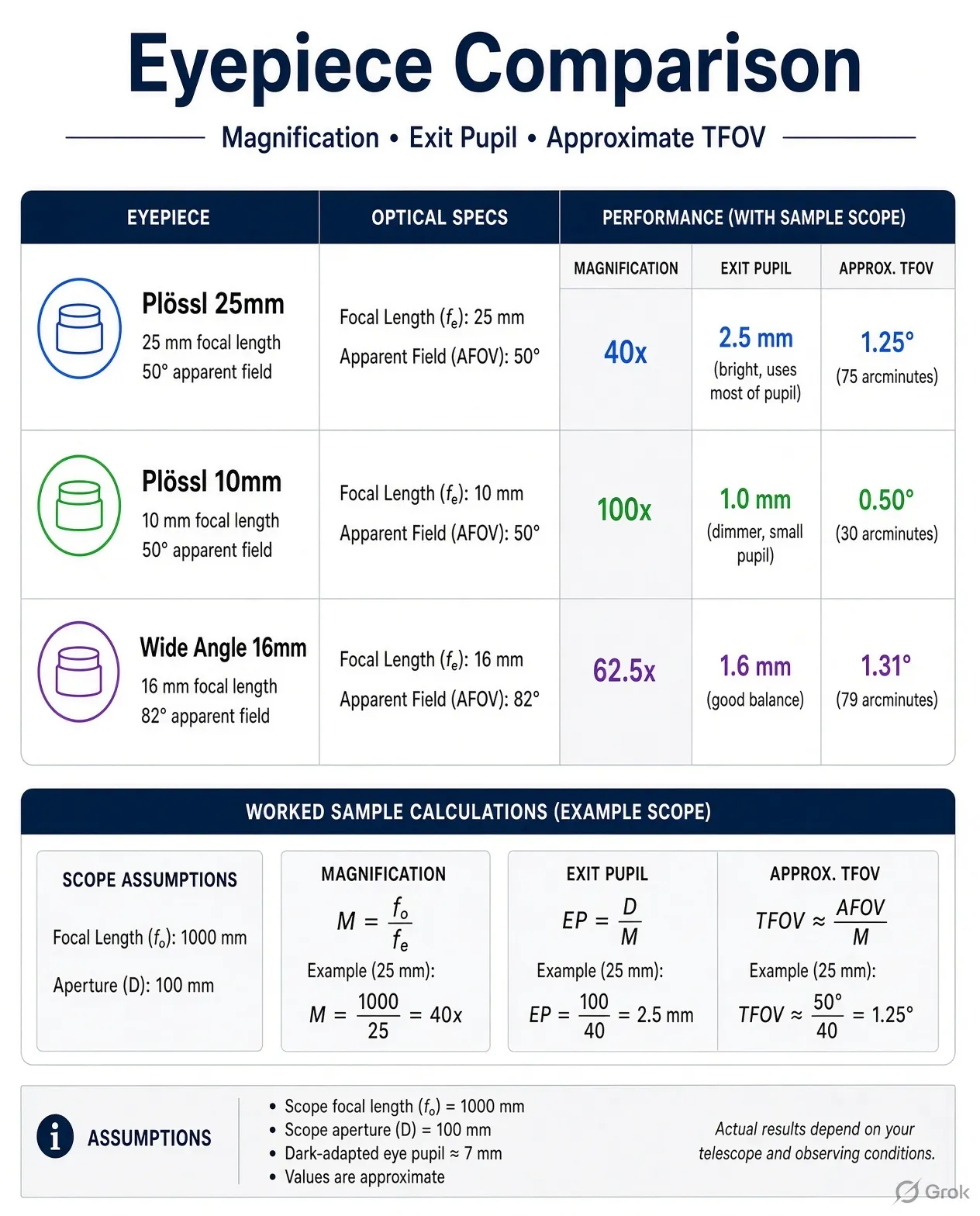
The simple method: true field ≈ apparent field ÷ magnification. The more exact method uses the eyepiece field stop: true field = field stop ÷ telescope focal length × 57.3. For a hypothetical 21 mm field stop on a 1000 mm telescope: 21 ÷ 1000 × 57.3 ≈ 1.20°, close to the simple 50 ÷ 40 = 1.25°. Makers do not always publish field stop, so the simple method is common, though less exact for very wide eyepieces.
Using the telescope eyepiece calculator
In the telescope eyepiece calculator, enter aperture and focal length (mm), eyepiece focal length (mm), apparent field and an optional Barlow or reducer factor. It returns effective focal length, focal ratio, magnification, exit pupil and true field, with a note when the exit pupil is large.
Moon, planets and wide-field examples
| Eyepiece on 100 mm f/10 (1000 mm) | Magnification | Exit pupil | True field (50° eyepiece) |
|---|---|---|---|
| 25 mm | 40x | 2.5 mm | 1.25° |
| 10 mm | 100x | 1.0 mm | 0.5° |
| 25 mm + 2x Barlow | 80x | 1.25 mm | 0.63° |
The Moon is about half a degree across, so it just fits at 100x here and fits easily at 40x.
Worked examples, practical checks and limitations
- 102 mm aperture, 900 mm focal length, 25 mm eyepiece: 36x, f/8.8, exit pupil 2.83 mm.
- Check that the eyepiece barrel size fits your focuser; the calculator does not check barrel size or eye relief.
- Start with a low-power eyepiece to find objects, then step up.
Common mistakes and when to seek expert confirmation
- Using the aperture in inches in one formula and millimetres in another.
- Forgetting the Barlow factor.
- Assuming more magnification always shows more detail.
- Pointing any telescope near the Sun without proper solar filtration.
For wide-field eyepieces, take the apparent field from the maker’s page. For solar observing, buy purpose-made certified equipment and follow the maker’s instructions.
Frequently asked questions
Which eyepiece is best for my telescope?
There is no single best one. A low-power eyepiece for finding and wide views plus a medium and a higher-power one for detail covers most uses; use the formulas to check each against your telescope.
How do I find magnification?
Divide the telescope focal length by the eyepiece focal length.
What does a 2x Barlow do?
It doubles the effective focal length, so every eyepiece gives twice the magnification.
Why is my true field smaller with a Barlow?
Because magnification rises and true field is the apparent field divided by magnification.
Conclusion
Work out magnification, exit pupil and field before buying, keep a range of eyepieces, and let the sky conditions decide how much power is useful.
Sources
- Sky & Telescope: Simple Formulas for the Telescope Owner
- Sky & Telescope: An Eyepiece Primer
- University Lowbrow Astronomers: basic telescope functions
- University of Sheffield PHY217: visual telescopes


















Share Your Opinion
Comments are closed on this post.