 Vista
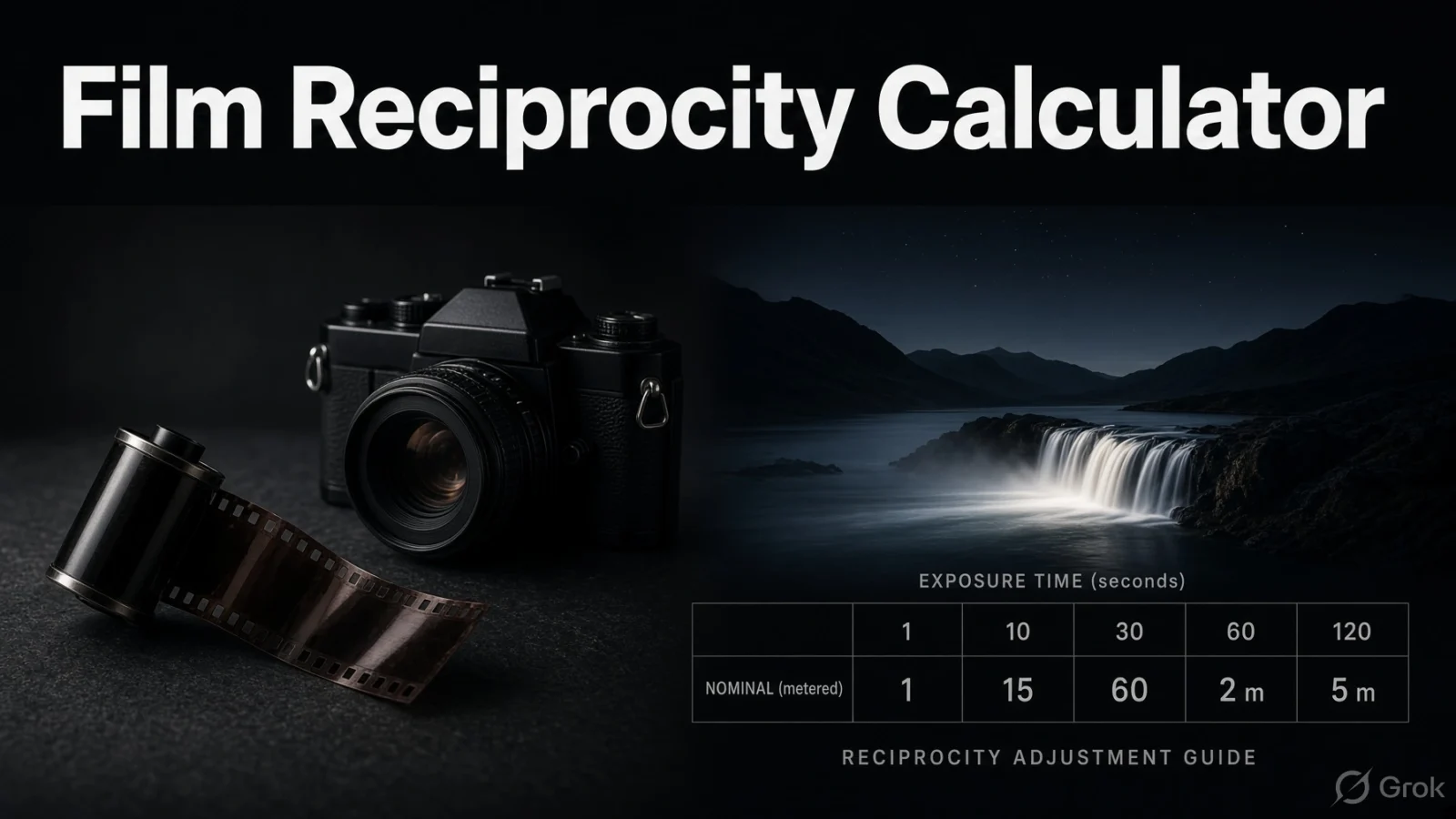
Shoot film at night and your meter may say 10 seconds, yet the negative comes out thin. That is reciprocity failure: at very long exposures, film responds less than the meter expects. This guide explains what it is, shows the published ILFORD power formula with worked numbers, and explains why you should follow your own film’s data sheet. Only films with manufacturer data are listed; nothing here is guessed for other brands.
To run the numbers quickly, open the free film reciprocity calculator.
Why film loses reciprocity at long exposures
Normally exposure depends on light level multiplied by time, so half the light for twice the time gives the same result. In dim light with long exposures, film becomes less sensitive and that rule fails. ILFORD describes this as lower image density for the same total exposure given over a longer time, which reduces the effective film speed.
Metered time versus corrected time
The metered time (Tm) is what your meter indicates. The corrected time (Tc) is what you actually give the film. Correction is needed only for long exposures; ILFORD’s December 2023 technical note says exposures of one second or less need no compensation. Some older ILFORD film sheets quote half a second instead, so check the sheet for your film and bracket if the shot matters.
Film-specific reciprocity correction methods
Different films need different corrections, which is why one universal number does not exist.
Manufacturer formulas and data sheets
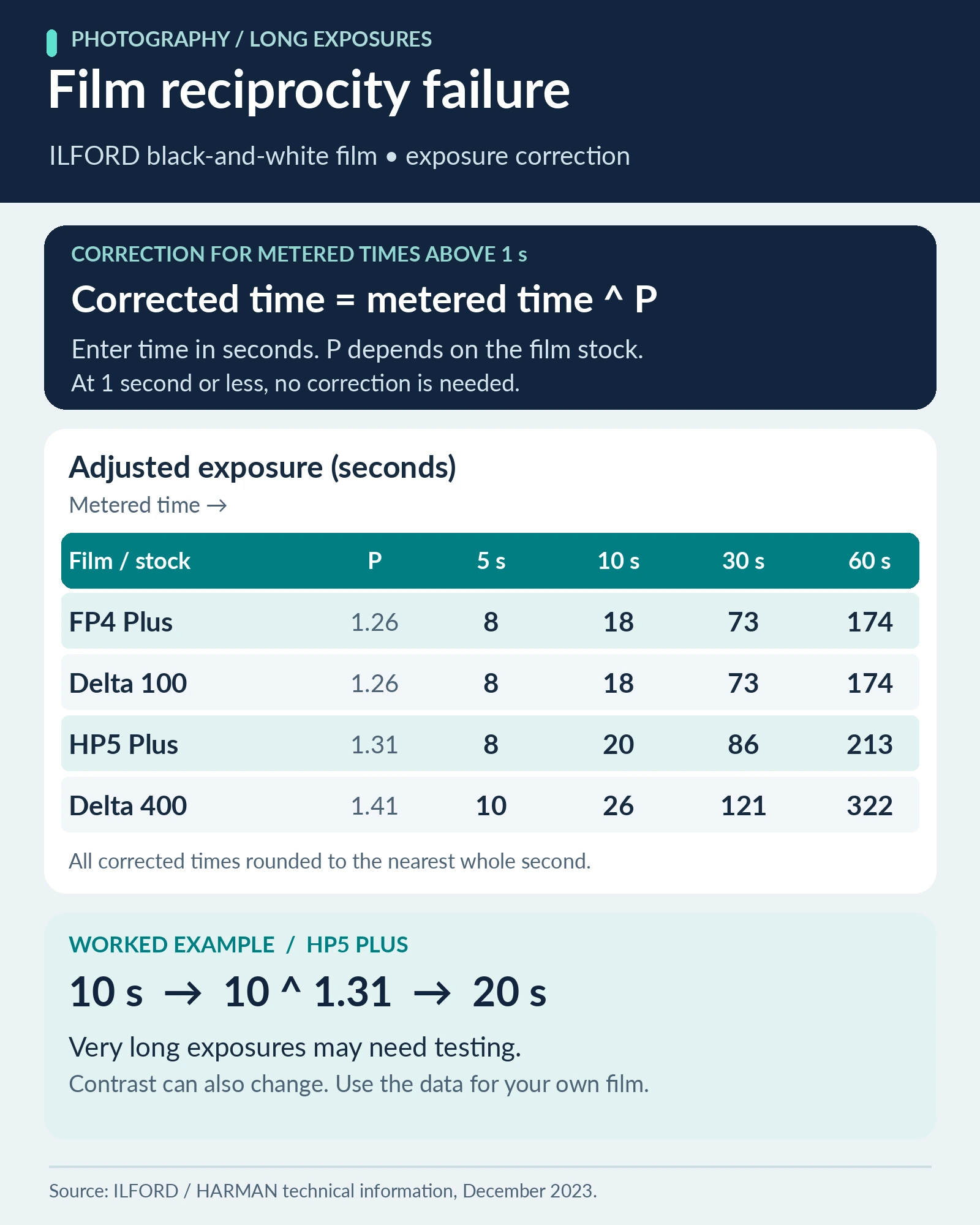
ILFORD publishes a power law: Tc = TmP, where P is a factor for each film. Published factors include:
| ILFORD film | P |
|---|---|
| PAN F Plus | 1.33 |
| DELTA 100 | 1.26 |
| FP4 Plus | 1.26 |
| HP5 Plus | 1.31 |
| DELTA 400 | 1.41 |
| DELTA 3200 | 1.33 |
| Kentmere 400 | 1.30 |
Other makers publish their own tables, graphs or notes, and other formulas exist that give slightly different results. If your film is not above, use its maker’s data sheet rather than borrowing a factor.
Reading long exposure compensation charts
Many data sheets give a graph or table of metered versus adjusted time. Find the metered time on one axis and read across to the adjusted time. A formula gives a smooth curve; a chart may differ at the extremes, and some photographers report that older charts and the later power-law formula do not match exactly, so prefer the current sheet and test.
Worked examples with supported film stocks
- HP5 Plus, 10 s metered: 101.31 ≈ 20.4 s, about 1.03 stops more (ILFORD’s own example).
- HP5 Plus, 60 s metered: 601.31 ≈ 213 s, about 3.5 minutes.
- DELTA 100, 10 s metered: 101.26 ≈ 18.2 s.
- Any of these films at 0.5 s: no correction.
Notice how fast the correction grows: a one-minute meter reading becomes more than three times longer.
Using the film reciprocity calculator
In the film reciprocity calculator, pick an ILFORD film (the factor fills in), enter the metered time in seconds and press Calculate. It returns the corrected time and the extra stops. For another film choose the custom option and type the factor from the maker’s sheet; the tool will not guess one.
Unknown stocks, exposure logs and colour shifts
- Keep a log of film, metered time, corrected time and result so you can refine your own numbers.
- Colour film can shift in colour at long exposures; the calculator gives no filter or colour correction.
- Development changes for long exposures are not included. Follow the film maker.
- Digital sensors do not follow this rule.
Worked examples, practical checks and limitations
The formula is a guide, not an exact law. For very long exposures other factors such as the accuracy of the light reading come into play, so round to a practical shutter time and bracket important frames: one at the corrected time, one at roughly half a stop to a stop either side.
Common mistakes and when to seek expert confirmation
- Applying an ILFORD factor to a different brand of film.
- Correcting exposures that are already under one second.
- Entering minutes where seconds are needed.
- Forgetting that the meter reading itself may be unreliable in near-darkness.
For critical work such as astrophotography on film, rely on the manufacturer’s current data and your own test rolls.
Frequently asked questions
How to calculate film exposure compensation at night?
Meter the scene, then raise the metered time to your film’s factor P (Tc = TmP) if the maker publishes one, or use the maker’s chart.
When do I need reciprocity correction?
Generally for exposures longer than about one second with film; check your film’s sheet for the exact threshold.
What is the HP5 Plus reciprocity factor?
ILFORD gives 1.31, so 10 seconds becomes about 20 seconds.
Does this apply to digital cameras?
No, this is a film and photographic paper effect.
Should I change development time?
Follow the film maker’s advice; this guide covers exposure time only.
Conclusion
Correct only long exposures, use your film maker’s own factor or chart, and bracket the frames that matter.
Sources
- HARMAN technology (ILFORD): Film Reciprocity Failure Compensation, Dec 2023
- ILFORD HP5 Plus technical information
- ILFORD PAN F Plus technical information

















Share Your Opinion
Comments are closed on this post.