 Vista

Pterodactyl Dinosaur Mexico viral video — fact check: A short, grainy clip circulating in November 2026 appears to show an unusually large winged silhouette over Ciudad Juárez in the Mexican state of Chihuahua. Online posts claimed it might be a living pterodactyl, Pteranodon or another prehistoric flying reptile. There is no verified evidence that a living pterosaur was found in Mexico. The municipal Civil Protection authority said the footage does not substantiate such a sighting. A large modern bird has been offered as a plausible explanation, but the available reports do not establish an independently verified species identification for every version of the clip.
The earliest local report we found quoting the municipality was published by Radionet on November 11. Civil Protection chief Sergio Rodríguez described the posts as entertainment without verifiable evidence. The original unedited camera file and exact species remain unverified. Radionet: statement from Ciudad Juárez Civil Protection.
People searching pterodactyl dinosaur Mexico, Mexico flying dinosaur video, pterodactyl Mexico real or fake, pterosaur pictures or Ciudad Juárez pteranodon video often encounter dramatic still images and contradictory headlines. This article separates the evidence into distinct questions: where did the clip come from, what did local authorities say, how much can its silhouette tell us, what exactly were pterosaurs, and how can readers distinguish a genuine fossil or scientific reconstruction from an AI-created image?
Where Did the Mexico Pterodactyl Video Come From?
The first widely discussed security-camera recording was reportedly dated October 29, 2026, and attributed to the Anapra neighborhood in Ciudad Juárez, Chihuahua, near the border with El Paso, Texas. The clip lasts only a few seconds, with the unusual flying shape visible briefly. Reports described a dark silhouette with large wings passing across the nighttime frame. A strange shape in low-resolution footage naturally invites curiosity, especially when the camera is distant and the surrounding buildings provide unreliable clues to scale.
Mexican broadcaster Jaime Maussan helped popularize the recording through his No Humano program and related social posts. He discussed the possibility of a creature resembling a pterodactyl or Pteranodon. A second clip, said to have been captured near Ciudad Juárez’s international airport, entered the discussion soon afterward. Yet separate videos of winged silhouettes are not automatically evidence of the same individual animal, much less an extinct species.
The sequence is documented by Mexican reporting, including El Financiero’s November 16 overview and Infobae’s November 12 account. The original story became increasingly difficult to assess as screenshots, AI-enhanced reconstructions, social-media edits and humorous memes circulated alongside the much shorter source footage. Repeated sharing can make a claim feel widely witnessed without adding a single independent observation.
Some posts estimated an enormous wingspan or suggested an unexplained origin. Those are not measurements that can be derived reliably from a blurred silhouette. To estimate the size of an airborne object, researchers would need reliable information about its distance from the camera, lens characteristics, scale reference, exposure and recording geometry. Without that, a bird passing close to the lens can look larger than a distant building or mountain.
What Did Ciudad Juárez Authorities Say About the Flying Creature?
The central claim is straightforward: Did the footage prove that a prehistoric flying reptile survives in Mexico? The answer is no. The city’s Municipal Civil Protection chief, Sergio Rodríguez, rejected the suggestion that the circulating videos provide scientific support for a living pterosaur. A November 12 report from Azteca Ciudad Juárez describes the official response and the authority’s warning against spreading unverified claims as fact.
That statement should be understood precisely. Rejecting a prehistoric-animal identification does not, by itself, mean a forensic laboratory has formally analyzed every frame of every online edit. An original recording might show a modern bird. Another circulating image might be an artist’s interpretation. Some posts could combine genuine nighttime scenery with computer-generated material. These possibilities require separate source checks; they should not be collapsed into one sweeping unsupported explanation.
An extraordinary biological discovery needs evidence beyond an impression created by a screen. Researchers would seek clearly documented sightings, independently examinable photographs or videos, physical material, trace evidence, repeated observations and expert review. For a sizable population of flying reptiles, a long-term ecological footprint would also be expected. None of that has been demonstrated by the viral Ciudad Juárez material. This is why a cautious fact-check says the pterosaur claim is unsupported, rather than claiming it has solved every detail of every clip.
Could the Mexico Video Show a Great Blue Heron Instead?
A more ordinary possibility was described in local Azteca reporting on November 13: the silhouette could have been a great blue heron (Ardea herodias), called garza morena in Spanish. This large North American waterbird has long wings and a distinctive outline that can appear surprisingly unfamiliar when filmed from below, at an angle or in the dark. A typical viewer may not immediately recognize its long neck and broad wingbeats in a noisy security-camera recording.
The heron explanation is worth considering because it fits the general category of a large flying animal known to exist in the region. But “a heron is plausible” is not the same as “the exact species has been proved in every viral version.” We did not find an independently published analysis that securely identifies every source frame across all circulated clips. A reliable report should distinguish a possible identification offered by specialists from a fully documented forensic conclusion.
Low light can hide a bird’s color and feather detail. Motion blur can smear the wingtips, while a low frame rate can make wing movement look unnatural. Digital compression can create blocky edges around a moving silhouette. Finally, forced perspective can make an everyday animal seem much bigger than it is. These effects explain why an unusual outline is not enough to identify a surviving Pterosaur, although no single effect should be declared responsible for a particular video without examining its original file.
Is a Pterodactyl a Dinosaur? Pterosaur vs Pteranodon Explained
The search phrase pterodactyl dinosaur Mexico contains a common scientific mix-up. Pterosaurs were flying reptiles, not dinosaurs. They lived during the Mesozoic Era alongside dinosaurs but belonged to a distinct evolutionary group. The popular word “pterodactyl” is often used for almost any prehistoric flying reptile; more precise scientific terms distinguish the entire group from particular genera.
| Term | Scientific meaning | What it does not establish |
|---|---|---|
| Pterosaur | The broad group of prehistoric flying reptiles | That the animal was a dinosaur or survives today |
| Pterodactylus | A particular genus within Pterosauria | That every large winged fossil belongs to that genus |
| Pteranodon | Another pterosaur genus, famous for its head crest | That a blurred viral silhouette represents this animal |
| Great blue heron | A living modern North American bird species | That every uncertain clip must necessarily show a heron |
The Natural History Museum in London explains that pterosaur wings were constructed differently from bird wings. An extended fourth finger supported a large membrane; birds instead developed feathered wings built on modified forelimbs. Several pterosaurs had long jaws or head crests, features that appear prominently in scientific reconstructions. These similarities to fantastical flying creatures make for striking illustrations but cannot substitute for a specimen or a verifiable identification.
Pterodactylus and Pteranodon are not interchangeable species names. Pteranodon is commonly associated with a large wingspan and a distinctive crest. Pterodactylus refers to a different lineage within the larger group. A blurry video cannot establish details such as jaw anatomy, limb structure, the fourth finger or diagnostic crest shape. That is why social posts saying “experts confirmed a Pteranodon because of its head” overstate what the available footage supports.
When Did Pterosaurs Go Extinct? Are Any Alive Today?
Pterosaurs inhabited Earth for a vast span of geological time, but the final members of the group disappeared about 66 million years ago, at the end of the Cretaceous Period. Their extinction coincided with the mass-extinction event that also eliminated non-avian dinosaurs. The Natural History Museum and the American Museum of Natural History provide museum-level explanations of their anatomy, age and fossil record.
Birds are not living pterosaurs. They belong to the evolutionary lineage of dinosaurs, whereas pterosaurs were a separate branch of flying reptiles. That distinction matters when a modern bird resembles a creature from a documentary or a movie. Similar silhouettes can arise from the demands of flight without implying that one living animal is an ancient Pteranodon. A video showing a long-beaked bird is not a photograph of a surviving prehistoric species.
Scientists know pterosaurs through fossils, including bones, impressions and other geological evidence. They use those fossils to reconstruct wing shape, muscle attachment, size, skull structure and possible flying behavior. What they do not possess is a verified modern specimen, tissue sample or independent body of ecological evidence demonstrating a pterosaur population surviving in North America. An alleged sighting would need to clear a high evidentiary bar because it directly contradicts extensive fossil and biological knowledge.
It is scientifically legitimate to investigate an unfamiliar animal without automatically pretending its identity is known. The careful distinction is between something not yet identified in a particular clip and proof of a species believed extinct. The first can happen with poor images of everyday wildlife; the second is a monumental biological assertion that requires far more than a few seconds of compressed footage.
Is the Pterodactyl Mexico Video AI-Generated or Edited?
Not every video circulating under the same title is necessarily the same media file. Some short clips may use actual streets, sky, surveillance footage or birds. Others may be reposts with added narration, sharpened frames, CGI or explicitly AI-created artwork. In reports about the case, “AI-enhanced image” was also used to describe interpretive visual material. An enhancement is not the same thing as an original sensor recording, and AI can generate details that were absent from the raw image.
To verify a viral video, start with the oldest identifiable upload and record its date, uploader and accompanying explanation. Look for the original security-camera file instead of a compressed screen recording of a social-media clip. Compare distinct versions to check whether wings, scenery, shadows or backgrounds change. Seek independent local reporting and named experts, then check whether any complete technical analysis of the file was actually published.
Signs such as changing anatomy, repeated patterns or inconsistent shadows can raise questions, but they are not definitive proofs of AI creation. Ordinary video compression and motion blur can also create strange edges. Likewise, a generic AI-detection percentage may not settle the matter for a short nighttime clip. The best available conclusion is based on provenance, reproducible analysis and independent evidence, not whether a single screenshot “looks fake” at first glance.
In the Ciudad Juárez case, the crucial point remains intact even if some footage was captured by a genuine camera: a camera recording of an unidentified flying shape is not evidence of a living pterosaur. A realistic re-creation can help explain what the claim describes, provided it is clearly labelled as an illustration.
Pterodactyl Dinosaur Images: Real Fossils vs CGI and AI Illustrations
Image searches for pterodactyl real photos, pterosaur pictures, pteranodon vs pterodactyl images, pterodactyl flying HD wallpaper and Mexico flying dinosaur photo return very different kinds of content. The reader-friendly way to organize them is into three categories: genuine fossil photographs, scientific reconstructions based on fossil studies, and creative or AI-generated concept art. Each is useful for a different reason.
Real fossil photographs document preserved bones or impressions and are primary evidence that pterosaurs existed. Scientific reconstructions use fossil-based anatomy to picture animals alive; colors, skin surfaces and posture may contain informed artistic decisions. CGI and AI images can convey an exciting scene but should never be mistaken for documentary footage of a 2026 sighting. The viral-story context makes this distinction particularly important.
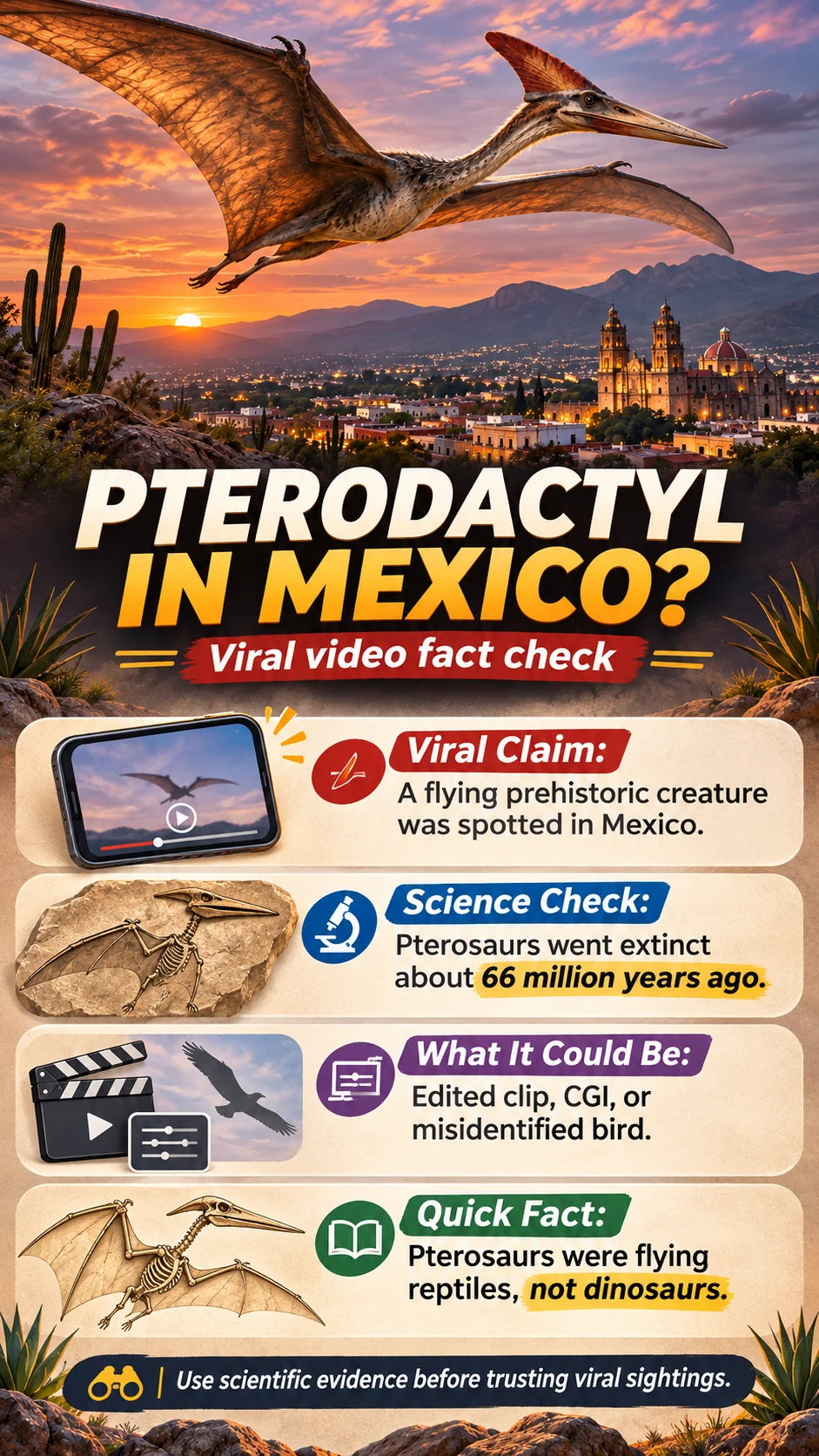
The OG featured image and English infographic displayed with this article are original AI-created educational illustrations. Their purpose is to visualize what a pterosaur might look like and explain the claim. They are not actual Ciudad Juárez photos, stills extracted from the camera recording or official Mexican government photographs. Museum reconstructions and fossil displays can be explored through the Natural History Museum’s pterosaur guide.
An image title should not imply “real pterodactyl found in Mexico” when the picture is fictional. For image SEO, accurate alt text such as “illustration of a pterosaur above a Mexican city during a viral-video fact check” is more transparent and helpful than a sensational label. When users share a visual on social media, a clear caption helps prevent the artwork from starting another cycle of misinformation.
Mexico Flying Dinosaur: Myth vs Fact
| Claim | What the evidence supports |
|---|---|
| A living pterodactyl was confirmed in Mexico | False as a confirmed claim; no verifiable living pterosaur evidence has been produced. |
| The clip has a huge winged silhouette, so it must be prehistoric | A silhouette alone does not establish size, species or distance from the camera. |
| An AI-enhanced image shows the creature’s true details | AI-enhanced frames can add reconstructed detail and are not original camera evidence. |
| All “pterodactyl” images online are photographs | Most are fossil images, scientific artworks or imaginative CGI/AI reconstructions. |
| Every viral clip definitely shows a great blue heron | Heron is a reported plausible explanation, but a definitive identification across all videos is not established. |
Good fact-checking avoids two extremes. It should not confirm a sensational animal discovery without physical evidence. It should also avoid claiming technical certainty about an unknown original file merely because the headline is implausible. Reported local facts, museum science and interpretation of an unclear clip should be visibly separated.
Frequently Asked Questions: Pterodactyl Mexico Video
1. Was a real pterodactyl spotted in Mexico in November 2026?
No verified evidence supports that claim. A short recording circulated from Ciudad Juárez, but municipal authorities said it did not substantiate a prehistoric flying reptile.
2. Where was the Mexico pterodactyl clip reportedly recorded?
The first widely discussed security-camera footage was attributed to the Anapra area of Ciudad Juárez, Chihuahua, and reportedly dated October 29, 2026.
3. What bird might explain the flying shape?
Local reporting discusses the great blue heron, or garza morena, as a plausible candidate. The exact identification is not independently proven for every video version.
4. Is the entire viral pterodactyl video confirmed to be AI-generated?
Not as a blanket statement about every circulation and source file. Some material may be edited or AI-enhanced, but each clip requires a separate provenance and technical check.
5. Are Pterodactylus, Pteranodon and pterosaurs the same thing?
No. Pterosaur is the broader group. Pterodactylus and Pteranodon are different genera within it. Calling every flying prehistoric reptile a “pterodactyl” is common but imprecise.
6. Are any real photographs of living pterosaurs available?
No authenticated modern photographs of living pterosaurs are recognized by science. Fossil specimens and scientifically informed artwork are available through natural history museums.
Bottom Line: A Viral Shape Is Not Proof of an Extinct Animal
The Pterodactyl Dinosaur Mexico trend combines a genuine news event—the widespread sharing of unusual-looking clips—with a claim that has not passed scientific verification. Reports connect the footage to Ciudad Juárez and its October 29 Anapra recording. Jaime Maussan’s discussion brought attention to a possible prehistoric explanation. Municipal authorities rejected that identification, and museum science shows that pterosaurs became extinct around 66 million years ago.
A large modern bird is a reasonable explanation to examine, while digital manipulation remains a question for source-by-source analysis. Until stronger evidence appears, the most accurate answer to “Is the Mexico pterodactyl video real?” is that the video’s prehistoric-animal claim is unsupported. Readers should look for the oldest footage, reliable local reporting and scientific sources before forwarding dramatic images presented as new discoveries.
Sources and Editorial Update
Last checked: November 17, 2026. El Financiero, November 16: chronology and viral memes; Azteca Ciudad Juárez, November 12: Civil Protection statement; Azteca Ciudad Juárez, November 13: large-bird explanation; Natural History Museum, London: pterosaur science; American Museum of Natural History: pterosaur facts.
Methodology and image disclaimer: The original files and independent forensic examination of every circulating video were not available for complete verification. Species identifications that remain uncertain are described as possibilities, not confirmed verdicts. The featured image and infographic are AI-created conceptual illustrations, not eyewitness footage.
American Museum of Natural History: What is a pterosaur?


























Share Your Opinion
Comments are closed on this post.