 Vista

How do you make a Chandrayaan-3 model for a school project? Create a wide grey cardboard base to represent the lunar surface, build a four-legged Vikram lander from a small carton, and add a smaller Pragyan rover with six paper wheels. For a science exhibition, make a separate paper LVM3 rocket to show how the spacecraft was launched from Earth. This guide includes six large Chandrayaan-3 school project images, materials, easy construction steps, mission facts and a short presentation children can use.
Chandrayaan-3 is a completed historical mission, not a newly announced 2026 landing. ISRO launched it on 14 July 2023 and the Vikram lander made a successful soft landing on the Moon on 23 August 2023, near the Moon’s south polar region. Pragyan was then deployed to explore and study the nearby surface. These facts come from ISRO’s official Chandrayaan-3 mission page.
Chandrayaan-3 facts students should know before building
Chandrayaan-3 followed Chandrayaan-2 and was designed to demonstrate three objectives: a safe soft landing on the Moon, a rover moving across the lunar surface, and scientific experiments performed there. It travelled aboard the LVM3-M4 launch vehicle from Sriharikota, India, and included a propulsion module, a lander module and a rover.
The Vikram lander was the spacecraft that made the controlled descent and soft landing. Pragyan was the rover that emerged from Vikram and travelled near the landing site. The propulsion module helped transport the lander configuration towards lunar orbit. The LVM3 rocket was the launch vehicle used at the beginning of the journey from Earth. These parts serve different functions; the full rocket did not descend onto the lunar surface.
ISRO designed the lander and rover to operate for approximately one lunar day, roughly 14 Earth days. After landing, scientific instruments collected information about the lunar surface and nearby environment. The rover’s instruments included the Laser Induced Breakdown Spectroscope (LIBS) and Alpha Particle X-ray Spectrometer (APXS), used for elemental studies. Older pupils may write these names in a small fact box; younger children can simply explain that the rover studied rocks and soil.
Did Chandrayaan-3 land exactly at the Moon’s South Pole? No. It landed in the high southern latitudes, near the south polar region, not precisely at 90° south latitude. For dates, goals and landing-location facts, see ISRO’s official mission details.
Materials for an easy cardboard Chandrayaan-3 model
A simple static display requires a wide piece of cardboard, a few small clean cartons, light card paper, glue or tape, pencil, eraser, ruler, scissors suitable for the child’s age, and grey, white, gold and black colours or markers. To decorate the Moon surface, use grey paper, lightly shaded craters and tiny paper rocks. For Vikram, a small square box is enough. For Pragyan, use a much smaller rectangular box and six circles cut from stiff paper.
You may use recycled packaging instead of buying a specialised model kit. A school craft does not need real solar panels, motors, batteries or communication equipment. Gold-coloured paper can suggest the appearance of insulated spacecraft surfaces, but it is only a decorative approximation. The most important features are that the lander has a recognisable landing structure, the rover is smaller, and each is clearly labelled.
Adults should help with cutting thick cardboard. Avoid sharp craft knives, hot-glue guns, metal pieces with exposed edges and heavy components. Keep the model low and balanced so it can be transported safely in a school bag or box. Allow glue to dry before lifting the finished base.
Six Chandrayaan-3 school project model pictures
These images are illustrated craft references, not official photographs, precise spacecraft blueprints or dimensionally accurate replicas. Tap a poster to see the full-size picture and use it alongside the steps below.
1. Complete Chandrayaan-3 School Project Model
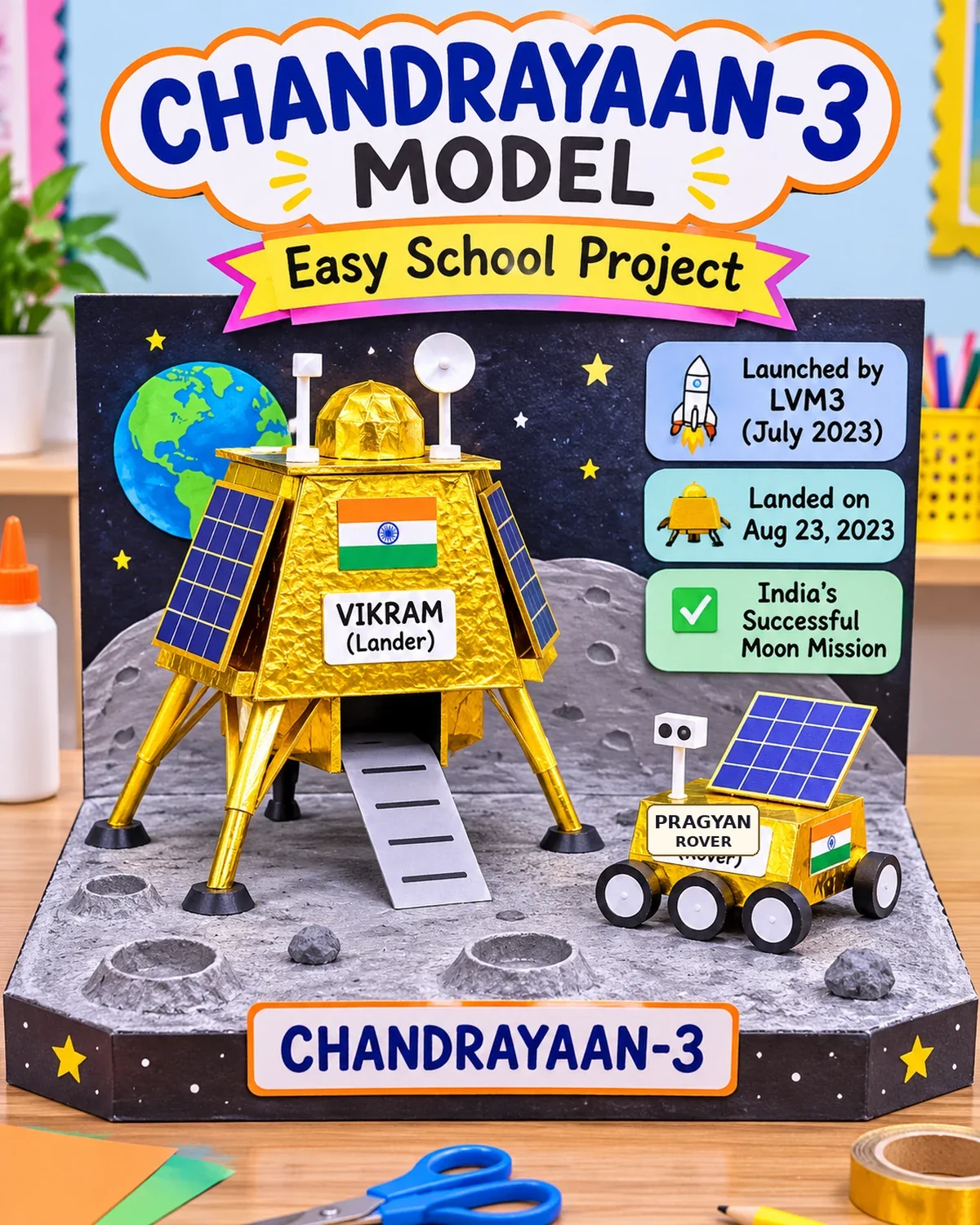
The full scene shows a Moon-like base, a small lander, a rover and separate labels. It is a practical overview for a science fair where pupils need to explain the major parts together.
How to make it: Use a broad cardboard board for the lunar surface and colour it grey. Make shallow circles for craters. Place the four-legged lander on one side and a smaller six-wheeled rover nearby. Add clear name labels without claiming exact physical scale.
Remember: This is a simplified craft layout, not an official engineering replica of ISRO’s spacecraft.
2. Vikram Lander Cardboard Model
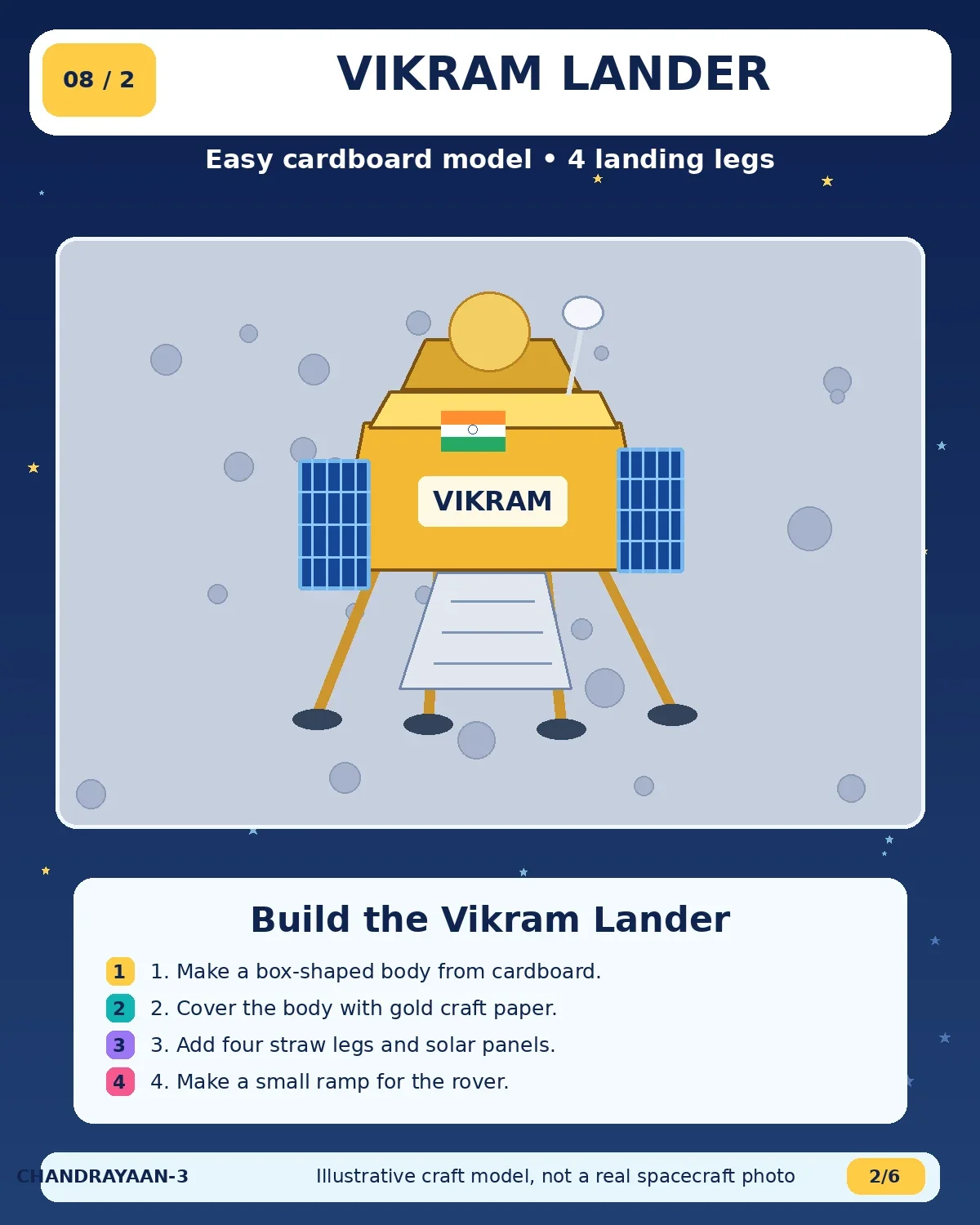
The Vikram lander was the module that achieved the soft landing on 23 August 2023. Children can depict its main body and landing legs with light cardboard.
How to make it: Cover a small square carton with white or gold-coloured craft paper. Make four short landing legs from folded strips, securing them to a wide base. Add a small antenna-shaped paper detail on top and a contrasting panel on one side. Test that the model stands steadily before moving it.
Remember: The model does not need functional instruments, thrusters or a real landing mechanism.
3. Pragyan Rover Six-Wheel School Model

Pragyan was the small rover deployed after the lander touched down. It carried instruments to study lunar material near the landing site.
How to make it: Make a tiny rectangular paper body using a matchbox-sized carton. Attach three circular paper wheels along each long side, making six wheels in total. Add a flat panel on top and one simple camera or sensor illustration. Set the rover close to the lander on the grey board.
Remember: The wheels do not have to rotate. A static labelled representation can still show how the rover differed from the lander.
4. LVM3-M4 Launch Rocket Paper Model
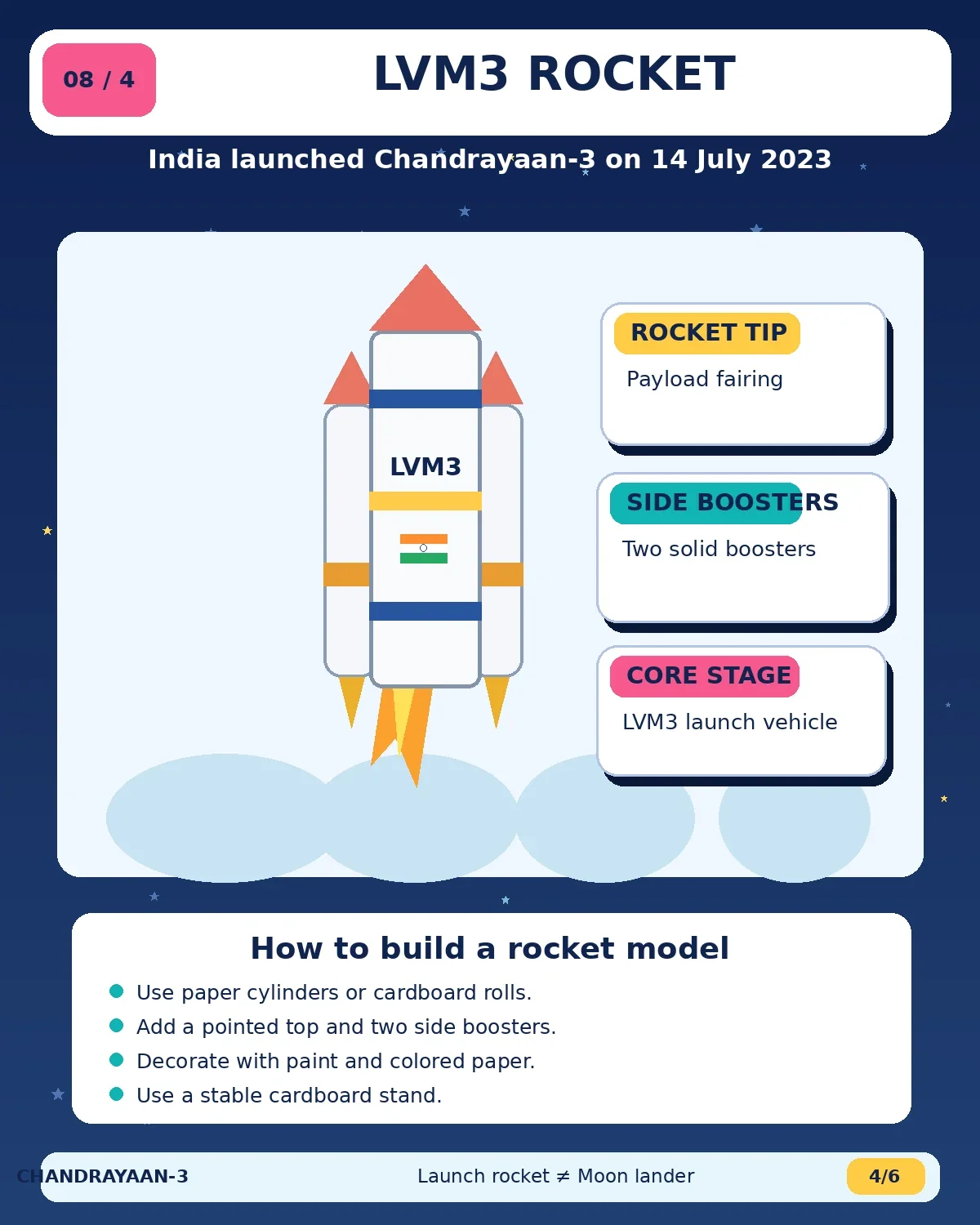
Chandrayaan-3 was launched from Earth aboard an LVM3-M4 rocket. The launcher is different from the Vikram lander and did not land on the Moon.
How to make it: Roll craft paper into a tall cylinder and attach a paper cone at its tip. Make two simple booster shapes beside the central cylinder and secure the display to a wide cardboard stand. Label it ‘LVM3 Launch Vehicle’ and place it in a separate launch section rather than beside the rover as though it were a lunar machine.
Remember: Never add fuel, fire, fireworks, pressurised bottles or real rocket motors to this school craft.
5. Chandrayaan-3 Model Materials Checklist
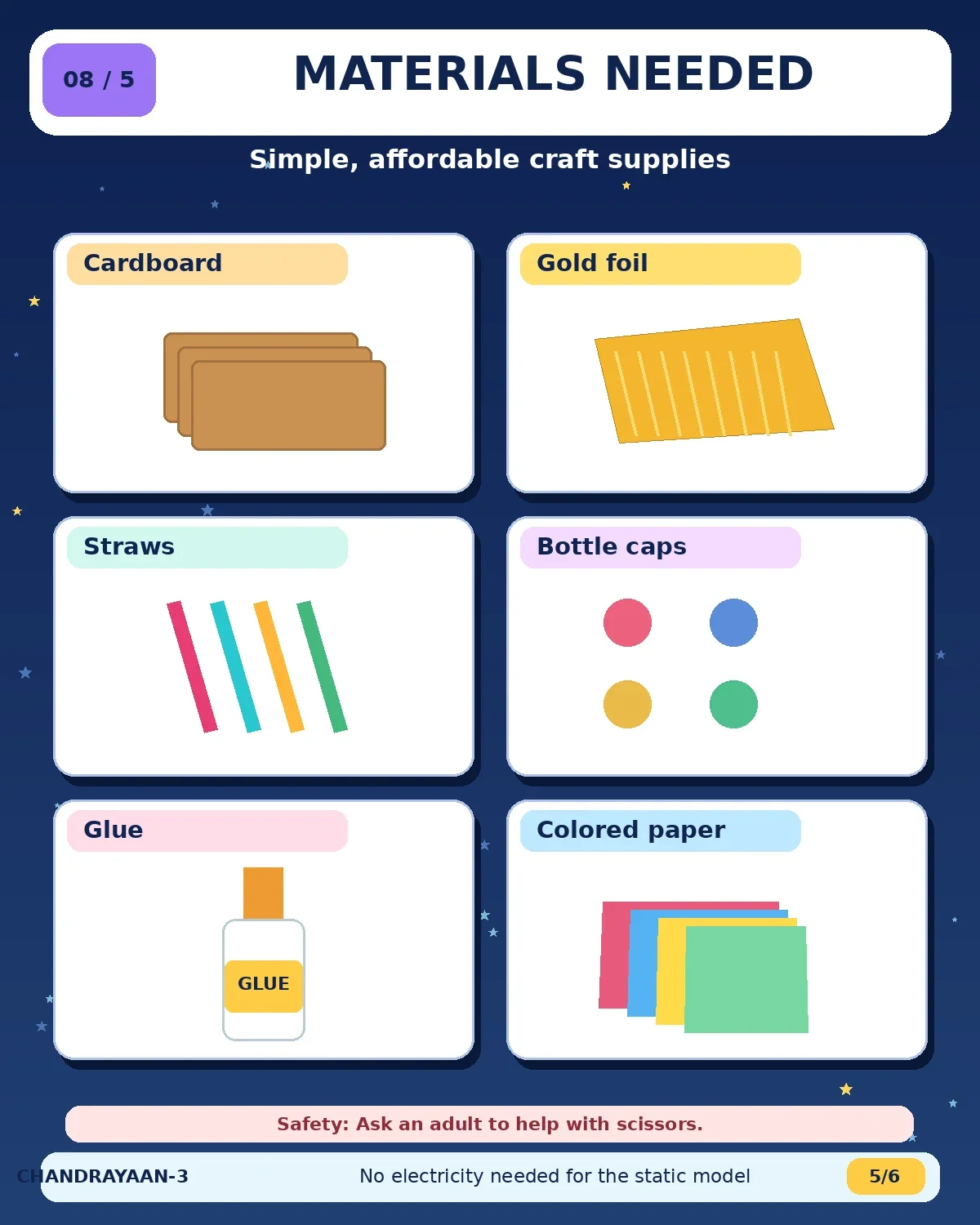
A light craft model can be built from recycled cartons, coloured sheets and basic school stationery. It does not require electronics.
How to make it: Gather a cardboard base, small empty paper boxes, white and grey paper, gold-coloured craft paper, pencil, ruler, tape, glue and markers. Make six small round paper wheels for the rover and folded strips for the lander’s legs. Ask an adult for help with any necessary cutting, and avoid sharp hobby knives or hot glue.
Remember: Choose light pieces that will survive being carried to school rather than heavy metal or fragile decorations.
6. Build Chandrayaan-3 in Four Easy Steps
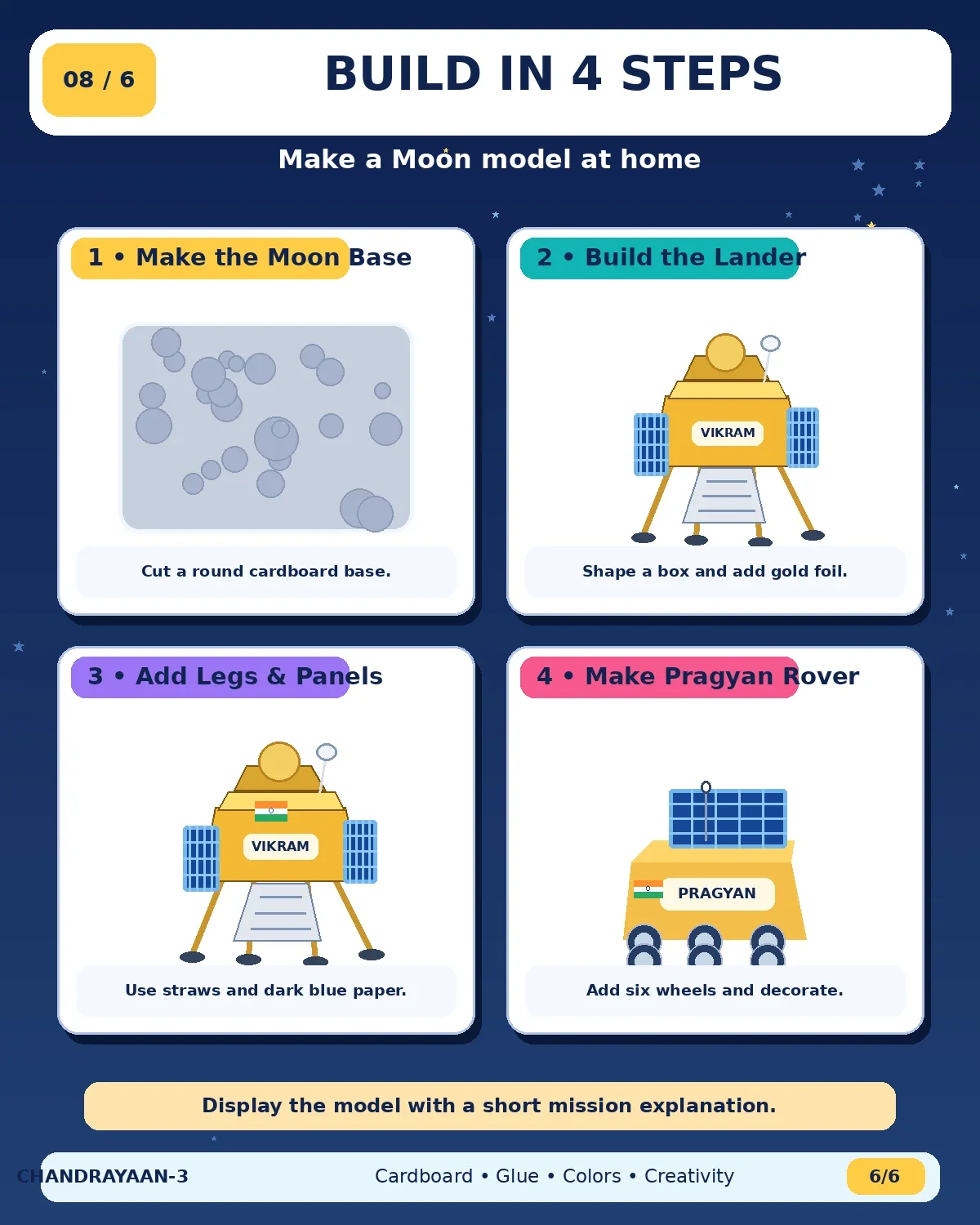
This poster summarises the construction order: lunar base, lander, rover and final assembly with labels.
How to make it: First prepare the grey Moon surface. Next make Vikram’s carton body and four legs. Third, prepare Pragyan’s smaller body and six wheels. Finally arrange both on the board and add the mission name, launch date and landing date. A separate paper LVM3 rocket may be included to explain how the journey began.
Remember: Check dates, names and mission facts against ISRO’s official details before writing them on a school display.
How to make a Chandrayaan-3 model step by step
- Prepare the lunar base. Cover a flat cardboard board with grey paper and add light pencil shading to suggest Moon craters. Keep a large flat area for the spacecraft.
- Build the lander body. Choose a small square carton and cover it with light paper, leaving room for the name ‘Vikram’.
- Add four landing legs. Fold short strips of firm card and attach them to the corners underneath. Check the lander can stand without tipping.
- Make the Pragyan rover. Shape a smaller rectangular box and attach three round paper wheels to each side. Add a flat top panel and a tiny instrument-like detail.
- Place the rover beside the lander. Arrange the rover as though it has rolled down a ramp onto the lunar surface, but do not claim the layout is an exact photograph of the landing site.
- Optional LVM3 rocket. Roll paper into a cylinder, give it a cone-shaped top and add two simple boosters. Place this on a separate launch panel labelled ‘Earth Launch’.
- Write factual labels. Add ‘Vikram Lander’, ‘Pragyan Rover’, ‘LVM3 Launch Vehicle’ and ‘Lunar Surface’.
- Include the correct dates. Put ‘Launched: 14 July 2023’ and ‘Soft Landing: 23 August 2023’ in a small corner box.
- Check the model. Confirm all paper joins are dry, no sharp edges are exposed and the school can easily carry and display it.
This is a static display model. Some search results call such projects a “working model”, but the educational objective does not require the spacecraft parts to move or operate. A motorised rocket or pressurised launch is unnecessary and unsafe for a basic cardboard school project.
Vikram Lander vs Pragyan Rover vs LVM3 Rocket
Vikram: The lunar lander carried out the soft landing and hosted scientific instruments. Its landing legs were part of the system that supported touchdown. In a classroom model, represent it with a box, legs and a few labelled paper panels. Pragyan: The rover deployed from the lander and explored the nearby Moon surface. A small six-wheeled cardboard vehicle conveys that idea without requiring moving wheels or electronics. LVM3-M4: The rocket launched the spacecraft from India and did not make the lunar landing.
This distinction is important because a dramatic model with an entire rocket placed on the Moon can give the wrong impression of the mission. For a display, show Earth launch on one side and Moon operations on the other, connected by a simple labelled arrow. If your teacher asks about the propulsion module, explain that it carried the lander configuration toward the Moon and had a separate role from the launch rocket.
ISRO released scientific data from Chandrayaan-3 on 23 August 2024 and reported that instruments on the lander, rover and propulsion module collected measurements. These included studies related to the lunar surface and local environment. This is useful background for older students, but it is not necessary to reproduce actual payloads on a junior school craft. ISRO’s science data announcement provides more details.
Short Chandrayaan-3 school project presentation
A student can say: “This is my Chandrayaan-3 school model. ISRO launched Chandrayaan-3 on 14 July 2023 with the LVM3 rocket. The Vikram lander successfully touched down on the Moon on 23 August 2023, near the lunar south polar region. The Pragyan rover then moved on the surface and helped collect scientific information. I made the Moon base, Vikram lander, Pragyan rover and launch rocket using cardboard and paper.”
If a teacher asks why the mission was important, explain that it demonstrated India’s capability for a safe lunar soft landing and rover operation. If asked whether the craft has real spacecraft instruments, answer that it is an illustration for learning, not an engineering copy. Knowing what each part did is more meaningful than adding complex decorations without explanation.
For a longer presentation, show a simple timeline: July 2023 for launch, August 2023 for landing and the subsequent planned scientific operations. Label the display “Chandrayaan-3 Mission (2023)” to make clear that it is a historical science project, not a newly scheduled spaceflight.
Common mistakes in Chandrayaan-3 school models
Putting the full LVM3 rocket on the Moon: The launch rocket and lander were different machines. Showing Pragyan as bigger than Vikram: The rover should be much smaller in a simple conceptual model. Writing the wrong landing year: The successful landing was on 23 August 2023, not in 2026. Claiming it landed exactly at the South Pole: It landed near the Moon’s south polar region. Calling the craft an exact ISRO replica: Classroom illustrations simplify shape and proportions.
Do not make a working fire-powered rocket to add excitement. A neat static display, safe supplies, correct mission labels and a short explanation are enough for the learning goals. If a school explicitly asks for a different kind of working science model, ask the teacher whether a static Chandrayaan display fulfils the assignment.
Frequently asked questions about Chandrayaan-3 school models
How can I make a simple Chandrayaan-3 model at home?
Make a grey lunar cardboard base, a four-legged Vikram lander from a carton, and a smaller Pragyan rover with six paper wheels. Add clear labels and correct mission dates.
When did Chandrayaan-3 launch?
ISRO launched the spacecraft on 14 July 2023 aboard an LVM3-M4 launch vehicle.
When did Vikram land on the Moon?
The successful lunar soft landing took place on 23 August 2023.
What is the difference between Vikram and Pragyan?
Vikram was the lander; Pragyan was the rover deployed onto the lunar surface to perform scientific investigations.
Do I need a motor or fuel for this model?
No. A static model made from paper and cardboard is enough to show the main mission parts safely.
Are these images official spacecraft diagrams?
No. They are simplified educational craft illustrations. Use ISRO’s official website for engineering details and scientific facts.
Conclusion and official ISRO sources
A good Chandrayaan-3 model for a school project explains a real historical achievement with simple, recognisable craft pieces. Build a stable Moon base, distinguish Vikram from Pragyan, show the LVM3 launch vehicle separately and write the mission’s 2023 dates correctly. The six large images are useful references, but the student’s own understanding and explanation should guide the final display.
Official sources: ISRO Chandrayaan-3 Mission; ISRO Mission Details and Objectives; ISRO Mission Science Data. Facts reviewed November 2026. This is an educational guide to a 2023 mission, not a live mission update. Images are illustrative, not engineering blueprints.
More ideas for school projects
- Volcano Model for a School Project: 6 Pictures and Steps
- 6 Easy Solar System Drawings for School Projects








Share Your Opinion
Comments are closed on this post.