The Divine Origin of Maa Narmada: A Celestial Tale from the Puranas
In the sacred land of Bharat, rivers are revered not merely as sources of water but as embodiments of divine goddesses. Among these, Maa Narmada holds a place of exceptional sanctity and devotion. The ancient scriptures, particularly the Skanda Purana’s Reva Khand and the Narmada Purana, narrate a beautiful and enchanting story of her origin, transporting us to the Satya Yuga, an era marked by righteousness and deep penance.
Lord Shiva’s Austere Penance and Birth from Sweat
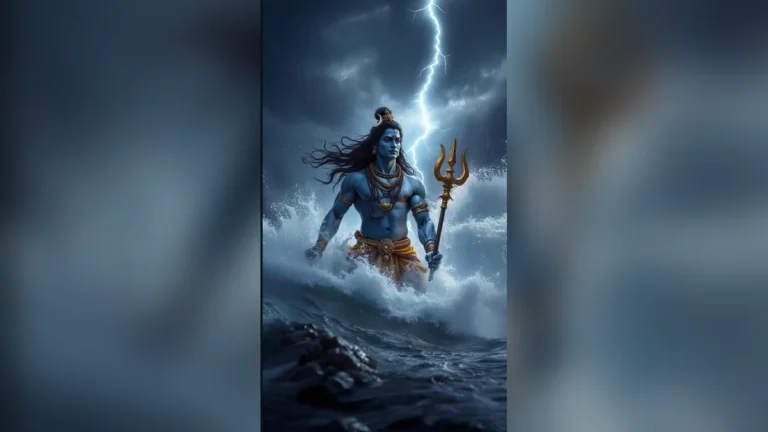
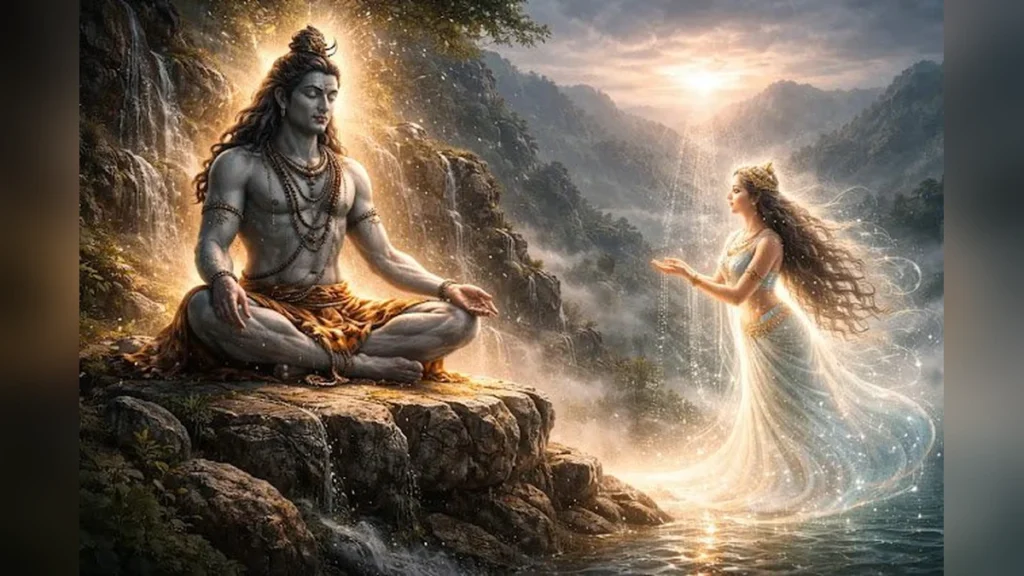
In ancient times, atop the मैकल पर्वत (Maikal Mountains), situated between the Vindhyachal and Satpura ranges, the great ascetic Lord Shiva was immersed in profound meditation. His penance was so intense and deep that divine beads of sweat began to form on his body. These radiant drops of sweat collected in a kund (a sacred pond) on the Maikal Mountains. As these divine drops fell into the kund, a radiant, beautiful, and lively maiden emerged. Her beauty was so extraordinary that even Lord Shiva and other deities were captivated upon seeing her. The melodious, flowing sound of her presence filled the entire atmosphere with joy.
The Mystery Behind the Name ‘Narmada’
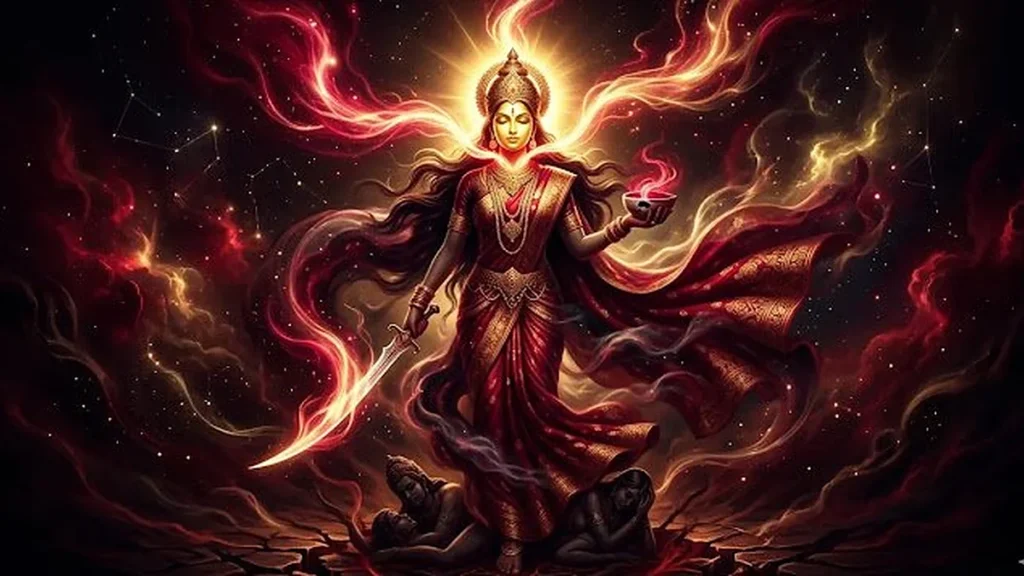
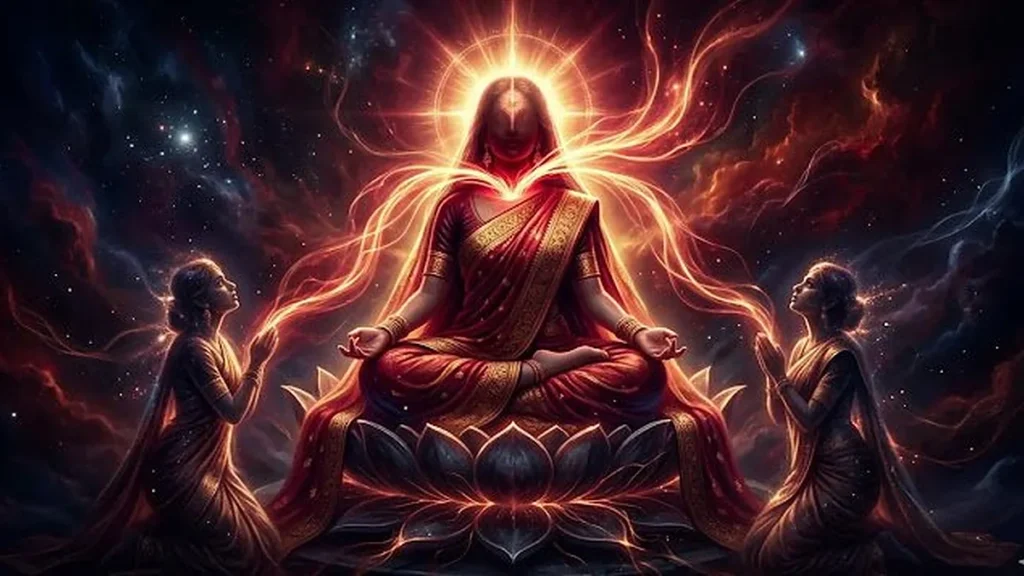
Observing the maiden’s divine beauty, playful nature, and joyous spirit, Lord Shiva bestowed upon her the name ‘Narmada’. ‘Narm’ signifies happiness or joy, and ‘Da’ means giver. Thus, Narmada translates to ‘the one who bestows happiness and joy’. Lord Shiva blessed her, decreeing that she would flow on Earth as a holy river, and merely by beholding her, one’s sins would be washed away. He also granted her the boon of remaining eternally a maiden and that her existence would endure until the end of time. This is why Maa Narmada is also known as ‘Kanyarupa’ (the maiden form).
The Glory and Uniqueness of Maa Narmada
Maa Narmada is considered unique among rivers in several aspects, and it is this distinctiveness that makes her the bestower of salvation and worthy of worship.
The Salvation-Giving Narmada: Liberation Through ‘Darshan’
A famous verse highlights this: “गंगा स्नानेन वै मुच्यते, यमुना दर्शनेन वै मुच्यते, सरस्वती स्मरणेन वै मुच्यते, रेवा नाम स्मृत्या वै मुच्यते।” This translates to: Liberation is attained by bathing in the Ganga, by the sight of the Yamuna, by remembering the Saraswati, but merely by remembering the name of Reva (Narmada), one is liberated. This is a testament to her unparalleled purity and her power to grant salvation. She is considered a form of Lord Shiva himself, and every stone in her riverbed is regarded as a ‘Narmadeshwar शिवलिंग’.
The World’s Only River with a Parikrama
Maa Narmada is the world’s only river that is circumambulated (parikrama). This pilgrimage spans approximately 3,500 kilometers and takes several months to complete. It is not merely a physical journey but a profound spiritual experience that brings the devotee closer to nature, the self, and the divine. This pilgrimage is known as the ‘Narmada Parikrama’ or ‘Narmada Yatra’.
The Mystery of Flowing East to West
Most rivers in India flow eastward, merging into the Bay of Bengal. However, Maa Narmada flows in the opposite direction, from east to west, emptying into the Gulf of Cambay (Arabian Sea). Both scientific and mythological reasons are attributed to this unique characteristic. Geologists attribute it to the rift valley formation, while Puranic tales see it as a symbol of Maa Narmada’s strong resolve and her choice to carve her own path.
Narmada Parikrama: A Spiritual Odyssey
The Narmada Parikrama is more than a journey; it is a rigorous penance that leads devotees towards self-purification and liberation.
Significance of the Parikrama
- Absolution of Sins and Meritorious Deeds: It is believed that undertaking the parikrama eradicates sins accumulated over lifetimes and bestows immense punya (merit).
- Spiritual Awakening: This journey detaches the seeker from worldly attachments and leads them into the depths of spirituality.
- Connection with Nature: During the parikrama, pilgrims traverse through dense forests, mountains, and villages along the Narmada’s banks, offering an opportunity to connect intimately with nature.
- Cultural Immersion: The journey provides a chance to engage with diverse cultures, traditions, and local communities.
Rules and Challenges of the Parikrama
The Narmada Parikrama adheres to certain strict rules, such as walking barefoot, observing celibacy, consuming sattvic (pure) food, and never crossing the Narmada’s waters (except at its origin and confluence). The journey is physically demanding, but devotees complete it with unwavering resolve and devotion.
Key Mythological Tales Associated with Maa Narmada
Numerous fascinating and inspiring stories related to Maa Narmada’s life are found in the Puranas, further enhancing her glory.
The Pride of Vindhya Mountains and Narmada’s Resolve
Once, the Vindhya mountain became arrogant about its height and began obstructing the sun’s path. The gods sought the help of Sage Agastya. Sage Agastya ordered Vindhya to reduce its height. Meanwhile, Narmada, with her own will, chose her path, deciding to flow westward by carving through the Vindhya range, thus demonstrating her independence and strong resolve.
The Marriage Episode of Narmada and Sonbhadra
This tale is widely prevalent in Amarkantak. It is said that Maa Narmada was betrothed to Sonbhadra (the Son River). However, Narmada’s friend, Juhila, deceitfully married Sonbhadra. Heartbroken by this betrayal, Maa Narmada resolved to remain a maiden forever and began flowing in the opposite direction, while Sonbhadra continued to flow eastward. This story illustrates Narmada’s proud and independent nature.
Sage Markandeya’s Penance and Narmada’s Blessing
Sage Markandeya performed intense penance on the banks of the Narmada. Pleased by his devotion, Maa Narmada appeared before him and granted him boons. Sage Markandeya, describing Narmada’s significance, composed many hymns that are still revered today.
Major Pilgrimage Sites on the Banks of Narmada
Numerous ancient and sacred pilgrimage sites are situated along the banks of Maa Narmada, drawing devotees from far and wide:
- Amarkantak: The origin of Maa Narmada, home to the Narmada Kund and several ancient temples.
- Omkareshwar: One of the 12 Jyotirlingas of Lord Shiva, located on an island in the Narmada River.
- Maheshwar: The capital of Ahilyabai Holkar, featuring beautiful ghats and ancient temples.
- Nemawar: Considered the navel (nabhi sthal) of Narmada, housing the Siddhanath Mahadev temple.
- Bharuch: The place where Maa Narmada merges with the Arabian Sea.
Mantras and Aarti of Maa Narmada
Several mantras and aartis are popular for the worship and remembrance of Maa Narmada. Simply chanting her name is a powerful mantra in itself.
- Simple Mantra: ॐ नर्मदे हर! (Om Namade Har!)
- Meditation Mantra: Recitation of ‘Narmadashtakam’ or chanting “Namami Devi Narmade”.
The aarti of Maa Narmada is performed with great devotion on her ghats during the evenings, filling the atmosphere with spirituality. Special pujas and aartis are organized on Narmada Jayanti (Magha Shukla Saptami).
Conclusion
Maa Narmada is not just a river; she is a living goddess whose Puranic tales impart knowledge of dharma, penance, determination, and the path to salvation. From her origin to her unique parikrama, every aspect holds a deep spiritual significance. Maa Narmada inspires us to respect nature and maintain the purity of our inner selves. Her glory is infinite, and merely remembering her brings happiness, peace, and liberation into life. Let us, too, express our devotion to this sacred flow and chant: ‘Narmade Har!’