A giant dancing peacock made from 3,473 drones is the striking image behind the Mysuru Dasara drone-show story. Reporting described it as a Guinness World Record for an aerial display of a bird using multirotors or drones. The key detail is the record category: this is not the same claim as the largest drone show of any kind anywhere.
The account concerns the October 18, 2026 display at the Torchlight Parade Ground in Bannimantap, Mysuru, reported in an October 24 article. It is a retrospective explanation, not an announcement that the show is taking place tonight. That distinction matters for readers finding the video later.
What made the peacock formation the headline?
A peacock combines a recognisable body, curved neck and broad fan of feathers. Those features give a light-show designer a distinctive shape to work with. When many points of light form a familiar outline against a dark sky, the overall image can be legible even though no single drone carries the picture.
In this case, the reported 3,473-drone figure belongs to the peacock formation associated with the record. Readers should not automatically treat that number as the total for every formation, every night of the festival or an unrelated display. Specific numbers become misleading when separated from what they actually measure.
What the Guinness record does—and does not—mean
Records are defined by categories and conditions. A record for a bird-shaped aerial display is different from records for the total number of drones, a particular object, the duration of a show or another type of performance. The accurate headline keeps the bird-display category visible rather than replacing it with an unlimited superlative.
The report identified CESC as the organiser and BotLab Dynamics as the company performing the display. This article does not independently reconstruct the adjudication process or claim access to flight logs. For the event account and its associated social footage, use the linked reporting rather than an invented certificate or a simulation presented as evidence.
How can separate drones make one moving picture?
In a typical drone light show, each aircraft acts as one controllable point of light. The audience sees the combined arrangement, much as separate pixels become an image on a screen. Unlike screen pixels, however, the lights occupy physical positions in the air, and the aircraft need space to move.
A useful mental model is a sequence of planned formations. A recognisable image requires both where the points are placed and how their colours appear. A transition matters too: the drones must move between arrangements rather than instantly jump from one picture to another.
This is a general explanation of the medium, not a disclosure of the exact equipment, software or flight plan used in Mysuru. No claim about the show’s technical configuration, positioning accuracy or safety margins is being inferred from a short audience video.
Why animation is more demanding than a still outline
A static outline needs the audience to recognise one arrangement. An animated figure must stay recognisable while changing. A moving neck or opening fan, for example, is understood through differences between successive positions. If the outline becomes confusing during the transition, the intended movement is harder to read.
The quality of the result therefore cannot be reduced to a drone count. Shape, spacing, timing, colour and the viewing direction all affect the experience. A large number is impressive, but it does not by itself explain why an image looks graceful or why a crowd can identify it quickly.
Drone lights, fireworks and palace illumination are different
A drone display arranges moving points of light. Fireworks create light through pyrotechnic effects, and architectural illumination lights a structure from fixed positions. All can be part of a festival’s visual identity, but they are not interchangeable technologies or evidence of the same record.
It is also too simplistic to describe any one format as having no environmental or operational impact. Equipment, energy, noise, permissions and local conditions all matter. This article does not make an unsupported claim that the record show was impact-free or that one format is always the best option everywhere.
Watching the video without losing the event context
Look for the original account or a report that identifies the event, place and date. A short repost may remove the date or add a claim about another city. The peacock shape is memorable, so the same clip may circulate long after the festival has ended.
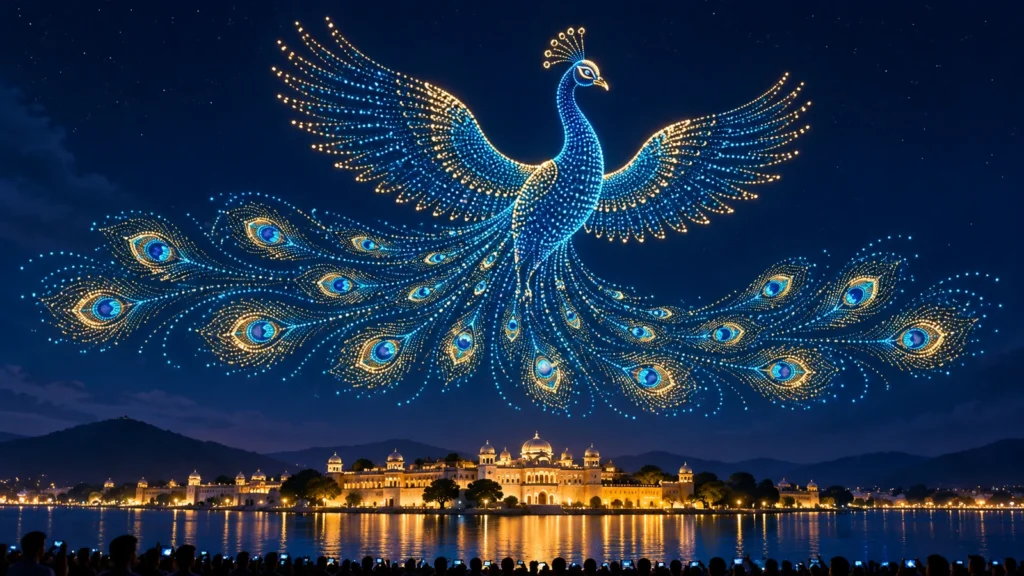
The featured image on this page is a representative artistic illustration. It is not an authenticated photograph of the record flight and should not be used to count drones or confirm exactly how the real formation looked. Actual footage and an illustrative news image serve different purposes.
Advice: if you are planning a future visit, consult the newly announced festival programme for that year and date. This record story does not provide a current ticket, entry pass, operating time or guarantee of another performance. Do not travel on the assumption that a viral video describes a show still running.
Frequently asked questions
Was this the world’s largest drone show overall?
The reported achievement concerns an aerial display of a bird using drones. It should not be broadened into a record for every kind of drone show.
Why are both Mysore and Mysuru used in searches?
People use both forms when searching for the city and its Dasara celebrations. This article uses Mysuru while recognising the common search phrase “Mysore Dussehra drone show.”
Does 3,473 mean every show used the same number?
No. The figure discussed here is attached to the reported peacock-record formation. It does not establish the count for every display or festival date.
Can I watch this show tonight?
This is coverage of a past event. Check a current official programme before making any visit; no ongoing performance is promised here.
Is the image on this page an actual record photograph?
No. It is a clearly identified representative illustration. Use the linked event reporting and original footage for the real display.
Conclusion: the Mysuru peacock is interesting both as a festival visual and as a coordinated light display. Keeping the record category, event date and illustrative-image distinction clear makes the story more useful than an exaggerated “biggest ever” headline.