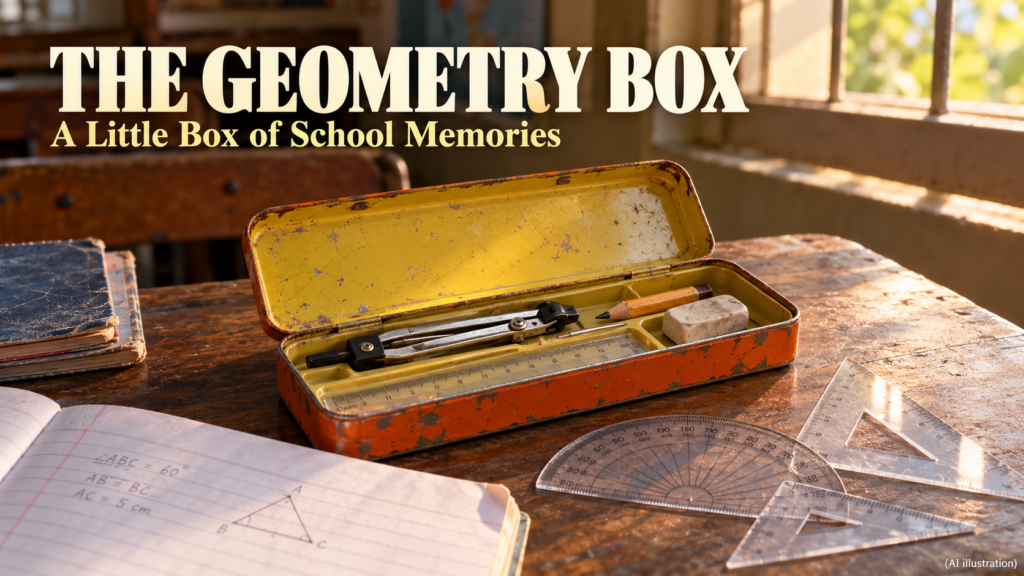
The 90s India geometry box: a small tin full of memories
The click of a metal lid, a short pencil and an eraser loose in the tray can bring back a classroom faster than a formula. A search for a 90s India geometry box is often a search for that feeling. One person remembers an orange-and-yellow tin, another a blue case, and another only the scratched lid that survived.
These are illustrative memory prompts, not a claim that every Indian child owned the same set. This guide explains the instruments and how to document an old box carefully. All three pictures are fictional AI reconstructions, not recovered photographs from the 1990s.
What belongs inside a mathematical instrument set?
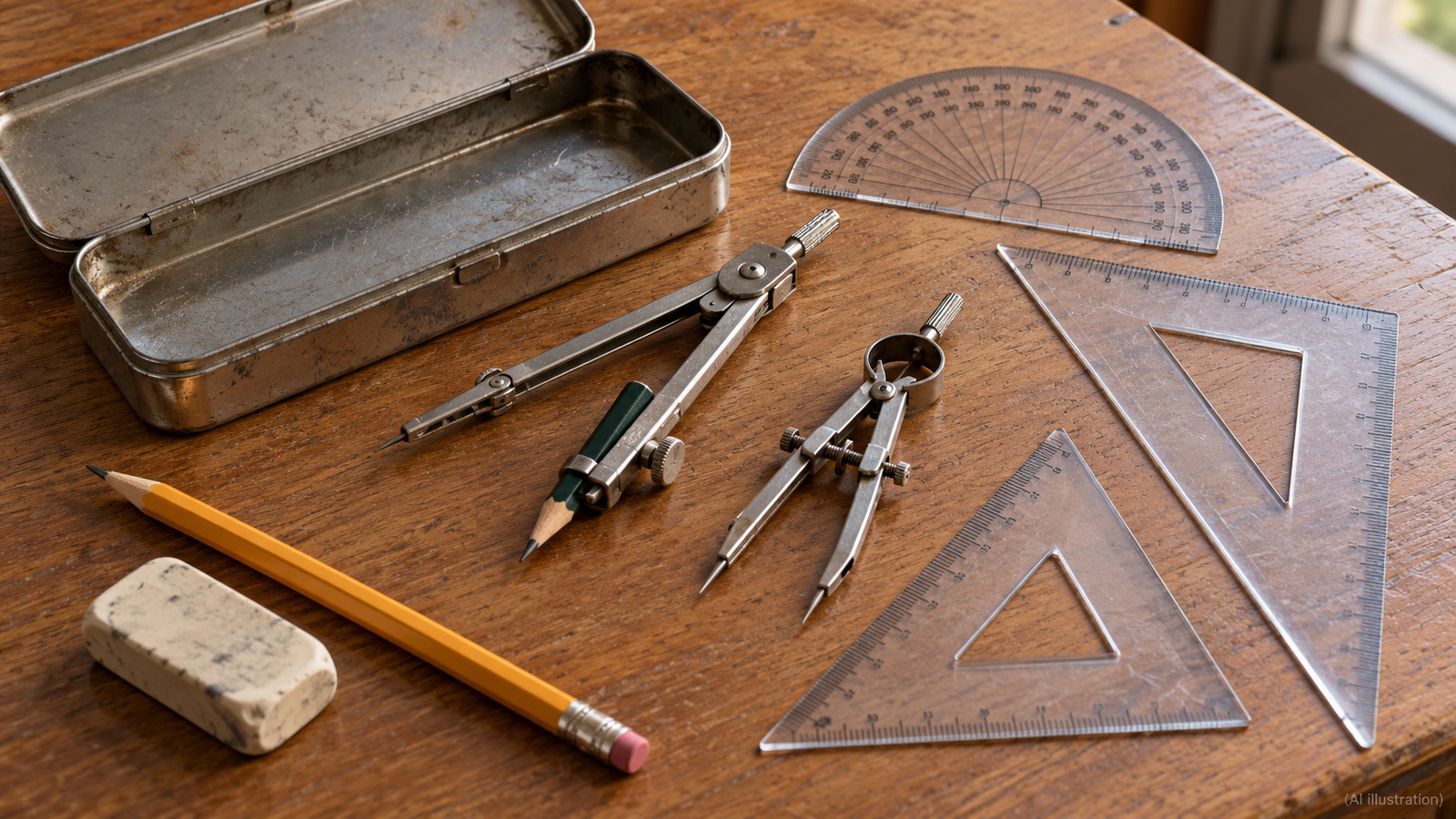
A mathematical instrument set may include a ruler, compass, divider, protractor and two set squares, with a pencil, eraser and sharpener in some packs. Contents vary by brand, model and period. Missing pieces in an old tin do not establish its original packing list.
The available Hindustan Pencils Nataraj catalogue and Camlin product pages document such tools in their respective packs. These are contemporary records, not proof that every set sold in 1993 had the same arrangement or number of pieces. Original packaging and dated evidence matter when identifying an older model.
A ruler helps draw lines and measure distances. A semicircular protractor is used with angles. The two triangular set squares offer different angle combinations. For an exact construction, follow the method in an appropriate textbook rather than treating an illustrative photograph as a precise drawing.
A compass is different from a divider
A compass has a pivot point and provision for a pencil or lead to draw arcs and circles at a fixed opening. A divider may have two pointed ends and is used to compare or transfer a distance. Their similar silhouettes make it easy to mix up their names in a memory or caption.
If a photograph hides the tips, ask for a clearer view rather than identifying the instrument from its tray slot. Attachments and designs can vary. Replaced or broken parts do not reliably describe the original model.
Store pointed instruments closed and securely in the tray, away from small children. A bent point, loose joint or cracked scale should not simply be assumed accurate for classroom work. This is a documentation guide, not certification that an old instrument still measures correctly.
Nataraj, Camlin and identifying an older model
Searches may combine Nataraj, Camlin and Camel. Record the spelling actually visible on the object and distinguish a brand from a model. Photograph marks on the lid, base, tray and instruments separately. Parts from different sets can end up together over years of use.
Old-looking and made in the 1990s are different claims. Rust, scratches and faded print cannot date a tin to a particular year. Preserve the context of any price label, batch code, bill, family photograph or period catalogue. Do not invent a year by guessing how a partly legible code works.
FACT: A current product photograph is not an archival image of an older model. An AI reconstruction can evoke a memory but cannot establish a logo, year, original layout or condition.
Camlin’s 2018–19 annual report describes a 2-in-1 geometry and pencil box. It is a dated example of a later design, not a record of a 1990s tin. This article does not claim that one brand made the first Indian set or that every child preferred the same product.
How to photograph an old geometry box
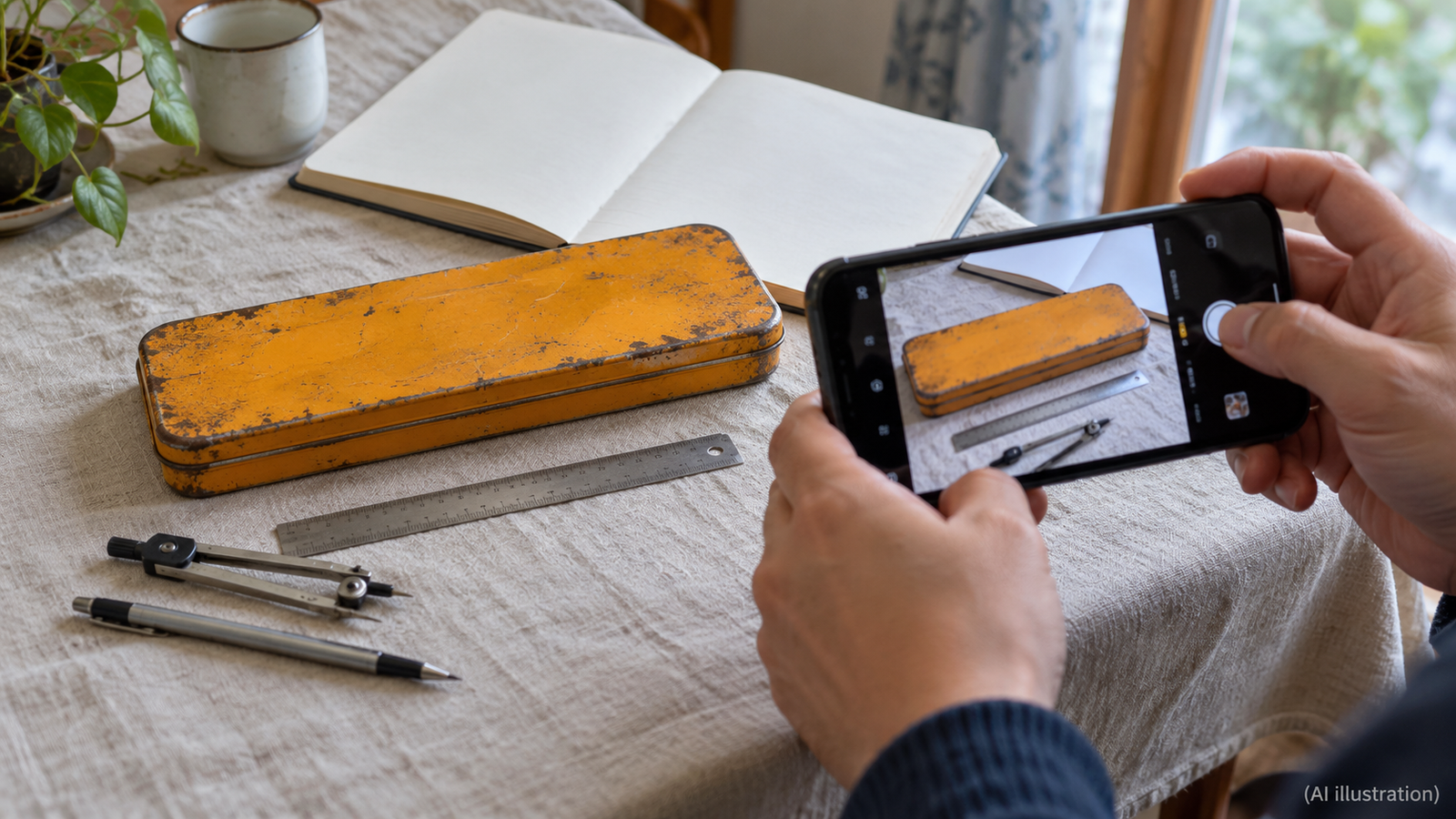
Start with the whole closed lid, then the base and hinges, an open top view and separate instrument photographs. Place a ruler beside the item in approximately the same plane. Use ordinary daylight without a beauty filter so scratches and colours remain part of the record.
Cover personal names, school details, telephone numbers and addresses before sharing photographs publicly. Keep a private original if needed. Take readable close-ups of model text without cropping away all context about the object and its condition.
Document the surface before polishing, repainting or abrasive cleaning. A clearer historical record is more valuable than an artificially improved appearance. If a hinge resists, photograph the closed tin rather than forcing it open for the shot.
An honest caption might say: “Metal geometry box kept by the family; purchase year unknown; photographed in 2026.” If the date comes only from a family memory, label it as an estimate instead of a manufacture date.
Advice: turn a school memory into a useful record
Make four notes: the name visible on the object; the pieces that remain; the evidence behind a remembered purchase or use date; and the date of the new photograph. Those notes can later be compared with a catalogue or another family record.
Ask which class the owner used it in, who gave it to them and whether an exercise book or photograph survives. Individual answers can enrich a memory article without becoming a universal story about every school in India.
Obtain permission before publishing someone else’s old photograph and credit its owner or source. Do not add a watermark to an online image and call it your original collection. Keep AI disclosures in captions and alt text for generated reconstructions.
Do not value a supposedly rare 90s box from one photograph. Completeness, originality, model evidence and condition are different questions. This is not an appraisal or buying recommendation; it is a way to connect a memory with honest documentation.
Frequently asked questions
Are these real 1990s Nataraj or Camlin photographs? No. All three are fictional AI reconstructions.
Does today’s catalogue prove an older packing list? No. It documents its own pack and period.
Are a compass and divider the same? No. Their drawing and distance-transfer arrangements differ.
Can rust identify the model year? No. Dating needs independent evidence.
Can an incomplete box be documented? Yes. Record what remains and what is uncertain.
Sources and AI reconstruction disclosure
Nostalgia and general educational information. Brand names are identification references, not endorsements or affiliations. Images are fictional AI reconstructions, not archival photographs or exact branded-model replicas. Sources support contemporary packs and dated documents only. Checked on 24 October 2026.
- Hindustan Pencils: contemporary Nataraj catalogue, not a 1990s record
- Camlin: current Scholar pack and instruments
- Kokuyo Camlin: 2018–19 annual report and later 2-in-1 design
- CBSE: practical geometry learning objectives