Jhijhiya Geet: The Songs, Dance and Navratri Tradition of Mithila
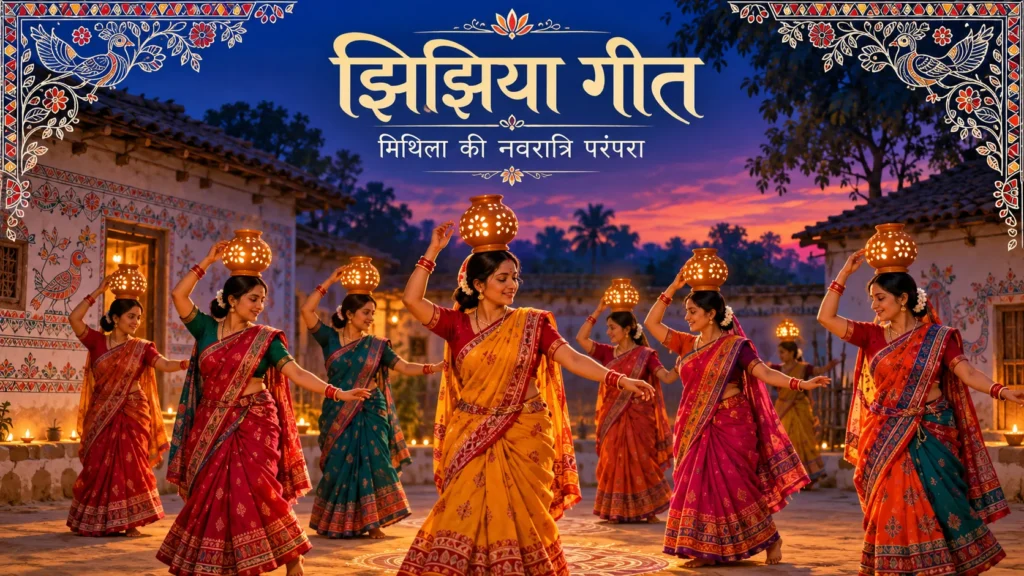
A glowing clay pitcher balanced on the head, women moving together and the pulse of a group song: this is the image that often draws people to Jhijhiya. A search for “Jhijhiya geet” may mean someone wants to understand the words, watch a performance or identify the tradition for a cultural programme.
Jhijhiya is more than the title of a single new song. It also names a song-and-dance tradition associated with Mithila. This guide explains the regional context, the pitcher and ways to understand a performance. It does not offer a complete commercial-song lyric sheet or an unauthorised download.
How is Jhijhiya connected with Mithila, Bihar and Nepal?
Sanjeev Kumar Mishra’s ShodhKosh study places Jhijhiya within Mithila, particularly Nepal’s Tarai, describing women’s collective performance and Dashain devotion. India’s Incredible India page for Ahilya Gautam Mahotsav also includes Jhijhiya among Mithila folk arts.
Pay attention to the community and language rather than treating a national border as the entire cultural explanation. A costume or tune seen on one stage is not necessarily the only form across Mithila. Ask which locality and style the artists represent before treating a viral caption as a complete history.
FACT BOX — quick identification
- Form: folk song, collective dance and devotional cultural expression.
- Context: Mithila, with performances associated with Bihar and Nepal’s Tarai.
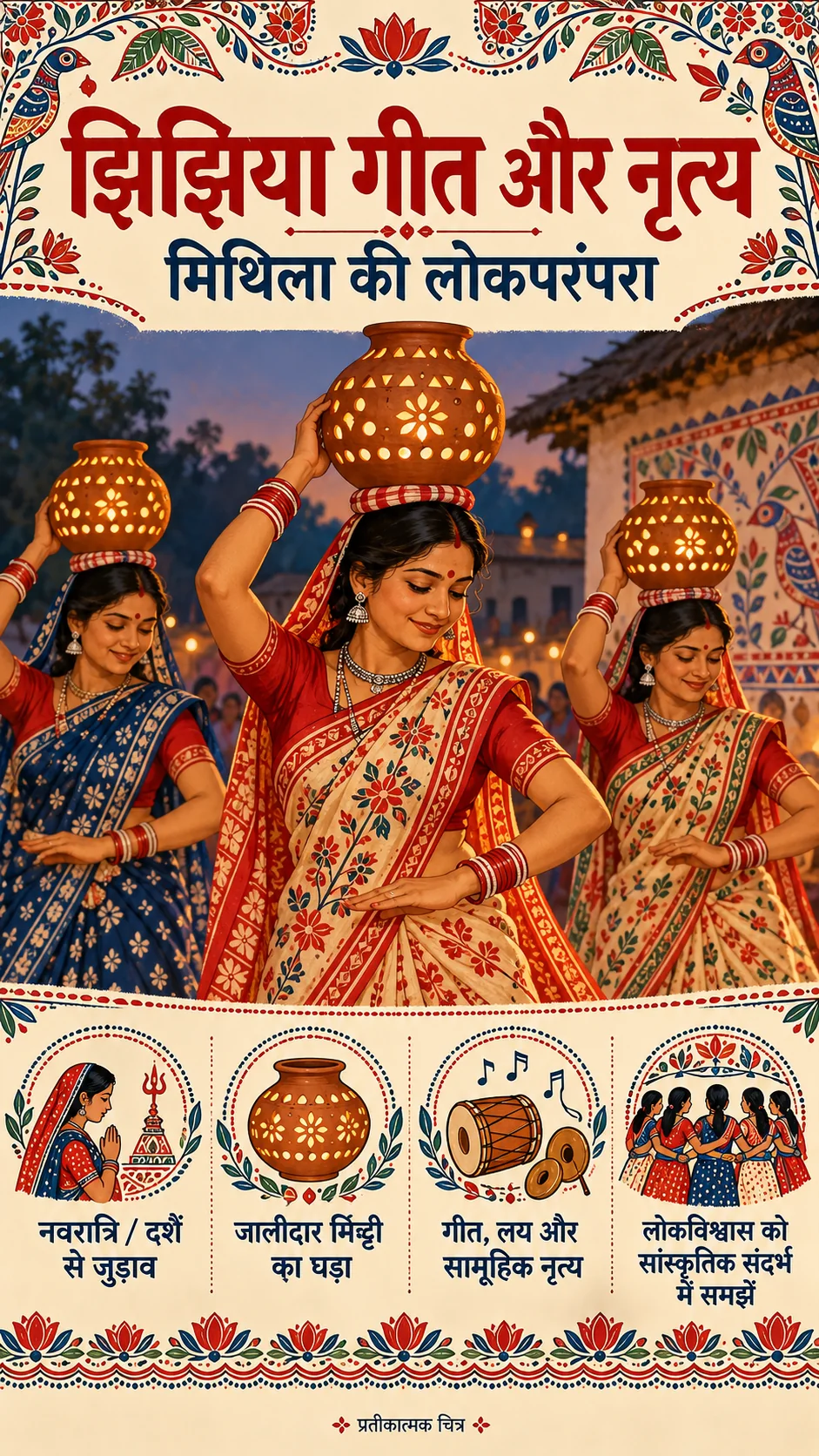
- Visual marker: a perforated pitcher with light showing through it.
- This article: a cultural introduction, not the lyrics of one commercial recording.
Navratri, Dashain and the pitcher on the head
The “Unique cultural dances of Janakpurdham” section of Nepal Tourism Board’s Janakpur booklet places the performance in Ashwin during Dashain, from Ghatasthapana to Vijaya Dashami. It describes a perforated pitcher balanced on the head with a lamp inside.
The account also records beliefs about avoiding misfortune. Read these as cultural beliefs, rather than evidence of supernatural events. A song, pot or dance step does not establish a remedy for illness, accidents or another person’s alleged magical influence.
Watch the coordination, balance and singing to appreciate the performance. If an artist explains a local symbol differently, record that interpretation with the person’s name and locality. A general introduction cannot capture every village’s memories or every troupe’s practice.
| What you see or hear | How to approach it |
|---|---|
| Perforated pitcher | A prominent visual element; ask the artists about their local practice. |
| Lamplight | A devotional symbol; fire safety is a separate practical concern. |
| Group singing | Listen for the lead voice and the group’s response. |
| Stage version | Duration and arrangement may differ from a village performance. |
How to understand a Jhijhiya song and its words
Mishra discusses the songs in terms of goddess praise, blessings and collective prayer. That provides a devotional and community-welfare context. The meaning of every line, however, should be checked against the particular recording and local language rather than assumed from a general description.
Identify the refrain first, then listen for the group’s repeated response. Ask a local speaker or performer about an unfamiliar Maithili word. Replacing it simply because another Hindi word sounds similar can change the meaning. When transcribing, avoid presenting an uncertain word as an established text.
A search for Jhijhiya lyrics can return different versions. Identify the singer, troupe, recording title and official upload. No single recording is presented here as the universal original text. A modern arrangement or recording has its own context and rights, separate from the wider identity of the folk tradition.
Watch a Doordarshan National Jhijhiya performance
Watch the Jhijhiya performance on Doordarshan National’s channel. Its title begins “The vibrant Jhijhiya folk dance of Bihar…”. It is an example for recognising and appreciating a performance, not presented as a live broadcast from a local event on 15 October 2026.
If the video is available, watch the full scene: group movement, balance and response to the music. A short excerpt is not a complete instruction manual for the tradition. If the embedded player does not load, use the YouTube link above; availability depends on the uploader and platform.
When sharing, retain the original video link and credit the channel and performers. Removing someone else’s watermark or uploading their recording as your own does not give the tradition proper recognition. For your own event, seek the artists’ and organiser’s agreement before recording, and spell their names correctly.
Why distinguish Rohilkhand’s Jhujhiya from Mithila’s Jhijhiya?
IGNCA’s Navratra ke geet collection describes a Rohilkhand tradition in which groups of girls sing from house to house with illuminated perforated clay lanterns. This is a regional reference with a similar name; it should not automatically become the description of every Mithila performance.
Similar names and visual elements invite comparison, but they do not establish an identical origin, song or date everywhere. State which region you mean in a school project, article or video caption. That keeps local communities and their own explanations visible.
A PIB account of IFFI 2024 cultural programmes also records Bihar’s Jhijhiya as a stage performance. This supports its presence on cultural stages; it does not mean every stage adaptation must be described as an ancient village rule.
ADVICE — for a school or cultural programme
- Consult a local folk artist about style, pronunciation and the introduction.
- For children, choose a light prop with an LED instead of a real flame; this is a suggested safety adaptation.
- Rehearse with an empty, safe prop first rather than calling the adaptation a compulsory ritual.
- Credit the region and performers. Avoid scenes accusing a real person of witchcraft or causing misfortune.
Five questions about Jhijhiya songs and dance
Is Jhijhiya just one song? No. Searches can refer both to the tradition and to individual recordings.
Is it found only in Bihar? Sources also place it in Mithila and Nepal’s Tarai.
Why does the pitcher contain light? Sources describe a lamp and devotional symbolism. That is not proof of supernatural effects.
Are lyrics identical everywhere? Do not assume one recording is the fixed text for all communities; identify the version and artists.
How can children perform it? A cultural adaptation can use guidance from local teachers or artists and light, flameless props.
Sources and related Navratri reading
References: Nepal Tourism Board, Janakpur booklet, printed p.14 · Sanjeev Kumar Mishra: Jhijhiya in Nepal, ShodhKosh 2(2), 466–470, DOI 10.29121/shodhkosh.v2.i2.2021.5794, CC BY 4.0 · Incredible India · IGNCA regional collection · PIB programme record · Doordarshan National video. Checked on 15 October 2026.
यह झिझिया गीत और नृत्य गाइड हिंदी में पढ़ें · Navratri Songs Playlist: related Hindi guide.
This is a cultural introduction; local practices and songs can vary. Images are symbolic AI illustrations, not photographs of an actual troupe or event. Describing a folk belief does not verify a supernatural claim.