Emperor Ashoka: The Life, Empire, and Legacy of a Great Indian Ruler
India’s rich history is adorned with numerous rulers who left their mark through valor and conquest. Among them, Emperor Ashoka stands out, a name synonymous with India’s glorious past. His life story is a remarkable testament to transformation, evolving from a formidable warrior into one of history’s most influential advocates for peace and humanity. His empire, policies, and enduring legacy remain integral to India’s identity.
Early Life and Accession to the Throne

Born in 304 BCE in Pataliputra, the capital of the Mauryan Empire, Ashoka was the grandson of its founder, Chandragupta Maurya, and the son of Bindusara. From his youth, Ashoka displayed exceptional talent and ambition, mastering warfare, weaponry, and administration. He was known for his intense, aggressive, and determined nature. Facing a challenging path to the throne amidst numerous siblings, Ashoka eventually ascended the Mauryan throne in 268 BCE after a fierce struggle for succession. In his early reign, his ruthlessness earned him the epithet ‘Chanda Ashoka’ (Ashoka the Fierce), as he spared no effort in expanding his empire and crushing opposition.
Expansion of the Mauryan Empire: An Invincible Ruler
Emperor Ashoka significantly expanded the vast Mauryan Empire established by his ancestors. His dominion stretched from Afghanistan in the northwest to Bangladesh in the east, and from Kashmir in the north to Karnataka in the south. He was a brilliant strategist and a skilled military commander, securing numerous victories in his early years and consolidating his empire’s borders. Ashoka’s reign marked one of the largest and most powerful empires of its time. His administrative acumen was unparalleled, and he established a robust central administration to govern his sprawling territory effectively. However, his greatest trial was yet to come: the Kalinga War.
The Kalinga War: A Historic Turning Point

The Kalinga War, fought around 261 BCE, was the most pivotal moment in Emperor Ashoka’s life. Kalinga, a region corresponding to modern-day Odisha, was an independent state that had not submitted to Mauryan authority. Ashoka launched a brutal military campaign to conquer it. This conflict became one of the bloodiest in Mauryan history, resulting in the deaths of hundreds of thousands of soldiers, countless injuries, and the displacement of thousands of innocent civilians. The sight of the battlefield, strewn with corpses, groaning wounded, and the lamentations of widows, profoundly shook Ashoka. For the first time, he witnessed the horrific reality of violence and war up close. This experience filled him with deep remorse and guilt. Following the Kalinga War, Ashoka resolved to abandon the path of war and violence forever. It was a decisive moment that transformed ‘Chanda Ashoka’ into ‘Dhamma Ashoka’.
The Path to Dhamma: Buddhism and the Way of Peace
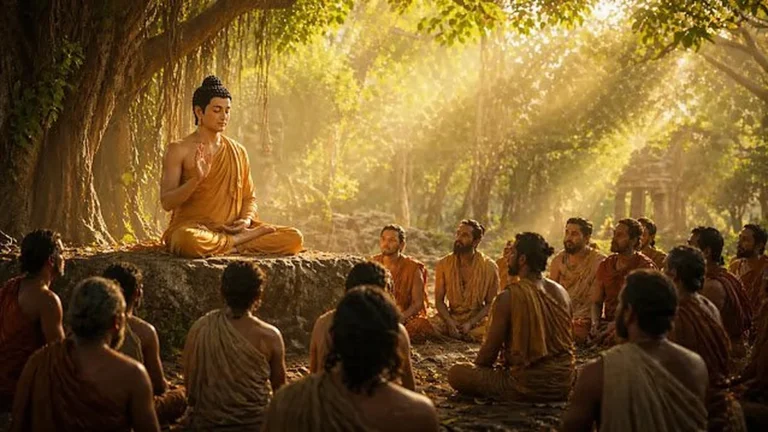
After the Kalinga War, Emperor Ashoka embraced Buddhism. He not only personally adhered to Buddhist principles but also made them the foundation of his state policy. He adopted the path of ‘Dhamma Vijaya’ (conquest by righteousness) instead of ‘Digvijaya’ (conquest by war). Ashoka’s ‘Dhamma’ was not merely a religious doctrine; it was a comprehensive code of ethics, social welfare, and human values, encompassing principles like tolerance, non-violence, compassion, charity, truthfulness, and respect for all living beings.
Key Principles of Ashoka’s Dhamma:
- Non-violence and compassion towards all creatures.
- Respect for parents and elders.
- Reverence for Brahmins and Shramanas (ascetics).
- Humane treatment of slaves and servants.
- Religious tolerance and respect for all faiths.
- Speaking the truth and practicing honesty.
Ashoka tirelessly promoted the spread of Buddhism. He commissioned the construction of stupas, viharas, and chaityas across the land. He dispatched Buddhist monks to distant lands such as Sri Lanka, Southeast Asia, and Central Asia to propagate the faith. His son, Mahinda, and daughter, Sanghamitra, played a crucial role in spreading Buddhism in Sri Lanka, where it remains a major religion today.
Ashoka’s Edicts and Pillars: Symbols of an Enduring Legacy

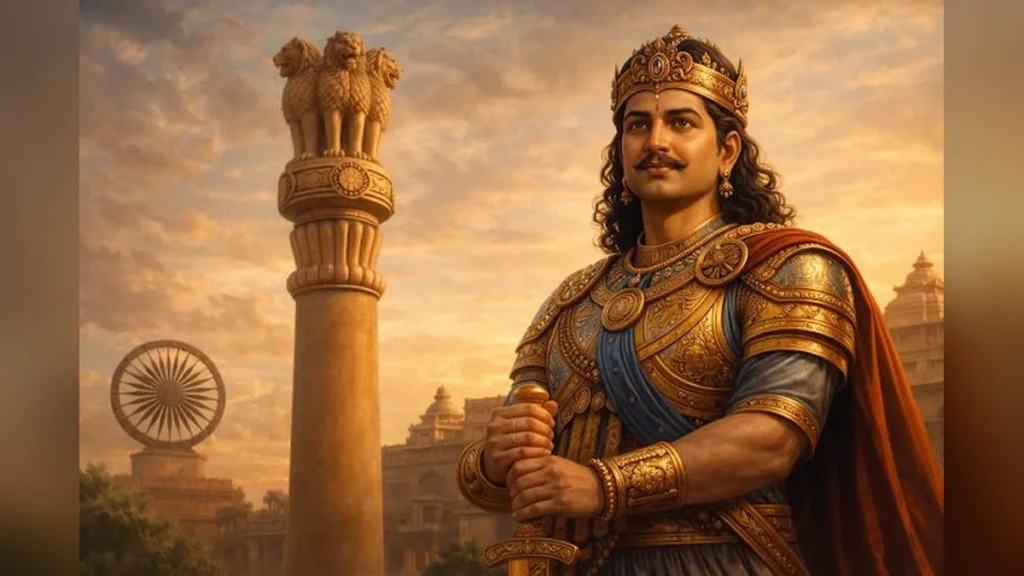
To disseminate the principles of his ‘Dhamma’ to the masses, Emperor Ashoka had inscriptions carved on rocks and erected massive pillars throughout his empire. These edicts and pillars provide vital information about Ashoka’s reign and convey the messages of his Dhamma. The rock edicts were inscribed in various languages (Prakrit, Greek, Aramaic) to be accessible to local populations. The pillars, made of polished sandstone, were topped with carvings of the Dharma Chakra and animal figures like lions. The Ashoka Pillar at Sarnath, crowned by four lions, forms the basis of the Ashoka Chakra, India’s national emblem, which adorns our national flag.
Through these inscriptions and pillars, Ashoka not only propagated his Dhamma but also articulated his vision for justice, public welfare, and religious tolerance.
Ashoka’s Administration and Social Reforms
After embracing Dhamma, Ashoka brought about revolutionary changes in his administration, implementing the concept of a welfare state. He initiated public welfare projects, including the construction of roads, digging of wells, building rest houses, and planting shade trees for travelers. He established hospitals and dispensaries for both humans and animals. In his justice system, he strove to make it accessible and fair. Officials known as ‘Dhamma Mahamattas’ were appointed to propagate the principles of Dhamma and maintain harmony among people. He fostered peaceful coexistence among various religious communities.
Ashoka’s reign is considered a golden age in Indian history, a period that prioritized peace, prosperity, and ethical values.
Ashoka’s Legacy and His Place in Indian History
Emperor Ashoka ruled for approximately 40 years and passed away in 232 BCE. Following his death, the Mauryan Empire gradually declined, but his legacy endures. Ashoka is revered as one of India’s greatest rulers, not only for building a vast empire but also for showing humanity the path of peace, non-violence, and compassion. His Ashoka Chakra continues to fly proudly on our national flag, symbolizing righteousness and progress. Ashoka’s principles and life story have inspired leaders and thinkers worldwide. His life offers a timeless lesson on how power can be used for construction and welfare, rather than destruction. His story reminds us that true greatness lies not in winning wars, but in conquering the mind and establishing peace.