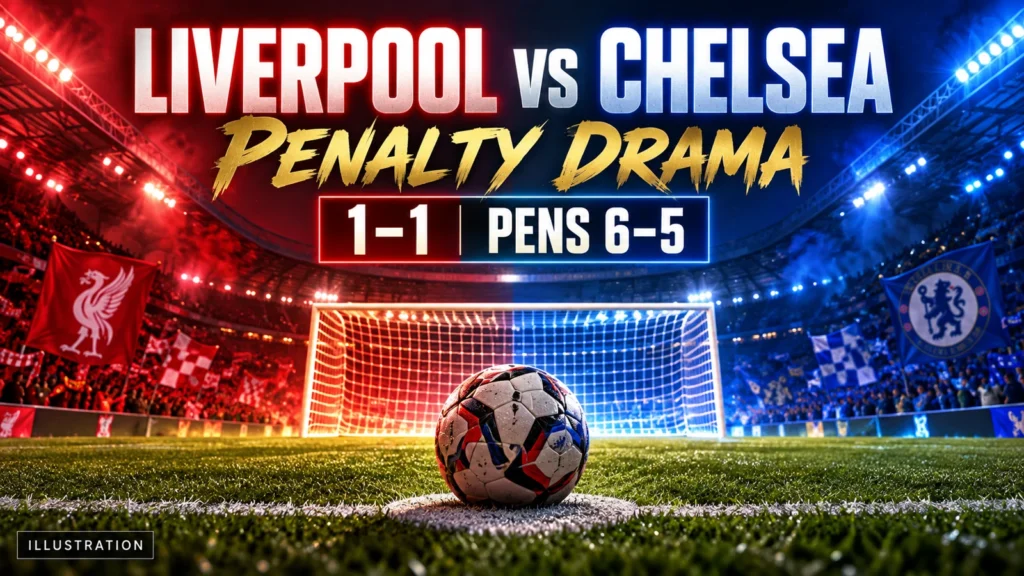
Liverpool vs Chelsea finished 1–1 at Anfield on 28 October 2026, with Liverpool winning the penalty shootout 6–5. The result sends Liverpool into the Carabao Cup quarter-finals. Morgan Rogers and Cody Gakpo scored first-half penalties before the tie eventually turned on another series of spot-kicks.
For supporters waking up to different score displays, the distinction is simple: 1–1 was the match score after normal time; 6–5 was the separate shootout score. Liverpool did not win the match 7–6 in open play. This report brings together the verified result, the decisive moments and an explanation of the shootout.
Liverpool vs Chelsea result: the verified score
Liverpool’s official results page records Rogers scoring in the 40th minute and Gakpo replying in the 43rd. The competition was the Carabao Cup and the venue was Anfield. The fixture took place on Wednesday evening in the United Kingdom, which explains why it appeared among Indian searches on Thursday morning.
The outcome is a knockout advancement, not a Premier League win. Neither team earns league points from this cup result. That matters when reading headlines alongside league tables: a dramatic cup night can affect confidence and selection conversations without directly changing a team’s position in the league.
The cleanest way to share the result is “Liverpool 1–1 Chelsea; Liverpool win 6–5 on penalties.” Keeping those two scorelines together prevents a common misunderstanding among readers who see only a screenshot or a cropped social-media graphic.
Rogers and Gakpo exchange first-half penalties
According to Liverpool’s match report, a challenge on Moises Caicedo brought Chelsea their penalty, which Rogers converted. Liverpool then received a penalty after Wesley Fofana handled at a corner, and Gakpo scored the equaliser. The quick response left the teams level at the interval.
Our reading of that sequence is that Chelsea’s advantage had little time to settle into a different match state. A lead can encourage a side to manage territory and risk; an almost immediate equaliser removes that opportunity. It does not prove which team controlled the whole contest, but it explains why the two penalties are the first moments to revisit in the highlights.
There is also a useful distinction between a penalty awarded during normal play and one taken in a shootout. The first-half goals counted as match goals for Rogers and Gakpo. Later shootout conversions determined progression and are recorded separately from the 1–1 score.
Why the goalkeepers mattered before the shootout
Both official club reports describe important second-half goalkeeping. Mike Penders kept Liverpool out, while Giorgi Mamardashvili prevented Chelsea from finding a winner. Among the chances described were a Ronald Araujo header and a late Marco Palestra effort. Neither side added a second goal before the final whistle.
That part of the game deserves attention because a penalty headline can erase the saves that made a shootout necessary. One successful intervention in normal time can preserve the opportunity to win later. The result therefore should not be reduced to a single missed kick or treated as evidence that every earlier contribution was irrelevant.
This is an editorial interpretation of the reported sequence, not a claim based on independent tracking data. We have not assigned invented expected-goals figures, possession percentages or numerical player ratings. Those details require a verified statistics feed or a separately explained assessment.
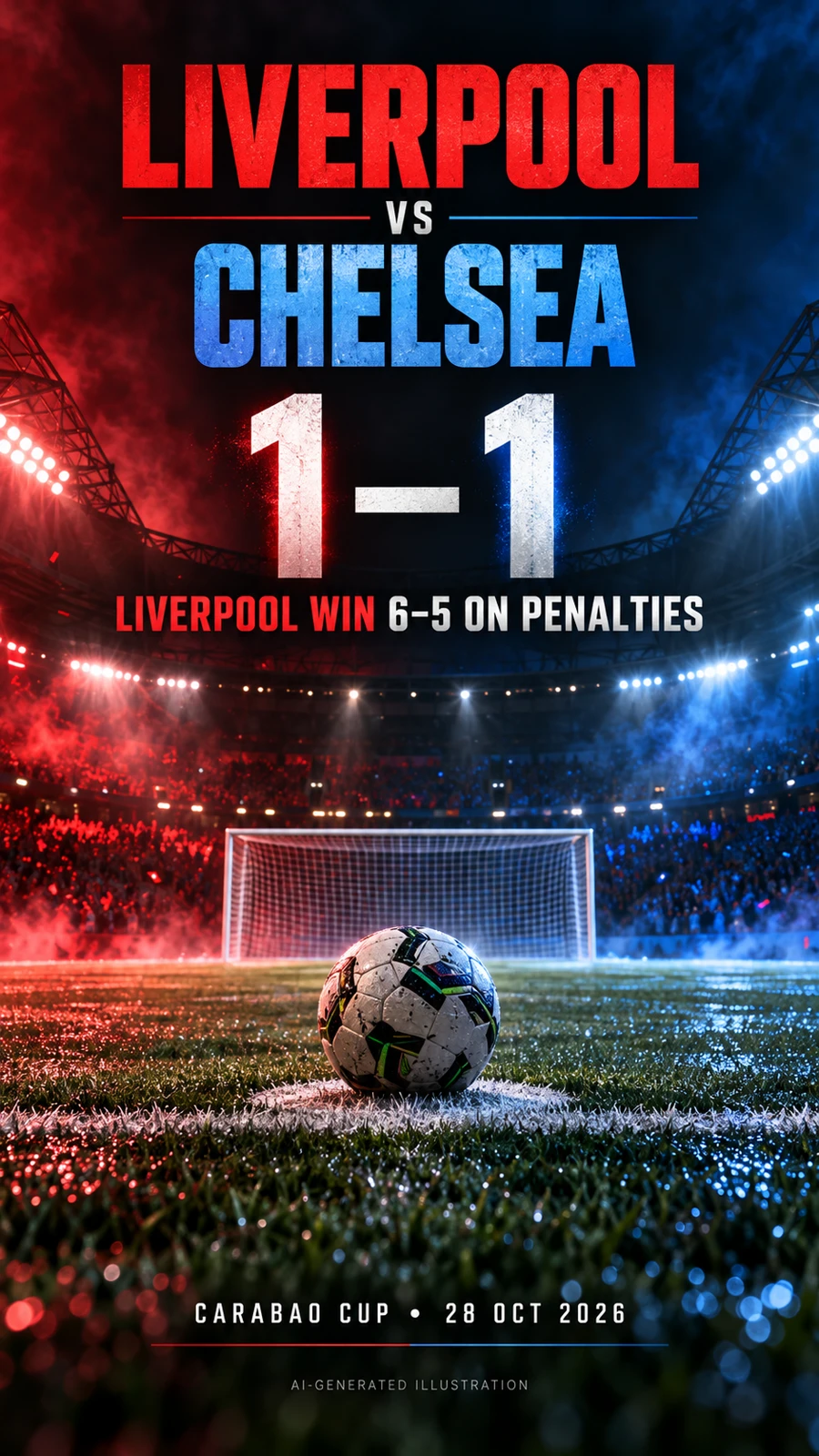
FACT box: match score and shootout score
Fixture: Liverpool vs Chelsea.
Date: 28 October 2026, UK.
Venue: Anfield.
Competition: Carabao Cup, fourth round.
Normal time: 1–1.
Shootout: Liverpool 6–5 Chelsea.
Outcome: Liverpool advance to the quarter-finals.
How the Liverpool vs Chelsea penalty shootout was decided
Chelsea’s official account details the changing opportunities. Both teams had chances to finish the contest before the decisive pair of kicks. Penders saved Ryan Gravenberch’s attempt, Mamardashvili denied Emmanuel Emegha, and Joe Gomez then converted before Fofana sent his effort over.
A sudden-death shootout must be read in pairs. When the first side scores, the second side still receives its corresponding attempt. The contest ends only when one side has scored and the other has not after the same number of kicks. A running lead in the middle of a pair is not yet a completed victory.
This is why the sequence around Gomez and Fofana matters. Gomez put Liverpool ahead in the next pair; Fofana’s miss then completed the result. It is also why isolated clips can confuse viewers. A saved penalty may be dramatic without being the final action, because the opponent can still fail to convert its own chance.
The fairest short account recognizes both sides of the story: Liverpool survived difficult moments and ultimately advanced; Chelsea created opportunities and had shootout chances, but could not convert the final one needed to stay level. A narrow knockout outcome does not require inventing a story of total domination.
What the result means for the Carabao Cup
The EFL’s fourth-round roundup confirms Liverpool’s progression on a night that also included Manchester City’s shootout win over Brighton. Both matches show the basic reality of knockout football: a drawn match can still produce an immediate winner and an eliminated team.
For Liverpool, the practical reward is another round in the competition. For Chelsea, attention returns to the remaining schedule. Any stronger claim about the clubs’ entire seasons would go beyond what one tie establishes. Cup selection, opponent quality and the closeness of the game all matter when judging a result.
The EFL’s published competition calendar places the quarter-final round in the week commencing 14 December 2026. Check the clubs’ fixture lists for the confirmed individual match date, kick-off and broadcast information instead of assuming every tie is played on the same evening.
For wider football coverage, our Ballon d’Or 2026 report covers the separate individual award story. Tournament results and individual awards answer different questions and should be read in that context.
Advice: where to check highlights and match details
Use the official Liverpool, Chelsea and EFL pages linked above for the match report and any highlights they make available in your region. A headline using “highlights” does not mean an independent website owns the match footage. Avoid downloads or sign-in pages that promise clips while asking for unrelated personal or payment information.
When comparing reports, verify the fixture date first. Liverpool and Chelsea meet in more than one competition and season. An old final, a league meeting or a previous shootout can surface beside the current match in search results. The combination of date, venue and competition is a better identifier than the team names alone.
Frequently asked questions
Who won Liverpool vs Chelsea?
Liverpool advanced after winning the shootout 6–5. Normal time ended 1–1.
Who scored the match goals?
Morgan Rogers scored Chelsea’s penalty and Cody Gakpo scored Liverpool’s penalty in the first half.
Who scored Liverpool’s final shootout kick?
Joe Gomez converted before Wesley Fofana missed Chelsea’s corresponding attempt.
Was this a Premier League game?
No. It was a Carabao Cup fourth-round tie at Anfield.
Does the 6–5 score include the normal-time goals?
No. The shootout is recorded separately from the 1–1 match score.
Editorial note: checked on 29 October 2026 against official club and EFL reports. Analysis is identified as interpretation. Images are AI-generated editorial illustrations; no match footage is hosted here.